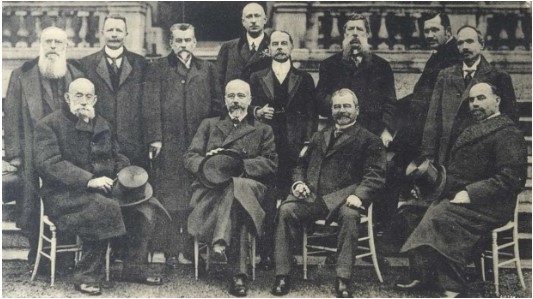
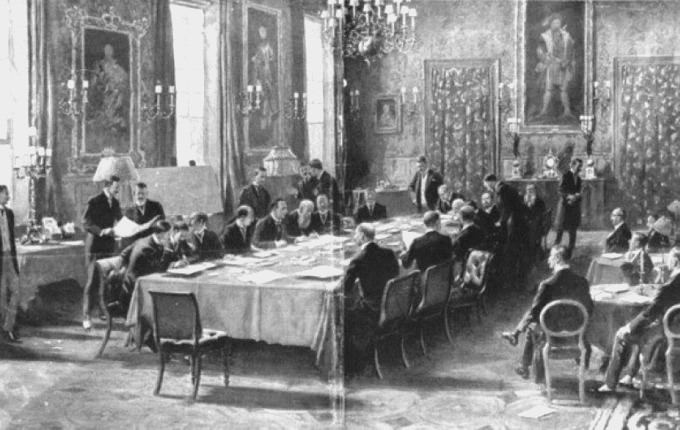


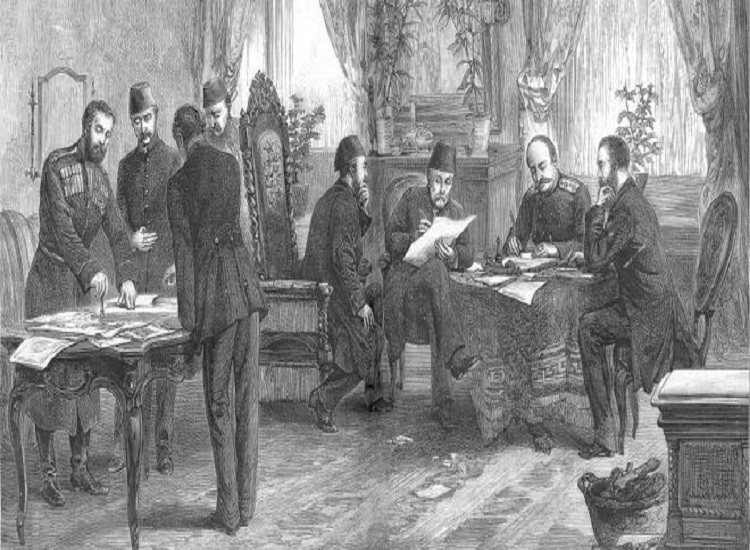
Memorie.al / On July 29, 1913, with the decision of the Conference of Ambassadors in London, the “de jure” recognition of the Albanian state took place. This act constitutes the fundamental international document for the creation of the Albanian state and the recognition of the supervised independence of Albania by the six Great Powers of the time: Austria-Hungary, Italy, Great Britain, France, Russia, and Germany. This act was attached to the internal act of Albania’s independence, declared on November 28, 1912. With this decision, the London Conference of Ambassadors changed its decision of December 17, 1912, which had granted Albania “Autonomy guaranteed and controlled exclusively by all six Powers under the sovereignty or suzerainty of the Sultan,” and decided to form Albania “as an autonomous, sovereign principality… under the guarantee of all six Powers.”
In jurisprudence, de jure recognition means stable, full, and final recognition. Although this decision of the conference did not recognize the independent Albanian state declared at the Assembly of Vlorë by the Fathers of the modern Albanian nation, but a state reduced to nearly half of its territories, it still has importance because it opened the first path towards recognition of the rights of the Albanian nation.
The Great Powers had reservations regarding the future of the Albanian state’s status. They recognized it as a subject of international law, accepted it into the community of states of the time, and established diplomatic relations, but they imposed upon it a series of obligations and conditions, not only to assure themselves of its abilities to move towards its political future, but also to keep it under institutional international legal control and supervision.
The newly formed Albanian state was placed under the rule of a prince selected by the Great Powers, and it was these powers that, through the International Control Commission, would direct, supervise, and care for the new state for a ten-year period. This international institution, in cooperation with the power given to the prince as head of state and simultaneously the embodiment of executive power (which he exercised through the prime minister), would constitute the highest political decision-making authority in the Principality of Albania.
It was the six Great Powers that guaranteed the status, integrity, and neutrality of the new state, a duty that in fact they failed to fulfill, due to a series of international circumstances and internal Albanian reasons. Also, the Great Powers reserved for themselves the right to establish state structures and to organize the life, political, economic, social activities, domestic and foreign policy, the construction of the army, gendarmerie, drafting and approval of the constitution, the Provisional Statute, etc., of independent Albania, rendering its independence fictitious.
These restrictions were asphyxiating for the sovereign attributes, specific and necessary for an independent state and subject of international law. The de jure recognition of the Albanian state coincided with the efforts of the Great Powers of the time to find a compromise between the participating states and to geopolitically stabilize the Balkans, troubled by wars. The Conference of Ambassadors needed more than eight months of discussions to decide on the projects and make the necessary adjustments! The difficulty was that the basic projects were far apart from one another, and compromise was quite difficult.
So difficult was this conference that to this day we remember as special what all the historical figures who would deal with the administration of Albania did. Even the European powers themselves found it very difficult. Among them, we recall the Swedes who immediately withdrew from the administration, leaving the burden of administering the gendarmerie to the Dutch. The American minister in Greece at the time would call this plan “a miracle of incapacity,” “an absolutely incompatible scheme,” “a tangle of unstable things.”
Faced with these difficulties, the London Conference postponed the final decision on Albania’s status from one meeting to another, without reaching a final decision. The evolution of events on the ground influenced changes and shifts in initial positions, and especially in the spring of 1913, the status issue took on new perspectives. On May 30, 1913, the Peace Treaty was signed at the Conference of Ambassadors in London, which for the Albanian issue is the second important act after the decision of December 17, 1912.
With this treaty, the Ottoman Empire was forced to renounce its sovereign rights over Albania, and the Balkan states were discouraged from continuing further dismembering activity on Albanian lands, since now it would be the six Great Powers that would decide on all matters related to Albania’s status, its internal organization, and the determination of its borders. This treaty was the first international act that expressed the idea of a separate Albanian state, albeit in a still undefined form.
The Albanian issue was determined through the prism of avoiding a confrontation between Austria-Hungary and Russia. Austria-Hungary found itself faced with the accomplished fact of the change of the Balkan status quo to its detriment and to the benefit of Serbia, Montenegro, and Greece, behind which, ultimately, stood Russia. To compensate for this, the dual monarchy, with the uncertain support of Italy, decided to now put into effect the long-standing plan to create an autonomous (later independent) Albanian state, which would need to have borders as “as large as possible.”
The treatment of the border problem of the new Albanian state was not based on ethnographic, historical, economic considerations, etc., but was done by the Great Powers through the prism of not breaking the “European Concert.” Serbia’s right to Kosovo (claimed even today, when Kosovo is legally and factually separated from Serbia) and Greece’s right to Chameria and other Albanian territories in the southeast, were the result of gaining these territories as war booty and internationally sanctioned by an institution that, in the essence of its work at that time, did not have today’s basic democratic principles governing international relations.
The activity of the Balkan states and the Great Powers in realizing this decision was aided by the state of Albanian society at that time. The five-century Ottoman occupation had conserved medieval conservatism and the ruralization of society. Albania suffered from the lack of an emancipated social group, suffered from the existence of a class of beys who had poorly developed the sense of national responsibility and still chased the fantasies of preserving their donated personal estates.
The emancipated liberal and pro-European forces of Albanian society were an almost powerless minority to undertake initiatives that would break the conservative taboos of a society newly emerged into freedom. This fragile freedom, accompanied by significant territorial truncations, sanctioned also by international agreements, followed step by step by the unbridled thirst of predatory neighbors, had disoriented the direction of progressive development of this society, leaving it prostrate and unprotected from adventurers who at that time (and why not, also later) were in the majority.
The Albanian issue was resolved without the slightest respect for Albanians, and the border of the new Albanian state was determined solely through the prism of avoiding a confrontation between Austria-Hungary and Russia, for which Albanians were not guilty and had nothing at all to do with it. The stance of the Great Powers of that time was criminal, because instead of opening the vital pores to a nation on its path to civic and national renewal, they truncated it territorially, cut off its vital arteries, and nourished the factors that make a people historically hindered on its development path easily manipulated and controllable.
It was these historical injustices that would bring clashes, blood, grudges, violence, and tears until the beginning of the 21st century that forced Monsignor Gjergj Fishta to accuse: “Oh! Europe, you whore of the weather!/ That denies faith in God!/ Yes, is this the joke of civilization?/ Taking the land of Albania/ among the pups of Russia.” But as a wise saying goes, “justice is slow, but does not forget.” The end of the 20th century had to come, for the geopolitical situation of Southeastern Europe to change.
The democratization of this part of Europe enabled not only the liberation of Albania from the communist dictatorship but also created a new entity in the Balkans, the “Republic of Kosovo,” as a sovereign, free, and democratized state, which Albanians were left out of in London in 1913. This new republic in the Balkans (with all its many problems with the Serbs and among themselves) is trying to progress in freedom, democratization, and Europeanization. Likewise, the Cham issue has turned from a “taboo” into a topic of the day in international discussions and parliamentary resolutions.
Today, after 113 years of division, Albanians are a factor accepted by Europe in the process of recognizing Western values of freedom, democratization, and Westernization. Opportunities have opened for our nation to use this occasion to unite their homeland in a Europe of the same values. In doing so, the West has generally corrected not only the principles on the basis of which peoples were divided at the beginning of the 20th century, but especially has corrected an injustice done to one of the oldest and most suffering peoples of the Western Balkans, the Albanians.
It is the duty of the Albanian political class in Albania, Kosovo, Macedonia, Montenegro, Presheva, Medvegja, and Bujanoc to use this fortune to pay off the debt that the poet speaks of: “I owe it to the year ’13, for not closing the wounds,” by designing common integrating policies in all fields. However, this first requires them to come to an understanding among themselves, since it is shameful, not to say anti-national, the hatred, accusations, disagreements, and grudges that political leaders have towards one another. Today is the time for unity through integration; tomorrow will be too late./ Memorie.al