By Mërgim Korça
Part Four
Memorie.al / The impulse that compels us to contemplate the historical period spanning the years 1939–1945 from a broad, fundamental, generalized, and thoroughly scientific perspective requires that we shed light upon, and subsequently rely on, historical facts that have not only been left to oblivion but also intentionally distorted by the historians of the dictatorship era. Therefore, we are forced to begin our analysis by first defining the core, genuinely scientific criteria regarding the use of specific linguistic boundaries without defacing their meaning, lest they allow for flawed interpretations (driven by political-ideological motivations) which, in turn, inevitably lead to entirely erroneous conclusions.
Continued from the previous issue
It is precisely now that the time has come to shed light on two highly significant moments regarding how two first-rate personalities of the Albanian communist hierarchy (along with their imaginary factions) were trampled upon and sacrificed. We bring forward these two examples because one was driven by immediate goals of political collaboration solely to preserve personal, egoistic interests, while the other possessed a somewhat more distant target objective, yet always… driven by that very same motivation by Enver Hoxha!
In archival documents, it is well-documented how Koçi Xoxe, in his confessions, stated without the slightest hesitation that for all the executions carried out under his order, but without being sentenced by a judicial panel, the approval of Enver Hoxha had been obtained by him (K. Xoxe – note by M.K.). During the years 1945 and onward, not only was Yugoslav influence at its peak, but the implementation of their directives had assumed an absolute form (beginning initially with macabre crimes and later with entirely staged and utterly baseless trials) against patriots as well as some of the most prominent secular and clerical intellectuals, with the objective of erasing them precisely as a social category!
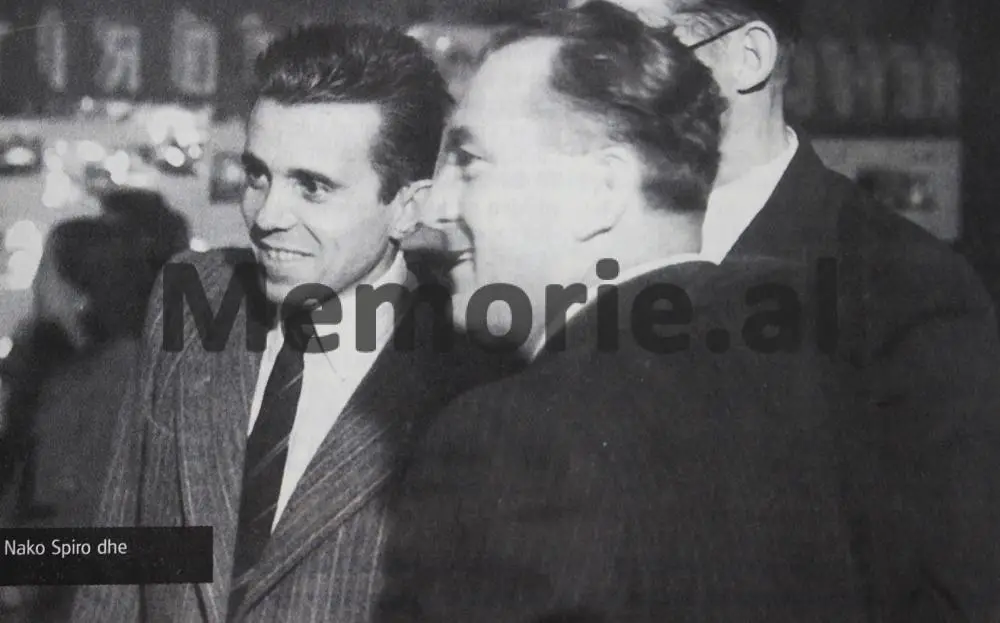
The year 1947 had begun to take shape as a highly problematic year for Albania; the Yugoslav side was failing to honor contractual agreements, slowing down the delivery of projects as well as supplies to Albania. This phenomenon increasingly and visibly fueled the dissatisfaction of Nako Spiru, who was the chief official responsible for the country’s economy. On the other hand, the Yugoslavs were intensifying their pressure regarding the equalization of the value of our currency, the lek, with their dinar, the removal of customs barriers, as well as the alignment of prices! It was not that Enver Hoxha did not feel these tangible concerns, but given that Albanian party and state relations with the Soviet Union passed through Yugoslav forums (and the Soviet Union had accepted this state of affairs as a given), he did his utmost to maintain friendship with Marshal Tito, with the objective that within Albania – as a future republic of the Yugoslav federation – he would at least preserve his position as leader.
On May 29, 1947, at the meeting of the Political Bureau (Politburo) of the Central Committee, it was decided that starting from June of that ongoing year, both the equalization of the Albanian currency with the Yugoslav one and the alignment of prices would be implemented, alongside the removal of the customs barrier between the two states (despite the negative consequences for Albania).
Here, I cannot omit the fact that when Nako Spiru returned from Yugoslavia – where, under the continuous pressure of radiograms from Enver Hoxha, he indeed signed all the agreements with Yugoslavia but, being conscious of what he was doing, had publicly expressed this fact in conversations among party leaders – Enver Hoxha never forgot it! And it is a fact that on November 22, 1947, “mistakenly, while playing with his weapon, Nako Spiru commits suicide!” (This being the official statement issued by the communist leadership of the Albanian state).
Thus, until that date, Enver Hoxha was completely and 100% under Yugoslav influence, a reality which, driven by his personal interests, he accepted as a given. However, March 28, 1948, arrived, when the letter from the Central Committee of the Communist Party (Bolshevik) of the Soviet Union regarding the rift between the Soviet Union and Yugoslavia was distributed and made known to the leaderships of the Cominform member parties! To complicate the matter further for Enver Hoxha, during his meeting with Vyacheslav Molotov on June 24, 1948, the Minister of Foreign Affairs of the Soviet Union explicitly told the Albanian leader: “…You, Albanian comrades, must examine and analyze the suicide of Nako Spiru!”
The potential choices for Enver Hoxha were only two:
- Continuation of the treasonous collaboration with Yugoslavia.
- Positioning against Yugoslavia, by supporting the Soviet Union.
However, both of these stances carried their respective consequences as follows:
- 1/a – Enver Hoxha would continue to be the leader of the Albanian Communist Party, as well as of the Albanian state, for as long as Yugoslavia refrained from annexing Albania, albeit with a level of economic aid restricted within the boundaries defined by Yugoslavia itself. Meanwhile, the Soviet Union, as a major supporting power of Albania, would potentially exit this orbit.
- 1/b – As soon as Albania was absorbed into the framework of a federative Yugoslavia as its seventh republic (since Tito had broken away from the dictate of the Communist Party (Bolshevik) of the Soviet Union), not only would Enver Hoxha immediately have the Yugoslav marshal over his head, but… he would no longer have anyone to complain to regarding any issue.
- 2/a – Enver Hoxha would now have direct relations with the Soviet Union without Yugoslav mediation, being himself the leader of Albania.
- 2/b – As the leader of the Albanian Communist Party, which had completely subjugated itself to the influence of the Yugoslav Communist Party since its creation by its emissaries Miladin Popović and Dušan Mugoša, and subsequently chosen by them to lead both the Albanian Communist Party and the war initially called the National Liberation War (but later turned into a civil war by them for the interests of the Yugoslav Communist Party), Enver Hoxha had to face an extremely difficult circumstance: Stalin and the Communist Party (Bolshevik) of the Soviet Union had to be convinced that he himself, at the helm of both the Albanian Communist Party and the Albanian State, was not only consciously breaking away from Yugoslavia but would also act loyally and in total submission toward the Soviet Union and its leader, Marshal Stalin!
Under these conditions, Enver Hoxha’s sense of self-centeredness, closely intertwined with his pragmatism, did not hesitate to make the decision. Within four days of his meeting with Vyacheslav Molotov, on June 28, 1948, he sent a letter to Marshal Stalin on behalf of the Central Committee, expressing Albania’s total confirmation of the Cominform’s decisions! This was the first step toward gaining the trust of the Soviet Union.
But this step had to be followed by other essential, convincing measures to demonstrate comprehensively Albania’s break from Yugoslavia. Along this path, where Enver Hoxha’s objectives for personal self-preservation were entirely clear, following the 10th Plenum of the Central Committee of the party and after the announcement of the Cominform Resolution, Enver Hoxha convened the 11th Plenum from September 13 to 24, 1948. There, he openly and fiercely attacked Yugoslavia’s policy, rehabilitated Nako Spiru along with his wife Liri Belishova, as well as Mehmet Shehu, and on the other hand dismissed Koçi Xoxe as Organizational Secretary of the Party (without expelling him from the Politburo), while expelling Pandi Kristo and Kristo Themelko from the Politburo, though not from the Central Committee.
Following these anti-Yugoslav measures, Enver Hoxha observed the Soviet reaction, which was not long in coming. The measures taken and the changes made were for the better, but… not yet fully convincing. Immediately after the conclusion of the 11th Plenum of the Central Committee – and I emphasize this moment, immediately after the conclusion of the 11th Plenum of the Central Committee – Koçi Xoxe, Pandi Kristo, Kristo Themelko, Nesti Kerenxhi, etc., were suddenly dismissed from all the political and state positions they held!
Subsequently, exactly three months after the 11th Plenum, the 1st Congress of the Albanian Communist Party convened, where the former Organizational Secretary of the Party, Koçi Xoxe, took the podium to speak… which was denied to him by the noise and the stomping of feet in the hall! This was followed on November 28 by his arrest, which culminated on May 30, 1949, with his execution by firing squad!
With the drastic and criminal measures taken by Enver Hoxha against his closest collaborators, he was finally able to win the trust of Joseph Vissarionovich Stalin! Naturally, the question arises: how long did this trust last? Theoretically, for as long as the COLLABORATION INVOLVING THE SUBMISSION OF ALBANIA’S NATIONAL INTERESTS TO THOSE OF THE SOVIET UNION was maintained. More precisely defined, from May 30, 1949, the day Koçi Xoxe was shot (and subsequently, when one by one they were equated with traitors to the fatherland and enemies of the party, severely condemning those who were labeled as the hostile and anti-party group of Koçi Xoxe).
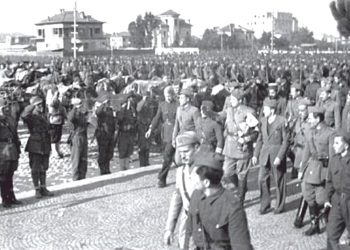
We now come to March 5, 1953, when the death of Stalin plunged Albania into mourning! On that day, Enver Hoxha forced the crowd gathered before Stalin’s statue to kneel in honor of his memory. This was one side of the coin. The other side (even sadder and never spoken of) involved dozens of participants of that funeral rally who were arrested and left to rot in prisons simply because they refused to kneel that day, or appeared cheerful instead of weeping (or at least pretending to weep)! Below are excerpts from the oath read to the participants of that funeral rally by Enver Hoxha himself before Stalin’s statue?
“…The peoples of the Soviet Union and us, and all the peoples of the world, have been covered today by a great misfortune. Our dear leader, teacher, and Father, Joseph Vissarionovich Stalin, closed his eyes forever; the mind of the greatest and brightest genius of our times has ceased to think…! We swear that we will strengthen and steel our sincere and deep love for the brotherly peoples of the Soviet Union…! The Glorious Communist Party of the Soviet Union, with its Leninist-Stalinist Central Committee led by Comrade Malenkov, will always be for us a great and inexhaustible source of light on our path toward a happy future…”!
Just three months after Stalin’s death, in June 1953, a high-level party delegation headed personally by Enver Hoxha went to Moscow. Malenkov received Enver Hoxha coldly. Subsequently, a reality began to take shape, outlining the phenomenon that the time period during which the Albanian dictator enjoyed the full trust of the Soviet Union had reached its twilight. The new times had to be faced with… new stances?
A year later, in June 1954, Enver Hoxha went to Moscow again, leading a delegation along with Hysni Kapo. From the meetings with Khrushchev, they clearly understood that his political objectives were threefold:
- a) Purging the party and state apparatus of Stalinists.
- b) A frontal war against the Stalinist cult of personality.
- c) Easing relations with Tito’s Yugoslavia.
By now, Enver Hoxha was experienced; he had to set to work on how and where to turn his coat so that his self-centeredness would not be compromised. Who would be the initial heroes and the subsequent future sacrifices for the sake of these personal interests of his?
Initially, to win the favors of the leader of the Soviet Union, Nikita Khrushchev, he boundly played the “Liri Belishova card”! The latter, along with her now-deceased husband Nako Spiru (“mistakenly self-killed while playing with his pistol” on November 22, 1947), who had been rehabilitated by pro-Soviet policy, began to be used as a catalyst in relations with the Soviet Union! If nothing else, Enver Hoxha thus gained at least some credit in relations with Khrushchev and, certainly, time. A positive sign was the fact that when, on May 14, 1955, the leaders of eight Eastern countries gathered and founded the “Treaty of Friendship, Cooperation, and Mutual Assistance,” which they named the “Warsaw Pact,” Albania too was invited to that assembly with full rights.
Thus, without entering into details that deviate from the objective of this analysis, relations between Albania and the Soviet Union continued with ups and downs, centering on the interests of the leader of Albania. Thus, on January 1, 1959, “Zëri i Popullit” published a greeting addressed to the Soviet Union, where, among other things, Enver Hoxha emphasized in full:
“…All of our people, with boundless gratitude, direct today their warmest thanks to the glorious Soviet Union, the mother communist party of the Soviet Union, its Central Committee, and Comrade Nikita Khrushchev. We assure them that we are bound to them forever with a friendship and loyalty that shall never perish…!”
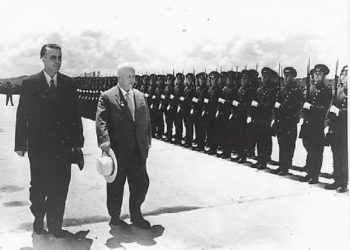
Subsequently, on May 26, 1959, in the same “Zëri i Popullit” newspaper, Enver Hoxha’s speech was published from the reception given to Nikita Khrushchev at the head of the Soviet delegation when they landed at Rinas Airport:
“…The Albanian people value friendship with the Soviet Union as their most precious treasure…! Our friendship is as strong as granite and as eternal as our mountains!”
Four days later, and to be precise, on May 30, 1959, Nikita Khrushchev was declared an “Honorary Citizen” of Tirana! This act, along with the joint planting of the “Tree of Friendship” by the leaders of the Communist Party (Bolshevik) of the Soviet Union and the A.L.P. (Albanian Party of Labour), gave the illusion that the Albanian leader had finally won the favors of Father Nikita (as Enver Hoxha repeatedly addressed the Soviet leader, Nikita Khrushchev, during those days)!
However, this flirtation did not last long. In the framework of Khrushchev’s frontal war against the long-standing cult of personality of Stalin as the unquestioned dictator of the Soviet Union, as well as the new Soviet leader’s insinuations regarding the Albanian leadership – which had been at the helm of the party and the Albanian state for 16 years and ought to hand over the reins to younger leaders – these matters could not pass without causing Enver Hoxha to take a stand.
Along this track, we are aided by the two-volume work of André Fontaine titled “History of the Cold War,” where in Volume II, p. 395, we read:
“…Tito had never ignored that the path leading him toward the liquidation of his Albanian enemies also led him toward his full reconciliation with Nikita Khrushchev. And it was known that Khrushchev was inclined to bestow this gift upon the Yugoslav Marshal…”.
On September 14 of that same year, Great People’s China delivered the entire quantity of wheat we had requested at a time when, according to Enver Hoxha: “…The Soviet Union was leaving Albania to starve in order to bring it to its knees”!
November 1960 arrived quickly when, following the meeting of 81 communist parties, Albania broke away from the REVISIONIST Soviet Union, solely so that Enver Hoxha could continue to preserve HIS IMPERIAL THRONE! And naturally, with the break from the Soviet Union – which brought with it the end of Enver Hoxha’s personal interests regarding its leader, Nikita Khrushchev – the star of Liri Belishova set once again, this time permanently. She was expelled from the Politburo, from the Central Committee, as well as from the party, being interned under the now-standard accusation of being an “agent of Soviet revisionism”!
According to Enver Hoxha, Liri had reported every conversation held in Beijing with Liu Shaoqi to the Embassy of the Soviet Union in Beijing. Not to mention that in Moscow, she had dined with both Brezhnev and Kosygin, but without reporting in detail about the conversations held with them! Thus, the dictator cast Liri once again into the very same “basket” from which he had pulled her out… when he needed her!
In continuation, I cannot fail to mention a photograph, the purpose of which was to show Nikita Khrushchev, in documented form, the unbreakable unity of the party with Enver Hoxha. In the house where the party was founded, 13 members and candidate members of the Politburo were lined up and holding hands with arms raised high (besides Enver Hoxha: Mehmet Shehu, Hysni Kapo, Beqir Balluku, Kadri Hazbiu, Gogo Nushi, Abdyl Këllezi, Koço Theodhosi, Petrit Dume, Ramiz Alia, Rita Marko, Adil Çarçani, Spiro Koleka, and Pilo Peristeri). The photograph is dated November 8, 1961. The normal, logical question arises: how did events surrounding that iron unity unfold in the aftermath?
Gradually, six of those thirteen were executed by firing squad as enemies and traitors, not to mention on this occasion dozens of Central Committee members, government members, as well as high-ranking military officials who were shot or left to rot in prisons! Thus, Enver Hoxha, amidst extremely bloodthirsty stances domestically, as well as other allegedly principled Stalinist stances in foreign policy, leaped from the galloping “Soviet horse” onto the Chinese one!
This move, continuing the entire course of its demagogic path to keep his power untouched, led to the point where Albania became China’s only ally out of all the Eastern European states! These were the times when our representatives at the U.N. raised their voices, emphasizing that the Soviet revisionists fell into the same category as the American imperialists, spreading propaganda of slander and hatred to fuel anti-Soviet hysteria worldwide!
Along this path, after the oaths were broken and the eternal, sincere, and unbreakable Albanian-Soviet friendships were shattered, as soon as a potential threat to the Albanian dictator’s power appeared on the horizon from Khrushchev, I present for curiosity parts of Enver Hoxha’s speech published in Zëri i Popullit on October 1, 1966, where he expresses himself regarding China, his new flirtation:
“The heroic and talented Chinese people, under the correct Marxist-Leninist leadership of the Glorious Communist Party of China with Comrade Mao Zedong at the helm, have achieved brilliant victories of historical importance…”.
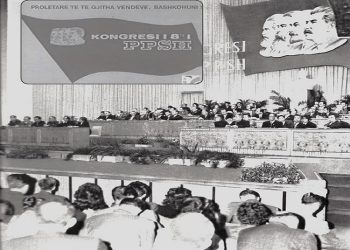
A month later, and precisely on November 9, 1966, the same “Zëri i Popullit” published Enver Hoxha’s speech at the 5th Congress of the A.L.P., from which we extract a passage:
“…The Congress expressed the unbreakable unity and militant friendship of our party and people with the 700-million-strong People’s China, with this unbreakable fortress of socialism and revolution led by the glorious Party of China with the outstanding Marxist-Leninist, the great friend of our people, Comrade Mao Zedong at the helm; and in the historic message he addressed to the 5th Congress of our Party, he expresses our common feelings and determination when he says: ‘Rest assured that no matter what happens in the world, our two parties and our two peoples will certainly stand together, fight together, and win together…’”.
In continuation of the praises for China and Chairman Mao Zedong, Enver Hoxha also stated:
“…The victory of the Great Proletarian Cultural Revolution, the crushing of the counter-revolutionary plots of Liu Shaoqi, Lin Biao, and Deng Xiaoping, has created a revolutionary state of affairs…! China has emerged with increased prestige in the world, victories linked directly to the name, teachings, and great revolutionary leadership of Comrade Mao Zedong, the great friend of our Party and people!”
However, this Albanian-Chinese flirtation also came to an end, precisely when that great friend and protector of ours began to soften its uncompromising policy both toward the imperialist U.S.A. and toward revisionist Yugoslavia!
Do not take my word for it, but find the volume “REFLECTIONS ON CHINA” and examine pages 304–305, where that same genial chairman Mao Zedong is depicted by Enver Hoxha as follows:
“Mao Zedong was a dreamer, but at the same time an emperor and a despot in his views… they were equipped with pronounced imperial, Confucian, mystical ideas, grafted with new ideas of world development that were unchewed, unacceptable, and unassimilated by him…!
Mao Zedong led the country wherever the wind blew, as long as he was at the helm, and in fact, he remained at the helm the entire time. Everyone had to obey him… to implement his ‘genial’ ideas, which in reality did not lead to the building of a more modern, more advanced, more organized China… he allowed courtiers to weave hymns and dithyrambs to him… with imperial actions he took measures, military and judicial measures, carried out political and ideological unmasking… and finally, he even condemned them to execution by firing squad.”
Thus, the day inevitably arrived when Enver Hoxha, after the rift with China, could no longer find any partner who – interested in what Albania could offer – could be linked ideologically, amicably, inextricably, eternally… and let us add adverbs with suffixes like ly, ally, edly, etc., etc. With his experience as a bloodthirsty criminal, he continued to terrorize his supporters and, through them, the Albanian people for nearly another decade, with Albania 100% isolated! / Memorie.al