By Erald Kapri
Memorie.al / In the autumn of 1944, when the war in Albania was expected to close quickly, all sides had begun to make political calculations for power after it. This calculation did not spare even the British, who began to worry about their influence in Albania. The great investment for the war on the side of the communists began to cast strong doubts among the British as to whether after the war Albania would be pro-British. A different report from 1944 gives some rare details and analyses about the communist movement in Albania. The British assessed that the Germans had no interest in definitively destroying the communist movement in Albania for the reason that they did not have full trust in the nationalists.
“It is clear that the Germans do not wish to destroy the partisans, who may be playing their own game. As long as the lines of communication are preserved, the existence of a partisan army constitutes an advantage for the Germans, since it helps to keep under control the ‘National Front’ and other nationalists not involved in politics and as a result, to make them obey it,” the British report states. This analysis sheds light on the military and political motives of the communists, and gives a completely different perspective on the war in Albania.
The full report
THE NATIONAL LIBERATION MOVEMENT (PARTISANS)
This is a convenient name for grouping together the elements with radical views, which are included in the National Liberation Movement (NLM) and the Albanians or the Communist Party. Despite its losses from the detachment of the ‘National Front,’ the NLM still claimed to be the most influential party in Albania. It is clear that it is closely connected with the communists, who are the only organized party that has remained its supporter.
A similar situation seems to be developing in Yugoslavia, where the communist initiative is predominant in the Left-Wing Union, but while Tito has formed the cabinet and the political committee, during which liberal elements and distinguished personalities are at the head, there is no data that the Albanian partisans have gathered around themselves important figures in Albanian public life to support them. The NLM and the Albanians seem to have activities that coincide so well with each other that it is difficult to say where one ends and where the other finishes. They recruit males over the age of 15 as fighters in the mountains, while choosing among them the executors for traitors, who have been sentenced by the party.
Boys, between the ages of 13 and 15, are recruited as agents and informants. Their work includes transporting notices printed in the mountains to the cities and posting them on walls at night. The movement has in its network agents who work in the occupied territory. Thus, at the beginning of January, the house of a 27-year-old peasant was raided in Babica and inside was found two typewriters, a considerable amount of communist propaganda material, medical medicines, dynamite fuses, and white paper.
Near another house, in the same village, light mortars and other military ammunition were found hidden in the bushes. In a dwelling in Shkodra a large amount of propaganda material and 300 Italian army uniforms were found. The partisans are visibly trying to detach the past connections with the resistance leaders into a federation of loose bands, of which 100 exist, each led by some distinguished figures, who command from 20 to several hundred fighters.
In their place efforts have been made to create a well-organized army and at the beginning of February 1944, a partisan pamphlet raised to the sky the achievements of what is now called the National Liberation Army. The influence of events in Yugoslavia is visible in the choice of the name; it is deeply based on the politics and organization of the partisans, who visibly reached the conclusion that Albania had nothing to gain by simply waiting for the defeat of the axis forces, but could influence the policy of the allies by taking control of events, just as Tito had acted.
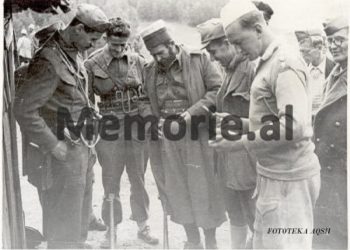
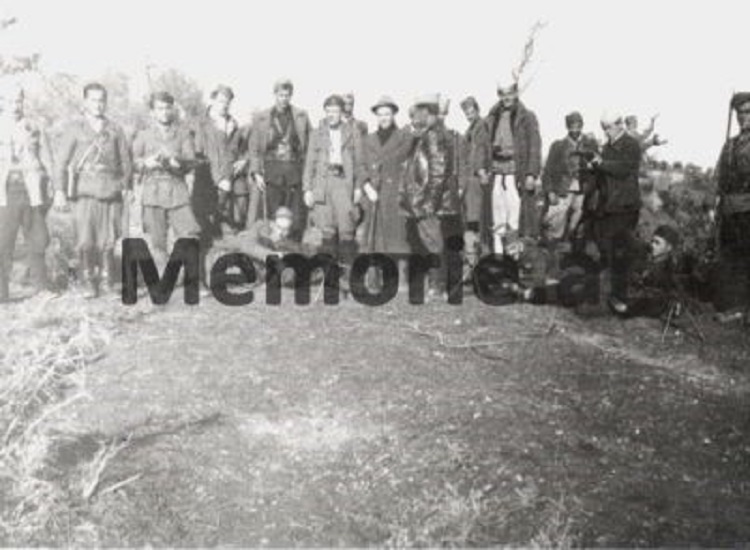
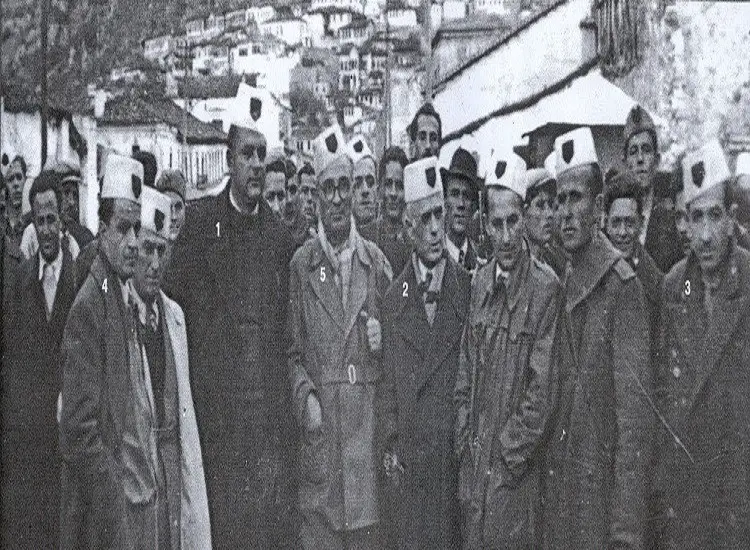
“The National Liberation Army of Yugoslavia,” they say, “with their blood and sweat, have secured for their people its rights with the approval and recognition of the freedom-loving world, of the democratic federal government.” “Go, then, and act thus,” they say. This is a refreshing contrast to the defeatist propaganda that the government uses. Such a challenge is ambitious, but the partisan army is still very small and its influence is limited mainly to the mountainous areas in the southeast of the country. It consists of six brigades – the sixth developed its inaugural parade in Përmet, on January 24, 1944, each composed of two or three battalions.
Thus, the regular forces of the army cannot be more than about 1500. However, all of them are not found at the same time in the field, since each battalion includes temporary personnel, who live in the area where the operations are carried out. The armament of a brigade is reported to be composed of three 81 mm mortars, one 45 mm mortar, 5 “Breda” machine guns, one grenade launcher, and six automatic and ordinary rifles.
The state of the clothing of the troops left much to be desired. The army does not seem to be larger than a core of modest forces, belonging to guerrilla bands, while the partisans are reported to have mobilized in the field 800 men in a single action – an attack against the village of Dukat, a bastion of the ‘National Front.’ Despite the involvement of a large number of peasants, a considerable number of young people belonging to the class of salaried workers, such as school teachers and commune employees, have joined the partisans.
This exodus from their work front must have taken large proportions, while the Germans issued a warning that all employees missing from their workplaces after December 15 would be treated as deserters. Regarding the fighting skills of the partisans, opinions so far have been varied. Thus, in last year’s attack on the village of Dukat, the partisans, although armed, failed to take the village under control after seven hours of fighting and when 300 Germans arrived there, they fled, wounding only one German soldier.
A British observer reported that they are “a band of vagabonds without fighting skills.” Since the Albanian has been characterized for a long time as a fighter, this suggests that “the young people of the salaried class,” more skilled in ideology than in matters of war, constitute a considerable part of the partisan forces. This class is inclined, as is the majority of the intelligentsia of small towns in the Balkans, toward rigid political doctrines, a lack of political tact and a communism less based on the understanding of Karl Marx than a frustration due to the inability of backward countries to provide rewards and recognition of merit and through them, salary according to the title they hold.
On the other hand, the “excellent fighting skills” of many partisan formations were praised by Mr. Churchill in November of last year and after the capture of Brigadier Davies in January, the official British statement singled out some partisan leaders as “typical heroes of the fighting spirit of Skanderbeg and his warriors.” One of the most severe criticisms of the partisans comes from an American source in the country which mentions that, “they are fully responsible for the civil war and for the interruption of actions against the Germans.”
Their attacks against compatriots and the dwellings of compatriots are thought to have forced the ‘National Front’ to have at the moment a role of dependence on German support. There seems to exist not even the slightest doubt that many supporters of Balkom, who wish to support the British, feared the partisans’ attacks against them more than German attacks for the liberation of the country.
For this reason, it cannot be assumed that the rank and the right people are necessarily the partisans. In fact, the flamethrower attacks against villages near their centers suggest that support for the partisans is extremely limited locally. What is again considered a disadvantage of the partisans is the fact that many of their political leaders are suspected not to be Albanian and that they play a considerable role in Balkom and German-inspired propaganda.
Thus, Dushan is believed to be Montenegrin, Miladin Popović and Sulović Serbs, Gjerges and Dhima Greeks, while Pirusheff and Soronovski Macedonians. Since Albania in the past has defended itself with difficulty from the territorial ambitions of its neighbors, this is, unfortunately, a blatant mistake. The life of Albania as an independent country is so short and complicated and its future appears so uncertain, that nationalism is still a burning issue.
In fact, one of the main issues raised by the civil war is the fact whether social conditions or the integrity of the nation should be listed first. The partisans, although their plans for agrarian reform and similar changes are reasonable in themselves and accepted by the majority of Albanians, have not shown great political wisdom in presenting them. The country has not felt itself as a whole, so that the partisans could realize these reforms more within the framework of a free and independent Albania, than a Balkan country clouded by Slavo-Soviet domination.
This must be imprinted in the mind whenever there is a tendency when we think that Albanian politics is divided between pro-Germans and pro-allies. This division exists, although the pro-Germans are undoubtedly few, but this is not always an effective policy day by day. Although the pro-Germans are few and the pro-allies are many, the latter are found in different groups—some even within the government, many of them among the ranks of Balkom, the Zogists and the less extremist in the ranks of the partisans.
But, they are scattered like those iron rods that seek the magnet of an allied landing or in the worst case, of an allied policy, for which they can gather popular support on the bases of self-satisfaction. The most active part of the partisans is far from being pro-allies. They attack capitalist Britain and America, as well as Nazi Germany.
A long circular thought to have been issued by the Central Committee of the Albanian Communist Party in November 1943, claimed that the Anglo-Americans had contributed very little to the war against the German army and that any connection with them had little value, since their policies, as in the past, were based on personal interests. The circular did not give impressions regarding the presence of British missions, but commented: “In many provinces there are English missions, who try to stick their noses into internal political affairs and especially in the matter of our military organization.
They strive to join with the reactionaries, to organize them in order to use them as tools for a possible landing. We must maintain a good attitude toward the British, but also, a firm attitude. They must not interfere with our internal affairs.” After suggesting that the British were trying to increase the prestige of Balkom, “to fight the Germans in order to have them in dependence in the future, it is required that any information regarding their activities must be forwarded to our general staff and in case any important or personal document is discovered, then it must be sent to the personnel of the British mission through our general staff.”
The greater part of this material, however, is provocative. Albanian extremists stand in positions similar to the early Bolshevik leaders. With the lack of support from outside, with a harsh and ready organization and with a continuous threat of being annihilated by a foreign army with the support of their compatriots, their behavior is extremely harsh. They have not yet secured the services of a fine statesman and a visionary to create a movement, which would satisfy either the nationalists or the social reformers.
CONCLUSIONS
It is worth mentioning the fact that, what can be done to secure a maximum degree of cooperation with the Albanians in the task of expelling the Germans, whether to facilitate the allied landing from the air, or to make it unnecessary. The preliminary work necessary on our part is to a small extent only a military problem. This means that, while the Albanians will need weapons, it will be less necessary simply to supply them with weapons, than to decide to whom and under what conditions their supply will be made.
There can be no greater mistake than to assume that all that needs to be done is to pump weapons to the partisans and depend on them to do our task. The reasons for this are briefly as follows:
a) The partisan movement in Albania cannot be compared with that in Yugoslavia. In Yugoslavia, Tito has harmonized nationalism and social policy. The nations of Yugoslavia are many and the promise of federalism and radical reforms allows anyone, whether Slovene or Macedonian, to join the partisans without exercising violence against local patriotisms. In Albania, where the existence of the state itself seems in danger to many, the partisan movement plays the role of the divider rather than uniting. Nationalism there is a matter of mood compared to the rest of Europe, while the partisans have not managed to convince the nationalists that they are able or will harmonize social reform with the independence of Albania.
b) In case weapons were to be sent to such an extent that the partisans could crush any other element in the country together with the German army, then we must help and not hinder the German occupation. It is clear that the Germans do not wish to destroy the partisans, who may be playing their own game. As long as the lines of communication are preserved, the existence of a partisan army constitutes an advantage for the Germans, since it helps to keep under control the nationalists not involved in politics and as a result, to make them obey it.
The partisans have not yet benefited from the gift of differentiating between someone who acts as a collaborator with premeditation, and a sincere and progressive patriot, who, through the force of circumstances, remains inactive. The more powerful the partisans become in other parts of the country – naturally to a certain extent since they cannot become powerful up to the domination of the country – the more their political intransigence will push the moderate pro-British and pro-American elements into the hands of the Germans.
c) The partisans do not have in their bosom popular figures and an administrative talent to secure public support and to maintain calm on the eve of an allied invasion. We would be involved in a civil war, during which the rebels would include thousands of those who would sincerely wish for an allied victory, while the forces we relied on would consider us as something with which one deals with a contemptuous tolerance.
d) Supplying only the partisans would remove from our hands the greatest convincing power we possess – the capacity to use our resources of food, clothing, and weapons, as an argument for the return of national unity on the bases of an effort against the Germans. This would be entirely a mistake in the framework of the evidence that,
a) elements of Balkom are becoming more aggressive under German occupation and that
b) the Zogist element is gaining wide popular support and six out of ten prefectures are already reported to be almost completely loyal to the Zogist movement. We are facing several thousand armed Germans and Kosovars – the latter are foreseen to develop a desperate battle against us and both these can be annihilated only if we can exploit all the elements not compromised by German support. We need the partisans, the Kupi formations and the ranks and number of Balkom fighters.
Together, they can form an “iron ring” by surrounding the Germans in the lowlands and any policy that does not tend first to unite them would bring confusion in itself. It is thought that the possibility of a union is greater now than ever before for the following reasons:
a) The territorial concessions, with which there has been so much manipulation recently, would have lost much of their shine due to the acts carried out by the Kosovars. There has always been a powerful element in Albania considering the view that irredentism should not be encouraged in order to preserve friendship with Yugoslavia and that instead of new territorial claims by Albania, desirable elements among the people of Kosovo should be absorbed, through the intensification and cultivation of their land. This view must have been spread widely in recent months.
b) The course of the war shows all the uncertain elements that there is no hope in the policy of balancing the promises of the allies, who are on the eve of victory, with the promises of the Germans, who are toward certain defeat.
c) Since the Tehran conference, the partisans have lost the bases for the extension of their influence which implied disagreement between the British and the Americans on one side and a Soviet Union committed to a world revolution on the other. Since opponents with the popularity of the Zogist regime, such as Bishop Noli, accepted King Zog as the temporary leader of the war period, he is again recognized to be, as he has in fact been for a long time, the central figure on the Albanian scene.
As such, the recognition of this status is the maximum that even the Zogists themselves can foresee during the war. On the other hand, the guarantees given by Zog that the future of the regime will be decided by the people and the fact that the allies are able to see that these circumstances have been realized, enables the partisans to lower their extreme claims for a common good, without doubt that they will find themselves at a disadvantage after the war.
It is emphasized, in the framework of these considerations, that support should not be given to any single element at the expense of the rest, but that our considerable and growing advantages should be exploited to recreate unity in Albania and as a result, to make possible the return of prestige to the allies and the saving of hundreds of allied lives in the coming months./ Memorie.al