


By MËRGIM KORҪA
Part One
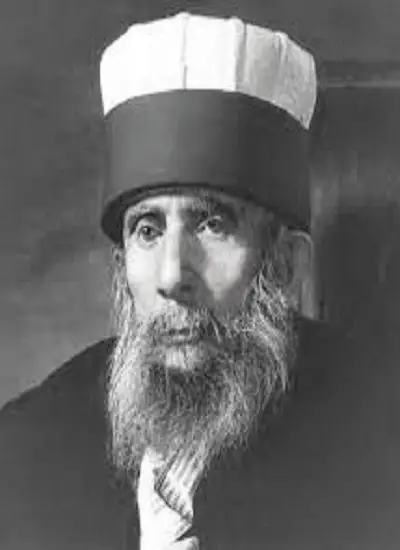
Memorie.al / I consider myself fortunate that as soon as we set foot on this blessed land of America, we immediately got to know, and quickly became friends with, one of the most distinguished personalities of our nation, His Grace, Baba Rexheb. We could hardly wait for the weekend to spend it with him, his sister, Aunt Zejnep, as well as all the friends and well‑wishers who came to visit him, to confide a trouble, or even to serve him and the Teqe. But weekends were far apart from one another – separated by seven days – until the phone would ring in the middle of the week and Baba’s so dear voice would say, “Where are you, my sons? Come, we miss you.” And the next day, as soon as we got off work… straight to the Teqe! I remember those times that will never return, and honestly my eyes have become so clouded with tears that I can barely see the computer screen as I try to write down these memories. The only thing that consoles me is the fact that whenever I spent time with Baba, I tried and made use of the time that stubbornly slipped away, and I left no issue undiscussed with him, even if it meant going past Baba’s bedtime, which he respected fanatically.
I recall one of the first meetings with Baba Rexheb. After I kissed his hand and he embraced me, he asked: “I have great respect for your late father, and I especially admire his determination and courage in how he ended his life, although I do not wish to judge his action. But you – do you believe in God?” I confirmed that I was a believer. Baba Rexheb looked deep into my eyes and replied: “Given that you have not been tainted by religious faith, as unfortunately your whole generation has not, how is it possible that you have this conviction?” I answered that initially it may have been the influence of the bond between my father and his friends – Hafëz Ali Korça, Father Anton Harapi, Sheh Ali Pazari, Dom Lazër Shantoja, Iriné Banushi, etc. – where the topic of belief in God was very frequently present, which awakened my curiosity to expand my circle of knowledge.
Then, over the years, the treatment inflicted on the most prominent clerics of the nation – executing them, imprisoning them, interning them – as well as the violent official stance against religious institutions, were without any doubt actions that strengthened my inner revolt and finally pushed me towards belief in God. Add to those events in my own life that I could not explain otherwise than by the intervention of God’s hand, and so my faith gradually grew stronger. As I looked Baba Rexheb in the eyes, I saw that he was pleased with the answer I had given. He closed his eyes a little, raised his hand to his beard (a habitual gesture of his), and, as if not addressing me directly, said more or less:
“Throughout history, it has been documented that the most suffering category has been believers, because they, trusting their leaders, have sacrificed themselves with conscious self‑denial – and not always for a just cause… while agnostics have always tried to find an opposing side… while charismatic people, for good or ill, have constantly ruled, at a time when the anonymous have been used as cannon fodder.” After these reflections, Baba fell silent. He opened his eyes and said: “You made me think deeply when you told me you are a believer, and I felt compelled to elaborate these clarifications, because for the Albanian people, under communist violence, there were no longer any social categories – they had turned everyone into anonymity.”
I also remember… No. I will not continue along this path only with memories, without considerations and comparisons. May the reader forgive me, but I will try to establish some criteria, based on which it will be easier for us to mutually understand the depth of Baba Rexheb’s philosophical thoughts – as a man, as a religious figure, and, what is even more difficult, as a mystic. The passage of time has confronted humanity, without the slightest doubt, with a broadening of horizons regarding past experiences. This fact has inevitably led to the search for ever more complex answers to questions that, as science advances, have become ever more elusive.
In this context, time itself – as a notion in itself – is very relative. A young child understands nothing of the concept of time. Adolescents can hardly wait to grow up. From mature age and throughout all of a person’s active years, the individual thinks that time is always on his side. Then comes its devaluation along with old age, when a person usually just passes the days. At this point, rational logic steps in and asks: are these categories of people talking about the same process? This perspective on the concept of time shows how statements in life must be considered very relative, and a wise man should not fall into the position of making categorical assertions. Let us now refer to a concrete example. A lie, whenever it is told, remains a lie. But a truth that is not asserted in time… no longer has value! Based on this preliminary condition, which we have treated very superficially, one can understand how varied the questions become about the complex, multi‑faceted and equally mysterious manifestation that concerns living beings in general, and human beings in particular, with the passage of time.
From the depths of time, feeling the need to give explanations to the most diverse questions, beliefs arose, where believers found support in what the leader of the faith told or explained to them. Subsequently, as questions about existence and death became more complex, these became religious faiths, and step by step, from belief in many gods, monotheism (belief in one God) was reached. Over the centuries, different religious faiths gained great authority. Later they caused battles and wars, but on the other hand they also helped different categories of people. History also testifies that these wars not infrequently overthrew kingdoms or, in their course, glorified people of no value. That is reality. But in principle, from a philosophical point of view, what service do religious faiths in God provide to humanity? Their purpose and high mission is to offer spiritual support to believers when they need it, and to help them throughout their lives.
There is no doubt that there are questions that are extremely difficult to answer, both regarding the origin of life on earth and what happens after a person’s death. In this specific case, religious faiths help with answers, but the very purpose of religious faiths is not to find the answer to the question of what absolute truth is. The case is different with science. Its goal is objective truth. However, with its extraordinary advances, this goal becomes ever more distant, elusive, and complex, especially with regard to human society, philosophy, and religious beliefs. The phenomena of human society and personal life are infinite and extremely complex. Not only do many components intertwine in them, but these components themselves appear in extraordinarily diverse forms and manifestations. This is where science begins to limp. Because those who study phenomena are forced to make the information selective in order to subject it to analysis. This means that at a given time, certain parameters or models (it is not known how accurately they resemble the object to be studied) are subjected to observation.
Hence it follows that the theories arising from these observations cannot be established as a general rule, and even less can they be applied at all times. Thus, logically, selective observations lead to interpretations that are themselves subjective. Consequently, philosophy has sometimes been placed alongside religious beliefs and sometimes identified with science. Based on this very brief presentation, I think that, albeit superficially, it becomes somewhat clear how erroneous interpretations of data have led humanity at different times to fall into deep delusions with long‑lasting effects, perhaps for entire centuries. Suffice it to mention what was done and how it was done during the period of the Holy Inquisition (so‑called), or the spread of the communist experiment implemented in many countries of the world.
Let us now narrow the circle of the problem to be treated. The more distant in time the data taken from written history (let alone prehistory), the clearer it is that the conclusions drawn are relative and inaccurate. On the other hand, the greater the scientific discoveries, the greater and more extensive the contact with the unknown. So the more science progresses and develops the more unknowns and problems requiring explanation it faces. And this statement, synthesized, takes on a philosophical character when a contemporary English physicist asserts that, to land a space rocket at a certain point on the moon’s surface, interventions to change its trajectory are necessary.
And in this specific case we are dealing with only three celestial bodies moving simultaneously: the earth, the moon, and the space rocket. So when, in this case, the intervention of a scientist (a director) is absolutely necessary – who from earth directs the programme and corrects the trajectory – can one think that with this dizzying array of celestial bodies moving in synchrony, this harmony does not need a great director? Precisely faced with this impotence of the human mind, the English physicist is forced to declare that he renounces atheism, which he had previously defended with exaltation, and becomes a believer in a great directing God of the universe. This transformation of a man from a non‑believer in God into a believer with well‑founded conviction gives us the strength to continue in this vein of our reasoning. Let us now borrow a statement from philosophy, which is as present as the truth we experience. It asserts that people are roughly grouped into believers; believers as long as they are presented with tangible and convincing proofs (according to them) regarding the uncertainties they have about the Creator of the Universe; the undecided; and non‑believers. (Further on we shall see what the categories of people are according to mystical philosophy.)
Now we walk along the path we have tried to trace, showing all the difficulties encountered regarding the inaccuracies resulting from selective analysis, and we begin to narrow the circle of determinations so that our conclusions are as close as possible to objective reality. Based on this prerequisite, we take as a selected category to address the human community from which we have excluded non‑believers. They too are most welcome to follow our line of reasoning, but only when they begin to become undecided – that is, when they have set aside their negative prejudices. At this point we now seek help and bring onto the scene the mystic and deep thinker of Bektashi Mysticism, Baba Rexheb. I see immediately how the undecided (sceptics) are ready to say… why turn precisely to Baba Rexheb? My answer, as I have undertaken to address this issue, is very simple: first, because Baba Rexheb was indeed a very profound thinker in the field of philosophy in general, and on the other hand he was also a Master of Islamic Mysticism, as Professor Frances Trix of Wayne State University defined him in her work *Learning with a Muslim Master*.
On the other hand, precisely to avoid subjectivism resulting from the distortions that facts undergo under the action of time, the problems I will address are memories of discussions and views of Baba Rexheb, gleaned from hundreds of hours of unforgettable conversations with him! His statements will then, step by step, be compared with the statements and positions of two saints, Padre Pio and Mother Teresa, both contemporaries of our generation. I point out to the sceptics that the very selection of these three characters today eliminates many deviations from the truth that may and will occur over the coming centuries regarding their thoughts and deeds, when time – this invisible factor but extremely linked to humanity – will influence the transformation of truths.
And now I can continue by remembering how one day I asked Baba Rexheb and said to him… that discussions of a religious nature, regarding the existence or non‑existence of God, were the most talked‑about topics among people. Baba laughed and quoted Confucius, who said that in nature everything is something, while the ignorant is nothing. Then Baba added: “Unfortunately, the world is full of ignorant people, even educated ones, who want to make interpretations and generalisations, let alone reach conclusions. The only thing these narrow‑minded people achieve is to sink deeper and deeper into the swamp of doubts, and then they cannot get out! The terrain on which they tread with their ignorance is quicksand, and when they see themselves drowning… many of them begin to pray to God for mercy!”
A friend of mine who had worked at the Tirana Military Hospital and then escaped told me how, when Nako Spiru – the communist and staunch atheist – was brought in wounded, for hours he did nothing but call on God to have mercy on him and save him… until he gave up his soul! And now here is the interpretation from the mystical perspective that Baba Rexheb gave to his story: “Ignorance drove them to false statements (lies), and when they wanted to return to the truth – not out of deep conviction but for personal interests – that truth had become out of time and was no longer of use to them!” Let us now refer to that other great mystic, whom the famous biographer Renzo Allegri describes as “one of the most famous religious personalities in the world, one of the greatest mystics, and finally the saint, Padre Pio of Pietrelcina”… while the world‑renowned lawyer Bruno Cassinelli says, when speaking of Padre Pio: “Padre Pio is the genius of feelings, just as Giuseppe Garibaldi was the genius of actions and Leonardo da Vinci the genius of intellect…!”
Some educated but ignorant people say to Padre Pio, trying to put him in a difficult position: “Have you heard, Padre that a great tragedy has occurred in the port of Albenga? A large boat has sunk and 30 children have died! Why does God allow this pain to innocent creatures, if He exists?” The Padre was silent. His eyes filled with tears. Then he said: “A mother embroiders. Her child, sitting on his little stool, sees only the back of the tapestry, where his mother is making the embroidery: he sees a meaningless tangle of threads and colours. But if the child were a little higher and could see the right side of the embroidery, he would see its design and its combined colours. We, my children, are sitting on the low stool and cannot see what God is embroidering!”
While Dom Lush Gjergji, friend and scholar of Mother Teresa’s life, tells that when he decided to ask Mother Teresa about her dedication to the path of helping the poorest of the poor, she answered: “How God called me to this path should not worry you, because that is something between God and me. What is important is that God calls each one differently. We have no merit. What is most important is to answer His call with joy…!” Baba Rexheb always emphasised to us that he prayed for us, his friends, but he would also add: “For you I do not pray much because you do not have much need for prayers to God, but for evil people I pray more because they have greater need – and the worse they have treated me, the more I pray for them!” I considered this statement of his as something that Baba Rexheb, given his robe and position, was entitled to say. But I soon understood how deep and truly superhuman a meaning that statement had when it was put into practice.
During the war, Bedri Spahiu was the most zealous communist activist in the Gjirokastër district. As soon as Bedri left a village where he had propagated communist ideas, Baba Rexheb would go and, with patience and conviction, turn the people back to his side and his nationalist views. So Bedri Spahiu pursued Baba Rexheb, wanting to catch him and flog him alive. When Baba Rexheb saw that the communists were taking power, on the advice of Baba Selim (his murshid and uncle), he first left Gjirokastër and then Albania. While Bedri Spahiu, after the communists took power, first became attorney general and killed and cut down as he wished.
He even served as prosecutor in the Special Trial, with Koçi Xoxe as chairman of the court, where, out of the malice accumulated in their genes as failures, they condemned the heads of the Albanian intelligentsia. And three years later, at Koçi Xoxe’s trial, Bedri was again the prosecutor who demanded Xoxe’s execution. Later, the paranoid dictator also rotted Bedri himself in the prisons. But the important thing now is that after the fall of communism, Bedri Spahiu made and published his public self‑criticism in the newspaper “Republika”. I read it to Baba Rexheb. He followed the reading with deep concentration. When I finished reading, he thought for a long time and, as if speaking to himself, said: “… when people grow old, they begin to believe in God, repent, and seek relief for their souls from their sins.”
But Bedri, although advanced in age, continued to lie quite openly. “I have prayed much to God for his soul, but I see that I will have to pray even more for him.” When I heard this statement, I was stunned. Only then did I understand the greatness of Baba Rexheb as a mystic. Let us now glean an analogous event from the life of Padre Pio and draw a parallel between the two saints in question. The order issued by Father Provincial Bernardo d’Apicella, addressed to the Convent of San Giovanni Rotondo, dated 29 August 1936, states: “From today on, all lay believers are forbidden to enter Padre Pio’s cell in the convent. Any priest who distributes outside the convent things belonging to Padre Pio will, ipso facto, be suspended a divinis (automatically stripped of ecclesiastical garb forever)…!”
In this climate of suspicion and restrictions, Padre Pio passed his days. Let us now refer to the testimony of Padre Agostino, to whom Padre Pio had stated: “The testimony of a clear conscience before God is enough for me. I try to do my duty by doing well to souls and pleasing God.” And when Padre Agostino asked him if he felt any sense of revenge towards those malevolent people, Padre Pio looked with a lost gaze and said: “Revenge has never crossed my mind. I have prayed for those who accuse me and I continue to pray for them. I have even turned to God; praying that if to bring my malevolent people onto the right path they must be punished with the whip, give me those blows so that they may be saved!”
This attitude of Padre Pio towards those who humiliated, attacked, and fought him with unparalleled hatred can only be compared with the position of Baba Rexheb, the other mystic across the Ocean! How magnificent and in harmony these positions are – one of Islamic mysticism, the other of Christian mysticism: the two saints pray for their enemies, they suffer spiritually for them, and they offer themselves as victims to God so that He, alone, may save their enemies from eternal suffering!
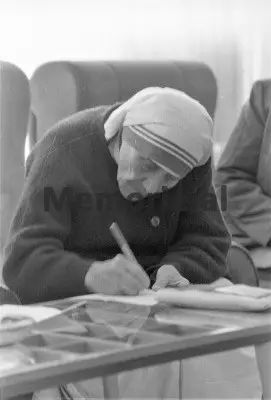
What about Mother Teresa – what position did she hold in analogous situations? I remember, and whenever this happens it makes me think, the fact that I will briefly present. Dom Lush Gjergji tells how Mother Teresa had a great desire: she wanted to come to Albania to meet her mother. They would not give her a visa to enter her homeland. The Secretary‑General of the United Nations, U Thant (1961‑1971), also intervened on this matter, and they told him that they could not allow her to come dressed as a nun, because our state was proud of being self‑declared atheist. But Mother Teresa accepted even that condition, even though she did not wear nun’s habit (her attire was that of the Missionaries of Charity), just to see once more her Drana who had brought her into the world.
And when they learned that she had accepted that condition… they still denied her entry! And Drana passed away without seeing her daughter alive. On this occasion, I will now relate what the late People’s Artist, the soprano Marie (Paluca) Kraja, told me with her own mouth – she had been assigned to accompany Mother Teresa during the latter’s visit to Albania in 1989, when she came and visited the graves of her mother and her sister Age. “They had placed in the programme that Mother Teresa would also pay homage at Enver Hoxha’s grave. I felt quite uneasy about how she would receive this proposal. We expected everything from her, but that she would say, ‘I have no problem, because all human beings, communists too, are nothing else but God’s creatures’ – that was the thing we least expected to hear from her mouth.”
Is there any need to elaborate further, comparing the attitude of the Albanian government with the behaviour of the Saint? I now bring a memory from the long conversations with Baba Rexheb that sheds light on what is described comparatively above. Baba asserted that “… people learn theology in school, just as they learn all other disciplines. But mysticism is separated from theology by a great chasm; mysticism is learned only by walking its path. On the other hand, if we look at how the pedagogues of Islam and those of Christianity explain their doctrines, we see that they start from the historical perspective, that is, as humanists. While mysticism is the deepest meaning of beliefs!”
Based on these explanations of Baba Rexheb, it is understood that mysticism is the deepest meaning of religious beliefs; thus, dealing much more deeply with the spiritual connection and union with God, it avoids the differences between beliefs and, focused as it is on its major objective, it makes mystics of different faiths draw near to one another and walk side by side, regardless of their religious convictions! One day, while talking with Baba Rexheb about different religious beliefs and the norms of different faiths, a lady intervened and said: “During the one year I lived in Italy, because opposite the house where I lived there was a small Catholic church, I would go from time to time to the church, pray to God, and light a candle. Have I sinned by doing so?” / Memorie.al