
By EUGEN SHEHU
Part One
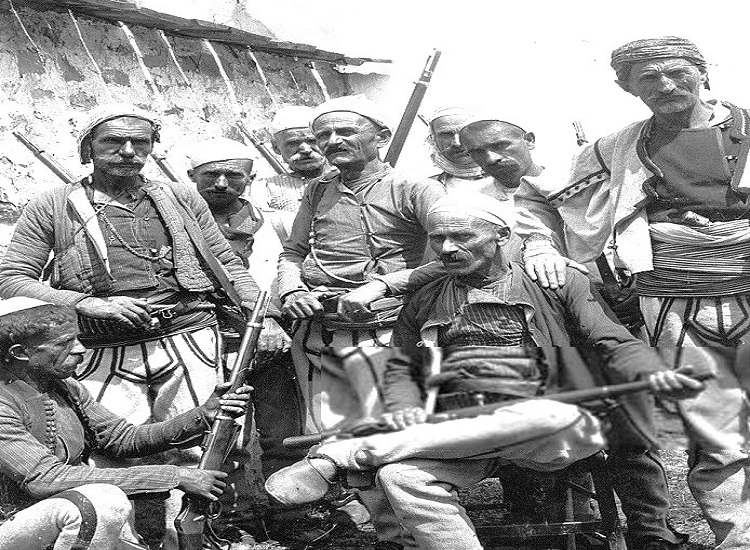
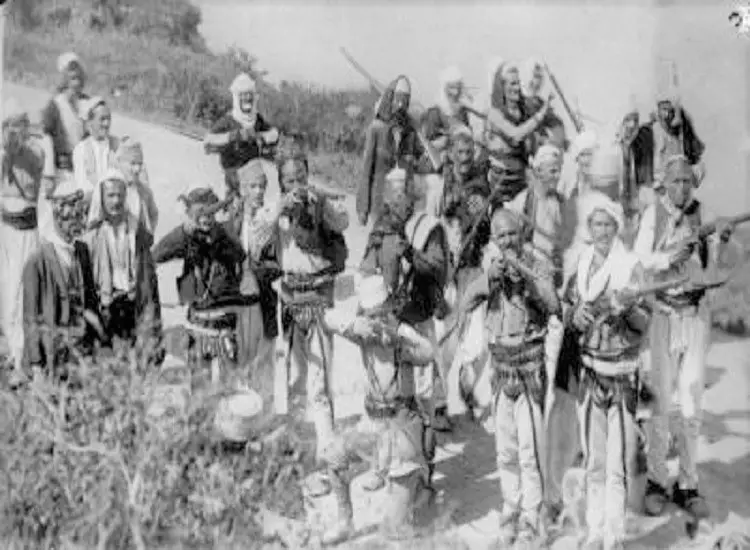
Memorie.al/ The Albanians of Kumanovo, those worthy sons of the ancient Arbërs, have been and remain to this day fighters for their very existence, for the protection of the most valuable Albanian traditions, and for the transmission of the message of natural union with the mother country. The philosophy of their very existence is, in essence, the philosophy of endless wars, of sublime sacrifices, in order not to submit to any conqueror, not to be assimilated by the demographic, political and criminal furies of the Serbs, Bulgarians and Slavo‑Macedonians. When we speak of the endless wars of the inhabitants of these lands of Albanian Macedonia, we have in mind an entire movement for freedom and justice in the last century, which assumed epochal proportions in the battles against the Young Turks, the Serbo‑Slavs and the Bulgarians, led by Bajram Vaksinca.
This son of the village of Vaksinc managed to secure the sworn allegiance of 5,000 men from the surroundings of Kumanovo, ambushing invading military expeditions and proving that Albanians allow no one to rule over them. For some time, the name of Bajram Vaksinca became known even in the Sultan’s court. Further on come Hakul Nikushta and Halil Breza, who placed themselves in the front ranks of those who opposed sending soldiers to serve in other armies? Ottoman battalions arrived from Skopje and Bitola, but the brave men ignited the war and the flames reached the skies of Kumanovo.
Then the rage of the Sublime Porte was great, because following the example of the Albanians in this region, others were also refusing to send their sons as soldiers or to allow the displacement of their fellow countrymen. Even today, in the regions of Kumanovo, the songs of Xhem Sadria and Halit Breza are sung; even today, the places where they fought with their bands are pointed out – where they had their hideouts, where they buried their trench comrades, where they sang after victories. The generations have lovingly passed on their memory, convinced that they will never see their like again, but the messages will continue.
The end of the First World War would be for the ethnic Albanians in Kumanovo a ray of hope, just as for all the other Albanians who had been cruelly separated from the trunk of the mother state in 1913. They followed with attention the situation in the Balkans and especially the consequences that might flow from the decisions of the Peace Conference in Paris in 1919. Without wishing to delve into those decisions, I believe that the conclusions of this conference were extremely discriminatory towards Albanians.
Not only were the borders of 1913 not discussed at all, but there were also moves for the further dismemberment of Albanian lands. If in 1913 Albania had been carved up by its neighbours, aided by the Great Powers, now there was discussion of how to erase it entirely from the Balkan map. Tired, ravaged by hatred and violence for almost six years (1913‑1919), the ethnic Albanian inhabitants of Kumanovo now faced other threats to their physical existence.
The period that had passed was filled with mistreatment by Serbs, Slavo‑Macedonians and Bulgarians – indeed the latter had even undertaken concrete initiatives to expel them. Even Slavic historians have been forced to admit that: “The attitude towards other nationalities, especially the Albanian one, was openly brutal, discriminatory, and liquidating.” (R. Terzievski, “Za diskrimatovska politika na bugarskiot okupator VRZ narodnostite vo Makedonija”, p. 159).
But Serbia emerged victorious from the First World War. At the Paris Peace Conference, it was strongly supported by France and England, and as a result not only did it not give up any territory, but on the contrary it acquired more. The departure of the Bulgarians from Kumanovo was a very temporary hope for the Albanians of this region, because this departure was accompanied by the establishment of the brutal Slavo‑Macedonian regime.
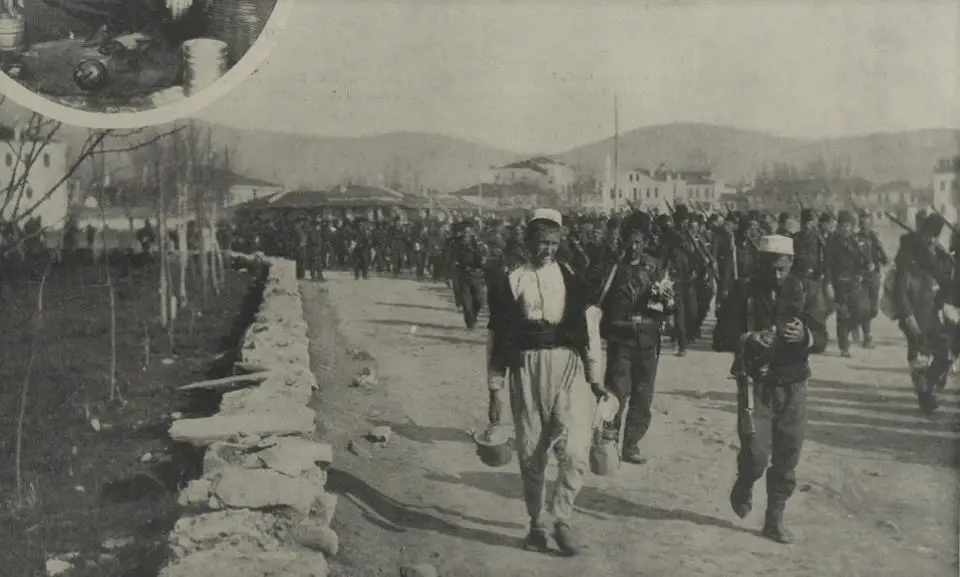
Although it was in the early stages of its organisation, this regime did not fail to show its iron fist against the defenceless Albanians. Thus, in the regions of Kumanovo, at the end of 1919 and the beginning of 1920, the High Military Command in Belgrade organised the mobilisation of recruits.
What was known was that these recruits, defined by law, were to be mobilised without distinction of race, religion or nationality. For the local authorities in power regarding the Albanians of Kumanovo, their aim was extremely clear. They wanted to remove from their ancestral lands the cream of the Albanian race – those young men and men capable of bearing arms and fighting – in order to thus more easily conquer our lands physically.
It is natural that the ethnic Albanians in the Kumanovo region would oppose the mobilisation of young men into the army of the Kingdom of Serbs, Croats and Slovenes. Consequently, many of those who were called up were forced to flee to the mountains, to Kosovo or to Albania. In this case, the local administrative power imposed extremely severe sanctions. The Slavo‑Macedonian press itself has written verbatim: “Our civil and military organs quarrel among themselves in many cases, but they very quickly agree when it comes to keeping the Albanians in chains.” (Newspaper “Socialistiçka Zora”, 31 March 1920).
Since at the beginning of 1920 Albanians constituted a considerable part of the population in Kumanovo, the Slavo‑Macedonians tried by every means to make their lives unbearable. But not only in Kumanovo. It was part of an entire strategy that included all of Kosovo and Albanian Macedonia. But violence in the Albanian regions of Kumanovo has always been more savage, because here Albanians have never been as compact and dominant as, for example, in Kosovo, Skopje, Tetovo, or Dibër and Struga, etc.
Although during the First World War Serbia had carried out two mobilisations of Albanian recruits in Kumanovo (as in all of Albanian Macedonia), although it had plundered Albanian Kumanovo three times in 1913‑1915 and 1918, the Slavo‑Macedonian atrocities did not rest. Through the exercise of the two powers, it now forced the inhabitants of Albanian Kumanovo to pay heavy taxes and remain silent in the face of injustices, to implement all kinds of administrative orders, even not to use their own language.
As for Albanian schools, in this period there was no question of them. I believe that this physical and spiritual genocide, among other things, originates in the infamous theories of B. Panjevci, who, in his capacity as Secretary of State General Statistics, emphasised in 1920 that: “It is truly dangerous, the increase of Albanians in the South, which will be a permanent danger for us Serbs. The danger is becoming more and more visible because the national feeling is awakening among Albanians. This awakening has favourable conditions because the Albanian population lives in compact areas and instead of being assimilated, as is the desire of our state, in reality the opposite is happening, because the children of the colonists, instead of imposing the Serbian language on Albanian children, the opposite is happening: Serbian children are learning Albanian.” (Politika e eliminimit të shqiptarëve nga trualli i Jugosllavisë së vjetër – “Përparimi” no. 5 – 1979, p. 433).
Feeling powerful enough to act at will against Albanians, the Kingdom of Serbs, Croats and Slovenes, in the autumn of 1919, undertook a broad strategic military plan. Indeed, the deployment of the Third Army in Skopje, which included the appropriate political and military elements, served this purpose, with a view to a severe and swift strike against Albanians.
Especially in Albanian Macedonia, this blow would be very heavy considering the events of 1918. Although I have mentioned elsewhere the issue of the Third Army of Skopje, I believe that its war headquarters always had as its own undisputed objective the massive elimination of Albanians from their ethnic lands, and perhaps even further, the ethnocide and genocide of Albanians in the Balkan Peninsula.
The dreams of the Serbian Tsars to reach the Adriatic waters seemed to be revived by the hordes of the Serbian inquisition in the 20th century. Thus, under the pretext of not reporting for military service, or with no pretext at all, in the Kumanovo region in March 1921, some gendarmes stormed the houses of Albanians in Hotla, seizing livestock and all valuable items. When one of the village elders told them that this was a criminal act and the work of thieves, the gendarmes savagely shot the 80‑year‑old man from Hotla, leaving him dead on the spot.
Also in the village of Hotël, in the house of Beqë Shabani, when they heard a child whispering in the Albanian language, they did not spare their bullets and then set the tower on fire. If any Albanian family head in the Kumanovo region had even objections with the simplest employees of the civil administration, the gendarmes would go inside the house, seize his livestock and other valuables, tie him up, and take him to the most distant and infamous prisons of the Yugoslav Kingdom.
Thus, from a secret report of the extraordinary commissioner of Skopje, sent to his superiors in Belgrade on 11 April 1920, it is stated, among other things, that in the Kumanovo district two Albanian insurgents had been shot and killed without trial, while three others, along with their families, had been sent to prisons. The Serbian prisons for the population of Albanian Kumanovo would later constitute another dimension of the tragedy of our nation.
Because no one defended them, Albanians would rot there for years, innocent, and only if a relative paid a bribe could he go one day near his house, to live the great prison of Serbian violence and chauvinism. In September 1921, when the Belgrade chauvinist saw that the colonisation measures could not immediately achieve their objectives, he ordered the Command of the Third Army of Skopje to carry out massacres throughout Albanian Macedonia, including the territories of Kumanovo.
The truth is that this massacre began earlier in the regions of Kërçova, Gostivar, Tetovo and Skopje, where Albanians were very compact demographically. While two detachments of the Skopje Army carried out a detailed inspection of the villages in Kumanovo, identifying where Albanian families were, what relations they had with the civil and military authorities, preparing the violence calmly and according to a detailed plan.
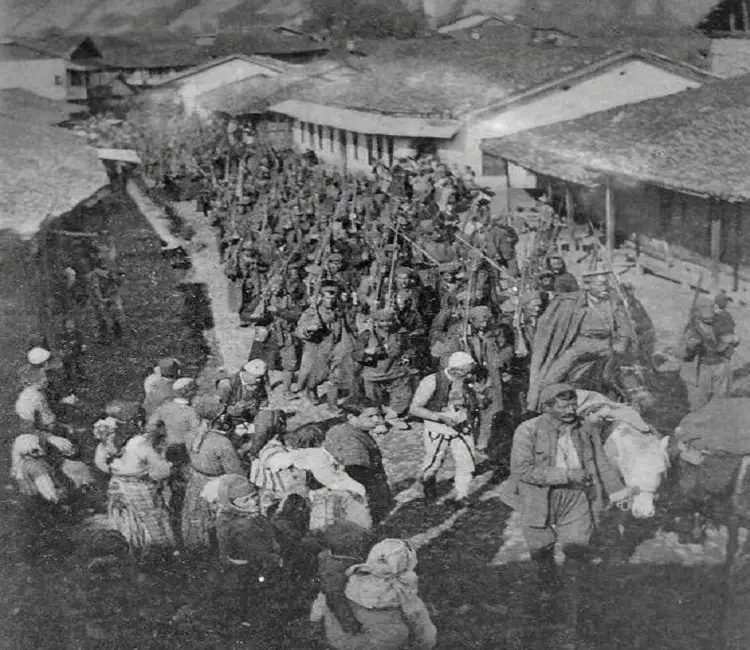
Thus, in the autumn of 1921, two battalions of the Third Army of Skopje, armed to the teeth, attacked the Albanian villages of Kumanovo. Their order was clear: no Albanian foot was to tread the soil of Kumanovo. In particular, the villages at the foot of Karadak were attacked, such as Llojani, Likova, Sllupçani, Hotla, Matejci, etc.
For days and nights, the fire from the towers did not cease, and the smoke mingled with the gunpowder of the rifles. The Serbo‑Slavo‑Macedonians, in their animalistic rage, spared neither women nor infants. A foreign correspondent, who took part in those battles, wrote about this massacre: “The Serbian military tactics in Macedonia have taken on the character of a general, almost terrible massacre. The army is applying a destructive, barbaric tactic at its peak. According to the accounts of soldiers and officers, between Kumanovo and Skopje over 3,000 Albanians have been killed…! The Albanian villages are completely burned. The people are being hunted in their own homes and killed like mice. The Serbian militarists report this human hunt with extraordinary praise.” (Central State Archive – Tirana. Fund “National Committee for the Defence of Kosovo”, File 35/2, sheet 4). /Memorie.al