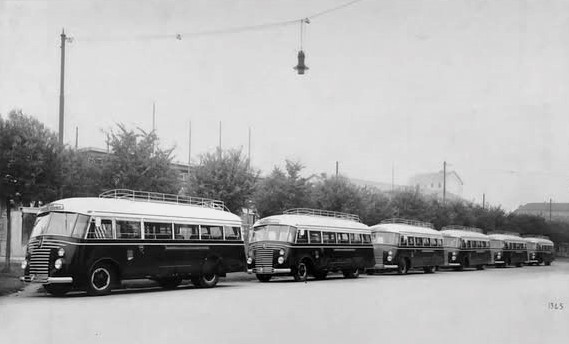
Memorie.al / With the establishment of Italian authorities in Albania after the fascist invasion, on June 2, 3, 4, and 5, 1939, the country was visited by a group of specialists from the vehicle manufacturing company “FIAT,” who were to survey the general state of the country’s road infrastructure, fuel prices, repair workshops, car brands in use, their prices, i.e., everything related to the automobile industry. This group visited the cities of Tirana, Durrës, Berat, Vlorë, and the Devoll district. This group of specialists also made a brief description of the equipment and level of technology in the country.
Albania was estimated to have about 1000 private telephone users. The number of bicycles in use was also 1000 across the entire country. The radios in use were of American brands, and it was estimated that there were between 500 and 600 sets. Whereas, across the country, there were only two cash registers. Albania had a road system created with minimal human intervention, mostly winding roads opened for military function.
Roads outside cities were in poor condition and often had potholes; it could be said they were unsuitable for vehicles. The main roads within populated centers had a width of 5 to 7 meters. The poor state made them dusty in dry weather and muddy when it rained. At this time, as this group also noticed, a program had just begun for the construction of almost the entire road network in the country. The first measure was laying gravel on every road. But even with this measure, vehicles (this group suggested) needed to be reinforced to cope with the difficulties.
Albania at this time had modest automobile traffic. To import a car into Albania, the tax was the same, whether for personal use or for business, and also the same for engine power. A car was cleared through customs for 50 Albanian francs. While the circulation tax was 5 francs per month, double for 7-seater cars. Petrol-powered trucks were exempt from the circulation tax, while diesel-powered ones were taxed 1 franc per horsepower. This greatly favored American-made trucks, setting aside diesel-powered trucks that were much more effective in relation to engine power.
Gasoline cost 2 lek per liter and diesel 0.25 francs, while lubricating oil cost 6.50 francs per 5 kg can. The annual fuel consumption was 3.5 million francs for gasoline and 2.2 million for diesel. Fuel sales points were not very widespread; across the country, there were 22 fixed and 120 mobile ones. Compared to countries like Italy, fuel prices were cheaper.
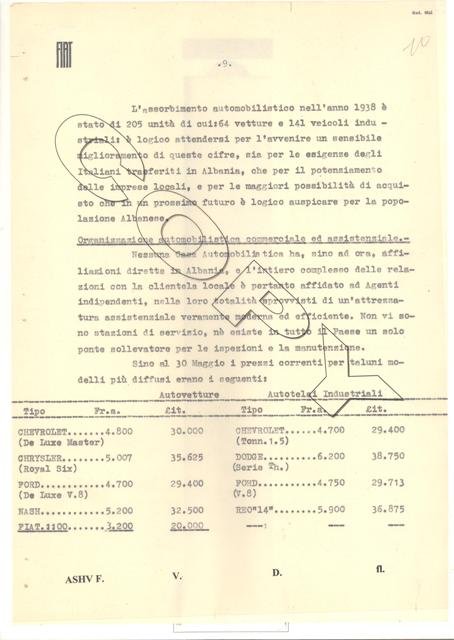
In Albania, up to 1938, there were 404 cars for personal use, 124 buses, and 442 trucks. In 1938 alone, 205 vehicles entered the country, of which 64 were cars and 141 were work vehicles. No vehicle manufacturer had its own concessionaire in the country. Vehicle trade was entrusted to private entrepreneurs, who did not guarantee any safe and reliable repair from the manufacturing company. Workshops were completely lacking, and across the country, there was only one place with a “lift” where you could raise a car. Spare parts were very few, to say the least, almost nonexistent.
The types of cars in the country were: “Chevrolet” passenger car, “De Luxe Master” costing 4,800 francs; “Chrysler” passenger car “Royal Six” costing 5,007 francs; “Ford” passenger car “De Lux V.8” costing 4,700 francs; “NASH” passenger car costing 5,200 francs; and “Fiat” 1100, the cheapest, at 3,200 francs. While there were four truck brands: “Ford V.8” costing 4,750 francs; “Chevrolet” – 1.5 ton costing 4,700 francs; “REO” – 14 costing 5,900 francs; and “Dodge” – TH Series, the most expensive at 6,200 francs. These prices were determined by the market itself; the cars completely met the demands of the Albanian market. Sales were always made in installments from 1 to 2 years.
(To give an example of the value of money, the price of the “Chevrolet” De Luxe Master, costing 4,800 Albanian francs or 30,000 Italian lire of the time, would be about 26,000 euros in today’s value; in 1939, one thousand lire had the present-day value of 870 euros).
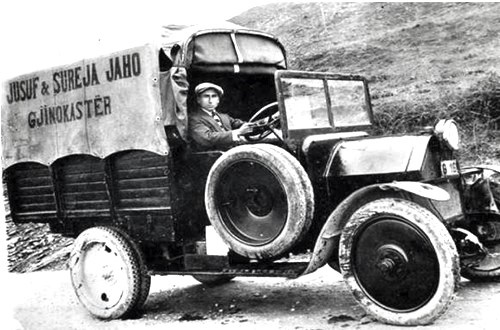
Public service was undisciplined, without precise schedules, tariffs, or stops. There was no transport company; each line was run by private individuals. Buses were mostly of American manufacture and could accommodate from 12 to 30 seats. Travel was very uncomfortable, but at least from the capital, there were daily trips to every major populated center. Taxi service did not exist at all.
Measures proposed by “FIAT”
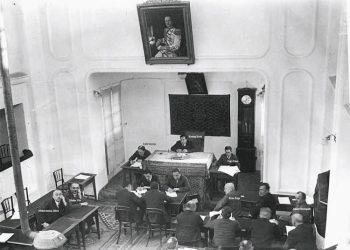
After conducting a detailed examination of the situation, this Italian observation group held a meeting with Francesco Jacomoni, the Viceroy of King Victor Emmanuel in Albania, and other fascist hierarchs. The meeting concluded that measures should be taken to discipline vehicle trade, prices, etc. A central workshop for repairs and assistance needed to be established, and another measure to discipline urban and interurban transport.
Regarding the disciplining and intervention in vehicle trade, it was understood that the opinion that only American-made cars were successful needed to be countered. For this, it was required that European firms, and more precisely “FIAT,” revise their sales prices, at least for the 1100 model (“Millecento”), to compete with American brand prices, even though the Italian firm found it difficult because cars destined for use in Albania required extra reinforcements to cope with circulation on damaged roads.
It was decided to establish a Central Workshop in Tirana that would carry out vehicle repairs. This workshop would also serve as a starting point to open branches in several cities that would carry out the most urgent repairs. If this workshop were opened (the specialists thought), it would undoubtedly become the nucleus of “FIAT’s” presence in Albania. For this reason, it could send one of its senior managers to the country, which could make a detailed report on the needs in the country. This report would be presented to the highest authorities in order to meet those needs.
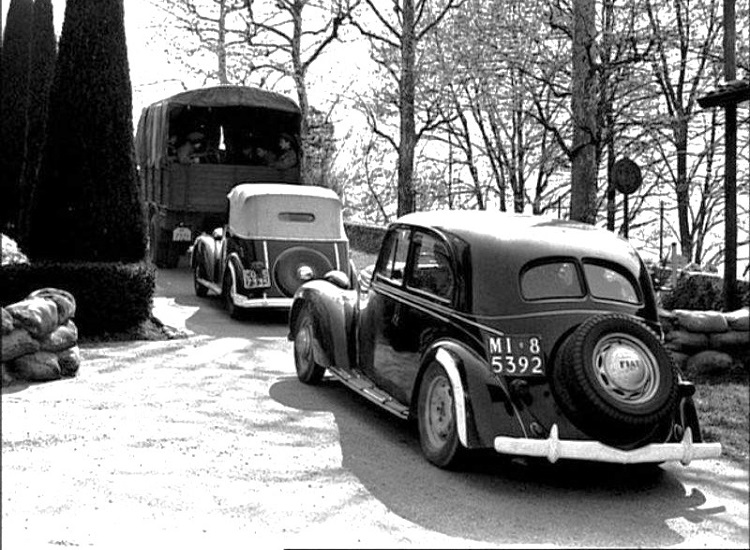
The primary issue for disciplining urban transport was the creation of a transport company. This did not take long, and in Albania, the well-known “Societa Automobilistica Transporti Albanesi,” abbreviated S.A.T.A., was created. The Italian vehicle manufacturing firm “FIAT” could enter the Albanian market with two models of its cars: “Berlina” and “Torpedo” with engine powers of 1100 and 2800. But both these models reinforced in sheet metal and leaf springs.
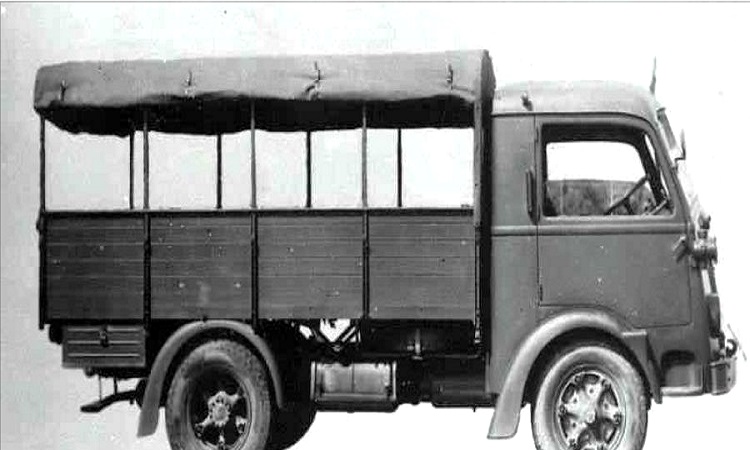
Whereas it could bring three truck models and one bus model. The prices for these vehicles would differ from the price list in Italy; likewise, “FIAT” would guarantee its presence also with spare parts. The transport of vehicles would be undertaken by the firm itself up to the port of Durrës. But this capital burden for the Italian firm was large, so it required that most of it be reimbursed by the State.
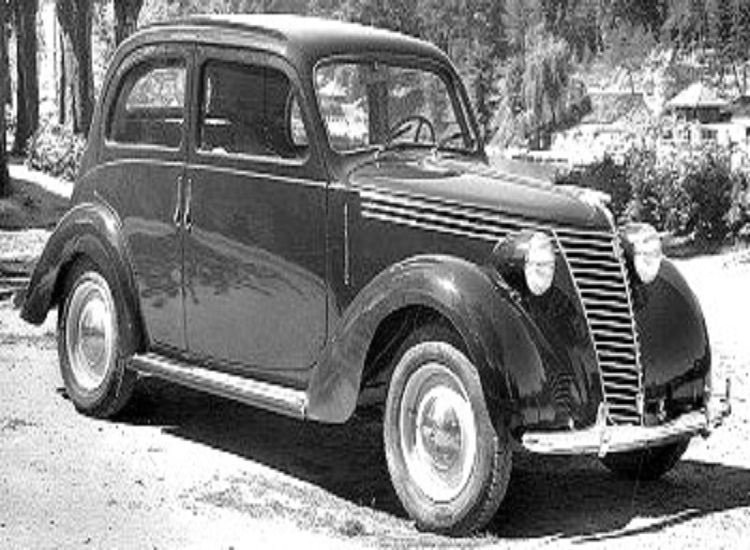
“FIAT” hoped that the car that would succeed in the country would be the 1100 model. This model had all the characteristics for a country like Albania: it was strong, cheap, and easily maneuverable. This model did not need many interventions to adapt to the Albanian environment; also, before 1939, this model had been sold in the country at the same price as in Italy, and with price intervention only for the Albanian market, this model would become more attractive. Certainly, requests for this model had come earlier from Italian citizens residing in Albania.
Cars with greater engine power and chassis, like the 2800 model, were finding use among high-ranking foreign and Albanian officials. This reinforced model was competing with American-made cars. It was very suitable for long-distance travel. The price of this model was expensive, but the firm judged that if there were reimbursement from the Albanian State, it would not be a problem.
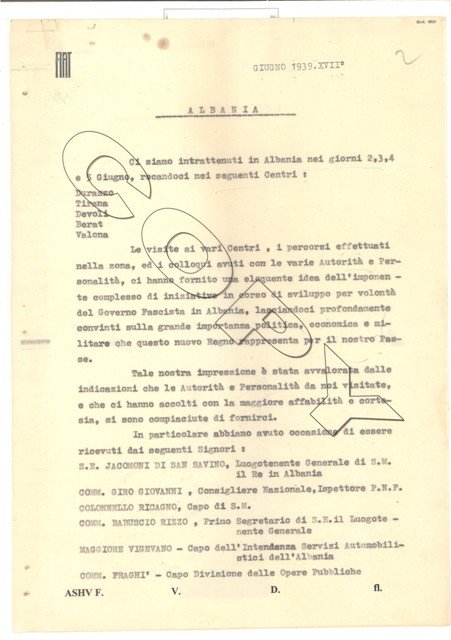
Certainly, if “FIAT” were to invest and bring its models to Albania, it had to be prevented that vehicles sold at a low price here would circulate within the territory of the Empire, because that would be a loss for the firm. As the document shows, it was calculated that the “Fiat Millecento” would be sold for 20,000 lire (with present-day value, somewhere around 17,000 euros).
The “FIAT” firm itself announced after the meeting that it had assigned specialists from one of its commissioners, to be led by an engineer. This group would contact the Albanian authorities to discuss urgent needs that might exist in the country. The firm also requested that normal working conditions be created, good relations with local authorities, and security for people and capital.
As is known to everyone, giant companies like “FIAT” would exploit the conquests of fascist Italy to expand their market. Regarding this interesting document we are publishing, its value lies in the scan it provides of the situation of roads, infrastructure, and car and fuel prices in Albania in 1939. This sector was so primitive that only with the arrival of the fascists, and, of course, for their own interests, were the first mechanics and first specialized drivers formed in Albania.
It is not at all surprising why, for a long time in the country, even after the war, Albanians called the bus line “SATA.” On the other hand, this also explains the fact that to this day, the terminology in vehicle driving manuals, as well as in everyday speech, Italian words are very present, such as kamio (cambio/gear), volanti (steering wheel), indietro (reverse), sotokarti (sottocarta/chassis? or underbody? likely dialectal), kofano (cofano/hood), pulexho (puleggia/pulley), kushineta (cuscino/bearing?), etc., etc./ Memorie.al