
Part One
Koniciana Notebook No. 7 /
Memorie.al /It is known that in the field of cartography, Albanian territories appeared for the first time on Ptolemy’s geographical map in the 2nd century AD, which gives not only the Illyrian territory between Durrës and Tirana, defined by the term “Albanopoli” as a city of the Albanians, but also attests to other Illyrian‑Dardanian settlements. Next comes the Tabula Peutingeriana, 3rd century (in its segment VIII, named “Iliricum” and “Iepirum”), which defines Illyrian‑Albanian lands and territories such as Scodra, Dyrratio, Apollonia, Aulona, and then continues with the map of Al‑Idrisi (1154), reaching the 14th–15th centuries, when Arbëresh and Albanian territories appear under the name “Albania”, including even their main cities, castles, rivers, boundaries, etc. There is no doubt that over the centuries, the proliferation of such maps bearing the term “Albania”, compiled by distinguished European cartographers, wonderfully constitutes a wealth and evidence of the ancient Albanian ethnicity.
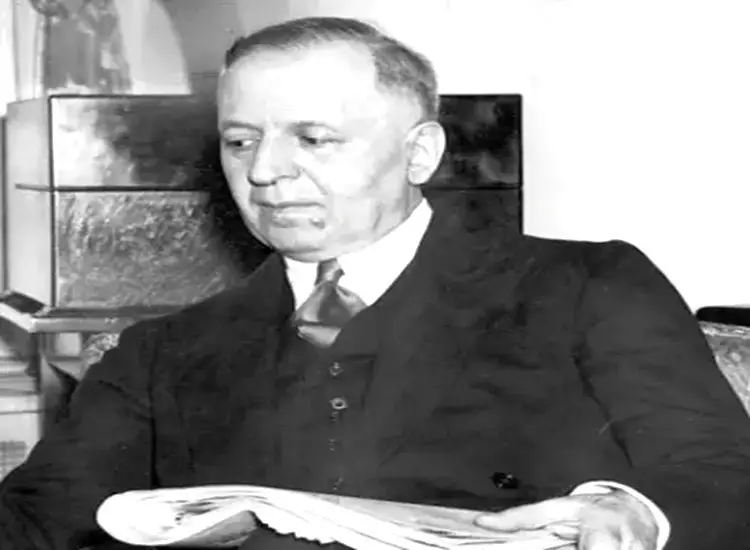
Faik Konica, an early tracker of everything Albanian in the libraries of Europe, is the first Rilindas (Renaissance figure) who became intrigued by and closely interested in the oldest maps reflecting Albania, managing to discover in the British Museum Camotti’s eight maps (Venice, 1571) under the name “Provincia di Albania”.
However, alongside the enthusiasm of his discoveries, he also became somewhat embittered when he noticed, especially during the 19th century, inaccuracies and distortions in toponyms, as well as marked limitations in the content of maps that showed Albania in a fragmented and “superficial” manner (the description is Konica’s own), within the context of southeastern Europe, the Balkan peninsula, or the so‑called “European Turkey”. Moreover, not a single map that fell into his hands was compiled specifically for Albanians, even though they depicted Albanian lands. They were simply intended for foreign audiences.
Nevertheless, he did not stop his research, and before we know it, at the beginning of the 20th century, he established direct working contacts with the great geographer Elisée Reclus, a prominent world figure, author of “Universal Geography” – a work that Konica calls a “monument” – in which he spotted that his own distant ancestor, Ali Pasha Tepelena, is proclaimed the “Restorer of Albania”.
We say that Konica established “working contacts” because the young Albanian genius had the excellent idea of publishing, for the first time, thanks to the Geographical Institute of Brussels, a map of Albania unique in its kind – a map with Albanian toponymic names – which he saw as a historical necessity.
As early as August 1901 (Albania no. 8, 25 August 1901, year V), he publicly announced: “We hope soon to give news of the publication of a large wall map of Albania for use in our schools. The project is under study at the Geographical Institute of Mr. Elisée Reclus. For the moment we are looking for the name of a generous person who will undertake all the expenses.”
In fact, regarding publications at that turn of the 20th century, when many Rilindas were hurrying to print their first books for Albanian schools – poems and patriotic prose to arouse national feeling, when abecedaria and literary books with a mixed alphabet prevailed – Konica aimed even higher with his Albania: he insisted not only on a common alphabet, but first and foremost on a common and unified Albanian language, with a thorough scientific elaboration; he insisted, therefore, on the LITERARY ALBANIAN LANGUAGE that we have today, which originates precisely in his writings – writings that Kristina Jorgaqi has meritoriously collected in a single volume under the title “Faik Konica – Linguistic Thoughts”.
Alongside the publication of his review Albania, which shone among Albanian circles at home and abroad as well as in European intellectual circles, Konica also undertook the publication of several Albanian books of special value – such as “The Life of Kara Mahmud Pasha of Shkodra” (1899) by Nasuf beg Dizdari, “The Life of Mustafa Pasha of Shkodra” (1898) by I.D., “Abecedary of the Albanian Language” (1899), “Calendar of the Mountains” (1899), “History of Albania”, Brussels 1902, “History of Turkey”, London 1902 by Dom Ndoc Nikaj – as well as the printing and distribution of a number of postcards featuring the figure of the National Hero Gjergj Kastrioti under the pencil of his Belgian friend Paul Nocquet.
However, in the midst of this, the publication that he would make of the “Map of Albania” with Albanian terminology would be the crowning achievement of his entire publishing work in the years 1898–1902 and would constitute – and still constitutes – a precious Koniciana ornament, marking a major event for Albanian cartography itself.
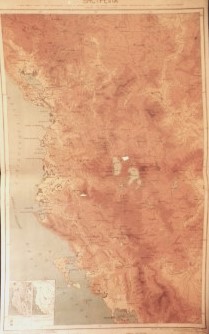
According to the Albanian Encyclopedia (FESH), the history of Albanian cartography “begins” with the map compiled by the distinguished Albanian geographer Ahmet Gashi in 1940. We have no objection, since the Koniciana Albanian map of 1902 was not known and remained for a long time in complete obscurity. Today, now that we possess a digitised copy of this map – fallen and left to sleep in oblivion – we are making it known for the first time to the Albanian public and scholar after 113 years, presenting its essential content and the qualities that characterise it.
We call this the “Koniciana Map” because:
1) The initiative for its compilation and design was undertaken by and solely by Faik Konica;
2) The toponyms, or “nomenclature of the map” as Konica calls it (“nomenclature” – French), are his sole authorship, based on these three sources: a) “My own memory” – he says, i.e., the genius memory of Faik Konica, described by Apollinaire as a “walking encyclopedia”; b) “Using all the books I could” (F.K.) – and Konica’s rich library, which disappeared without a trace, is known and recognised; c) “The excellent Geography of Albania”, published by the Jesuit Fathers of Shkodra;
3) The title, scale, format and print run of the map were determined by Faik Konica for two main purposes: for Albanian schools and for science;
4) The names of rivers, lakes, mountains and localities (small towns – which Konica calls “pshat (fshat) – bourg” in French), as well as the 250 villages included on the map, were determined by Konica with “precise accuracy”, as he himself explicitly puts it;
5) Konica himself did not want his map to have defined physical boundaries, since no natural boundaries existed with neighbouring states and historical parts of Albanian lands had been arbitrarily carved up since the Treaty of Berlin, to the detriment of the Albanian ethnicity and nation;
6) It was Faik Konica’s original idea to add to his map two miniature map insets for the geology and climate of Albania, which Konica calls in Albanian “kartica” (from the French “cartouches”);
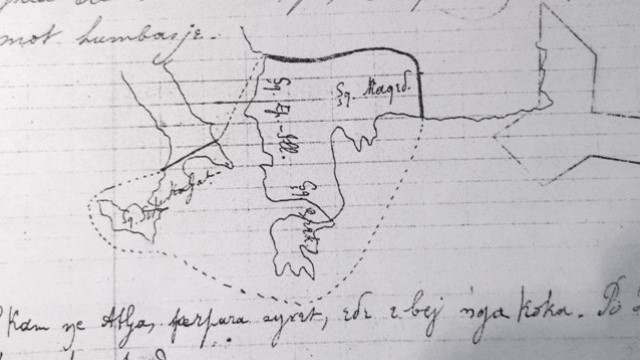
7) Konica himself had, so to speak, a draftsman’s knack for maps, if we consider that as early as 1896 he had sketched on a notebook sheet a map of Pelasgia, in search of the antiquity of the Albanian nation (Letter to N. N. Naços, 20 March 1896 – Central State Archive of Albania).
On the other hand, the simple truth is that Konica speaks more than once about the publication of this map, not only in his correspondence but especially in his Albania, devoting two articles to it – in Albanian and French – unable to contain his fully justified enthusiasm: “It is the first map of our land in Albanian”; it is “a most useful work for schools and useful for science”; “it is a light for our nation”, he emphasises, and exclamatorily, with a powerful exclamation point of joy and happiness, he shows admiration in a single word: “What a map!” (Albania, April‑May 1902, no. 4‑5).
Precisely this enthusiasm of Konica, the very notable event that the publication of the map in 1902 represented, as well as the great importance of finally discovering it in order to thus determine the origin and starting point of Albanian cartography – all these motives prompted us to address a simple message to the Royal Library of Belgium in January 2015, with the aim of being assisted in the research of an “Albanian map” published by the New University of Brussels, mentioning Konica’s European authority and the authority of Prof. Elisée Reclus.
It did not take long; the head of the Maps and Plans Section of that Library, Mr. Fabien Sansterre, replied that in their collections they did indeed have a map of Albania published by the Geographical Institute of the New University, but because the map itself had no descriptive data and no reference, they had encountered difficulties in identifying it, since everything on it was in the Albanian language.
Our uncontrollable joy is understandable when we saw the first clichés sent to us, convinced that we had found exactly what we were looking for. And we began an intense correspondence, in which we convincingly proved that it was the “Koniciana Map”, sending the French document (Konica’s base article in Albania) with the precise data on the format, scale, year and place of publication of the map, the circumstances of its publication, the Konica‑Reclus relationship, and above all by analysing the map itself in detail, in terms of its content and essential characteristics.
We concluded by assuring the staff of the Royal Library of Belgium that they thus possessed a “precious ornament”, a “rare Albanian map” that honoured their institution.
But let us take a closer look at this map:
Its title is given in the Albanian of the time in both dialects: Gheg – Shcypenia, Tosk – Shciperia, but with both dialects merged into a single word where y/i and n/r are given in smaller, broken letters – a symbolic creation, genuinely Konician – specifically in the form: y n Shc‑pe‑ ia i r.
Below the title, in capital letters: E’ para karte é dheut t’one é shtypur / n mé të holla të Lartesise Tij Don Ghinit, Marcés i Aladros é prints i Kastrioteve nga ghaku i te Madhit t’one Skenderbég, Pérendia i faltë jéte te ghate. (Here we notice the “e” which stands for the French “ë”, and also the accented “é” – a characteristic use of these two letters by Konica throughout his Albanian writings in Albania.)
At the bottom of the map, outside its frame, on the right, the publisher and year of publication are given in two languages: Ghithem sim i Ri. Institut Dhêshkrimtar i Bruselit (1902): Université Nouvelle. Institut Géographique de Bruxelles (1902). (Here again Konica’s tendency to Albanianise every foreign scientific term is evident – specifically the words “university” and “geographical”, which he gives in his own Albanian forms “gjithëmësim” and “dhéshkrimtar”.)
Below, in pencil handwriting, where we clearly distinguish Konica’s handwriting, is written: XIV G, Albanie, 1902 “Për lindia” (The Renaissance). This refers to the sponsor of the map, the “National Society”, which Konica called “Për lindia (Rilindja) of the Albanians”. And precisely on the left side of the map, in print, appears both the source or base on which the realisation of the sketch‑idea replied: “Ngrehur mbas punevet t’Institutit dhéshkrimtar ushtarak te Vjenes” (Based on the works of the Military Geographical Institute of Vienna), and the sponsor of the map: “Per Shoqërinë ‘Përlindia e Shcipetarevé’” (For the Society “The Renaissance of the Albanians”).
But all the details of this map – scale 1/500,000, format 1.20m x 0.75m, with five contours (five‑colour level curves) – are given in Konica’s article in French, which we present below, translated for the first time. Nevertheless, its print run remains a question mark, because we have no precise data. However, based on some indirect data from Konica himself in his correspondence, we believe the print run cannot have exceeded 300 copies.
Thus, in December 1908, he says that 150 unsold copies of the map were returned to him in London from America (Works 4, p. 169), when he may have sent about 200 copies there, and may have sold about 100 copies in Europe during the years 1902–1908. The price of the map was 5 francs (“1 florin or 10 groschen inside Albania” – he sets the price), almost as much as a book by a well‑known author cost at that time.
Based on these estimated calculations, the total printing cost of the map cannot have exceeded 1,000 francs – financed, as given in the subtitle, by Prince Aladro Kastrioti, who in fact during the same period (1902‑1903) had also set a prize of 1,000 francs as an annual reward for the best Albanian literary figure.
It was the time when the wealthy Spaniard Juan Pedro Aladro, self‑proclaimed Prince Kastrioti, opened his purse as he aspired to occupy the future throne of Albania and to reign as king of the Albanians.
Nevertheless, the fact is that in August 1912, Konica announced that “The geographical map of Albania is finished. It is a work that all scholars have liked – he continues – and truly no better could be made…” (Works 4, p. 176). Upon its publication (March 1902), he also informed the Austrian Foreign Minister Baron Gulochowski, underlining: “I have at your disposal as many copies as you need. It is not necessary to send me money for this purpose, because although the publication of this map has cost me a great deal of work, I have not incurred the slightest expense” (Works 4, p. 105 – our emphasis). “It has cost me a great deal of work” – says Konica without false modesty, when in fact, just to ascertain the names of Albanian cities and localities, he had to keep linguistic notes, make precise observations and draw the proper conclusions for standardisation.
Thus, in 1898, he was intrigued that Albanian proper names appeared in foreign publications in double form – definite and indefinite: Berat/Berati, Janinë/Janina, etc. “In the most common presentation of the word,” he writes, “the indefinite form is used. However, due to a contradiction that I cannot explain, in books and maps dealing with Albania, compiled by foreign authors, masculine names (Berat, Ulkin, Prizren, Ipek, etc.) are used in their indefinite form, while feminine names (Janina, Dibra, Dschakova) are used in their definite form. To avoid this mistake, we, he continues, will therefore write here, henceforth, Janinë, Dibrë, Dschakovë, etc.” (Albania, B, 15‑31 August 1898). And the fact is that he adhered fanatically to this correct rule that he set himself, not only in his *Albania* but also on the map we are discussing – a rule that continues to this day in Albanian cartography.
When giving the happy news of the map’s publication, in the same issue of Albania, Konica dwells on the use of the words kartë and hartë, specifically in the article “Linguistic Thoughts”. He sets forth his arguments as to why the phrase “kartë dhéshkrimore” (literally “earth‑writing card”) should be used in Albanian instead of the terminology “hartë gjeografike” (geographical map). Because – in his numerous neologisms, in all his analytical linguistic writings, and as the linguist and polyglot he was (knowing and speaking 15 foreign languages) – Konica always took the French language as a basis and model, which he mastered with skill; but he also relied on other Western languages such as German and English, which he called “great and beautiful languages”, thus expressing his absolute tendency and early conviction for the progress of the Albanian nation towards the European West.
Therefore, in this case, he preferred the Albanian use of the word kartë (Fr. Carte and Ger. Landkarte) and not hartë, a term that he saw as derived in this particular case from the Turkish “harita”, “which the Turks use” (dudumët – his disparaging term for Turks), as he puts it. Of course, the master of languages, who would write in 1904 the great book at European level “Essay on Natural and Artificial Languages”, knew the origin of the word hartë from the Latin charte (sheet of paper – card). But he could not stomach that Turkish “harita” for the word hartë in Albanian. / Memorie.al