From Bashkim Trenova
Part Thirty
– NAZIBOLSHEVISM – LITERATURE AND THE ARTS –
FOREWORD
Memorie.al / Historians, political philosophers, intellectuals from different schools or positions have dedicated thousands and thousands of pages, entire volumes, studies and articles to the comparison between Nazism and Communism. Generally, their publications and studies focus on the police control of society by these dictatorships, the role of the dictatorial state hierarchy and the head of state as suppressors of free thought, the omnipresent role of official propaganda in society, the mass massacres and the network of concentration camps, the activities of the police – the NKVD in the USSR (later the KGB) and the Gestapo in the Third Reich. In his book *Le Passé d’une illusion* (The Past of an Illusion), François Furet notes that Nazism and Communism share the same opposition to liberal democracy and what they call “capitalist bourgeoisie.” Both ideologies claim to be socialist and use the image of socialism. Communist countries called themselves “socialist.” “Nazism” is a shortening of National Socialism.
Continued from the previous issue
PAINTING AND SCULPTURE
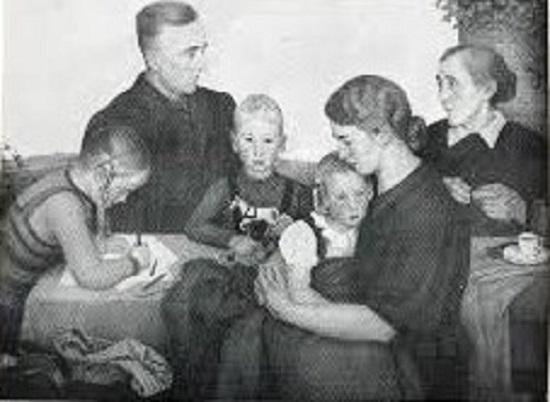
In the painting Kahlenberger Bauernfamilie (Kahlenberg Peasant Family), all the characters have white eyes as well as white hair. The boy sitting on his father’s knees focuses his gaze on the viewer of the painting, as if seeking to remind him that he embodies the future of the German race, that he will bear the family responsibilities if the father dies. The grandmother’s gaze directed at the boy shows that she too understands the great responsibilities that will fall upon this young man, a symbol of the continuity of traditions linked to blood and soil. The three children reflect the importance given at that time to the renewal of the Aryan race.
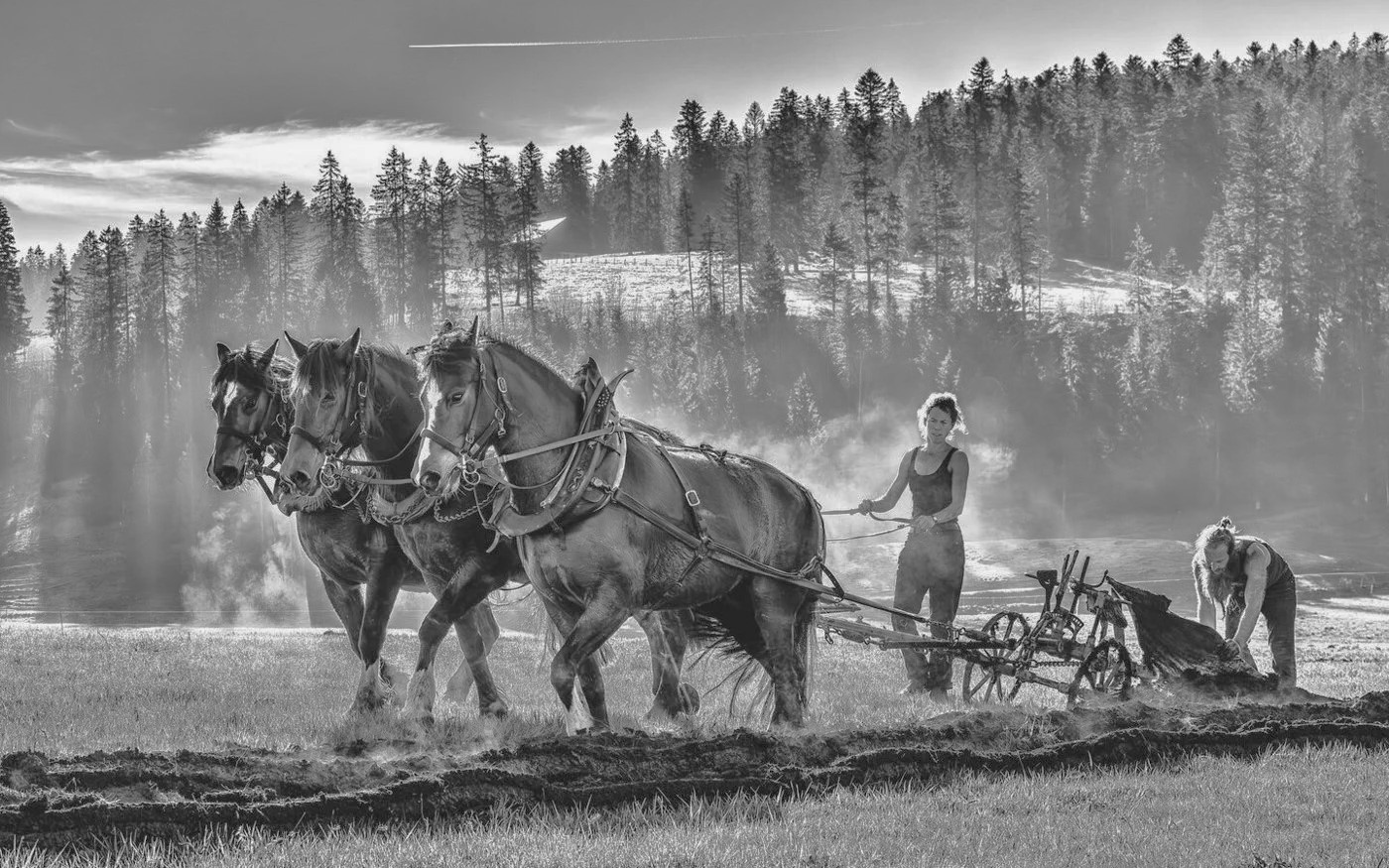
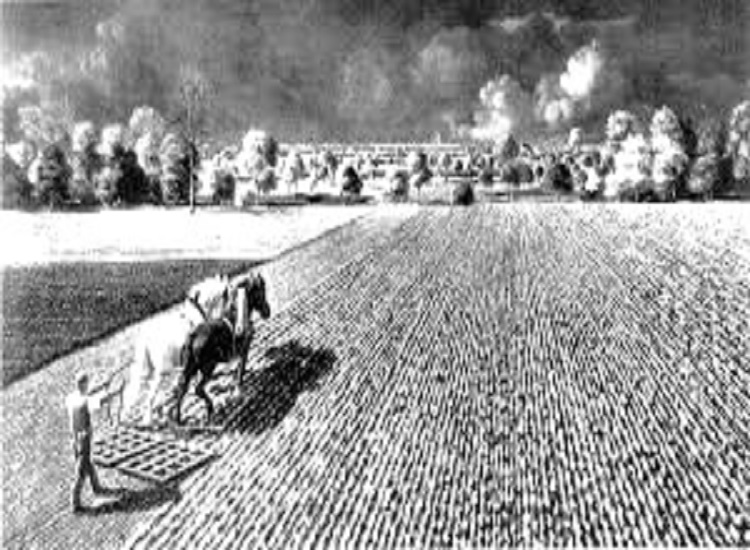
The peasant world and, through it, the connection with the land, are placed on a pedestal of honour in Nazi painting. For Nazi art, the production of images that address the family or the basic cell of the construction of the new Germany is important. Peasantry is naturally linked by the Nazis to the notion of work. The peasant is a symbol that simultaneously represents work and the connection to the land, a guarantee for the “continuity of life.” This notion, so dear to the Nazis, is perfectly presented by Julius Paul Junghanns in the painting Bergbauer beim Pflügen (Mountain Peasant Ploughing). Werner Peiner, in his painting Deutsche Erde (German Earth), 1933, continues in this tradition, adding the dimension of space or Lebensraum (living space). In both paintings, the field symbolises a space that must be won, as well as the wealth and importance of an untouched territory.
Painting is also linked to industry, to the working world, which Hitler flattered greatly at the beginning of his political career. Thus, the industrial proletariat could not be absent from Nazi painting. One can mention Wir sind die Werksoldaten (We are the Factory Soldiers) from 1939, by Ferdinand Staeger. In this painting, the individual is lost in favour of the collective. “Soldiers” of the industrial front are seen. One only needs to replace picks and shovels with rifles and grenades to understand the meaning of this regiment of workers, which manages to maintain its ranks even when it has to climb a fairly steep slope.
This force of discipline is also present in the painting by Arthur Kampf, 1939, titled Das Walzwerk (The Rolling Mill). Here too, the worker loses his individuality and lives only to perform the work. The painting emphasises heroism in work, so that the visitor is not repelled, does not see the hard working conditions, the traces of suffering and misery resulting from them. As Eric Michaud has emphasised, “The ideal aimed for by the National Socialist cult of work was that of a total absorption of workers into the Productive Work, in the name of the Community.”
Hitler considered him competent in all fields of art. He declared: “If Germany had not lost the war, I would not have become a politician, but a great architect, something like a Michelangelo.” “Something like a Michelangelo” – i.e., not only a genius of painting, of frescoes, but also of sculpture! Nazi sculpture also seeks to demonstrate the superiority and manliness of the Aryan race, the ideal man belonging to this race, stripped of any sentiment. Men are presented naked, extremely muscular, physically perfect, and unreal. The German man in sculpture is a kind of abstract symbol of beauty, which neither loves nor is loved.
As a rule, he is presented as harsh, angry, and strong-willed, a kind of saviour who puts an end to chaos, to the lack of order. These are the same traits attributed to Adolf Hitler. As for women, or the female in general, she is often presented clothed and as a kind of national symbol. In cases where she is naked, this is done to fully expose her character as a mother. So, in the case of women, it is not the muscles that stand out, but the form and expression of a strong, reproductive mother, a mother who simply and happily cares for her home.
Sculpture is undoubtedly one of the most characteristic forms of art being flooded by propaganda. Especially valued by Hitler, it knows a considerable number of authors, who hasten to set in marble or bronze Nazi ideas, as well as his figure, in the style of Roman consuls and emperors. An issue of the magazine Die Kunst im Dritten Reich (Art in the Third Reich) from 1939 gives some figures that speak to the role of sculpture in Nazi Germany. According to this magazine, in 1937, 200 statues were erected in Germany; a year later, 380; and in 1939, another 680 were erected. 265 sculptors worked on their creation.
The Nazis paid special attention to the erection of monumental works. One of the first constructions of this kind is the monument erected in Munich, in Königsplatz, in glory of the members of the Nazi Party who died before the Hitlerites took power. Monuments dedicated to the period of World War I, to the glory of all infantry, submarine, etc. branches, were erected in almost all of Germany. One can also mention the project to build a giant monument in Berlin dedicated to the soldiers who fell in World War I, where a large space is reserved for the “heroes of the present time.” Even in sculpture, the Nazis and the artists in their service seek to revive the heroic and mystical Germanic spirit and place it on the tracks of National Socialist ideology.
Heroism and war are essential themes of sculpture, just as they are for all Nazi art. Among the best-known authors of monumental sculpture in Nazi Germany are Arno Breker and Josef Thorak. Breker admired Hitler. He dedicated a bust to him. Hitler also admired Breker and considered him one of the artistic geniuses of the Third Reich. Hitler described Breker’s work as “powerful and full of will.” Hitler and Breker also had personal relationships. On 23 June 1940, Breker accompanied the Nazi leader to Paris. Arno Breker also had connections with other great figures of the Third Reich, such as Goebbels and Speer. He dedicated busts to them and to Göring’s daughter.
Arno Breker was an artist supported by the Nazi regime. Breker’s name is also found on the “Gottbegnadeten” list, i.e., the list of artists considered by the Nazis to be divinely talented. Breker’s neoclassical works correspond to the military aesthetics of this regime, which found in his work the aesthetic canons of the Third Reich concerning the strong Aryan man. The Nazi regime asked Breker to realise many monumental works. In 1936, on the occasion of the Berlin Olympic Games, he created two sculptures: Zehnkämpfer (Decathlete) and Die Siegerin (The Victorious Woman). In 1937, Breker became a member of the Nazi Party and was appointed by Hitler as “official sculptor of the state.” During the same year, he was given a large property and a studio with forty-three assistants, specialists, and workers.
Many French, Italians and Soviets also did forced labour for him. To realise his gigantic program of monumental sculptures, Speer and Hitler created special working conditions for Breker and placed colossal resources at his disposal, including cranes and a railway line with locomotive and wagons, as well as a port on the Oder. Adolf Hitler would ask Arno Breker to realise the sculptures Die Partei (The Party) and Die Wehrmacht (The Armed Forces). These two colossal sculptures, made entirely of bronze, with a height of 3.50 metres, would be worked on between 1938 and 1939. These works are perhaps Breker’s best known, created during the Third Reich period. They convey a strong ideological and symbolic message.
They occupied a place of honour at the entrance of the new Reich Chancellery, Adolf Hitler’s official residence from 1938 to 1945. His name became almost synonymous with the art of the Third Reich. No other artist of the time held such an important political-cultural position or received so many important commissions. Arno Breker would continue to honour Hitler’s orders until the end of World War II. Throughout this time, he worked in several studios creating in bronze heroes who manifest strength in unbelievable dimensions, the triumphant body of man, and an imperialist and totalitarian expression. Breker’s work is permeated by a strong contrast between light and dark elements as well as by a dramatic tension that appears in the musculature of his characters.
In 1940, he would work, in the same style, in complete accordance with Nazi ideology, on Der Wächter (The Guardian), a bas-relief appreciated by Adolf Hitler. This work was created to be placed in the new capital of the Reich, Germania, which Hitler wanted to build after the war. In 1941, Breker created the dramatic sculpture Kameraden (Comrades), which presents a standing man, defiant in his expression, with a severely wounded comrade lying unconscious in his friend’s arms. The sculpture was commissioned by Albert Speer in 1940.
In a general overview, it can be said that Breker, described by the local press of the time as “the Michelangelo of the Third Reich,” produced a number of sculptures that hymn the regime. The plastic representations of the human body, in a special way by Breker, are linked to the presence of a spiritual demand that, according to Nazi ideologues, acts from the “deutsche innerlichkeit” (German inwardness) and appears in the human body through its peculiarity and “beauty.”
This peculiarity, or this special “beauty,” is presented by Nazi ideologues as an inner demand of a man who pursues an ideal and surpasses himself, a man who makes this transition heroically, by self-sacrifice. Breker creates the new German monumental style. The neoclassical nature of his work, the aforementioned sculptures, but also others such as Der Rächer (The Avenger), Opfer (Sacrifice), Der Wächter (The Guardian), etc., represent Nazi ideals, are part of Nazi propaganda, and echo it. Propaganda also echoes his creativity. The Kulturfilm-Institut (Institute for Cultural Film) and the German media in general had the duty to echo the artists of the time, the grandeur of Nazi culture. Regarding Breker’s creativity, its presentation and distribution, Nazi propaganda engaged its entire range.
This is because his sculptures served to indoctrinate the population with the so-called German virtues of bravery, courage, etc. He was presented by propaganda as a dedicated artist with extraordinary abilities, as the artist who created the heroic models of the National Socialist regime. Josef Thorak is another sculptor among the most important and most valued by the Nazis. After Arno Breker, he is the second “official sculptor” of the Third Reich. He is part of the Sonderliste (Special List) of the Gottbegnadeten-Liste (God-gifted list). Hitler himself called him a saint and placed him alongside Arno Breker on the special list of “indispensable artists” in the field of sculpture.
Thorak worked on the realisation of busts of historical figures such as the King of Prussia, Frederick the Great, and Chancellor Otto von Bismarck, who united the German principalities and created the German state in 1871. He is also known for creating, in 1922, Der sterbende Krieger (The Dying Warrior), a sculpture dedicated to those killed during World War I in Stolpmünde, today Ustka in Northwestern Poland. Josef Thorak also created, with motifs from World War I, in the same year, Thüringisches Husaren Regiment (Thuringian Hussar Regiment). The choice of this theme testifies to his political orientation, before and after the Nazis came to power, as well as to their sympathy for this artist and the support they gave him.
Especially from the mid-1930s, the work of Josef Thorak was clearly under the influence of the Nazi Party. His art is dedicated to the purity, strength and superiority of the Aryan race. The naked, muscular bodies of his sculptures, in the neoclassical style, are part of this logic. They are exhibited as the opposite of the “degenerate” bodies belonging to non-Germanic races and fully meet the aesthetic demands of the National Socialist leaders, who used Thorak’s creations for public propaganda in Germany and abroad.
The art of the Third Reich had to testify to the path of aesthetic perfection of the Nordic race. The nude sculptures of Breker and Thorak, the busts, profiles, thighs, buttocks and other body parts that presented the perfect type of the race, were exhibited to be admired, but also to be emulated. These sculptural models were quite present in public places, in exhibitions, in cinema halls, to influence, for each to test within him the purity of the race, to nourish in each, especially among the youth, the dream of being immortalised in a “marble statue.” The Nazi fantasy of a perfect body or bodily form is linked to the equally fantastic idea of Nazism, the production of a race whose beauty would also speak of its superiority.
The busts created by Thorak in 1933–1934 best show the political orientation of his work. In the summer of 1933, his model was the propaganda minister Joseph Goebbels. In 1934, he created the portrait of his friend Ernst “Putzi” Hanfstaengl, who had participated, in November 1923, in Adolf Hitler’s failed military putsch. He also created a bust of Benito Mussolini. In 1940, Hitler gave this bust to the Italian fascist dictator. Thorak sympathised with Hitler, and he did not spare public praise for him in an interview given to the Völkischer Observer. Thorak also entered into a personal relationship with him. Invited by the Nazi dictator in the spring of 1936 to spend many days together in Obersalzberg,
Thorak worked on the realisation of his bust. In 1942, he worked on the marble bust of Hitler. Throughout his career, Thorak created several busts of the Nazi leader. Thorak is also the author of the massive sculpture Boxer (Boxer), created for the stadium of the 1936 Olympic Games held in Berlin. He is also the author of the sculptural group Göttin des Sieges (Goddess of Victory), which was placed on the route that took the delegates of the Nuremberg Congress of the Nazi Party to the hall of that Congress. In 1937, he created Kameradschaft (Comradeship) and Die Familie (The Family) for the Paris Universal Exposition. These two sculptures won the Grand Prize of the International Jury. They were placed at the entrance of the German pavilion.
Kameradschaft exhibits two giant naked men, posing a racial comradeship, shaking hands and, standing side by side, defying danger. Both sculptures, 7 metres high, express confidence, pride, “purity” and discipline – in other words, the “new Germany.” Over ten thousand tons of steel and stone, necessary for the construction of the German pavilion, were transported by more than a thousand trucks from Berlin. According to Nazi logic, this pavilion had to be built “starting from the sacred German soil” and “only with Germanic iron and stone.”
Joseph Goebbels, after seeing Kameradschaft and Die Familie in Thorak’s studio, i.e., before their dispatch to the Paris Universal Exposition, wrote in his diary: “Very grand and monumental. Thorak is our greatest plastic talent. He must be given commissions.” During the Third Reich, Thorak received many commissions. In 1939, he created Schreitende Pferde (Strutting Horses) for Adolf Hitler’s New Reich Chancellery in Berlin. In 1940, he created Frauenakt (Female Nude), which was bought by Hitler. In 1941, he created Danziger Freiheitsdenkmal (Danzing Freedom Monument) and, the following year, the sculpture Mutter mit Kind (Mother with Child). This sculpture, as an idea, is a sort of imitation of those created over centuries depicting Saint Mary with the baby Jesus in her arms – i.e., the devotion and love of the mother, the sacred duty of the mother-woman.
A good part of his statues exceed 10 metres in height. Some even reach 20 metres. In this way, the “grandeur of the Nazi ideal” was expressed. Hitler valued Thorak’s work. By order of the Nazi dictator, during the years 1938–1941, a giant studio was built in Baldham, near Munich, which was placed at his disposal for the creation of further monumental statues. According to his request, to work in this studio, the sculptor was also provided with dozens of French, Italians, etc., imprisoned in the Dachau concentration camp.
The sculptor Willy Meller also treated in his work the National Socialist idea of the superior race; Herrenmensch (Master man). Meller received the highest esteem that a sculptor could have during the Third Reich. This is also evident from the state commission given to him for the realisation of two works for the Berlin Olympic Stadium. His most famous work is Fackelträger (Torchbearer). In this statue, Christian and Greek symbolism as well as the pagan idea of light is clearly felt. The author refers to Prometheus, who brings fire to humanity. He treats the symbolism of light, very present in Nazi ideology, completely for political purposes. The fire symbolises the rebirth of the nation in Nazi Germany. Fackelträger is especially directed at the youth and reminds them of their oath: “You are torchbearers of the nation. You carry the light of thought in your struggle for Adolf Hitler.”
Fackelträger expresses a kind of unification between the Aryan and Nazism, expresses the ideal image of the “German,” who has not yet been created but is being created by being kneaded with the Nazi ideas of the German “Jesus” – in other words, the saviour of the German people and the whole world, Adolf Hitler. Fritz Graevenitz is another sculptor of the time who placed his art in the service of the deadly politics of German National Socialism. As he himself declared: “In the past, the artist was isolated and very often inclined to get lost in experiences stripped of any meaning for the people as a whole, but the cultural duties of the Third Reich demanded the inclusion of all artistic forces in the national community.”
In this “community,” he also ranked, hymning Hitler and war in his work. For his services, Hitler, in the final phase of World War II, in August 1944, included him in the Sacred List of the most important visual artists. One of Von Graevenitz’s first works after the Nazis came to power was the realisation of a bronze bust of Hitler. In 1935, he participated in the German Nazi Party Congress in Nuremberg. Seated next to Hitler, Graevenitz used the opportunity to study the Nazi leader’s head for several hours. He himself would later write that the impressions he had during these hours would serve as the basis for making the bust of Hitler. After 1935, Graevenitz also made busts of other Nazi leaders.
During his years of work as a Nazi sculptor, he created a large number of statues of Wehrmacht soldiers as well as several giant imperial eagles with swastikas. Before, but also later, he worked on a series of monuments dedicated to World War I, the bravery and heroism of German soldiers in that war, the fatherland, etc. This dominant line in his work is in complete accordance with the Nazi spirit and aesthetics for the arts in general, including sculpture. It directly influences the spiritual preparation of the people for a new war, in the name of the humiliated fatherland, which must be reborn, which has the strength and historical conditions for this rebirth. / Memorie.al
To be continued in the next issue