
By Zylyftar Hoxha
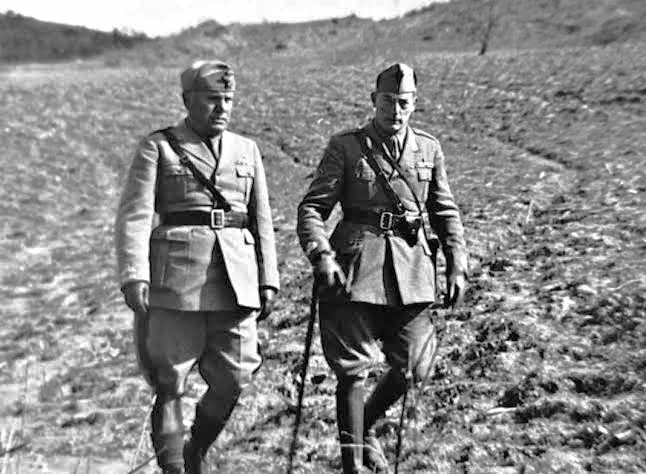
Memorie.al / Nearly two years after the occupation of Albania, Benito Mussolini (the Duce) set foot in our country for the first time. The purpose of this incognito visit, kept extremely secret, was not Albania, but the Italo-Greek front, where matters were going from bad to worse. His sudden arrival was meant to raise the morale, which had hit rock bottom, of the fascist troops, who were suffering defeat after defeat at the hands of the Greeks. The news of the Duce’s visit to Albania was made public on May 10, 1941, nearly a month and a half after he had returned to Rome. In his honor and in honor of those fallen in battle, a giant memorial was later erected on the heights of Tërpan in Berat, but unfortunately, it was demolished due to the mentality of the time.
Likewise, a beautiful memorial, which also suffered the same fate as the first, was located in the Italian soldiers’ cemetery in Uznova, Berat. The Duce stayed in Albania for 18 days, visiting the entire front line of combat.
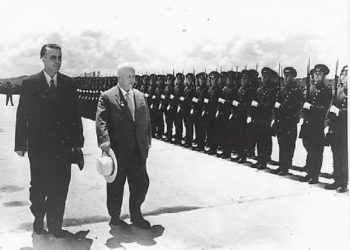
According to a diary of the Supreme Command of the Armed Forces of Albania, it is learned that Mussolini, having set out from Bari, arrived at Tirana airport on March 2, 1941, at 10:05 AM. There he was received by General Cavallero, the Viceroy General Jacomoni, and General Ranza.
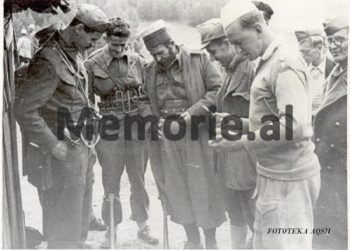
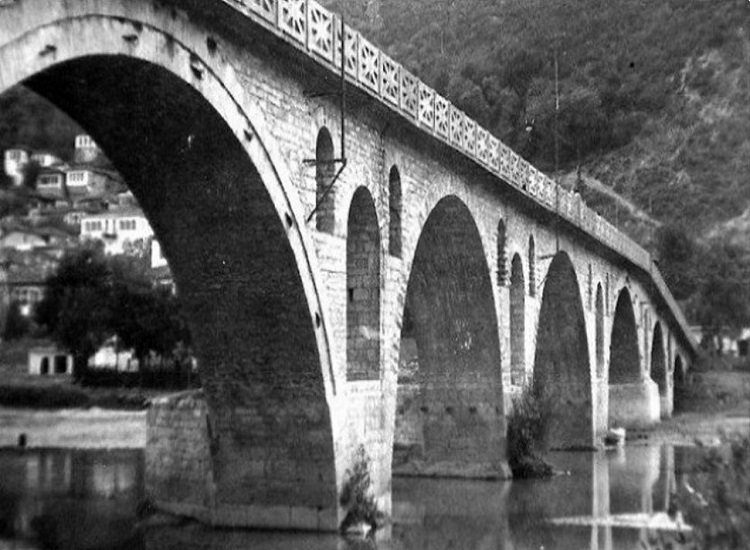
Without stopping at all in Tirana, and only briefly in Ndroq, where the command of the Bersaglieri of the First Regiment “Italia” was located, he immediately set off towards Rehova in Berat. In Berat, he was forced to temporarily stay among the soldiers of the “Bari” division, which was deployed on both sides of the Goricë Bridge, due to the bombings that the Allies were carrying out in the city.
After this short break, at midday he found himself in Rehova, where he tried to give courage to the officers gathered there. At 15:00, he set off from Rehova and, along the road to Fier, reviewed the “Siena” division. He spent the night in a unit stationed on the outskirts of the city of Vlorë.
On March 3, the Duce set off towards Dhëmblan and Tërpan, reviewing the “Lupi di Toscana” regiment, the 67th Infantry Regiment of the “Legnano” division, and also participating in a religious mass for officers in Dhëmblan. In the evening, he returned to position 22 on the outskirts of Vlorë, which in a way became his residence during the days of his stay in Albania.
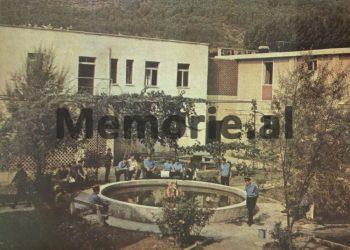
On March 4, Mussolini set off for Berat; on a packed day, he met with the “Blackshirts” who were marching towards the city and with detachments of the “Bari” division, stopped at Military Hospital No. 482, and then had breakfast with the workers who were repairing the road to Ujë i Zi.
In Rehova, he had a long conversation with the generals of the commands of the IV and VIII Army Corps, and of the “Pinerolo”, “Gagliari”, “Puglie”, “Bari”, “Centauro” divisions, etc. In the evening, he returned to his base in Vlorë.
On March 5, Mussolini went to the Devoll area, where he visited Albanian “volunteers,” returned to Kuçovë, where he had lunch at the headquarters of AIPA (the Italian Albanian Petroleum Company). He went again to Berat, showed interest in the wounded, and after reviewing the “Lancieri di Milano,” he returned to position 22, near Vlorë.
On March 6, the Duce went to Dhërmi, where he visited the military hospital, returned to Llogara, where he stayed at the naval observatory, then visited the hospital center of Dukat and reviewed the XVIII Infantry Regiment “Acqui”; he did the same in Shushicë with the XV Legion of the “Blackshirts” from Brescia, and in Brataj with the 77th Infantry “Lupi.” On his way back to his residence, he attended exercises by the “Arditi” in the afternoon and visited Hospital No. 118.
On March 7, at 10:00 AM, Mussolini met with a delegation of villagers, to whom he donated a school, laying its foundation stone. He spent the night at another base, in position no. 34, near Berat. On March 8, he went again to Rehova for a routine of meetings with officers and soldiers and slept again in position no. 34.
On March 9, he observed combat operations, spending the entire day in the trenches. He did the same on March 10 and 11. On March 12, Mussolini, accompanied by General Priçolo, went to Elbasan, where he spoke with the commander of the IX Army, General Pirzio Biroli. At 19:45, he returned to his previous position in Vlorë.
On the 13th, 14th, and 15th, there is nothing noteworthy to record, and apparently his visit had come to an end; he spent the entire day at the observatory and shared bread with the soldiers. On March 16, in the morning and afternoon, Mussolini received his generals. On March 17, he passed through Elbasan once more. On March 18, he went to Gramsh, inaugurated the bridge over the Devoll, and visited the hospital in Llixha.
On March 19, the Duce showed interest in defensive fortifications and roads. On March 20, he visited the hospitals of Krasta and went as far as Lake Ohrid; on his return, he listened to reports from the generals. On March 21, the fascist prime minister returned to Rome, dissatisfied and disheartened by what he had seen at the front. The toll of the Italo-Greek War was extremely tragic, but it is interesting that the figures are more or less balanced. / Memorie.al
Italy Greece
Killed 13,755 13,408
Wounded 50,874 42,485
Sick / III 52,108 10,000