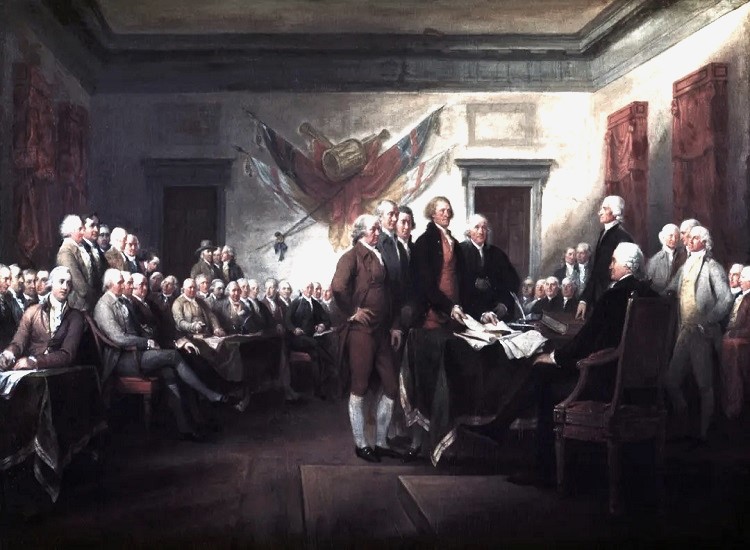




Memorie.al / Even though a full 250 years have passed since the Declaration of Independence of the U.S.A., the echo of the thirty-gun salute is still heard with pride, not only in the ears of the American people. The statesmen of the first great republic, led by the planter George Washington, after melting down the statue of the King of England and turning it into bullets with which they struck the soldiers of the English regiments, leading to the peace treaty of 1783, turned all their energies to building the state according to the principles of Baron Montesquieu, the three-branch structure of government: executive, legislative, and judicial, which could check and balance each other.
The passing of time proved the justice of what were called human rights, so much so that after World War II, the basic charter of the U.N. also made them its own, and the U.S.A. themselves not only remained the vanguard of the freedoms and democratic rights of peoples but also won the respect of the majority of civilized countries. On this basis, after the fall of the communist totalitarian regime in Albania, the friendly relations between our two peoples and countries were also built.
Around the end of the forties, when the Albanian government, within the framework of the madness that had overtaken it, expelled the American diplomatic mission, the head of this mission, Mr. Jacobs, a clever and very serious man, after putting his arm around our writer and patriot Petro Marko, who was accompanying him to the airport, whispered a few impressive words to him in intimacy: “We are leaving…! I see that we will meet here as enemies. But I want to tell you only this: You may curse Roosevelt, Eisenhower, and others, me, and all American authorities, but never the glorious flag of America. You have humiliated it. America will never, ever forget this.”
On September 11, 1991, our immortal writer Ismail Kadare, from Paris, where in a certain sense he had become the mirror of our national conscience and aspirations, addressed a letter to George Bush, in which he wrote: “Mr. President of the U.S.A.! I think it is inadmissible and contrary to all the laws of nature, of universal law, and of God, for this nation to continue to be condemned thus. The gift you made to the Serbian terrorists who killed Archduke Ferdinand of Austria-Hungary in 1914 in Sarajevo, giving them half of Albania as a reward, is one of the gravest crimes in human history. The sooner the civilized world frees itself from this crime, the better it will be.”
Naturally, the question arises: Why did our people, exhausted by the raging waves of fate, disappointed to the point of distrust, orient themselves in their subconscious towards that country about which for entire decades they had heard curses, slanders, and monstrous insults, and awaited the solution of the national question from that which they had systematically been trying to convince them was the international gendarme, the paper tiger, and the sandcastle? But just as naturally, the answer also comes: Peoples stand above the wickedness and depravities of their rulers; they, with a sharp and always infallible intuition, find the truth.
That is why our people quickly understood that America had long ago made its own the lapidary saying of the Virginia lawyer Thomas Jefferson, the framer of the Declaration of Independence: “Equal rights for all, special privileges for none,” and that this union of states, which some call the planet, was governed, at least since July 1776, by men who based the art of governance on the art of being honest and who understood the greatness of their country, as Wilson said, in the greatness of ordinary people.
When Plato codified the principles of his republic, he did not have America in mind at all, as it had not yet been discovered, but if he were alive today, he would proudly say: This is exactly how I envisioned it. When a friend of mine returned from America and repeated to me the modest assertion of an acquaintance of his there, that the U.S.A. has everything except history, I remembered a wise saying that “Time is measured not by length, but by depth.”
Perhaps this is exactly what two renowned history professors at George Washington University and Columbia University meant when they began their book with these words: “In the early 1600s, a stream of immigrants from Europe came and poured onto the shores of North America. (This refers to those who boarded the three ships that dropped anchor in Chesapeake Bay in 1607 – author’s note). It flowed for more than three centuries. It began as a thin trickle of a few hundred English colonists, but over time it turned into a true river… Driven by different but deeply determined purposes, they built a completely new civilization on a continent that was until then wild.” Having become within such a short time the most consolidated, most powerful, and most prosperous state, remaining the envy and point of reference for others, the example to be followed by everyone, and a global haven, whose motto is Grant’s expression that: “Work does not disgrace a man, but there are men who disgrace work,” America has the most glorious history and can rightfully be proud of it.
The author of “Common Sense,” T. Paine, who did so much for America and beyond, fortunately saw his prophecy come true: “Never has the sun shone upon a cause of greater importance. It is not the affair of a city, a region, a province, or a kingdom, but of a continent…! It is not the affair of a day, a year, or an epoch; future humanity also takes part in this struggle, upon which today’s events will influence more or less equally as long as life exists. Now is the time to sow continental union, faith, and honor. The slightest crack today will remain like the carving of a name on the soft bark of a young oak; this carving will grow together with the tree, and descendants will read that name in fully enlarged letters…: ‘Peoples coming from all four corners of the globe, converging in the most diverse forms, united firmly and committed themselves to the principles of democracy, economic opportunity, religious freedom, and the rule of law,'” write the authors Tindall and Shi. But it should not be forgotten that for the American citizen, freedom has the same meaning that it had for Bern when he said, “There is no man who does not love freedom, but the righteous man seeks it for everyone, while the unrighteous seeks it only for him.” Likewise, they give to peace – the virtue of civilization, as Hugo calls it – the same meaning that R. Rolland gives it: “True peace requires, first of all, the removal of the lords of war.”
And that is why, as soon as we turned our eyes toward the U.S.A., in difficult days for us, the encouraging brotherly message of President Clinton came: “You are neither forgotten nor abandoned.” Then, subsequently, stating, as he himself said, that “The cemeteries of the Balkans are full, with the broken promises of President Milosevic,” he had the manliness to take upon himself historical responsibility, giving the resolute command “Fire!”
We Albanians knew very well that this was not at all easy, as experience had taught us that war is not a hunting walk of slow hunters through the forest. And after the contribution given by the sons and daughters of Dardania themselves, with weapons in hand and with shed blood, here it is today, free and peaceful. And here the Kosovars are building their own future.
And here we come and go, as the truth is, whenever we want to one another, to become one within the framework of the European Union. We Albanians had the chance to prove for ourselves the seriousness of the statement: “As the world was preparing to enter the new millennium, the question facing the community of states that share common and sacred values for democracy and freedom was whether there would be coexistence with the philosophy of the domination of hatred and the oppression of one nation by another nation,” a statement which elevated to great heights the true essence of the psychology of American politics, which ultimately has its roots precisely in that bright day of 1776 when the phrase was enshrined: “We hold these truths to be self-evident. All men are created equal.” It is fortunate that even today, with the forty-eighth president, the honorable Donald Tramp; the U.S.A. remains faithful to the principle declared not so long ago, that the world needs peace and not wars. This is also the reason that explains this great state’s interest in achieving democracy and stability in the Balkans and, naturally, also in our country. This also justifies this strategic ally’s concern for carrying out quality reforms in Albania, where there should be no corruption that erodes and no injustice that brings discontent among the people.
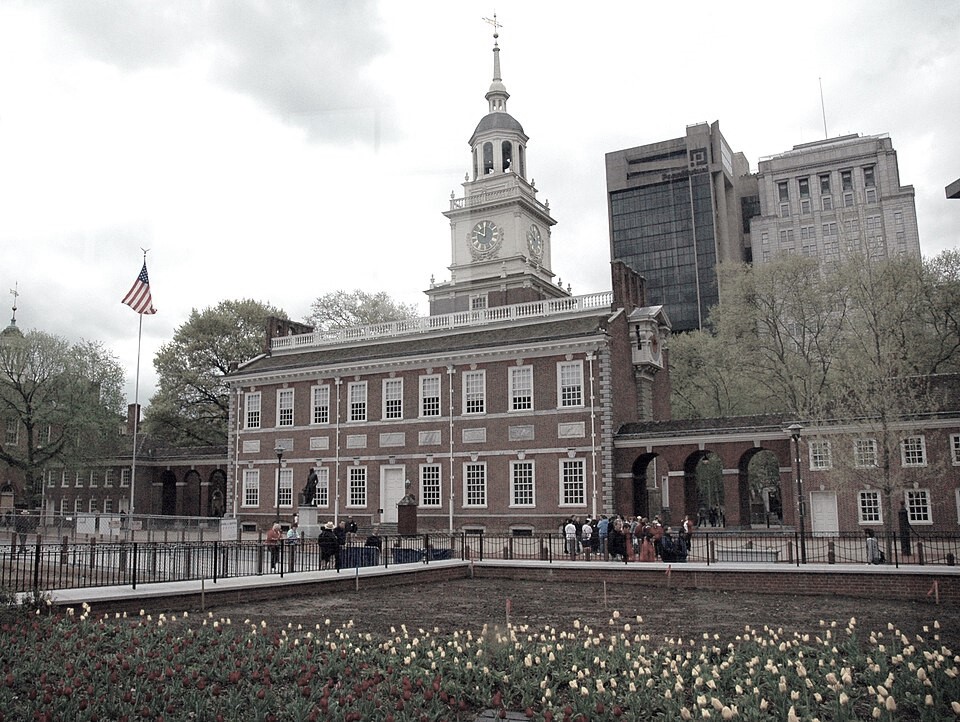
This is why the words spoken by Mr. Jacobs at the Tirana airport were not directed at the Albanian people, but were a venting of the disgust that a democratic system had toward that Byzantine-communist one; this is why the U.S.A. will be honored with all our hearts by our people; and this is why the American flag will wave alongside our national flag, just like that flag placed on that high pole, next to the Independence Hall in Philadelphia, Pennsylvania, where that historic declaration was signed – an original copy of which can be sold at auction for millions of dollars, but which remains the greatest treasure of all human generations, in terms of the universal values it carries and the secure perspectives it opens.
The saving role of the U.S.A. at crucial moments in the history of our Nation has been salvific; therefore we Albanians, more than any other people, celebrate Independence Day, just like our own National Holiday! / Memorie.al