From Urb. Arch. Ervin Taçi
Part Two
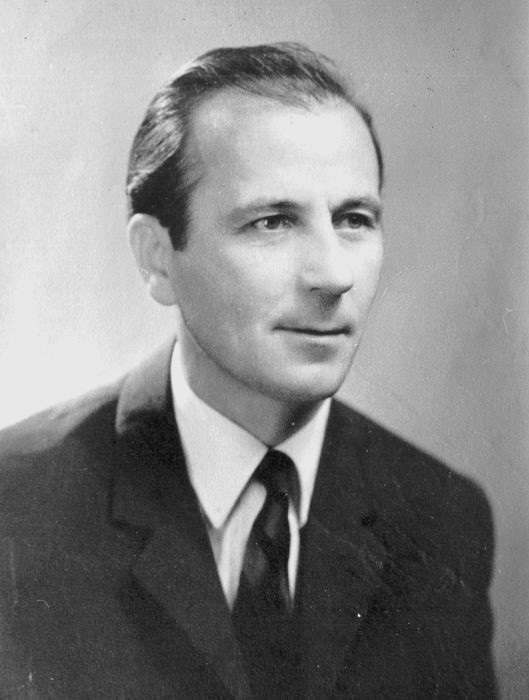
Memorie.al / Koço Miho, born in Gjirokastër in 1924, one of the most distinguished Albanian urban planners and architects after World War II. Immediately after the War, in which he participated as a patriot and partisan of the 8th Assault Brigade, he was educated in Moscow during the years 1948–1953. After graduation, he engaged in structuring the main design institutions in the country, initially as the head of the enterprise “Projekti,” later called the Institute of Designs No. 1, for eight years, and later in the leadership of the capital’s urban planning for 13 years with the status of Chief Architect of Tirana. In parallel, he significantly influenced the structuring of the Urban Planning and Architecture branch at the Polytechnic University of Tirana, where he was a lecturer for 10 years. He was transferred by the regime of that time in 1974 to the city of Durrës, to the position of a simple urban planning employee, as punishment for his uncompromising authority and personality, which distinguished him in the leadership of the most important national institutions of urban planning and construction in general.
Continued from the previous issue
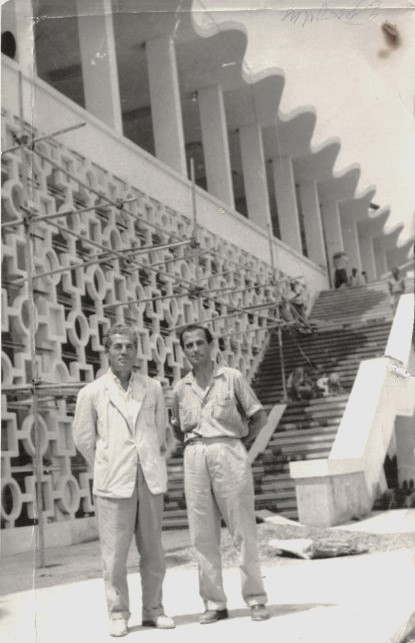
It seems as if the body of the building would have been the same if the author had not “invented” the semi-transparent element in the form of a textured brise-soleil “curtain,” functional for covering and creating semi-intimacy at the athletes’ entrance, clearly separated from the public entrance. The puzzle of creative dilemmas appears to be fulfilled here, and the author, if one researches more deeply into the building’s architecture, does not expend further on creativity or even the building’s economy.
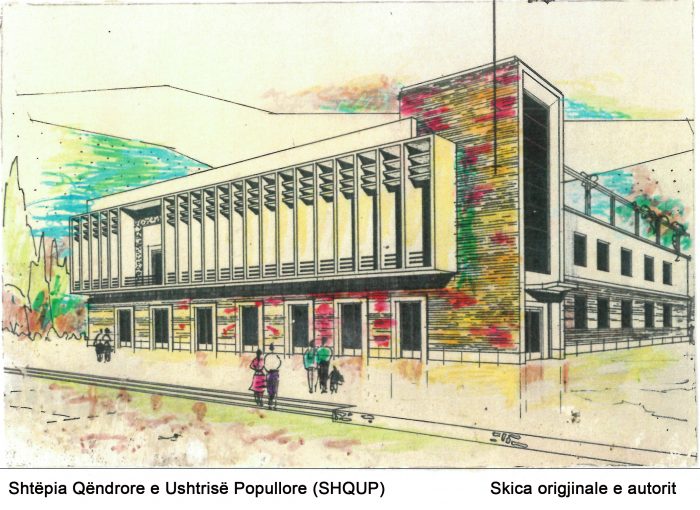
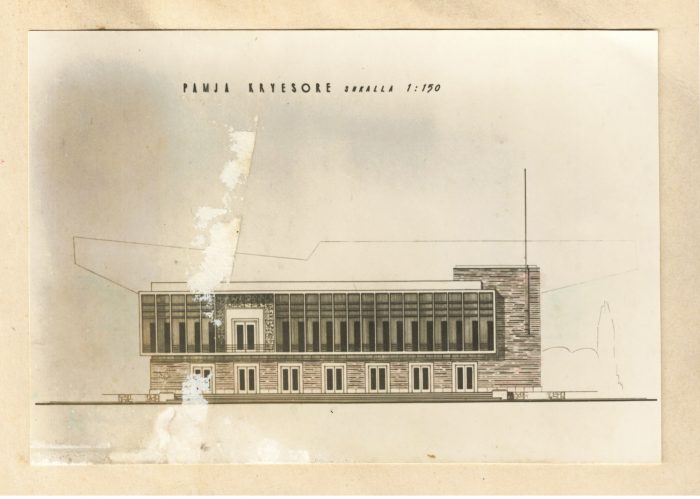
Another of the most important and prominent projects of his professional career is the Central House of the People’s Army, or “SHQUP” as it was otherwise known (today the central headquarters of the Democratic Party). The then-Minister of Defense, Beqir Balluku, called him to his office and urgently requested the design for the realization of a building where army officers could gather with one another for various organizational activities.
The urgency came from the Commander-in-Chief of the Armed Forces himself, as the highest military nomenclature was known at the time, which was equated with the role of the First Secretary of the Party of Labour, or with the former dictator Enver Hoxha himself.
This, the Minister explicitly conveyed to Koço in his role as director of the Design Institute No. 1, since apparently this had been the unexpected request. According to the author’s accounts, he was given only 4-5 days to propose a dignified building for this purpose, one that would identify the face of the Albanian Army of the time.
For the Minister, time was the priority; the building could even be very simple, since according to him, the state did not have much money for such an investment. The author’s responsibility was not only professional, but the degree of difficulty of the moment related to the extremely tight deadline, and above all, the expectations of Number One for a work that had to speak with the “force” of prestige.
Sleepless nights were spent on the conception and presentation of the idea through sketches to the First Secretary of the Central Committee, towards whom, just as in the case of the Sports Palace, the anxiety was about how he would receive it.
On the promised day, the author delivers the project idea to the Minister, who did not even wait to compliment before immediately expressing his worry that it would be a costly building that might not be supported for the investment that could be made for this new institution. The anxiety of anticipation accompanies the author. The concern about how the Minister could have presented it, but above all, how *he* must have received it?!
The wait lasts no more than a week, since the urgency seemed real for the dictator. The Minister’s face at the meeting displayed a deep smile, which left you understanding nothing other than approval from the decision-maker. “As soon as possible, Comrade Koço… you understand yourselves,” says the Minister.
The author recounts everything with the emotion he had directly experienced. In his professional accounts, beyond the anxiety, the author relates the experience of the compositional solution of the building’s architecture, referring to the extraordinary importance of its entrance from an important road in the city’s structure.
From the very first moment, the author sees the building as a body that must stand as solid in the monumental perception of the importance it carried, as it is also light in visual weight. This lightness comes and is harmoniously contextualized with greenery, which becomes the protagonist of the architectural-urban development of the plot.
Not only the massive planting of the inner perimeter of the building’s enclosure with non-deciduous conifers throughout the annual cycle, but also genuine elements of landscape and recreation, such as the “play” with water pools at the entrance and a recreational bar-café, later well-known as the most important functional element for the meeting of military personnel beyond the solemnity of the uniform, as people and friends.
The front façade of the building at first perception resembles a perfect visual equilibrium with a regular grid of vertical brise-soleils, which seem to repeat regularly across the entire length of the façade. But in fact it is not exactly like that, because the building is actually in a perfect equilibrium, but with a “hidden” dynamic.
The regularity is “broken” by the vertical volume block of the main entrance staircase, which seems to throw the building out of equilibrium, but being precisely that, it actually plays with the building’s silhouette, incorporating itself into a volume block with the ground floor of the building in the placement of other equilibria, which otherwise in modern architecture could be qualified as dynamic equilibria.
The non-random elevation of the staircase volume (functionally with an exit to the terrace) culminates with the element of the flagpole where the national flag waved. The author also “plays” with the visual effect in reinforcing the ceremonial experience of the building, with a journey starting from the main entrance of the outer enclosure, opened in the form of a square with a slight slope of 3%.
The journey is interrupted not by chance by a platform raised by about 50 cm with three steps about 10 m before the main entrance, where the visual “weight” of the volumetric mass of the building appears to be discharged.
In continuation, in the role of Chief Architect of Tirana, Koço Miho gathered around himself talented professionals who stood out, such as Maks Velo, Feri Dishnica, Fatbardha Daja, etc. In this period, for the capital, the construction of new neighborhoods for the new residents who had migrated from other cities of Albania was important, forming the new urban structure.
It was the period of designing new neighborhoods which, from the investment level, had to be as basic as possible, but at the same time had to form identity through the composition of the inner courtyard spaces, as well as the architecture of the special buildings placed in the urban context. The “Partizani Block,” “Ferit Xhajko,” the diplomats’ building on “Skënderbej” Street, the ATSH (Albanian Telegraphic Agency), and other projects designed by the urban planning office attached to the Executive Committee of the Tirana District, with project leadership by Koço Miho, stood out.
The author should be discussed at much greater length, as the buildings he left behind are qualified evidence of an interdisciplinary professional, not only an architect and engineer, but above all, with extraordinary knowledge in Urban Planning of small-scale urban compositions, but also on a city scale.
Particularly worth mentioning is the entrance to the city of Durrës in the 1980s, when Koço Miho led the urban planning office of the Executive Committee of Durrës. The intervention was of a very large urban scale, where the challenge was to confront anyone entering the city with the image of Durrës.
The traces left by the Italians before and during the occupation with the Regulatory Plan, as well as many buildings that remain among the most identified in the city today, remained isolated without creating an urban fabric extending to the identifying edges of the city’s structure. This was the objective to be achieved, and Koço Miho intertwined this entire macro-urban operation with the combination of placing the public transport terminal, which included the “New Train Station,” as well as that of regional buses.
The train and buses connecting the city with the rest of Albania had to be as close to the city as possible. Accessibility was very valuable for all visitors to the city, since on foot they could reach almost every main destination, but above all for the residents of Durrës themselves, whose daily lives were interconnected with Tirana. The student life of Durrës residents was linked to the train, going in the morning and arriving in the afternoon, so the station was not just any facility, but part of the basic organism of the city.
Thus, the choice of its positioning was the closest possible, despite the fact that the maneuver for the train’s entry into the station was not very simple, since it had a dedicated terminal entry and not a transit one, as would have been perfect if it were on the Tirana-Elbasan-Pogradec line.
The choice-solution was dictated and personalized in function of the organism of a city that lived with pedestrian movement. The exit or entrance to the station could not be anything other than a perfectly formulated urban square with the buildings of the new apartment blocks, which were part of the entire urban intervention. The square itself was also the bus station, where everything resembled a daily meeting place for people.
The automobile entrance to the city, indeed placed on the former road route, but with a completely transformed context on one side parallel to the railway line entering the station, accompanied by green areas and on the other northern orientation with a park-garden, which presented to the visitor not directly the buildings. The author “plays” with bifunctionality, greenery to convey the gradual sensation of entering the city and a recreation destination for residents of the new residential areas.
Immediately after the green block with a section of about 50 m, the perimeter of the new residential blocks was positioned, which gave the city the opportunity for massive growth to the North? The architecture of all the buildings of the urban intervention stands out for its simplicity, but at the same time for unifying identifying architectural elements, but particularly distinctive for the completion of the building silhouettes with spatial beams very special for the time.
The professional biography of Koço Miho was also linked to writing about architecture, where he wrote two well-known monographs such as “The Amphitheater of Durrës,” “Aspects of the Urban Profile of the City of Tirana,” and after the 1990s with the overthrow of the totalitarian system, he continued his professional activity by writing two other monographs, such as “Albania: An Urbanistic Overview,” dedicated to the urban development of the years 1922-1944, or otherwise known as the fascist period in urban planning and architecture, and “Architect Kristo Sotiri,” dedicated to the well-known architect of the early 20th century with his design activity mainly in Romania, who had impressed and inspired Koço Miho earlier with the Project of the Museum of War Martyrs at the end of the entrance axis to the city of Durrës. / Memorie.al
Author’s Note
Koço Miho – an excellent professional whom I had the fortune to know, and with whom we grew professionally during the stages of university formation. Any young professional is recommended to read the highly valuable publications that he bequeathed to the bibliography of Albanian architecture.