
By Fatmira Nikolli
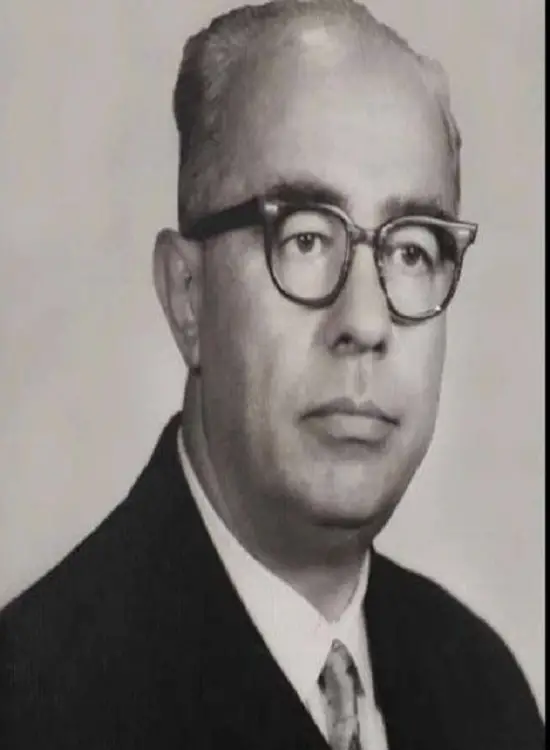
Memorie.al / He began his life as the son of a hodja, fed daily on Quranic verses. After studies at the Sorbonne and beyond, Isuf Luzaj would become a philosopher. Almost his entire life was spent far from Albania. He had left behind the family he lost, when communism was suffocating the country in its own loneliness. The Institute for the Study of the Crimes and Consequences of Communism (ISKK) announces the forthcoming publication of 6 philosophical books by the philosopher, writer and poet Isuf Luzaj (1913–2000), one of the most distinguished personalities of Albanian thought. “Anathema during the dictatorship and exiled, Luzaj remained and wrote his work mainly in Argentina. A drafter of the Decalogue of the National Front, Isuf Luzaj was among the anti-communist intellectuals who wished to realize the national ideal of the Renaissance for a United and Democratic Albania,” Agron Tufa makes known.
He adds further that the 6 books of philosophical and interpretative essays (metaphysics and meta-logic) are being published for the first time and have been organized within 2 volumes of over 400 pages each under the title “The Bee’s Meditations” [“Kujdesjet e Bletës”]. These are the beginning of a continuous publication of the entire philosophical legacy of Isuf Luzaj, left in manuscripts and comprising dozens of volumes. We thank on this occasion also Ms. Zyba Hysa, for the great work in preparing the texts for publication, editing and proofreading. At last Isuf Luzaj enters Albania through the “front door” and not through the “hidden door.”
BIOGRAPHICAL NOTES, THE UNWANTED LONELINESS
In the chapter “My friend, loneliness and Pan,” Luzaj recounts that he was a solitary nature. Here is what he writes: “It has been my nature to live alone even when I have been in the midst of society. I wish to live alone.” Although the son of a hodja, Luzaj said that for him “the word of God takes on meaning when I am alone. I do not believe that Religion is a theme for the intellect, nor for society in vain conversations and vanities. I believe only when I do not believe about Religion.
I need solitude as much as I need food. Solitude is the time that gives me the most rewards of the soul, but this solitude is not something I can choose — it chooses me. For me, to be alone means to be united with the whole world. In moments of solitude I put my parts together like the fragments of a broken mirror recomposed, and then I see clearly that small things appear large, while those that seemed large are small.”
He said he felt that solitude is an act of love with the entire universe. And at this point, he analyzes and compares his own sensations in two periods: when I was very religious, in a past time of sufferings and disillusionments, I murmured densely the prayers of Buddha, Christ and Muhammad together, simultaneously, seeking connections in the painful points of their metaphysics; however, at that time I had results of errors, because I lost intuition, imagination and the active spiritual power to build structures of my writings.
“Intuition suggests that I use it,” says Luzaj, adding that; “when it is its moment for discoveries of horizons, and to use meditation when I feel that I need presentation before God; to use reasoning when this comes naturally to help solve some solvable equation.” He has an interesting approach also to criticism: when they criticize me, I see that the critics want to make contact with me for some trouble of theirs that is unconfessable by them.
They do not disturb me and this gives me a kind of passive satisfaction, because they know that they erred and sank so low that Morality, Ethics and Aesthetics do not promise me contact with them. “My friends who appreciate my patience say that I resemble a FAKIR of BUDDHA, or a humble Christian monk. I do not know whether here they judge me rightly, but I know well that silence gives more satisfaction than quarrel,” Luzaj emphasizes.
Further on, he reveals an extremely important moment of human life. He reveals almost the attainment of Nirvana, as the final goal of many followers of Buddhism, about which he writes: For the love of the TRUTH and of the RIGHT, I must add that — it is indispensable, necessary, strong and constant — a GYMNASTICS of the brain mechanisms with the help of the study of the heroes of thought is needed to reach this milestone. After fifty years of gymnastics, not even I can affirm that I have reached one hundred percent the psychological atmosphere of NIRVANA.
THE ACQUAINTANCE WITH SARTRE
In another part of the first volume, Luzaj recounts his acquaintance with Jean-Paul Sartre. “In the two journeys Sartre made to America, the lottery fell to me to be the translator of his conferences, both at my University in Indiana and in New York, where he made this decision. I have a correspondence and I have visited twice in Paris, in the presence of Simone de Beauvoir. I believe I have known him a little closer than the world’s commentators.
I said fortunately, or unfortunately, because I am not sure which surname helped me or harmed me. For reasons of admiration for his thought, I lost the contract with NOTRE DAME of Indiana: an institute of higher studies but radically Catholic, without permission to depart into DOGMA. 94% of the professors were Catholic priests and they rejected my criterion of freedom, which they confused with my Muslim faith. Perhaps, for my good fortune, because in other Universities there was 100% — I decided the BIBLIOGRAPHY of the courses, and thus I lived in the icoosphere of French freedom of 1789, which is also my temperament.”
Further on, in “an ontogenic preface,” he recalls that for the first time in my life, on January 1, 1936, I entered the first class of the Normal School of Elbasan, as a teacher of the French language. “In February of that year, Xhuvani, the school director, assigned me the Pedagogy course of the final class. For the last time in my life, on January 1, 1993, I resigned from the chair of Philosophy, for health reasons, in Chicago.
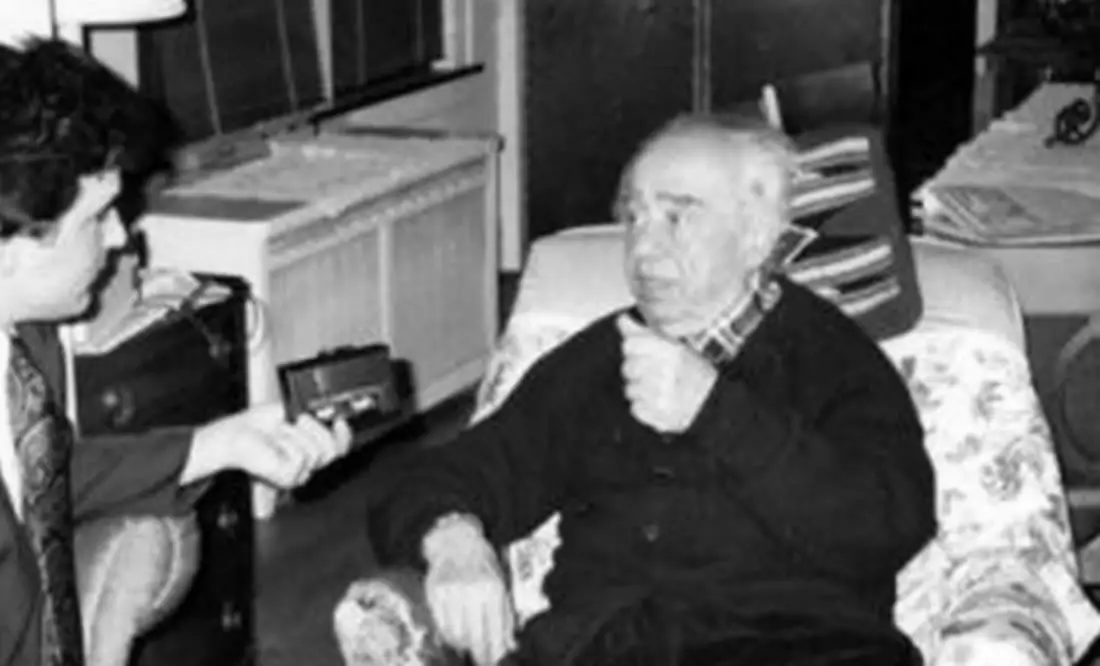
Heart arrest, on November 28, 1992, while giving an interview to the newspaper Illyria, to the correspondent Vehbi Bajrami. During these 56 years, with the exception of the parentheses of my life: imprisonments, internments, volunteer fighter, there remain exactly 51 years as a schoolteacher:
Albania, Italy, Argentina, Buenos Aires, Lima Peru, Bogota, Colombia, Boston Massachusetts, Colchester, New Hampshire, Lake Forest Illinois, Bloomington Indiana, Saint Joseph Indiana, Champagne Illinois, Visiting Professor during holidays: Notre Dame Indiana, San Francisco, Austin Texas.”
Luzaj had admitted that “the first who fell from the pedestal I had seen built was Bergson, my former master at the Sorbonne. The last who disillusioned me was SARTRE; I ask his forgiveness for the friendship he gave me. I suffered greatly spiritually for their contradictions and for the conflicts that were growing in my mind, because it seemed to me too much presumption to overturn some parts of their theories, and because I felt myself guilty of sincerely teaching those thousands of young souls, who expected the truth from me, that which I believed – while I was not in accord with my own mind and with the stars of thought, whether I was truly teaching the TRUTH.”
In the same place, he adds that for Sartre freedom coincides in its roots with NON-BEING, which is in the heart of man. For a human being, TO BE means to choose oneself; nothing comes to man either from outside or from inside, which arrival he will await or accept. “This thought is heavy in meaning and also broad in its consequences. Man is entirely and without any hope under the dominion and mercy of the unbearable necessity, to make himself BEING, even down to the finest details of his existence.
So FREEDOM is neither BEING nor the state of BEING, is it rather the being of man, which means his NON-BEING. If we begin to conceive of man as a COMPLETENESS – WHOLENESS, it becomes absurd to seek in him (in man) psychic moments or ZONES OF FREEDOM; we would be looking for an empty place inside a vessel full of water. Man cannot be sometimes free and sometimes a slave (SERF); either he is always and entirely free, or he is never, never and never free. This concept of Sartre clearly explains his philosophy on FREEDOM,” Luzaj wrote about freedom. / Memorie.al