By Eugen SHEHU*
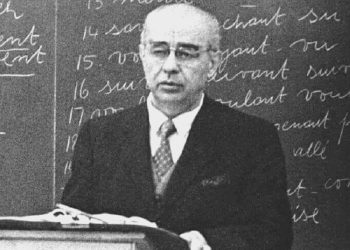
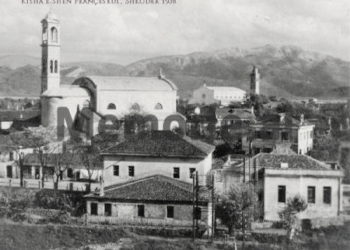
Memorie.al / Greater Dibra – that Albanian region, encircled by roaring rivers and high mountains—has throughout the centuries always shaken the ridges of brave men. These men, at every moment, have stood up for the fates of their nation. But on those ridges, wise men have also been rocked, whose words were first passed along with respect in the Dibran odas (council chambers), and have for centuries been transformed into an institution of trust and pride at the same time. A heavy cornerstone in this institution of Dibran besa and manhood remains eternally Sherif Langu, who was born in the distant October of 1877, in Greater Dibra. Early in his childhood, he would feel the oppression and the heavy weight of several centuries of Ottoman rule. His family would always be under the strict control of the gendarmes of the Sublime Porte, because his grandfather, Selim Bej Rusi, had been among the military leaders of Greater Dibra, during the glorious years of the Albanian League of Prizren.
Although this league was violently suppressed, the men who conceived and led it passed on, without fear, to the younger generations the heroism and the great spirit of sacrifice that had characterized all those years.
Little Sherif would be greatly influenced by the life of the kaçak (guerrilla) and military leader that his grandfather was, and thus he never left his side. At the age of 8, Sherif Langu went to study at the famous Madrasa of Greater Dibra, not far from his home. The teachers loved him because he was characterized by a great will to acquire all knowledge, no matter how distant in time it might be. But they also loved him because they saw, in the noble features of the 8–9-year-old student, a deep sense of compassion that was often read in his eyes for his beloved homeland.
And secretly, during his years of schooling at the city’s Madrasa, he wished to speak to his compatriots about the heroes of the Albanian League of Prizren, naturally not forgetting his grandfather. After finishing the city’s Madrasa with excellent results, Sherif Langu went to Monastir (Bitola), continuing his studies at the gymnasium, where – especially in the early years of the century we left behind – our national consciousness had begun to awaken. “From his school years in Monastir, Sherif Langu collaborated with the well-known patriots Hamdi Ohri, Zyhdi bej Ohri, and Hajdar Blloshmi.” (B. Gaçe, “Those Who Declared National Independence”, Tirana 1997, page 100).
In 1904, Sherif Langu would take the road to Istanbul. Although he expressed a desire to study Islamic Theology, he was inherently inclined that, through the opportunities given by the robe of a patriarch, he would influence as much as possible to orient his countrymen towards the missing light of Albanianism. In Istanbul, in those years, it is worth noting that a number of great patriots of Albania were active, at the head of who, undoubtedly, were the Frashëri brothers. First, Sherif Langu would meet Ibrahim Temo and Dervish Hima, who – knowing from what family the young Dibran came – entrusted him with many secrets of the Albanian autonomist movement which was being prepared precisely in the heart of the Ottoman Empire. The long discussions with these two men would convince Sherif Langu that the Islamic Theology he was studying would only be valuable when it unfolded as a message to illuminate the path of freedom for his nation.
But, in Istanbul, the son of Greater Dibra would also meet Mehmet Pasha Deralla, Ali Riza Shkupi, and Hasan Prishtina. From them, he received the word that at the first opportunity given to them, when the homeland demanded pledged trust of men, they would unite, and Sherif Langu joined them. As soon as he finished the Islamic Theological University, he sought to serve in one of the religious institutions in the Albanian vilayets. In the autumn of 1907, he went to Greater Dibra and, under the religious title of Hafiz, immediately began national activity. In this way, in the spring of 1908, after direct contacts with Dervish Hima and Vehbi Dibra, Hafiz Sherif Langu started working on the creation of the “Bashkimi” (Union) club, presented at that time as a club for the dissemination of the Albanian language, but which in reality sought to develop according to the model of the Secret Committee of Monastir. With work and heroic efforts, the “Bashkimi” club, although still unannounced, was transformed into a warm nest for patriots acting especially in Monastir.
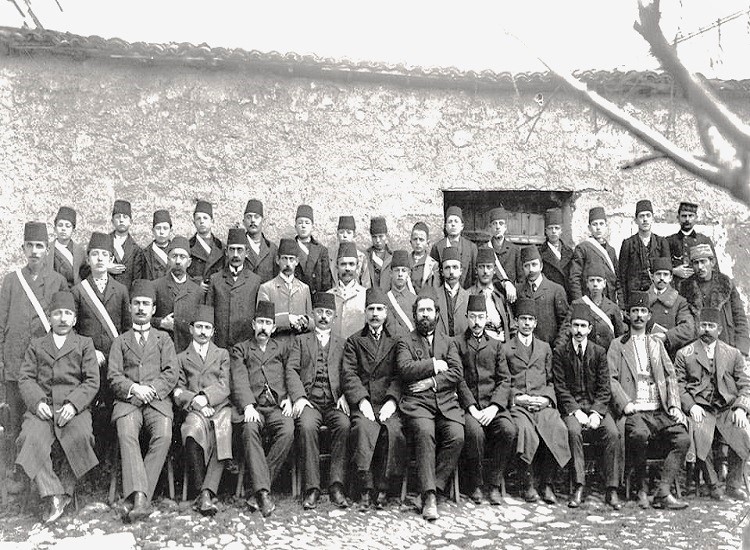
Despite the fact that the formation of the “Bashkimi” club was announced in December 1908 (with chairman Hafuz Sherif Langu), it had directly influenced the smooth running of the Congress of Monastir for the alphabet of the Albanian language. “At the ‘Bashkimi’ club, dozens of members carried out extensive propaganda in the city and regions to keep alive in the people the love for the homeland and the desire to sing and write in Albanian. The word of the chairman Sherif Langu and Vehbi Agolli on these issues was heard with interest everywhere, thus providing a valuable service to the national cause.” (Archive of the Institute of History – Tirana, File A.VII.63, sheet 4).
At the head of the patriotic club “Bashkimi”, Hafiz Sherif Langu would try to gather around the national cause not only Dibran patriots, but also those from Kosovo and Montenegro. Even when the Young Turks rushed with fire and iron to suppress any autonomist aspiration of our people, the man of Dibra was not afraid. Many members of the club he led were scattered from Kukës to Ohrid and Struga, creating and keeping alight the education of children in the beautiful Albanian language.
It was precisely the activity of these committees that kept the education of children in the beautiful Albanian language burning. Although the Young Turks tried to burn every Albanian book, entire caravans of books, coming from Sofia or Bucharest, went to the villages and the most remote towers of Dibra. Hafiz Sherif Langu would preach with love and wisdom among his compatriots that: “Albanianism is for Faith and Homeland. The more we embrace it, the closer we are to God, and He will undoubtedly help us in our desires and troubles.”
Hafiz Sherif Langu was convinced more and more every day that in the face of the violent and divisive actions of the Sublime Porte, Albanians had to rise up and demand their independence at the barrel of a gun. Thus, in early March 1912, Dibran patriots organized in the vicinity of the village of Homesh a great assembly, in which about 4,500 men from Gryka e Vogël and Luznia to Bulqiza took part. At this assembly, Hafiz Sherif Langu read a program which, according to documents, was precisely the order of the Monastir Committee for the preparation of the armed uprising. This program, unlike other times or other assemblies, determined very clearly that: “Now we will make an uprising not to ask for the freedom to teach our language, but to raise the red and black flag.” (Archive of the Institute of History – Tirana. Fund A.VII 63, sheet 69).
And right here, after hearing the speech of Hafiz Sherif Langu, which was interrupted several times by warm Dibran applause, and right there on that lawn, like lightning, the *besa* was pledged to drive the Ottomans out of Dibra. Through special couriers, the request of the men of Dibra was sent to the Albanian deputies in the Ottoman parliament and especially made known to Hasan Prishtina, who gave instructions for maintaining contacts with all Albanian vilayets. On March 24, 1912, in the village of Çidhmë in Lower Dibra, Albanian fighters clashed with an Ottoman battalion positioned in fortified positions and armed to the teeth. It took several hours of fierce fighting for the Turkish battalion in Çidhën to be completely routed, leaving hundreds dead and wounded and a considerable amount of military supplies.
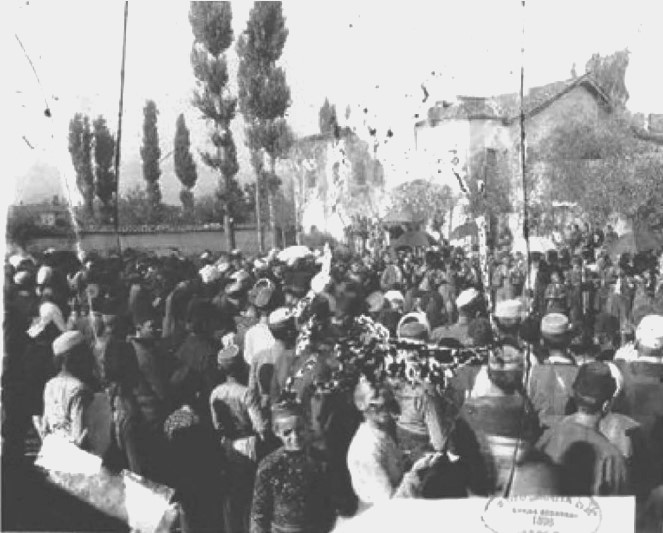
Meanwhile, the flames of the uprising were spreading rapidly. On March 27, 1912, Dibran forces led by Elez Isufi and Sufë Xhelili surrounded the Turkish garrison in Reç and Dardhë, and after fierce fighting, managed to rout these forces. Now, for every honest Dibran, as well as for every such Albanian, it was clearer than ever. “In June, the uprising also encompassed Upper Dibra, while on June 21; movements began inside the city of Dibra. At the Spile bridge, numerous insurgent forces gathered, led by Sadulla Strazimiri, Sheh Latifi, Ismail Strazimiri, Hafiz Sherif Langu, Eqrem Cami, Shahin Cami, Nurçe Xhuglini, Qamil Daci, Ali Zeqja, Rifat Mizoja, Dan Cani, Dine bej Maqellara, Abdulla bej Allabegija, Izet Dalipi, Sefedin Ilimca, etc. It was clearly seen that the whole of Dibra was engulfed by the idea and waves of the uprising.” (Q. Xhelili, ”Vehbi Dibra, Prominent Personality and Activist of the National Movement” – Tirana 1998, page 83).
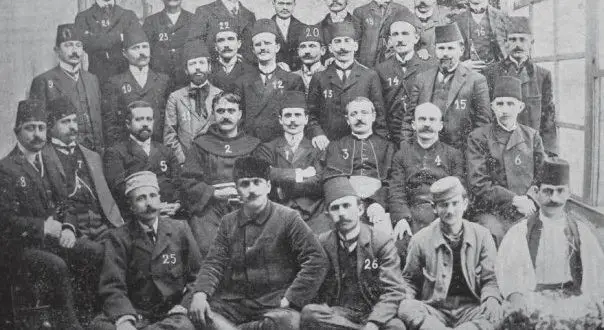
It is easy to guess that the culminating event in the life of Hafiz Sherif Langu is undoubtedly his participation in the historic assembly of Vlora. In the conditions of the complete defeat of the Ottoman Empire as well as the danger posed to Albanian lands by the Slavic-Greek chauvinists, it was natural that only independence could save Albanians. On November 18, 1912, at the telegraph office of the municipality of Dibra, the telegram of elder Ismail Qemali would arrive, inviting the Dibrans to choose their representative as soon as possible, to raise the Flag in Vlora and to declare the independence of the Albanian lands.
Under these circumstances, on November 19, 1912, the notables of Dibra, in cooperation with the prominent leaders of the mountains, gathered in a magnificent assembly, which was opened with the reading of the telegram from the elder of Vlora. Two days after this assembly, amidst numerous discussions, two delegates who would represent the Dibran people in Vlora were also appointed. “It is interesting that the mandate to represent Dibra in the assembly of Vlora was unanimously and without hesitation given to Vehbi Dibra and Hafuz Sherif Langu. Both outstanding and respected men, known as clerics but also as active fighters for the national cause.” (Q. Xhelili, ”Vehbi Dibra, Prominent Personality and Activist of the National Movement” – Tirana 1998, page 90).
Immediately after receiving their mandates, the two men of Dibra, accompanied by the love and respect of thousands of Dibrans, set off for Vlora. They would have to travel sometimes on foot, sometimes on horseback, day and night, especially avoiding clashes with formations of the Serbian army. And always, they would find themselves surrounded by Albanian generosity and nobility. Their journey lasted a full 7 days and, despite the difficult conditions of means of communication, upon arriving in Elbasan, they learned of the constant interest of Ismail Qemal Vlora. Thus, in a telegram he sent to Elbasan, to Aqif Pasha Elbasani, among other things, he asked: “Did the representatives of Dibra arrive? The greater the danger, the more important are measures to face this danger…” (A.Q.Sh-Tirana. Fund “National Assembly of Vlora”, File.1. fl.23).
Then, during the historic days of the assembly, Hafiz Sherif Langu would live, amidst the love of hundreds of other Albanian patriots, the moments of glory and pride for the raising of our red and black flag. Albania declared the great act of independence, leaving behind entire rivers of blood. Together with Vehbi Dibra, the man of Dibra drafted the “Fatwa”, responding fiery against the anti-national stance of some of the Albanian notables, who denied not only our nationality and faith but also our flag. By exploiting the fact that traditionally, at Albanian assemblies, senior religious clerics would necessarily say their word, the Dibran patriot representatives in Vlora drafted within 3–4 days the “Fatwa”, a sort of address which would shed light on the past and future of our nation.
At first glance, this “Fatwa” resembles an ordinary cleric’s sermon, while in reality, its content and ideas made the great appeal of the time, addressed to all Albanians, to love forever our past and our flag. In legal terms, this address could also be taken as a model of intertwining the duties of the legislative power with the executive power of the state. In the first Albanian government, emerging from the assembly of Vlora, Hafiz Sherif Langu collaborated with Mid’hat Frashëri, appointed in that government as Minister of Internal Affairs.
In April 1913, when the Serbian troops were withdrawing from Dibra and Mat, the provisional government of Vlora thought of sending a special commission there, which would organize local power in those regions. By direct order of Mid’hat Frashëri, this commission consisted of: Hafiz Sherif Langu, Tajar Tetova, and Ahmet Dakli.
Meanwhile, it was the Vlora government that had instructed its commissioners to take, in Mat, the closest possible ties with the 18-year-old youth Ahmet Zogu, who had declared to Ismail Qemali in Vlora that he would be the right arm of the first Albanian state in those regions. Regarding this mission, on May 22, 1913, the Minister of the Interior of the Vlora Government, Myfid bej Libohova, writes to the Prefecture of Elbasan, among other things, that: “We have received the telegrams of Messrs. Tajari, Sherif and Ahmet. It is necessary that Dibra and the region of Mat be connected to the provisional government as soon as possible. Bajram bej Curri and other leaders are in Mat, awaiting instructions from the provisional government. Messrs. Sherif, Tajar and Ahmet must depart as soon as possible for Mat.” (Central State Archive Tirana, Fund 71, file 2, document no. 11223).
Although in extremely difficult conditions, in the face of internal turmoil as well as Serbian and Montenegrin intrigues, the Dibran patriots, led by the prominent man Sherif Langu, managed to carry out a great activity in the northern Albanian regions for the benefit of the first Albanian state. Because he had knowledge not only in theology but also in jurisprudence, the man of Dibra would rush from Mat to Dibra and Gjakova, trying to convince the notables of these regions that it was necessary to avoid anarchy in order to obey the state laws to the end. With the direct help of Sherif Langu, the new prefecture of Dibra was established, in which, in addition to the areas of this region liberated from the Serbs, it was decided to include the regions of Luma and Mat. At the same time, although facing difficulties, local administrations were established in Upper Dibra and Lower Dibra, where the contribution of Sherif Langu has been and remains indisputable.
The great turmoil in the years 1913–1914, when Albanians were killing each other to satisfy the appetites of our old and greedy neighbors, would not pass easily through the soul of the man of Dibra. In these moments, in his warm speech and especially his mature thought, Sherif Langu would always be among the ranks of the men who placed Albanianism above everything. In the company of Rexhep Mitrovica, Ahmet Zogu, Murat Toptani, Mid’hat Frashëri, Myfid Libohova, Aqif Biçaku, etc., the man of Dibra would rush from one corner of Albania to another, fighting with rifle and pen to prevent the independence of the Albanian state—like that newborn baby—from being devoured by the wild waves of wars and the ambitions of our chauvinist neighbors. Even in the years 1914–1918, when he served as a judge in several Albanian courts of that time, Sherif Langu was characterized by justice and wisdom in making decisions.
For him, everyone was equal before the laws, so each one was worth answering with his life. But severe punishments were very rare for the great patriot and clergyman; these punishments were given only in cases when treason against Albania came out into the open. Meanwhile, he would in no way accept cooperation with Esat Pasha Toptani, who, seeing his courage, kept him closed in the Elbasan prison for 7–8 months—the prominent man of Dibra. Furthermore, we will see Hafiz Sherif Langu giving his valuable contribution, alongside Vehbi Dibra, for the independence of Albanian religious objects and cults from Istanbul. It is worth considering that such a thing was very difficult to achieve in those times, bearing in mind the mentality and backwardness inherited by our people from the past. In this way, alongside his theological and philosophical thought, the contribution of Sherif Langu remains of profound value, as in every action and word of his, deep feelings and a nationalist spirit are noticeable.
Like few others in those difficult moments, Hafiz Sherif Langu tried to evoke in the souls of believers or other Albanians around him the feeling of national pride, the evocation of the best traditions of our people as a prerequisite to cast away blind fanaticism and regional divisions. For these traditions to be evoked and passed on, for them to be seen as models that could still apply—according to the man of Dibra—all Albanians needed to increase efforts for the Albanian language and culture. Especially in the conditions when the Albanian kingdom was giving great priorities to the school and the Albanian language, Sherif Langu would encourage the brilliant galaxy of clerics of that period to unreservedly support Albanians on both sides of the border, to elevate their minds only on the side of knowledge.
According to the book *“Dibra and its Ethnoculture”*, it is learned that Hafiz Sherif Langu, from 1938 until 1941, performed the duty of Chairman of the Council of Ulema in Skopje. In October 1941, the Slavic-Macedonian church prepared an assassination attempt on the man of Dibra, having seen in his figure more than a clergyman of the Islamic faith—the deep national feeling that the Chairman of the Council of Ulema conveyed in every action. It was precisely some of his friends in Skopje who fell victim to the assassination attempt. Secretly, dressing him in the costume of the peasants of those parts, they managed to get Sherif Langu beyond political borders, sending him to Tirana.
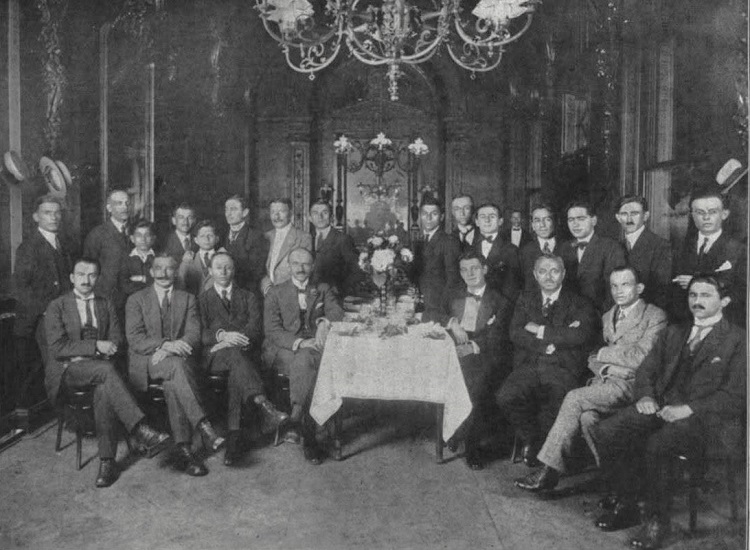
There, the man of Dibra is welcomed with joy by the Albanian government officials; even the high Muslim clergy placed him in the highest function, that of the Chairman of the Muslim Community. Thanks to his refined patriotism, his uncompromising fight against the enemies of Albania, as well as his high theological and philosophical preparation, he remained in this post until October 1943. Always guided by the idea of Ethnic Albania, Hafiz Sherif Langu accepts with pleasure to be, in October 1943, on the High Council of the Albanian State, as a member of this Council. He would collaborate with such distinguished men as Rexhep Mitrovica, Lef Nosi, Father Anton Arapi, Mehdi Frashëri, Xhafer Deva, Thoma Orollogaj, Fuad Dibra, etc., despite the fact that these were attacked with arms by the communist clique of Tirana.
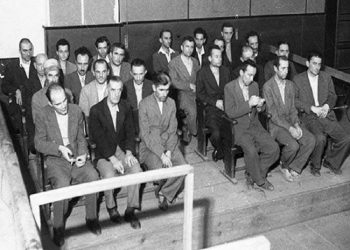
In January 1945, while teaching at the Madrasa of Tirana, Hafiz Sherif Langu was arrested. The charge against him can be summarized: “collaborator with Balli Kombëtar” and “Legaliteti”, close friend of Rexhep Mitrovica and Lef Nosi, fought for Ethnic Albania, severely sabotaging the National Liberation Movement”. The man of Dibra conducted his own defense, without a lawyer. In essence, his speech at the farcical trial of the communists of Tirana ended with: “I cannot be called an enemy because I want to live together with my brothers, which is realized by Ethnic Albania. On the contrary, the enemies are you. For this very ideal of mine, in Skopje they wanted to kill me. But the Slavic-Macedonians are realizing this in Tirana!”. He is sentenced first to life imprisonment and then to 25 years in prison. Hafiz Sherif Langu, the uncompromising nationalist, ended his life brutally tortured by the Bolsheviks of the mother state, on March 9, 1956—the man who had raised the flag in Vlora, he who for 7 decades worked and lived only for his nation. He was fully 79 years old when he closed his eyes, while his free spirit rushed beyond the bars of cells towards the Ethnic borders of Albania. / Memorie.al
*Bern – Switzerland