By DASHNOR KALOÇI
Part Three
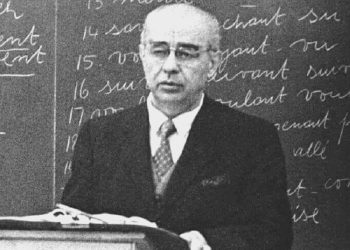
Memorie.al / Based on the previous document, we recall that Prof. Zihni Sako was a member of the cultural delegation that visited France from February 14 to March 7, 1962—a delegation (which was still called such even when composed of only two persons) headed by Prof. Dhimitër Shuteriqi. We also recall that their reports, sent to the relevant sector of the Central Committee of the PPSH, were drafted and submitted separately (based on the established rules for visits outside Albania), so that nothing of what had been seen or encountered during that visit would be concealed. In Prof. Sako’s information report, one encounters the meeting of Shuteriqi with the son of Kostandin Kristoforidhi in France – a fact that Shuteriqi does not mention at all.
This omission likely occurred also because Filip Kristoforidhi had informed them about a letter he wished to send to Harry Fultz (former director of the American Technical School in Tirana from the early 1920s and during Zog’s Monarchy), who, immediately after the end of the War, had returned to Albania, now as a member of the American UNRRA mission. However, under Enver Hoxha’s strict orders, Fultz was forced to leave Albania on November 23, 1946, being initially declared “non grata” and subsequently accused of being an “agent of American Intelligence” (CIA) who had operated disguised as Director of the Technical School in Tirana since 1923.
This may well have been the very reason why Shuteriqi does not mention at all in his information report the meeting with Kristoforidhi’s son (who was his grandmother’s uncle), since the letter he had prepared for Harry Fultz could have further complicated the situation, not to say it could have landed him (Shuteriqi) in some “agent group,” or, in the worst case, the State Security organs could have kept him under surveillance and followed him as such! It is also possible that Shuteriqi, regarding this meeting, may have spoken orally with Ramiz Alia (a fact that is also made known by Prof. Sako’s information report in question), but this version falls short when one considers Alia’s stature (or, more clearly, his character), who would hardly have taken on responsibilities of this nature.
Nevertheless, these are and remain hypotheses arising from logical deductions, based on certain concrete events, grounded in Prof. Zihni Sako’s information report, which is published in full and without any cuts. It is worth noting here that, with the exception of the “Filip Kristoforidhi” case, about which he “had no way to keep quiet,” in general he proved correct, emphasizing his professionalism as a folklore scholar. Like Prof. Shuteriqi, he too did not speak as a “party worker,” but as a scholar and a man of Albanian culture and letters.
R E P O R T
As is known, I too was a member of the delegation that went to France, from February 12 to March 9. According to the program, I also participated as a member of the delegation in the cultural discussions, since Prof. Dh. S. Shuteriqi will give the relevant report as head of the Albanian side, and I am not addressing this in my report, because the impressions and the course of the discussions we have clarified and discussed together, also with the chargé d’affaires, Mr. M. Sinojmeri. My general impression is that the discussions were conducted in a normal and correct manner.
The French side did not insist much on its own issues, and in general our project was accepted. On this occasion, I wish to note that during the first discussion, the head of the French side said, among other things, that he was satisfied with the implementation of last year’s plan, and that from now on, since conditions are more favourable, our joint cultural plans will be well realized. He also hoped to come to Albania. He said this as well on the night our legation gave a cocktail. Regarding my work, I had in my work plan: conferences, meetings, and archival research.
1) Conferences: a) On February 21, 1962, at the “Musée de l’Homme,” I delivered the conference “The State of Folklore Research in the People’s Republic of Albania.” The conference was held in one of the Museum’s conference halls. About 20–25 people attended, all individuals interested in folklore studies. The conference was opened by the Director of the Museum, Millot, who made the introduction and expressed his pleasure at such a scientific conference and meeting.
The conference was followed with attention and interest. To illustrate the conference on the themes of our folklore, seven translations were recited, which had considerable success. After the conference, which lasted about 50 minutes, questions were asked. The questions, which were mainly of a scientific character, were:
– What is the nature of Albanian folk verses and stanzas?
– Is there a connection between Albanian octosyllabic folk verses and Romanian ones?
– On the method of field research.
– Are there still storytellers of tales, and are tales still told?
After the questions were clarified, the director again thanked and expressed his pleasure at the conference as very interesting and clear, and congratulated the work done in this field, which was little known to them.
b) On February 22, 1962, in the conference and projection hall of the “Musée des Arts et Traditions,” the conference “Some Characteristic Features of Albanian Folk Music” was held, accompanied by tape recordings (12 recordings).
The conference was opened by the director of the Museum, Georges Henri Rivière. About 30–40 people attended, as the conference had been publicized in the press (in the newspaper ‘Figaro’). Here the conference was followed with great attention. Our polyphony and the musical motifs with the çifteli were received with great interest. As in the case of the first conference, questions were asked here too, with considerable discussion. Borata, a translator of Turkish tales into French, Turkish by nationality, discussed the possibilities of Turkish influence in the case of the Elbasan song “Ke selvitë e namazgjasë” (You have the cypresses of the prayer ground), while Mademoiselle Marcel Dubois, head of the ethnomusicology sector, discussed the songs: “Maje krahi” (Shoulder tip) as being from the Mediterranean basin, as well as the presence of the heptatonic scale in polyphony.
2) On February 28, 1962, again in the projection hall of the Musée de l’Homme, the screening of the film “Vallja e Shqipeve” (The Dance of the Albanians) took place. Very few attended, about 10–12 people. Questions were asked about the professional dancers and singers, as well as about their costumes and decorations, since the film has a quite artistic presentation. In both these institutions, gifts were made of books published after liberation with oral and musical folklore materials, as well as three brochures with songs, in which the property rights of the Institute of Folklore were noted. Despite the interest shown and the questions asked at the conferences, they had a rather formal character.
3) Meetings:
On February 14, 1962, a meeting was held with the Director of the “Musée des Arts et Traditions,” Georges Henri Rivière, and the head of the Ethnomusicology department, Ms. M. Dubois. On March 2, a meeting was held with Ms. Teneze, head of the Folk Prose department, and with Mr. Gilbert, choreographer of the Choreography Department. In these meetings, we discussed the archival method for musical texts and prose texts for their cataloguing. At the Musée de l’Homme, a meeting was held with Ms. Fontanes, who had also been to Albania.
She gave us a small descriptive study of Arbëresh costumes, as well as 29 photographs from the expedition made in 1961 in Calabria. She gave us three records of Arbëresh music and two lithographic maps of Shkodër and Ragusa.
b) On the occasion of the conferences, I met with Ms. Fanjen, who has visited Albania. She gave for the University library an album “Les merveilles de France.” On the evening of the cocktail, I met André Mazon. A very interesting man, who took great interest in Albania and expressed a desire to visit it once. He knew S. Kuneshka, S. Spasen, and A. Xhuvani.
He expressed pleasure that much work had been done in Albania for the humanities, but regretted that he knew very little or none of it.
– In the first days, we met with the author of the book “The Etruscans Begin to Speak.” Mr. Manjani is an Israeli who fled from Russia. He seemed to us a simple and poor man. He has persisted in the study of the issues raised in his book. I believe his study is of interest. In various articles, he speaks sympathetically about Albania. He has found stern opponents in the archaeologist Palotini, an Italian, and the Frenchman Blok. But despite the severe criticism, Manjani does not wither or retreat.
I think his weakness lies in the fact that he knows the Albanian language very little, and does not know the etymological and semantic problems of Albanian. For this, I think he should be helped by the University with materials of this nature, so that in his revisions he can make use of more accurate and more scientific linguistic materials. Being still a young man, with such help he could revise his epigraphic studies many times and bring a significant contribution to the field of Etruscology and increase interest in Albania and the Albanian language in the scientific world.
– We also sought the son of Mario Roku, we even wrote to him, but he did not reply!
1) During our time in Paris, Ms. Fontana and Ms. Fanjen invited us for lunch. We also met with the son of Kostandin Kristoforidhi, Filip, who gave us a microfilm of Frang Bardhi’s book “Georgius Castriotus,” a copy of which he had also sent to the National Library in 1951. He is very old, 75 years old, and lives in the village of Jargeau near Orléans, in a state where several American officers rent from him. He also spoke to us about a letter he had sent to H. Fultz; after we told him who Fultz is, he tore up the letter and we handed it over to Mr. M. Sinojmeri, but since the letter was in English, we did not read it to be able to say anything about its content.
Having been absent from Albania for a long time, he has some mistaken views about the present situation, about which Mr. Dhimitër may have spoken in his report; nevertheless, he should be kept close, he has great nostalgia for Albania, he is very happy about the progress that has been made here, and he is very touched by the treatment of his father’s figure in such an honourable manner.
– In all the meetings and conferences, their attitude was correct; no provocative question was posed to us, either directly or indirectly. Regarding the conversation with Wurmser, comrade Dhimitër Shuteriqi will speak in his report; about this conversation, comrade R. Alia was also informed in the meeting we had with him last week, as well as Mr. Misto Treska.
2) Archival research was very limited. There is nothing about Dozon; we only learned that between 1885–1890 he was a professor at the “École des Langues Orientales.” It appears that there is material on Hecquard in the archive of the Ministry of Foreign Affairs, in the materials of French consuls of the 19th century. We tried to find nothing in the “Mazarin” library, but there, apart from copies of Bogdani and Bardhi, there is nothing, especially from the new period. There was only Konica’s “Albania” and some insignificant French authors.
3) Attached to this report, I am also sending you a list of the materials I brought, with notes of where I have deposited them. The Museum of Arts and Traditions, as an exchange of books, undertook to send to the Institute of Folklore a number of books, following a selection I made in their library.
4) Some requests from them and from us.
They asked that we send them our folklore publications in exchange. The Musée de l’Homme requested, for the enrichment of the Albanian fund, ethnographic materials by exchange or purchase. In this museum, the Albanian section was very poor. There were only two costumes: one from Malësia e Madhe (women’s) and one from Tirana (men’s). Meanwhile, as I learned, they have in their archives rich ethnographic material from Kosovo. Also, from the expeditions they make in Calabria, they have photographic material.
I think that through exchange, fruitful work could be done for factual materials through photographs, for costumes from various areas, for residential architecture, for tools of work and household items, for woodworking, for musical instruments, and others. I think that official correspondence could be entered into, not privately as has been done so far through Rrok Zojzi and Kolë Luka. From the Musée de l’Homme, they also gave a letter for the Institute of History and Linguistics.
I also think that the Institute of History and Linguistics should write to Mr. Manjani and send him materials and an opinion – however rigid but preliminary – for a broader review of assistance for his work. For research work in the Paris archives, Ms. Farjen could also be of help, who showed readiness to assist. She asked that the Institute of History and Linguistics, if possible, assist with ethnographic materials (photographs) from the life of the Aromanians settled in cooperatives, since she is working on an ethnographic study./ Memorie.al
Zihni Sako
Central State Archive, Tirana.
Ibid., Fund 14. Ap. Central Committee of the PPSH, (Structure) File 715. Year 1962