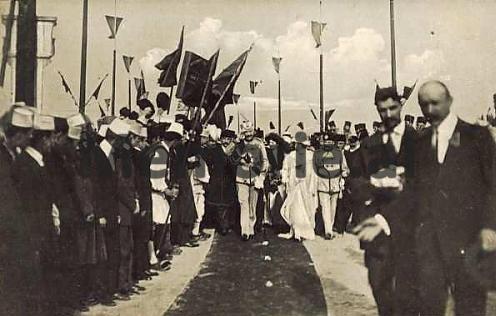
Memorie.al/ The situation was growing incomprehensible grave. During the month of June, the Austrian sculptor Gurschner and the architect Wirth made an appeal to their fellow citizens in Vienna to register as volunteers. They were requested to go and serve in Albania, in aid of the Albanian Prince. Within just one week, three thousand volunteers registered in their studios, including several officers. Only those who had completed their military service were accepted. Additionally, 400 foreign volunteers in Trieste stood ready to defend Wied. The press had welcomed such an initiative, stating that Austria could not allow Albania to be dismembered and divided without a single shot being fired in its defense.
However, Italy viewed this Austrian initiative with suspicion. The Italian ambassador in Vienna had told the British ambassador that he saw this movement as an open contradiction to the agreement existing between Italy and Austro-Hungary. Furthermore, Count Berchtold, whom he had met a few days prior, had not mentioned this alternative to him at all. He himself had no intention of questioning him about it. Nevertheless, the arrival of a disorganized crowd of Austrian volunteers in Durrës could trigger a conflict. At the same time, he expressed doubt regarding the authorization of such an expedition. Yet, after 400 volunteers – mostly foreigners – had arrived in Trieste; they declared they were determined to go to Albania at their own expense.
Terwin Registers Her Name as a Volunteer
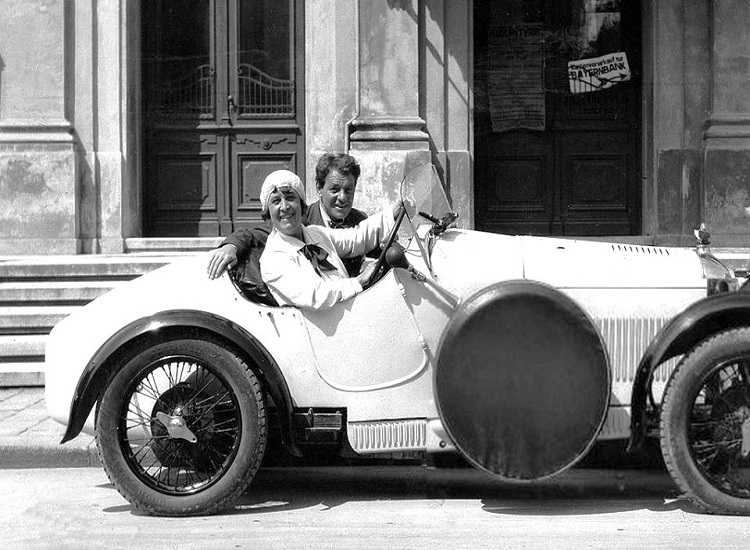
Registration in Vienna continued. Hundreds of people were jostling to sign their names on the recruitment list to depart for Albania. Meanwhile, Italy and Austria approved Prince Wied’s request for three Romanian battalions to guarantee the maintenance of order in Durrës. On one of those days, a woman arrived at the door of the sculptor’s studio. She had recently begun to make a name for herself on the Viennese theatrical stage. The lady occupied nearly the entire space of the doorway, leaving little room for light to enter. The sculptor stood up and shook her hand. It was the first time during those days that a woman had entered there alone and unaccompanied by anyone.
Meanwhile, the architect put on his spectacles to get a better look. “My name is Johanna Terwin. I am an actress,” she said, shaking their hands. She then stood waiting for their reaction. “Please, go ahead,” the sculptor told her, assuming that a mistake must have surely been made. “Here we assign combat positions, not roles for actresses.” The architect made a sign indicating that the sculptor had been too hasty. “Please, madam, speak,” the architect repeated. “I want to register as a volunteer for Albania,” she said. “Surely there is some misunderstanding,” the sculptor rushed to say again. “We do not accept female volunteers, only men. Furthermore, only those who have completed their military service.”
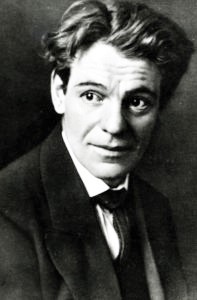
The actress shook her head. She had been living with Alexander Moissi for three or four years and knew his weaknesses regarding Albania. It was the country he loved most. The conversation with her husband the night before had been precisely about this registration of volunteers. “Very well,” the actress said, “I want to register my husband. His name is Alexander Moissi. He meets all the conditions. Besides, he is of Albanian origin.”
The sculptor lowered his head. He had long known of Alexander Moissi’s fame and did not wish for the names of actors to be included in his list of volunteers. For, while this initiative might indeed look like theater, no one could predict its end. Therefore, he replied: “Tell Alexander to continue to shine as before, because his name has reached America. Indeed, even to the end of the world. But here, on our list, we cannot register him.” “Why?” asked Terwin, seriously concerned by this rejection. “Alexander is of frail health and might not withstand the dangers of war. People are going there to win, but they might also die. It will be a proper front against the Serbs, Montenegrins, and Greeks. Perhaps even against the Russians or the French. No one intends to carry or transport fragile actors on their backs, who might faint at the sound of a bomb,” he said calmly.
“Alexander is not the type to faint from bombardments,” Terwin interjected. “I just told you that he is Albanian. That is enough to understand that he is stoic. That people has grown up amidst suffering. Write him on the list!” the actress said in a commanding tone. But the sculptor refused, giving a definitive “no.”
The actress pulled a notepad and a pencil from her pocket and addressed the sculptor: “Then give me your name, since you refuse to write down the names of the volunteers. I will report you to the Ministry of War.” The sculptor crossed his arms and turned to the architect as if to say: “Look what trouble I’ve run into!” At that moment, the architect picked up another notebook and wrote down the name: Alexander Moissi. “I have written it,” he said, “thank you for your trouble!”
The actress shook her head, convinced that they were deceiving her. But she could do no more. Inadvertently, she murmured the words: “No one hurts more for Albania than Alexander.” On the other hand, with the instincts of an artist, she had understood that these lists might serve formally to support the independence of Albania or the Prince of the Albanians. The real weight remained upon the politicians, and especially upon the Albanian people and the militaries with war experience.
Moissi, with Two Albanian Passports
When he learned that Wied was to be appointed prince of the Albanians, Alexander Moissi requested a brief meeting with him. However, the meeting did not take place due to the fact that he was occupied with rehearsals day and night. Nevertheless, he notified Prince Wied that as soon as he assumed the leadership of the Albanian state, he would ask a favor of him. It concerned an Albanian passport to verify his identity.
Prince Wied fulfilled the great actor’s request, providing him with an Albanian identification document. This is proven by the fact those three years later, in an interview for a German newspaper where he also spoke about his origin, Moissi stated: “I am Albanian and I am equipped with a regular Albanian passport from the government of Prince Wied.” It appears that Wied’s passport may have become invalid, as an previously unknown document has recently been discovered regarding another issuance for Alexander Moissi and Johanna Terwin, with another passport in 1933.
Here is the document:
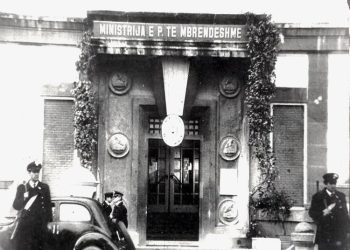
In 1933, a time when he was Minister of Internal Affairs, Musa Juka proposed to the Prime Minister’s office to fulfill the request that Alexander Moissi had made in Vienna to be granted Albanian citizenship. Musa Juka explained that Alexander Moissi belongs to the Albanian race. His family had relocated from Kavaja…! Taking into consideration his profession as a dramatist, which can be of value to the history of our nation, we propose that the Council of Ministers accept his registration, along with his wife, into the citizenship of his own race, with a definitive residence in Kavaja, requesting that after being reviewed, “the possibility be seen to present it for a Royal decree based on Art. 9 of the Civil Code, granting Albanian citizenship to the two mentioned artists of importance, one of whom is of our Albanian race.”
On February 26, 1934, the Council of Ministers took decision No. 91, which stated:
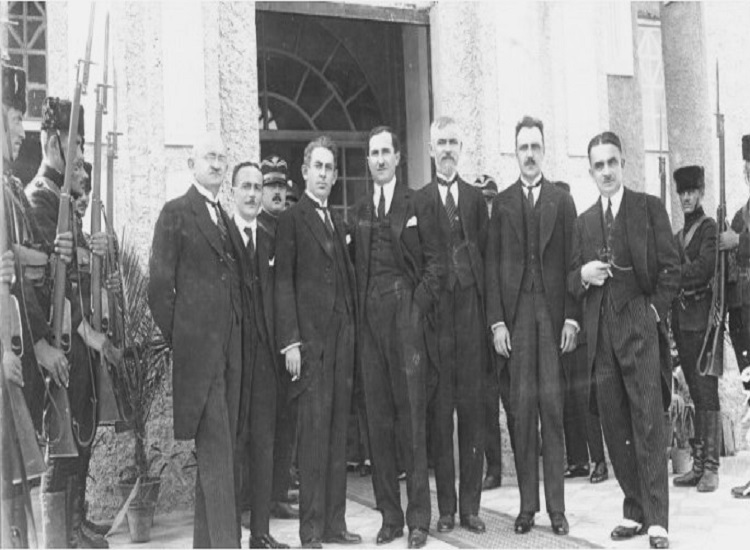
“The Council of Ministers, in its meeting of today, held under the chairmanship of Mr. Pandeli Evangjeli, Prime Minister, with members Mr. Vasil Avrami, Minister of Justice; Xhafer Vila, Minister of Foreign Affairs; Musa Juka, Minister of Internal Affairs and Deputy Minister of National Economy; Abdurrahman Dibra, Minister of Finance; Dr. Mirash Ivanaj, Minister of Education; Sandër Saraçi, Minister of Public Works, examined the proposal of the Ministry of Internal Affairs and the Ministry of Foreign Affairs. Given that Mr. Alexander Moissi, now a German citizen residing in Switzerland, has never denied his Albanian nationality, ‘taking into account also the numerous services he has rendered to our country in the greatest states of the world through his profession as a renowned dramatist, upon the request made by him, based on Art. 9 of the Civil Code, Albanian citizenship is granted to him, along with his lady Giovanna Moissi-Terwin, also an artist, of German origin and born in Munich on 18.III.1884.’”
The Prime Minister’s office presented the matter for decree to His Majesty the King. On March 14, 1934, Zog I, King of the Albanians; “Upon the proposal made via document No. 1732 ex. 33, dated February 28, 1934, of the Prime Minister’s office,” decrees “The approval of the aforementioned decision, No. 91, dated February 26, 1934, of the Council of Ministers, and orders its implementation.” This document is signed by King ZOG (m.p.); the Prime Minister, the Minister of Foreign Affairs, and the Minister of Internal Affairs (Musa Juka, m.p.).
At the end of the correspondence, there also exists the document belonging to the date March 19, 1934, which contains the following text:
“We have the honor to present to you that the decision of the High Council of Ministers No. 91, dated February 26, 1934, decreed by His Majesty the King, was transcribed in the Municipality of Kavaja on March 28, 1934.” (AQSH, Fund 152, File 484, pp. 2-7) Alexander Moissi.
The Absence of a Serious Albanian State: A Sorrow for the Great Artist
Alexander Moissi was an Albanian artist renowned across all continents. His dramatic roles astonished the art-loving public of that era. He performed on dozens of world stages in Austria, Germany, Turkey, America, Switzerland, Norway, etc. He held the most prominent roles in world dramaturgy. Yet, Moissi had experienced the trauma of his identity since childhood, as he was called “a man without a homeland.” Some called him a Jew, others called him Italian. A segment considered him to be of undetermined citizenship.
This attitude had turned into a sort of inferiority complex that constantly tormented him. During the years 1889–1891, the Albanian actor had managed to raise the awareness of the entire intellectual world with his magnificent voice and talent. Yet the drama of the non-recognition of his Albanian identity was the most shattering. At that time, stating publicly in the middle of Europe that “I am Albanian” was considered a sort of inferiority. Alexander Moissi declared this hundreds of times. Indeed, in journalistic interviews, he published his origin almost with pride. He spoke of his ancestors, and of his father who had died in 1898.
In the years 1912–1913, Moissi was reaping extraordinary success with the drama “Fedya.” In March 1913, when Russia was playing a denigrating role toward the Albanian nation, influencing the London Conference, Moissi went to St. Petersburg to play the lead role of Tolstoy’s Fedya, with which he unmasked the old world. Following the play, the long applause of the spectators kept the actor on stage for several minutes. They gifted him many smiles and bouquets of colorful flowers. It was his first tour in Russia.
One morning, an official from the Ministry of Culture would invite him, wishing to give him a gift. Upon meeting him, he would ask about his origin. “I am Albanian,” Moissi said simply. The Russian official froze and made no movement. After a moment, he said to him: “Albania is not yet a state, and it is not known what it will be.” “You are mistaken,” Moissi replied. “The Albanians are one of the oldest peoples in the world. I perform on foreign stages for the time being only because there are no theater halls over there.”
The Russian was shaken by this bold statement. He had thought that under conditions where the Albanian state was in a coma, any prominent European artist or citizen would hide their Albanian origin so as to not lose points before their interlocutor. But Moissi was unaffected by the souring of his dialogue partner. “I am Albanian,” he said again, adding: “As soon as the legal state is sanctioned, I will go to Albania to obtain my Albanian passport. I have my father’s house there and some of my sisters.”
This manner of speaking impressed others who attended that conversation. Perhaps they would have liked to believe, or at least until then had believed, that no Albanian was worthy of being so famous throughout the world. “Nyet, nyet,” the official’s wife said to him. “You are not Albanian, and there is no way you can be Albanian.” Moissi cast her look that showed regret for the misunderstanding created. She lowered her head. The conversation ended there. But this stress experienced by the actor due to his ethnic affiliation, resulting from the lack of a serious state for the Albanians, forced him to be constantly current with the events occurring in Albania.
Wounds Bleeding Black, Who Would Not Feel Pitiful!
The middle of 1914 marked grave events for Albania; the infamous Protocol of Corfu had been signed but was not being implemented, as the Greeks had rushed toward Albania. In the North, the Montenegrins demanded the Vermosh valley. They wanted to take the entire coast of the Buna River at any sacrifice. In this cacophony of events, the Greek government issued a decision for the expulsion of 10,000 Albanian refugees of the Muslim faith, who had sought shelter as refugees following attacks by Epirote bands. Meanwhile, the Balkan neighbors annexed large territories from the Albanian borders.
Serbia profited the regions of Pirot, Vranje, Niš, and Toplica, while Montenegro, which also gained its independence for the first time, profited the regions of Nikšić, Kolašin, Spuž, Podgorica, Žabljak, Bar, Plav, and Gusinje. Following great Albanian resistance, instead of Plav and Gusinje, Berlin would grant Montenegro the entire territory of Ulcinj. The London Conference institutionalized the Balkan crime against Albania and severed entire regions, cities and villages, plains and hills, parts of seas and lakes from the motherland—areas that had traditionally been Albanian for many centuries.
This historical injustice removed from the map of Albania Prishtina, Gjakova, Prizren, and the entirety of Kosovo, the Plain of Dukagjin, Ulcinj, a portion of the Vermosh zones, Plav and Gusinje, Skopje, Tetovo, Janina, Preveza, Chameria, a part of Lake Pogradec, a part of Lake Shkodra, and so forth. For 100 years, the Albanian nation has languished under the consequences of this treachery, constantly endeavoring to remedy something from the insidious decisions of that massacre. / Memorie.al