By Alma Mile
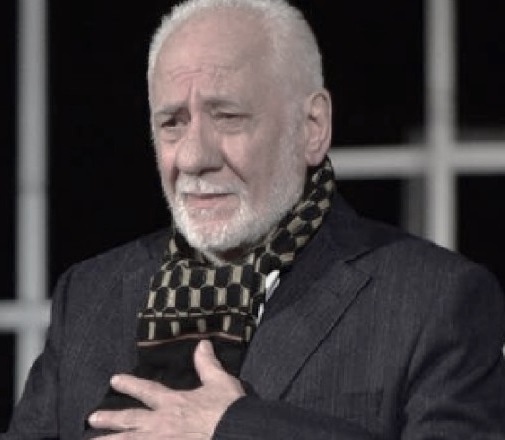
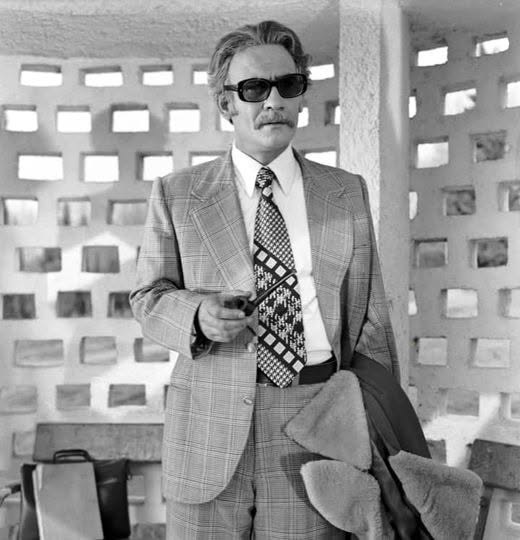
Memorie.al / When you sit at a table with Reshat Arbana, it feels as though you have before you a film character. Handsome portrait, powerful voice, inspiring figure…! It is impossible to hold a conversation without being interrupted by dozens of greetings from people wishing him a good day or wanting to shake his hand. It is still early, because in all likelihood there would also be those who would want a photograph with the actor, one of the best of the Albanian stage and screen.
“You cannot buy a name with money. The name is given to you by that simple person who greets you on the street,” says the actor, who returns everyone’s greeting with his hand on his heart. He has performed 45 roles. Not all of them are dear to his heart, but for all of them he worked hard, and when he hears debates about banning films or “uncovering truths,” it is impossible for him to hide his indignation.
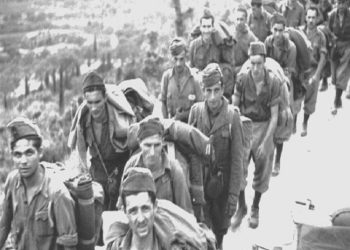
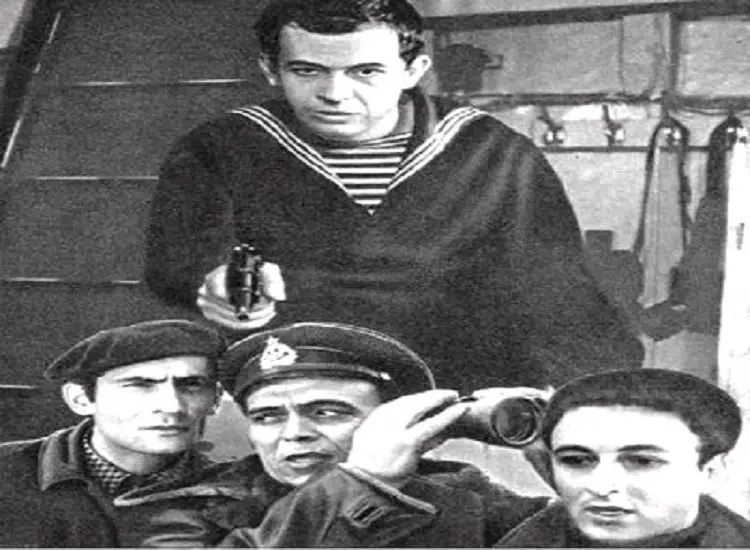
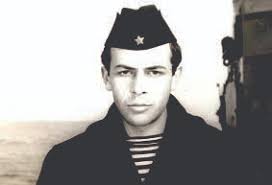
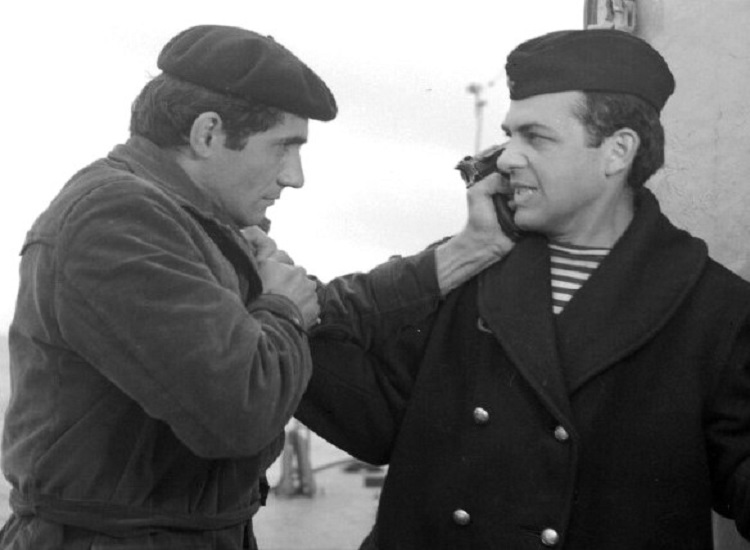
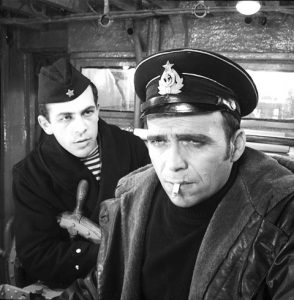
“We have given so much of ourselves, we have been moved in order to give people emotion, that I do not understand how someone can come out and say, ban it!” says the actor. According to him, to think today that the films of the early ‘90s stir up communist ideology among young people are entirely absurd. Even though he does not follow the media closely, because not rarely, according to him, they tell untruths and distort words, he responds to the invitation to recount something from his experience, in the cast of the actors of the film “Duel i heshtur” [Silent Duel].
He had the role of Islam, one of the sailors who sought to escape. A few days ago, the former director of the Archives of the Ministry of Internal Affairs published some documents and cast doubt on the veracity of the events treated, something the journalist Fatos Baxhaku had also done earlier.
Reshat Arbana, “Honor of the Nation,” recounts how the filming of the film was carried out on the open sea amid waves, how he met Spiro Kote, and the meeting with Vlashi from Rrogozhina, who claimed that he was precisely the character Arbana played in the film. Among other things, he recalls how he became an actor and how much this profession has given him…! Not money, but the love of people.
How did you become part of the cast of the film “Duel i heshtur”?
I had just finished school and had done a role in the film “Komisari i dritës” [The Commissioner of Light] with a screenplay by Llazar Siliqi and directed by Dhimitër Anagnosti and Viktor Gjika. There I had the role of the servant of a gang leader, who was against the opening of schools, whom they called “Doda’s puppy,” Nikollë Mustaqeziu.
It was a film that I liked and that was well received by the public, with an artistic realization that, to tell the truth, we no longer encounter today. This role led me to the film “Dueli i heshtur,” in the role of Islam Kallulli. I did not think I could get that role, because I was very young. I remember that the director and the screenwriter had had friction, because of some cuts in the screenplay.
In the end, the film was intended so that the sailor, when he returns, after having triumphed over the enemies, meets the commissioner and the sailors and says the expression known in the army: “I serve the People’s Socialist Republic of Albania.” Likewise, as far as I have heard, the screenwriter was not in favor of me taking that role, since in his idea, Islam was a hardened enemy, older than me…! Nevertheless, the director had decided it.
The filming took place on the open sea; how difficult was it for you?
We began filming on January 16, 1967. It was winter and the atmospheric conditions were very bad. I remember, one day we went out for filming, but the meteorological center had forecast a sea of force 7-8. It was an extremely frightening sea. I did not go out, and along with me Ndrek Luca as well. We did not agree to do filming that day, because it was too grueling. We suffered in that film with the sea, more than can be told. The sea is extraordinarily beautiful, but from the shore; when you go into it, you must be very strong.
Even with force 2-3 it made us dizzy, the sea overcame us. Today I distinguish myself in some episodes that I was dizzy, but we had to film. Even the captain of the motorboat did not go out, and Spiro Kote himself took the helm. I recall Rikard, the wonderful cameraman Petraq Lubonja, as well as another worker, the sea did not bother them and they went out to sea. After 1 hour or 1 and a half hours they returned, very tired and without having completed the work. In short, it was very difficult.
The film is based on a real event; was it still spoken of even 20 years later, when you did the filming?
When we finished filming, the premiere was given at the summer cinema in Durrës. The film had great success, and after the premiere, during a cocktail at the “Durrësi” restaurant, while I was with a friend of mine, drinking a glass at the bar, someone comes up from behind me and pretends to put a pistol to my hip. Not that I was frightened, but I turned around immediately…! “Hey Reshat Arbana, why did the event happen like this, as it was in the film?!” he said to me. “You have made a good film, let me tell you the truth, but the event did not happen like this. The truth was that we wanted to leave and we did not take this into account at all. He asked us, where you going and we are replied: we are escaping, haven’t you understood yet. No, my friend, he told me, I know that we are going to look for the commissioner.
No, my friend, what commissioner, we are leaving. He did not prolong it; he took the machine gun and fired at us. I survived. I am from Rrogozhina and they call me Vlash,” the man continued. “But we have made a film, Vlash, and that event that happened to you, we could not do it word for word, since this is an artistic creation,” I told him. So, this is a dialogue that I really had with this man.
Was he a survivor?
A few years ago, Fatos Baxhaku did an article about this event and I told him the story of Vlashi, of this man who spoke with me, who told me that the role you play is me.
Did you ever meet the hero of the event, Spiro Kote?
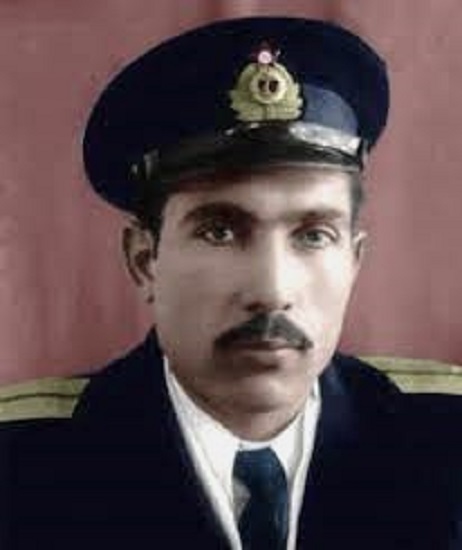
I remember Spiro Kote very well. He was a strong young man, an interesting figure. When we were going to make the film, a consultant was sought for the event. As far as I know, it was proposed to Spiro, but he refused. He came once when we were filming, and when we met him personally, we noticed that he did not know how to exchange two words. We wished to gather and have him tell us the event, but he refused.
Did this not make you doubt the veracity of the events?
As far as I remember from what was said at the time, after the ship had returned, Spiro was arrested to clarify the event, how he managed to kill the sailors, lest perhaps it was some mistake of his. They held him for some time and then released him and declared him “Hero of the People.” As far as I know, he went for studies in the Soviet Union, returned to the Fleet. He was a respected man, even though he was not distinguished for any great eloquence. As for the truth of the events, I cannot say how they were, whether Spiro Kote was a great patriot or whether the situation was created as such. It is difficult to judge today. One must judge with the mentality and psychology of the time.
Today many “brave men” come out who give advice and judge, while they themselves have done nothing. Heroes are turning into enemies and enemies into heroes, but history is stubborn. But I can say with conviction that we made a film that ranks among the top productions of Kinostudio. That is enough for me. In these times when our country has so many troubles, that it walks and does not know where it is going, these “problems” seem to me excessive, “a burden upon the saddle.” This people are loaded enough with daily troubles.
What do you think is the reason for this “campaign” against films made before the 1990s?
They justify themselves with the idea that the feelings of communist ideology might be ignited among young people, that they create nostalgia with their themes full of partisanship… But who has more desire for communism to return?! The fear of the return of communism is a fairy tale with a king. They simply want to hit some truths. They want to convince us that art also began with democracy, but this is not true. Art did not begin in 1992.
The great artists were made in that time, with those values, with those pieces, and they remain figures that the people do not forget, that they hold in mind and soul. I have made 45 films and I did not receive a single lek. If I make a film today, I receive a good reward. But do you see how many people come and meet me?! These are values that cannot be bought with money. A name cannot be bought with money. The name is given to you by that simple person who greets you as you walk.
And yet, you cannot say that all the films were good or that partisanship was absent…?!
Of course, not all 300 films that were produced were good. In fact, there are cases where I say that some films should not even be counted as such. Not all are embroidered artistically, but if from them the spectator can see 150, it is a great victory. We made 14 films a year, because that was the plan. Of them, not all were good. If there were 3-4 good ones, realized in those conditions so difficult, it was a great thing. I was a simple mechanic in the Truck Park, and these films made me known. I was anonymous; the film, dramatic art, made me known.
From mechanic to actor, how did this transition happen?
The cause was a friend of mine from Përmet. It was time to go as soldiers. We were both tall and they would send us to the Navy for a full 48 months. And, rather than going as soldiers, it was better to go to school. It was he who pushed me toward the school of actors, even though I did not want it, because I was timid. And yet I went.
We prepared those materials that were required. We did not work with any actor. We went with our own mind. At the head of the jury was Nina Çefranova, artistic director of the theater and a very good director. She asked the translator to tell me to improvise a moment as if I were the director of the park. We were at the end of the year, the plan had not been fulfilled, and I had to hold a meeting with the collective and I had to mobilize them…!
I did not agree. Apparently, the way I reacted pleased her. After two days the lists of winners came out. Of course I had no hope; nevertheless I had my name on the list, while my friend did not. I completed 4 years of school with excellent pedagogues. As pedagogic head I had Kadri Roshi, with whom I developed both artistic speech and the craft of the actor.
Strangely, they did not send me to the theater, but to Radio Television. After 8 years I did the party internship at the Geological Plant and returned again to Radio. Thanas Nano informed me that I would move to television with the group of directors. I did not agree and insisted that I leave. Finally I went to the theater. If it were today, I would not have agreed, since I faced a very great workload. On one side roles in the theater, roles in film, dubbing, meetings…! A tiring work, but that gave me an extraordinary satisfaction, which I see was not bought with money.
45 roles is a lot; among them are there roles of the heart, that you could play at any time?
Even today I am amazed at how I did them. And it has not been simple. But among 45 roles, only 6 or 7 are dear to my heart. I would have wished to return again to some roles, but age does its own thing. I would have wanted to return to the role of Selim Bruka in “Familja e peshkatarit” [The Fisherman’s Family], or Sami Ameni in “Fijet që priten” [The Threads That Are Cut]. I was 34 years old and we worked a lot to achieve that figure.
But I believe the role of Isa Boletini marked you, so much so that even today one confuses the figure you realized with the real figure…
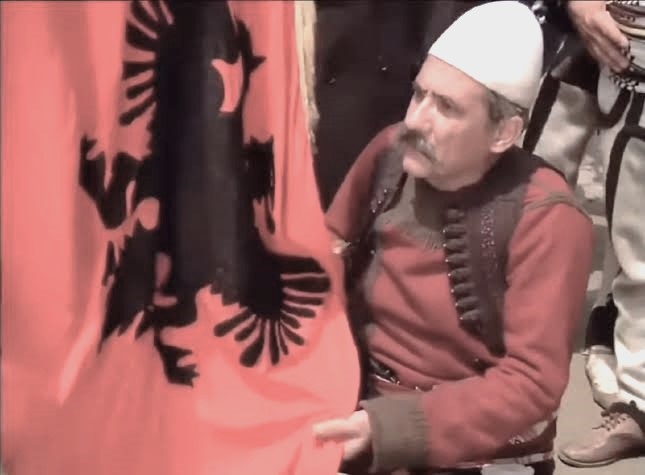
Yes, it is true. Photo tests were being developed and the late director Viktor Gjika had placed side by side a photograph of mine and one of Isa Boletini. Both were black and white. And, at first glance, even I did not distinguish them. Once Aleks Buda, a great figure, former president of the Academy of Sciences, after having seen the film, meets me and tells me that we should have made another film, properly about Isa Boletini, while I was still strong. As far as I know, Vath Koreshi built a screenplay, but it remained unfinished. We are indebted to these figures, who have contributed so much for Albania. But a film needs a lot of money…
Money is thrown around, but it seems the bottleneck is the themes selected. Why do we no longer see everyday life in a film?
There are so many themes…! Albania is so loaded with themes, as it has never been before, but an auto-censorship is felt on the part of the directors. Even when we treat social themes, we treat them lukewarmly. There are social themes that shock you. Do we have interesting figures, people, good ones? Yes, there are, but they must be found, sifted…! Let us recall the film “Dora e ngrohtë” [The Warm Hand], which reaped an extraordinary success, because it treated the theme of the day, broke the schemes, treated the theme of the family, brought before the public also the investigation, the prison, the figure of the scoundrel…!
How many stories like these are there?! We have had very good directors and they made very beautiful things. Together with my colleagues we have had to face difficult roles. I have in mind Kadri Roshi, Sulejman Pitarka, Prokop Mima, Naim Frashëri…! What roles, what pieces! I recall “Arturo Ui,” staged in 1971. A model show, resolved so beautifully with 17 scenes by the great Pirro Mani and the master of scenography, Agim Zajmi. Can the National Theater realize it today? I say no, because there is no longer an Arturo Ui (Kadri Roshi), a Zhivola (Prokop Mima), Ndrek Luca…! Not that today there are no good actors, there are, but if they had the same love for the work as we had, they too could achieve it. There have been good shows in these 25 years, but not of this level. / Memorie.al