By Auron Tare
Part Two
Memorie.al/ From Cairo to Albania. First with the nationalists and later with the communists. James Hudson, former captain of the American secret service, in an account about Albania in 1943.
I would like to begin with a simple question: Who is Captain James Hudson?
I finished college in Pennsylvania and graduated in chemistry and physics. I was selected by the army to be an officer of the American special services. They put me into several projects and trained me in how to deal with microfilms and other things of this kind. The reason was that they needed someone to record with a handheld camera the events of the war. That is, a chronicler type.
Continued from the previous issue
Did you meet any leader of the local partisans?
The partisans treated me well and I never had problems with them. I almost always had with me an Albanian-American, such as Albert Toli or Nik Kukiç, who translated for me, since I did not speak Albanian, something I should have learned from the beginning. I was a bit lazy. I could not converse properly with them, although it is strange how sometimes one manages to communicate with signs and gestures without knowing the language. They gave me food from time to time, even though when I jumped I had 20-30 packages with me.
We could not take much, because it is not good to have many parachutes with equipment when you jump. The leaders always treated me well. The word they often used was “Tedski,” they would point with a finger in one direction and wanted to tell me to be careful of the Germans.
In your view, did you think the partisans were fighting the Germans? Did you get the impression that they were the only force fighting the Germans?
No, not at all. I told this to Fultz and to all the others. I did not agree with Tom Stefan, throughout the whole time. The partisans stayed in isolated areas. One of the things they did was that they had a good defensive perimeter.
Whenever a German truck passed, there was a squad on it, so almost every kind of German truck you saw would have 12 men. They were trained in ambushes to stop immediately and jump from the sides of the truck. They were trained not to make noise, so they would jump and not shoot.
I tell you that it is very difficult to find guerrillas that you can train. They are an independent group and each one is in his own head and they shot everywhere. As a result, the Germans would discover them immediately and shoot them. Because the guerrillas lost many men in this way, what they usually did was to let them escape, because there was nothing strategic there, only mountains.
They had their equipment in very isolated areas high in the mountains, in those partisan camps where perhaps Hoxha stayed. I imagine, because I never saw it, that they must have also fought some hard battles, because they tried to find the best equipment. But those I met were usually in this protected perimeter. They treated me well, they helped me.
What do you think about General Trocki’s document, which says that the partisans were the ones who should have been equipped with armaments?
I thought of it as an unwise thing. I could see how senseless it was as a strategy; we did not have a tactical mission, we did not have troops in Albania. Tactically we had no business being there, strategically yes, since it was part of the Balkans. Our mission was to liberate Albania and not to fight with Albania, nor to fight with the Germans in Albania. We wanted to liberate it, you know, it would be the first country to be liberated in all of Europe.
So we only wanted to liberate it and the best way to liberate it was to leave it in order. The Germans left and you have a state, a government. It is not so easy to form a state; there is a lot to do. So people like the Frashërs kept the state on its feet. They had an infrastructure, not much, but it was something.
Did Fultz instruct you on how to behave with the partisans?
No, never.
Did he instruct you, or did you hear the idea of creating a spy network that would be used even after the war? Did Fultz think about after the war?
Actually he never told me this openly, but I certainly felt such a thing.
Was he trying to create a network that would be used after the war?
Yes, but I cannot say for sure whether he wrote it or told me such a thing. He did 99% of his work with Memo.
Enver Hoxha accused Fultz of being an American spy and of using his students to gather information. Do you think he was right about this matter?
No, I do not think so. I think Fultz agreed with the agreement or decision of the English to equip the partisans against the ‘National Front.’ Fultz almost had the same views as me regarding the ‘National Front.’ He was a boy from Tirana; he had lived in Tirana and knew the government well. He was not Hoxha’s type.
You would not see him in the mountains; he was an educated city boy, sharp and very intelligent. He never left me with the impression that after the war he would do something against someone. I think he was playing straight and was part of the American army, trying to win the war.
I have read some reports where the American OSS was complaining about the treatment by the English. It seemed there was a kind of rivalry between SOE and OSS in Albania and that SOE did not like having the Americans underfoot…?
In the group I worked with and the others, we were everywhere in Albania, we never had any problem with the British Secret Service, we were all one. The English Service boys who came for special missions, of the type to blow up bridges etc., were hard to meet. Very rarely might I have seen any of them.
Who did you meet from the British? Did you meet Smiley or…?
Yes, I met Smiley.
Julian Emery?
No, I do not remember this one.
But you did meet Smiley?
Yes, yes.
I would like to know some personal detail about the Albanian-Americans with whom you worked, such as Tom Stefani. How was Tom Stefani?
Yes, I knew him quite well. He was a very official boy who was not much liked by his own people, but who mastered the Albanian language well and was an officer. This was a very big difference and it was surprising, because even in the American Service, officers felt different and were treated differently.
Harry Fultz knew that you were operating and working in a territory of the National Front. Why did he parachute you into Enver Hoxha’s Headquarters?
For a very good reason. They knew that this commander’s time was coming.
Harry Fultz parachuted you near Hoxha’s Headquarters, for what reason?
Fultz no longer trusted Tom Stefan. Tom became so close to Hoxha that they were hardly separated. The Service boys were constantly evaluated by their superiors and terms like “inclinations” were used and he was inclined… I do not accuse him, but he was inclined toward the communists. In my case, there was no doubt; everyone knew that I was pro-‘National Front.’
Did you have the feeling that perhaps the communists had penetrated OSS information?
Yes, I did. I certainly believe this.
Do you believe that the partisans infiltrated the American Service?
Yes. And I will tell you why. I knew some OSS officers who had no connection with us, but they knew a lot. And I think they were communists, American ones. They approached me in Bari quietly and carefully, but I told them that I hated communists so much that they moved away from me. But of course I believe there were communists infiltrated in the ranks of the American Service.
You met Enver Hoxha. What did you feel during the conversation with him? Or any detail about him or the people around him?
I never socialized with him. I only had official meetings regarding that problem of the landing of the commandos. What he did when he met me was that he began to ask me for a list of materials, such as; “I want more ammunition, I want more of this, or that.” We never had any strategic conversation with him, about what he would do in the military field.
But I had heard enough from his people that they intended to take over the leadership of the country and about this there was no doubt. They did not give details about whether they would kill all their enemies, but I had the impression that this would happen and much blood would be spilled when they reached where they aimed. All these things I tell you, I have documented. Many such, letters from Fultz, about how to build intelligence, about how Tom was taking another role, etc.
What did you think when you met Hoxha? Did he seem to you like a guerrilla fighter, or like a commander of his own people?
Of course I felt that he was like one who commanded. There was no doubt about this, he was a leader. And people followed him, but there was also much fear among them. Was he a dictator then? To be honest with you, they did not call him such, but he behaved like a leader and had all the connections with Russia.
But they were looking for a high authority, because they did not have one. This was typical of all Albanians of that time; they did not have an authority to lead them. The communists had Hoxha, because he was the only person who had a stature with anyone.
Can you classify him as an intelligent man?
I did not talk enough with him to have any philosophical opinion about him, but his person gave you to understand that without doubt he was the commander. There was no one who challenged him as far as I could see. From this point of view, I say that he had full control.
Do you think OSS had its own people among the partisans? There has been a big debate in Albania about the former Albanian Prime Minister Mehmet Shehu, who was a former student of Fultz and a famous partisan leader. Did he work for Fultz during the war?
My opinion is that at that time Fultz had not reached that level of the game. He began to change in the autumn of 1944. Then we all began to think about this and this is why I left and went to Austria, to command an American Service network there. Personally I do not believe that Fultz wanted to go in that direction earlier. But after the autumn of 1944, yes.
In all the documents you have seen, in your knowledge, or in what Fultz may have told you, is there any contact precisely about Mehmet Shehu, who was a student of Fultz and became a very famous communist leader?
I was truly very close to Fultz, although he was not much of a conversationalist as I mentioned. Mehmet Shehu was different. It is not that I got very close to him, but I knew him. However I have not heard anything of the kind.
The English landing in Saranda and the famous orders that you received from Hoxha to go to the British and stop the invasion of Albania. Can you tell me something about this?
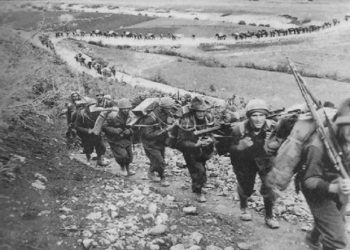
Yes, with details. First I made a journey of 120 miles, in 3 days, which was suicide. The Dukat River was swollen and the streams in those mountains are dangerous when they are in bloom. I had with me a wounded lieutenant of the American air forces on a stretcher and we had to cross the Dukat River to reach the coast.
At one point we separated, but finally I found them again on the other side of the river and so we continued toward the coast. The other thing is that they had placed the troops along the mountain in the eastern part, which did nothing but stay in the rain and were caught by gangrene and other diseases in their feet, and did not have even a pair of shoes to change into; I could not believe they were commandos.
Did they fight any battle there with the Germans?
No, until then. But later yes, they did, but not much. The Germans tried to provoke them a little.
And the partisans? Because you mentioned a famous battle between the partisans and the Germans?
Yes, I know. The only thing we saw was that Corfu affair that they were shooting from the ships with heavy weapons.
That is, the English did not fight much there?
No, certainly not.
In your memoirs, you mention the famous ‘White Book,’ in which the Americans keep the names of friends who helped them during the war. What happened to these friends?
You know that this book was a product of my imagination.
Yes, I know, but I am interested to know what happened to the friends? Were the friends killed or not?
Yes. By the way, since then I have tried to make our army have such a book. Even now there are such examples in the CIA or the Military Service, but no one is interested. Look at what you do, we, all of us. We go here and there and ask people to give their lives, their money, and their homes for us.
What happened to the OSS network that you built? What happened to those people?
This is a very good question. Of course I know about those who were caught and killed, but not about the others.
But do you not think that those people were abandoned to their fate?
Yes. This is what makes me feel bad, and we did this.
Some British from SOE, in fact, like Julian Emery or David Smiley, people known in English society, have written in their books, or said publicly, how the British felt ashamed that they had abandoned their Albanian friends into the hands of the communists. Do you think the same thing happened with the people who helped SOE, that is, they were abandoned to the communists?
Yes. Let me tell you what disappointed me. I saw no interest at all on the part of the Americans, including the OSS. I think they showed no compassion at all for what happened, or responsibility. This hurts the character. But I truly blame much of our fear and the Tehran Conference and along with it the fact that we were so afraid of irritating the Russians.
Who is Captain James Hudson?
He has finished college in Pennsylvania and graduated in chemistry and physics. He was selected by the army to be an officer of the US secret services. He was trained in several projects to engage with microfilms and other special processes.
Called into the intelligence services initially by the need that someone had to record the war. He served for some time in Cairo on the staff of General Russell Maxwell, head of the Command of the American Army Forces of the Middle East. Later he came with a mission to our country. / Memorie.al