
By Erald KAPRI
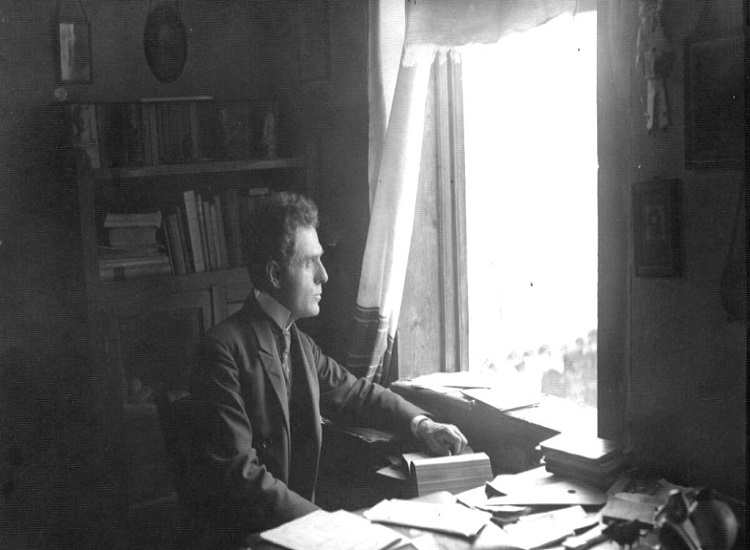
Memorie.al / The head of the ‘National Front’ (Balli Kombëtar), Mid’hat Frashëri, handed the British a rather interesting memorandum in April 1945, after the end of the war in Albania. In it, he confirms that the ‘Balli Kombëtar’ was never a collaborator of the occupiers and fought against them. Meanwhile, Frashëri criticizes British policy for supporting the communists during the war and their seizure of power. Mid’hat Frashëri’s memorandum, addressed to the British government, is addressed to Dr. Okley Hill, chairman of the UNRRA Commission for Albania.
Frashëri gives rather interesting details from the activity of the ‘Balli Kombëtar’, but also the reasons why the communists began the civil war. He says that the communists had a secret agreement with the Germans and this was reflected in several key moments during the war. Specifically, in the spring of 1944, for several months there was no battle between the parties, while many detachments of the ‘Balli Kombëtar’ found themselves caught between German and communist fire. This rare memorandum sheds light on the positions during the war of the ‘Balli Kombëtar’.
THE COMPLETE DOCUMENT
It has been suggested to us that we present this memorandum on the matter of the propaganda of the Allies’ radio against the ‘Balli Kombëtar’, in connection with our so-called collaboration with the occupiers. We, of the ‘Balli Kombëtar’, have been and still are firmly convinced that, in defense of Albanian Nationalism against the communists and in the war against communism, we have worked not only for the good of our country, but also for that of the two great democracies, and thus we have done our part of the duty, to serve all humanity.
Moreover, we have felt good about the hostile stance of the communists toward Great Britain and the United States. The two democracies have been openly accused by the reds in Albania as capitalists, plutocrats, and reactionaries, therefore, as a consequence, enemies.
Disregarding this fact, the Albanian section of the BBC undertook not only to favor but also to exalt communism in the eyes of Albanians, trying to make them believe that the red ideology was not dangerous for them, all the more so Radio Bari, which attacked and denounced the ‘Balli Kombëtar’ (which is Albanian Nationalism), very unjustly and with no concrete facts whatsoever.
It was so pro-communist that it used from time to time the red motto “Death to fascism, Freedom to the people.” And this was done at a time when the secret circulars of the Central Committee of the Communist Party in Albania had already been made public, which denounced the Anglo-Americans and ordered its members to maintain a hostile stance toward the British military missions!
The pro-communists, and consequently also the anti-Albanian propaganda of the BBC and especially of Radio Bari, was then and still is a mystery to Albanian nationalists, who thought that then it was (as it is also now), more in the interest of Great Britain to be an ally of the right, than to collaborate with the communists.
Nationalists are more sincere and more reliable allies not only because of their conviction and love for Democracy, but also for the simple reason that the interests of Albanians go together and coincide with those of Great Britain and the USA. While the communists, being tools of Pan-Slavism in Albania, have entirely different interests compared to those of Great Britain and the USA and naturally will not be the friends, but the enemies of these two countries. The recent events in Greece have proven our viewpoint best.
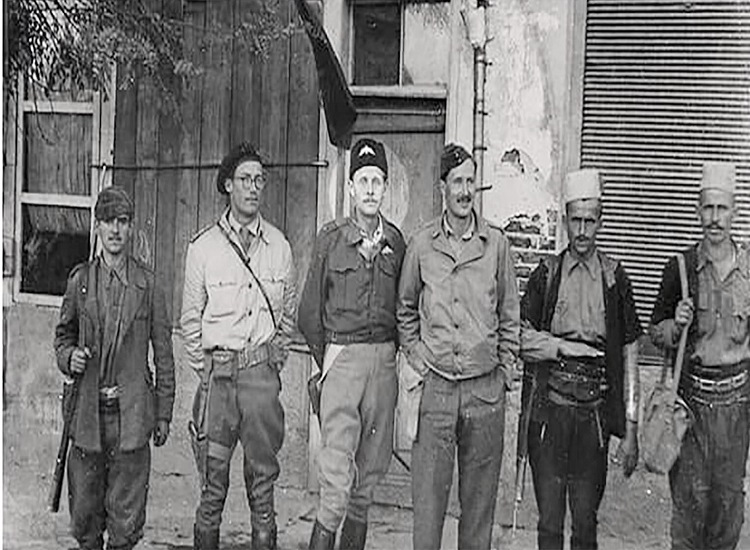
Thus it is also with Albania. Had the Allies helped Albanian Nationalism and organized its forces, as we had asked several times of the British Mission in Albania and especially of General Davis, in November 1943 (giving him a written statement) that we would have been of more effective value in terms of the war against the Germans, than was the National Liberation War and in terms of preserving the cause of democracy in the Balkans.
Even though the communists openly showed their hostility toward us and planned their attacks against us, we did everything to be tolerant, thinking and saying that they, too, were sons of Albania and that a day would come when they would feel and act with more reason.
The main goal of the ‘Balli Kombëtar’ has been the war against the Italians and Germans. But the communists not only attacked us with all the means they had, but also dared to collaborate with the enemies of Albania in their attacks against the ‘Balli Kombëtar’. There are numerous cases in which the communists attacked us, precisely at the time when we were engaged in fighting the Germans.
And the British military missions have been aware of this. Only when we were attacked by both sides, then we were forced to suspend the fighting against the Germans and defend ourselves from the communists. Sometimes, during this period, even the Germans attacked the communists according to their own calculation. This situation made the reds try to present to public opinion in Albania and abroad as “collaboration between Albanian nationalists and the Germans.”
But if that is to be called collaboration, then the communists themselves have collaborated with the Germans, when it is judged that they attacked and fought us at the same time that the Germans were attacking us. In the battle of Preza, for example, on September 14 and October 15, 1944, the Germans attacked our positions with grenades, while the communists attacked us from three sides. So, the argument of “collaboration” works very well in reverse against the communists themselves.
Moreover, the communists have been several times in direct contact and understanding with the Germans during the Nazi occupation of Albania. One case is when the communists entered the city of Berat, in September 1943, after the capitulation of Italy: they were on very good terms with the Germans, who moved freely through the city without being touched by the reds. This agreement was made by Gjin Marku, the red commander, and the Germans, through Iljaz Sevrani, red commissar of Berat, who acted as intermediary, and this situation lasted three weeks.
(The Chairman of the Special Court of Tirana, Bedri Spahiu, admitted this fact and tried to justify it to a certain extent). Another very important example of the day is the visit that German Major Hanz made to the communists’ headquarters in Skrapar, March 1944. They reached an agreement there, and it is a fact that for three or four months after that visit, neither did the communists attack the Germans, nor did the latter undertake any operation against the reds.
If this cannot be called collaboration, nothing else can be called so. From the middle of the summer of 1944, the ‘Balli Kombëtar’ decided to resume the suspended fighting against the Germans, based on the encouragement, impetus, and threats of the BBC and Radio Bari, which were attractive, not only for the organization as a whole, but also personally for its president Mid’hat Frashëri (BBC, September 9, 1944).
The fighting began in the first week of September and developed in the village of Preza and the surrounding area. But even then, the ‘Balli Kombëtar’ was attacked twice fiercely by the communists, as we have already mentioned, even though the Allied Military Mission, which was staying with us, was not very far.
In the operations that the Germans undertook against the communists in Albania, the militia also took part as a people’s force, which belonged to the surrounding villages. But it is superfluous to say that these forces had nothing to do with our organization: the only thing they had in common with the ‘Balli Kombëtar’ was that they were anti-communist. As a typical example of these people’s forces, we can mention here those of Dibra, where the ‘Balli Kombëtar’ did not have any guerrilla group of its own.
These people’s forces of Dibra fought fiercely against the communists and kept them away for a long time; the communists managed to get out of the situation in the region of Dibra only when they brought to help their Macedonian brigades of Tito, composed of Slavs.
Another example is that of Elbasan, where the only guerrilla force of the ‘Balli Kombëtar’ was that of the region of Polis under the command of Nezir Muzhaqi; the other groups were only people’s forces that fought the communists, but had nothing to do with our organization.
In order to get us into trouble with the Allies, the communists, as well as the Germans, tried to make public opinion believe that Irfan Ohri, Nuredin Dino, Vizhdan Risilia, Halil Alia, and others, were members and commanders of the ‘Balli Kombëtar’. But in fact, these people and their sympathizers were never members of our organization, nor did they command any force of ours.
We have denied this categorically several times in our newspaper “Flamuri” and in the leaflets we have issued. We especially emphasize here the fact that, even though we had suspended our hostile actions against the Germans because of the communist attacks, we have always had a hostile stance toward them.
The fact that for the moment we were not fighting them did not make us their friends. The harsh leaflets that the ‘Balli Kombëtar’ issued in November 1943, against Irfan Ohri and the Germans, speak for itself and needs no comment. So, the Germans knew very well that the reason for the suspension of our fighting was communist pressure: as a result, they greatly suspected our pro-Allied tendencies and feelings and fought our organization.
It suffices to mention here the infiltration and internment in Serbia and Germany of hundreds of members of the ‘Balli Kombëtar’ from the prefecture of Vlora (1943-1944); and the killings (beginning of August 1944) of lawyer Skënder Muço, member of our Central Committee, and Professor Yzeir Ismaili and Zako Mezini, members of the zonal Committee of Vlora.
All three were arrested by the Germans near Vlora and killed by them in the vicinity of the city of Lushnja. The German viewpoint regarding the Balli Kombëtar is also expressed in the confidential brochure, issued by the German command for the use of its troops in the Balkans.
On its cover we read: “Nur für Dienstgebrauch Truppenmerkblatt -Nordest-Ballkanit-Herausgegeben von der Dienststelle der Feldpostnummer 00.049.” On page 26 of this brochure we have: “Die Fronti Nacional (‘Balli Kombëtar’) ist eine nationale democratische Partei, die eher zu Angli aks zu hinneigt Deustchland. Ihr Führer ist Mitat Bej Fraschery.”
“This means: Fronti Kombëtar (‘Balli Kombëtar’) is a national democratic party, which leans more in the direction of England than toward Germany. Its leader is Mid’hat bej Frashëri.”
Being true, it is surprising how the radio propaganda, especially Radio Bari and the newspaper “Mundimi,” never ceased accusing us that we were collaborating with the enemy, using the term “Nazi-ballist” and other offensive and undeserved phrases against the ‘Balli Kombëtar’. It is true that we did not attack the Albanian government when it was fighting the communists, but it is ridiculous to call that collaboration.
Also, we were forced for several months to allow the participation in the government of three of our members, who later withdrew and cut all relations with us. On the other hand, there are numerous cases, which we have mentioned in a previous document of our policy, when the government has openly shown by deeds its distrust and hostile stance toward the Balli Kombëtar. Some of our members have been persecuted and imprisoned by the government of Tirana.
The Minister of the Interior also issued a circular letter (May 1944), ordering the prefects to take measures against the ‘Balli Kombëtar’. In conclusion, we must also mention another important point. It must be kept in mind, if someone sincerely tries to present himself in place of the Albanian nationalists, that the Germans were not the only enemies of Albania.
After all, when the Germans leave Albania, the danger will not be finished: another dangerous phase will present itself, that of our northern neighbor, Yugoslavia, which had worked closely with the communists in our country.
We were more confident regarding Greece, even though we see now that it has cast a covetous eye toward Korça and Gjirokastra, which the Greeks call “Northern Epirus.” Albania needed, therefore, to preserve its main forces for the final war for its ethnic existence, as we had understood, that no guarantee and no security of any kind had been given regarding our borders, with the exception of some vague promises regarding the preservation of our independence.
Faced with this situation, the ‘Balli Kombëtar’ examined it and saw that the forces of the nation were preserved. But even with that preoccupation in mind, even with the anxiety of the final war with our neighbors, we would throw ourselves with heart and soul into the war against the Germans, if the communists would not attack us and if the Allied Missions had supported the nationalist forces, which we placed entirely at their disposal, as we have told General Davis in Shëngjergj, November 1943. Our opponents have not brought particular facts regarding our so-called collaboration: we have been accused in general terms.
And this makes one judge that: we have been accused of collaboration with the enemy, simply because we fought the communists. But it is known to all that it was the communists who began the war against the ‘Balli Kombëtar’ and we had to defend ourselves. And it was their attacks that made us suspend hostile actions against the Germans. So, that kind of suspension, if it can be called such, was imposed on us by the reds.
When we resumed our war against the Germans, September 1944, the communists tried with the same method: they attacked and tried to deactivate us, so that we would not have the opportunity to fight the occupier. This is the “collaboration” of the ‘Balli Kombëtar’! / Memorie.al