

By Auron Tare
Part One
Memorie.al / In April 1939, Italian military troops invaded Albania, which after a brief resistance surrendered its arms and accepted the fate of a small country on the threshold of a great war. The Italian aggression and European indifference toward this invasion has been a point of debate in many historical writings and analyses. In general, everyone has agreed with the fact that no one in Europe was interested in upsetting the balances established in a Europe dominated by the dizzying rise of Nazi Germany and the dreams of fascist Italy to build a new Roman empire. But apparently, from the publication of some documents coming from the American Military Intelligence Archive, it appears that not everyone was indifferent to the Italian invasion of Albania.
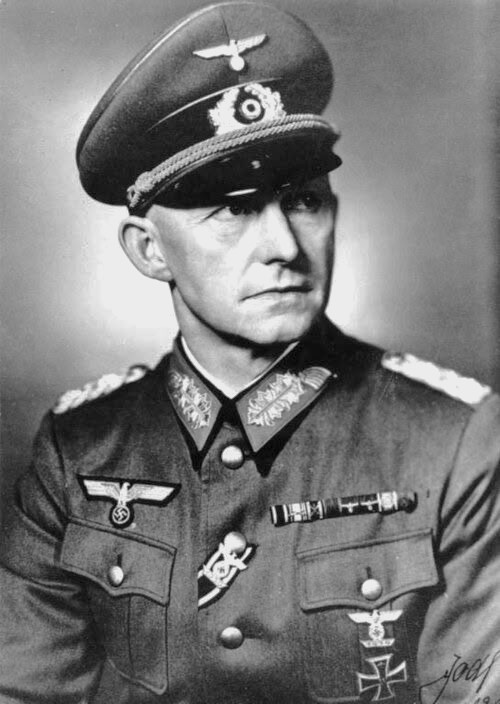
According to the testimonies given during interrogation by the American Military Intelligence Service of Colonel-General Alfred Jodl, former Chief of the German Oberkommando Wehrmacht (Operational Staff of the High Command of the German Armed Forces), it emerges that the person who forcefully opposed the invasion of Albania is none other than Hitler.
From his depositions, but also those of other officers serving in the German High Command, it emerges that Hitler tried to stop the Italian invasion against Albania.
Apparently, Hitler was presented with a fait accompli by Duce, who according to published historical testimonies was quite jealous of the victories of the German army and, for this reason, invaded a small country that could not offer effective resistance.
General Jodl’s testimony, taken from the original documents of American Military Intelligence, reinforces the opinion that Duce acted in impulsive moments and not according to a well-studied plan by military experts.
If the Italian invasion had been planned by the Italian General Staff, certainly Italy’s closest ally would have had prior knowledge and would have tried to coordinate these actions in a broader plan for the Balkans and the Mediterranean.
General Jodl states clearly that Hitler was against Italian actions in the Balkans, since in this way the German army, which was concentrating maximum attention on the Soviet Union, would be distracted in its rear, complicating the military and political situation in a region that was not hostile to Germany.
General Jodl says that Hitler tried hard to stop the invasion of Albania, offering in exchange an invasion of Crete, as a highly strategic island for operational actions in the Mediterranean.
Meanwhile, according to these depositions, Hitler was against the invasion of Greece, since in this way it would draw Britain into the Balkans, greatly complicating Operation “Barbarossa” (the invasion of the Soviet Union) and would delay it in its objectives for expansion in the East.
Italy’s shameful losses on the Italo-Greek front, it is understood, were the reasons why Germany was forced to enter the Balkans and hastily invade Yugoslavia and Greece.
General Jodl, who was in a very privileged position to know all the operations of the German army, deposes that Germany had no intention of invading the Balkans and even less Albania.
The sending of a German infantry division to Albania was considered by the Oberkommando of the Wehrmacht to help the Italian front in southern Albania, and General Jodl sent his brother to look into the possibility of German intervention.
From the German general’s report it is understood that Albania was not a country that offered possibilities for sending a German division and, for this reason, the invasion of Greece was carried out from the Bulgarian border.
Germany’s lack of interest in an eventual invasion of Albania must have been true, if we take into consideration General Jodl’s testimony, and this supports the idea of a number of pro-German Albanian nationalists who during the war claimed that Germany was only passing through and not an occupier.
However, at the moment when German troops entered Albania, to secure the passages and the Adriatic coast, things had gone too far and the anti-fascist resistance had gained quite broad ground.
Although the invasion of Albania in 1939 had encountered Hitler’s resistance, already in 1943, forced by political circumstances and the Italian capitulation, the German army finally entered a country which, no more than four years earlier, it had tried to keep away from the romantic ambitions of Duce for the creation of a new Roman Empire.
The testimony of Colonel-General Albert Jodl
Taken on 30 August 1945 in Nuremberg, Germany
From 14:30 to 16:45.
Lieutenant Colonel Thomas H. Hinkel
IGD, OUSSC
Official interpreter: Bernard Reyman
What prompted the German invasion of the Balkans?
Germany was intervening to keep Yugoslavia as neutral as possible. Not necessarily to line up with the Axis forces, but at least to preserve its neutrality. Apparently, we were successful in the Vienna Treaty.
It is now a known fact that a few weeks after this Treaty, the government in Belgrade was violently overthrown. This change brought to power a party that was entirely anti-German, which annulled the Vienna Treaty.
Did this government institutionalize actions against Germany?
No, they did not undertake military actions against us, but they prepared to undertake anti-German actions. The overthrow of the government took place in March and military actions were undertaken between 6 and 8 April. Likewise, we must take into consideration that in October 1940, Italy had attacked Greece against our wish.
What do you mean “against our wish”?
As I told you earlier, this attack was not in the Fuehrer’s concept and the Fuehrer had flown to Italy to stop this attack against Greece. He arrived in Italy at the moment when Duce told him: “this morning we attacked Greece.”
Why was German intervention necessary, when the attack against Greece was against German war plans?
For several reasons. First, we had no hostile intention against Greece. Second, the humanism and ancient Greek culture have not been valued anywhere more than in Germany.
Third, we thought that at the moment Greece would be at war, it would call Britain for help, which would be involved in the Balkan War, something we did not want.
Why then did Germany intervene in the Italo-Greek war?
Against our wish, Italy attacked Greece and, as usual, the Italians instead of defeating the Greeks were severely beaten. At this moment Italy began to seek Germany’s help.
I sent a Wehrmacht officer, who was my brother, to Albania to see how and to what extent German troops could be used to advantage against the Greeks.
As was understood from the report, all of Albania was a difficult country for our infantry troops and we could not use tanks and motorized vehicles in the Albanian mountains. At these moments, we had no mountain division available that we could use there.
Meanwhile, the British intervention grew greatly and turned into a danger. For this reason, we asked Bulgaria to allow us to pass through their territory to reach the Greek rear.
CONFIDENTIAL
Ref. No. SAIC / FIR / 11
24 July 1945
BALKANS
The decision to take part in the Balkan campaign was made only after the Italians demonstrated their complete incompetence in Greece. This Italian operation was not foreseen in any of the German war plans and the Italians had at no time revealed their intention for the campaign against Greece.
The Italian High Command denied having a plan against Greece at the meeting held between French Marshal PETAIN and Hitler in August 1940. At this time, Hitler ordered the diversion of his special train, going himself to Florence to learn the Italians’ plans from Mussolini himself. He arrived in Florence in the late afternoon of the day of the invasion. The Italians had attacked Greece that morning from Albania.
Being presented with a fait accompli was a repetition of the Italians’ behavior demonstrated in the invasion of Albania in the spring of 1939. At that time, the Italian military delegation led by General Pariani interrupted the first Italo-German military talks in Innsbruck without giving any explanation.
When Field Marshal Keitel, head of the German delegation, arrived in Berlin, General Maras, the Italian military attaché, told him that Italy would invade Albania the next morning.
Hitler immediately tried to persuade the Italians to abandon this independent operation and to plan an operation for the invasion of the island of Crete, but these efforts failed. A few months later, somewhere around Christmas, the idea emerged of using German troops in these operations.
This conclusion came as a result of the military observation undertaken by the German General ZEITZLER on the very poor performance of Italian troops on the Albanian-Greek border, as well as the observations he made on the Balkan passages and the Rhodope Mountains.
According to the source questioned, Hitler “regretted very much” the intervention he made in Greece, since he “had a great love for Greek culture!”
MS / T-101
FUEHRER AND COMMANDER-IN-CHIEF
HIGH COMMAND
The Fuehrer’s Command
17 May 1942
OKW / WFst / Abt. L (I OP)
Number 8 of 25 copies
No. 44.717 / 41gk / Chiefs / Memorie.al
Continued in the next issue