
By Natasha Lako
Memorie.al / The first act of Dhimitër Shuteriqi’s life does not coincide with the first act of my own life, but I, like every other life, cannot remember it without this classical rule connected to birth, zenith, and decline. His name, just as a name, is linked to my journey as a little girl toward Tirana, where for the first time I would encounter the fact that this world is overflowing with people. So many that one’s mind boggles. Given the above, regarding the figure of Shuteriqi, there was a point of orientation. I am speaking of the years 1960–’61, of a certain short-lived liberalism, when the 1950s had just been left behind. Although where the National Museum building would later be built, the “Kursal” café – an epicenter of meetings that belonged to the peak years of the 1930s and had not yet been demolished – was trying, with effort, to relocate to a café-pastry shop near the “Donika” hotel, on “Republika” Boulevard, somewhere close to “Zëri i Popullit” (The People’s Voice).
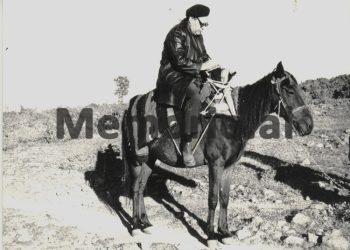
Right there, near Shuteriqi’s house, I learn the address of a master of Tirana’s intellectual life. He was still somewhat accepted from what remained of the 1930s, including the life of students who had seen Europe – the West – and were returning to their homeland. The same happened with doctors, among whom one might mention Doctor Ndroqi, tireless and self-sacrificing, and, of course, for me, Dhimitër Shuteriqi as well, who during the war period, as my father had described him to me, traveled on horseback. Moreover, Shuteriqi was a highly respected figure in the interconnection of all Arbëresh literature. And that was no small thing.
The Second Act:
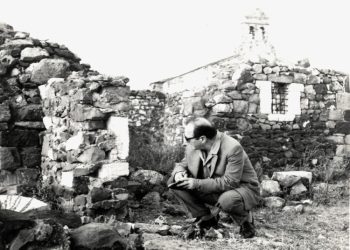
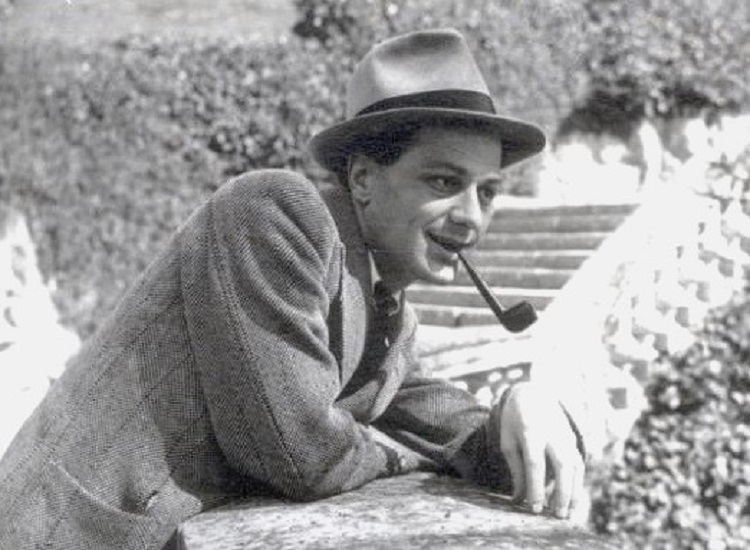
Chance had it that, as a member of the literary circle of Korça, I would take part in a gathering of young writers in 1964. I, a student at the Pedagogical School, unexpectedly found myself in the presidium, in the premises around the Theatre, after my first poems had been published. There I saw up close the man with the pipe, just as he has remained in everyone’s memory. Another surprise was that he liked to sketch, which I now think of as if he drew inspiration from Paul Valéry. And indeed, at that time, the idea circulated that if you didn’t read French poetry, you couldn’t get through poetic schooling.
When I returned to school, I felt like a different girl. My dream, of course, was university, all the more so since I was a student – as they called it then – of excellent standing, not one of those who today must absolutely earn a degree of excellence that also secures them a scholarship.
For me, just the right to study would have been enough. For many reasons that can be summed up by the period of more extreme revolutionarization, as well as the cultural revolution of leftist extremist influences that took place in faraway China, I was unable to attend university. This event, in my perception, resembled a punishment. And although my poems had been so well received, I went to work as a teacher in Pogradec. The only consolation was the fact that I would learn English as a benefit from that period, without tape recorders or private tutors. The years ’66–’67 were depressive years, as I thought that biographical reasons could become an obstacle for me, which might leave me completely without studies.
I recall here how a young and talented pianist from Korça, after high school and after a year of work, also in the district of Pogradec, was permitted to continue his higher education without fulfilling the two-year work criterion, as had been established for those continuing vocational schools. Then I understood that things don’t resolve themselves, as if by the Holy Spirit. Ahead of me, I might have a decisive year. I was afraid of breaking down and losing the will to write. It is something that resembles the complications of the second act, and the very important one, of the meeting with Dhimitër Shuteriqi, whom I expected to be extremely formal, but who, on the contrary, managed to be exceptionally warm.
This was an anxiety-filled journey to Tirana, to the Writers’ Union, whose headquarters were situated in a hidden building amid the greenery of the courtyard, and as I climbed the stairs of that house – once belonging to Musa Juka, a former minister during the period of Zog’s Monarchy – it seemed to me a solemn, weighty building. But contrary to my expectations, I met a man who listened to me with a smile. I often think that in intergenerational relations, the warmest are those between grandparents and grandchildren, rather than those between fathers and sons. It was precisely Shuteriqi’s smile that at those moments gave me courage and hope that I would be able to continue my studies.
For the first time I was entering an office, which for me was not such. And so, about Shuteriqi, I can continue to speak without a complete chronology, from the little booklet ‘Milosao,’ which was first published thanks to his care, to his apartment over there, where “Rruga e Elbasanit” (Elbasan Street) begins – as the orientation toward his birthplace had been determined, where he later settled. Gradually, it was forgotten that he had been chairman of the Writers’ Union, a position he relinquished almost carelessly and without attracting notice, despite the criticisms leveled at him at the IV Plenum of 1973 that he had failed to curb liberal ideas. The question that led into the abysses of that time was: who was more dangerous – liberalism or conservatism?
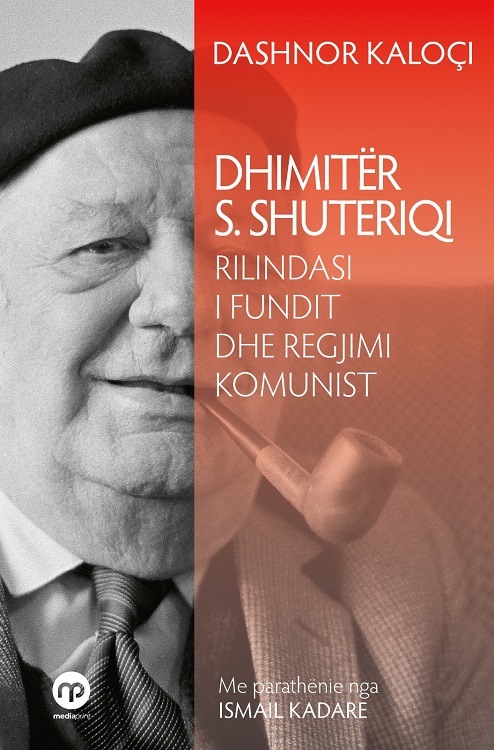
From that period onward, always bearing a power of knowledge, Shuteriqi, with his famous beret, continued to enter and participate in every meeting held at the Writers’ Union, always seated in the front row, with his pipe, sketching. For a long period, tirelessly, he shone in Albanian storytelling with a distinctive style, nourishing entire generations with the color of a rich linguistic tradition, closely tied to the very color of a great tradition of life – both human and historical. Chance brought me to listen carefully to his discussion in defense of the literary fate of the writer Koço Kosta.
This event occurred immediately and almost with alarm after the publication of one of his novellas in the magazine “Nëntori,” when the order had been given within the Union’s leadership “to give Kosta a proper thrashing, who continued to live undisturbed in his own life in Gjirokastër,” even discussing the possibility of depriving him of freedom. There, Shuteriqi spoke with an almost sublime calm, as if to extinguish a fire that he knew could easily be ignited. I felt that he, alongside Kadare and Agolli, were coming to the defense of all Albanian literature, which was endangered at every moment. Power could not impose itself on Shuteriqi’s tastes and stances, because he knew how to defend them masterfully. Just as he had defended me, to win a right to study.
The Third Act
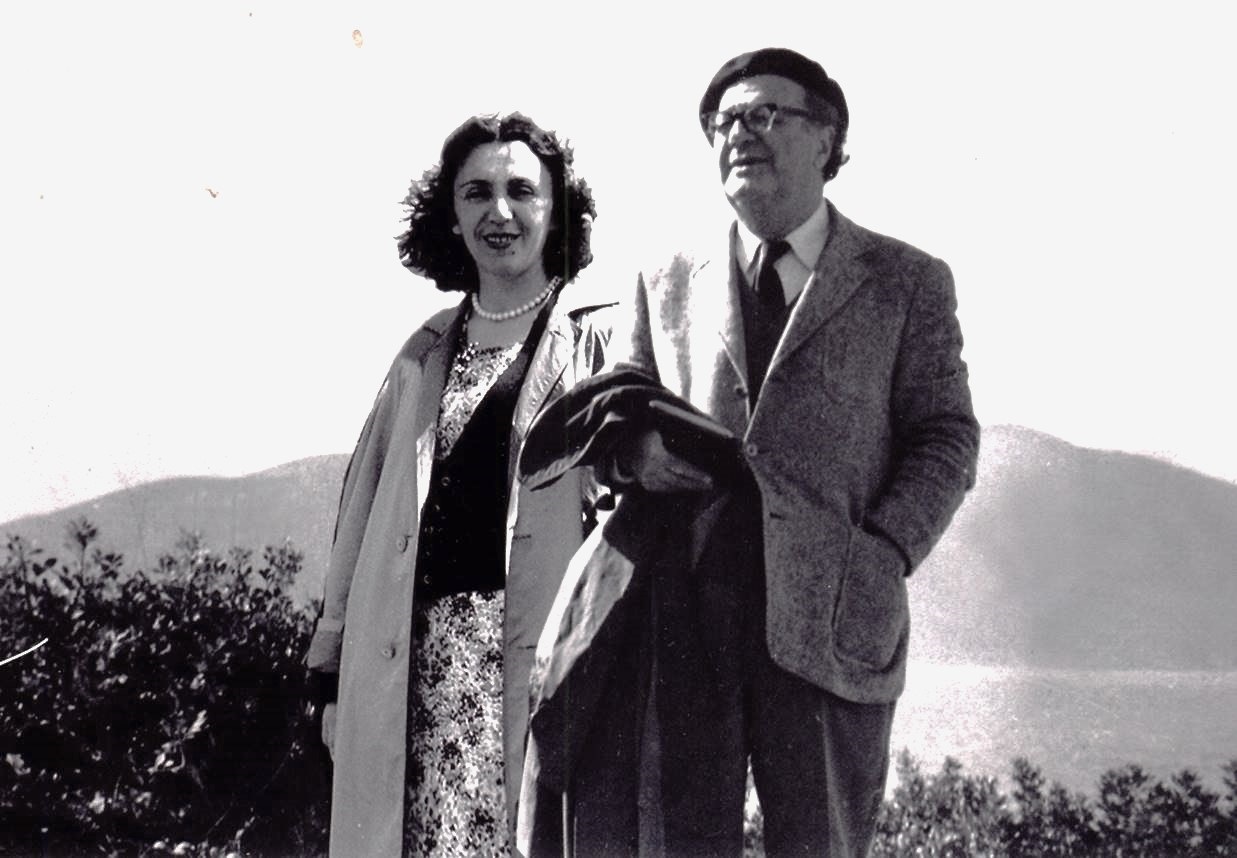
In the period after the 1990s, I always saw him inseparable from his wife. I often met him near the “New Bazaar.” There were people who began to think they could impose themselves on Shuteriqi with their tastes and attitudes, without considering that he did not forget that he came from the battles of the Second World War and those attitudes depend on many circumstances, such as those of a life’s formation. Orwell did not accept Salvador Dalí’s creativity, which was so widely accepted by the broad society of “aristocratism” that, according to him, in the 19th century, moved from a passion for hunting to the role of mercenary for culture.
At that time, Orwell had an essay on Dalí’s works censored, which he analyzed down to their perversion. But this did not diminish either Dalí’s oeuvre or that of the author of “Animal Farm.” Likewise, this does not render unappreciated even some very important poet who could not enter the school textbooks of the “victors,” in this extreme injustice. There are voices that, in the last period of Shuteriqi’s life, starting from completely opposite positions, began to criticize him, even for the way he had rendered De Rada into modern Albanian, without acknowledging either the merit or the risk.
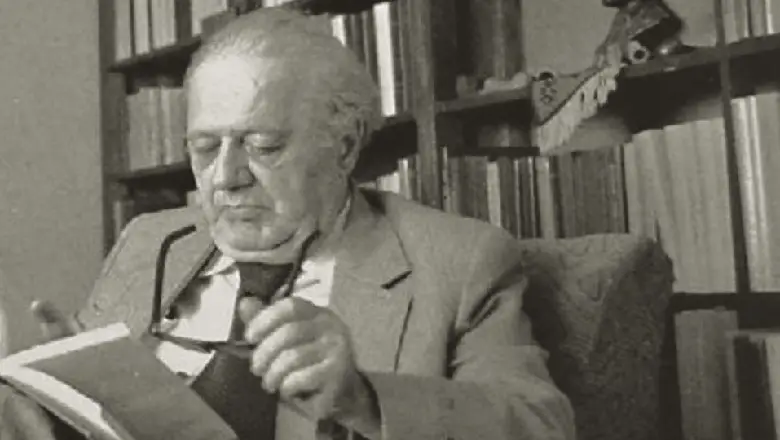
Entire generations, without that publication, would not have known the great Arbëresh author, where language, as an infinite treasure, can bring new levels. And without even reading his preface in that magnificent little book, where he himself, aware of the responsibility and the impossibility of penetrating to the depths of De Rada’s expression, apologizes to the reader for the lack of perfection. And precisely for this, he lived immersed among books. And again, books and notes from all four sides, which compose all the care and warm atmosphere of everything in its place.
This is how I saw him, too, in such a hospitable visit to his home, together with his wife. Shuteriqi always knew how to create a warm atmosphere. You immediately felt a certain comfort that he offered you where he lived. He disregarded, without being impressed at all, all the attitudes that judged with a kind of new totalitarianism, either because he did not have enough time for his erudite studies and his creative work, or because he understood life more broadly and knew that every attitude expressed only one aspect of human life.
It was a time when Moikom Zeqo visited him frequently, as if to connect them through mutual respect for Albanian cultural tradition, but also for sketching and painting. Likewise, his hospitality was noble, because you immediately felt all its liveliness. Shuteriqi never placed himself in the role of an elder, because in conversation he considered you completely equal, so much so that it seemed as if at every moment he was saying that he greatly respected the life of the person facing him.
I emphasize this rare meeting in his home because I understood how consistent his behavior in conversation was, with the same warmth that had not changed for years since I had first met him. Perhaps because there, in his office, inside that pompous villa-like building where the Writers’ Union had its headquarters, where I had knocked for the first time, I found a man who felt at home: the same demeanor, the same attention, the same hospitality. A man who, as he was in his own home, was so in all of Albania and in all events. Perhaps this power had also been given to him by the presence of Kristoforidhi’s life within that fortress.
At that time, I had not yet read the correspondence of the clubs that were preparing for the Congress of Monastir, where Elbasan would play an important role; just as the “Normal School” for teacher training had shown. His father, Simoni, was the main scribe of this correspondence, from which Shuteriqi’s entire love for his homeland originated. He said, with a certain resignation, that in front of his apartment building, new buildings were rising that was blocking his view of Dajti, that temple of Tirana. These words of his have remained deeply in my mind. / Memorie.al