Part Two
– Article from “The Times”, 1985, by journalist David Binder, its correspondent in the Balkans –
Memorie.al / On June 18, 1984, Albanian soldiers shot in broad daylight three French divers from the “Club Mediterranee,” killing one of them. On September 16, other border guards killed a Greek forester on the border. Such news reports about Albania do not seem at all ordinary – with pill boxes and concrete bunkers scattered through villages, a harsh foreign policy, a national anthem that includes the line “with pickaxe and rifle,” and a history of internal repression. What is surprising is that, despite such incidents, Albania – a lonely country that until recently was always the client of a major communist power – appears to be gradually emerging from an isolationist shell and seeking new relationships in both West and East.
Continued from the previous issue
Professor Albert was impressed during his stay by what he called “expressions of almost euphoric pride in one’s own technical progress.”
“Evidence of this,” he continued, “includes the importance of the permanent exhibition on Albanian Industrial Production and Technology in Tirana, the pride in several production centers, the success in exporting oil and electricity”! Oil production now reaches about three and a half million tons per year.
Private enterprise is extremely limited. Homeowners may cultivate a small area around their houses, or keep animals for household needs. Any slight surplus may be sold on the local market, but “only at compulsory prices set by the state,” reports Dr. Albert. In the cities, markets are abundant, as everywhere in the Balkans where the Turks once ruled.
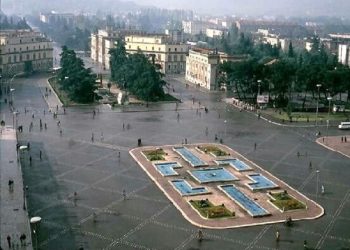
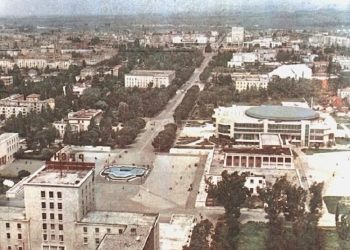
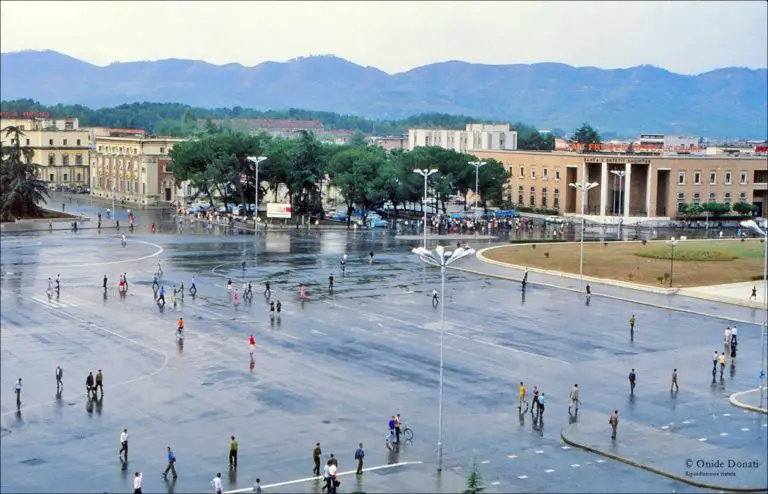
Until now a land of small towns, Albania is now developing urban centers. The capital, which had about 25,000 inhabitants in 1939, now has 200,000. Shkodra, the second city, is approaching 100,000.
In 1967, the Albanian leadership began a campaign to eliminate churches from public life – in a country that before World War II was 70 percent Muslim, 20 percent Orthodox, and 10 percent Catholic – with the declared aim of making the country “the first atheist state.”
Four Franciscan priests were sentenced to death in the first year, and by 1972, a priest from Shkodra was executed because he had baptized a child. Mosques and churches were mostly converted into secular buildings.
Professor Albert writes that in the Atheist Museum of Shkodra, he saw a graphic exhibit showing 150 mosques in the Shkodra region alone before the secularization campaign began. But he counted only 10 mosques during a month of travel through the country.
Organized religion, in fact, has gone underground in Albania, although visitors report having seen Muslims kneeling to pray at sunset in the countryside.
Judging from reports of escapees, the Greek minority in Albania has been particularly hard hit by the drive for secularization. But it is Pope John Paul II who has made the strongest statement about the religious situation in recent years.
Speaking on February 26 in Bari, Italy, from across the Adriatic, the Pope expressed concern regarding religious freedoms in Albania and said: “My thoughts go to our brothers in Albania, who cannot openly demonstrate their religious faith.”
In recent months, the Albanian government has taken steps to improve relations with its two close neighbors, Greece and Yugoslavia, which have been in a very bad state because of minority problems on both sides of the borders.
Since 1981, a large number of Albanians in Yugoslavia – (there are about 1.7 million) – have sought a separate republic of their own. Hoxha’s regime has expressed approval of the demands of Kosovo Albanians, adding to Belgrade’s anxiety.
There is irritation these days over the fact that about 40,000 Slavic Macedonians live in Eastern Albania, where their rights as a minority are barely recognized. Nevertheless, the Yugoslavs, concerned about the direction Albania might take when the Hoxha era ends, have engaged in investments that could create a greater community of interests between the two countries.
These include the opening of a railway link. Yugoslavia remains Albania’s largest trading partner, with a bilateral volume of about $112 million projected for 1984.
In an effort to improve the climate, a delegation from Tirana went to Belgrade at the end of June to draft a cooperation agreement in science, education, and technology. A Yugoslav commentator in the daily *Delo* noted that the talks had begun at a time when “Albania has again become more aware of its isolation and is trying to create links with some carefully selected foreign partners, such as Italy.”
Recently, however, the talks in Belgrade were interrupted, partly because of disagreement over the status of Yugoslavia’s minority in Albania. In the case of Greece, there are also minority disputes on both sides.
Athens expresses regret over the persecution, especially for religious reasons, of ethnic Greeks in Albania, who number at least 40,000 and perhaps two or three times more. For its part, Albania asserts that Greece discriminates against several thousand ethnic Albanians living in northern Greece.
The two countries are still technically in a state of war, as a consequence of border disputes at the end of World War II. When Greece’s Prime Minister Andreas Papandreou declared in February that ethnic Greeks in Albania were in “a serious situation,” the Albanians replied that this was “interference in internal affairs.”
Again, in the last week of June, Tirana sent a delegation to Athens under the chairmanship of Deputy Foreign Minister Muhamet Kapllani for talks that ended with the signing of an agreement to open two border crossing points, establish a chair of Greek studies at the Higher Pedagogical Institute of Gjirokastra (Mr. Hoxha’s birthplace), and promote trade. Greek officials say the state of war between the two countries may finally be resolved in the coming months.
There is another dimension to Albania’s relations with its neighbors – the flow of refugees. Following the unrest of the Albanian minority in Yugoslavia’s Kosovo province, some young men of Albanian nationality crossed the border illegally to seek asylum in the motherland.
With very few exceptions, they were turned back, telling Yugoslav authorities upon their return that they had been kept isolated for a time within Albania, as if they might “contaminate” people with Western ideas.
Of course, the standard of living in Kosovo, although the lowest in Yugoslavia, is still higher than in Albania, which has a per capita income of about $550 per year. The ethnic Albanians of Yugoslavia also enjoy far greater freedoms than their fellow Albanians.
In recent months, the number of Albanians fleeing to Yugoslavia and Greece has greatly increased. According to a Belgrade official, the number coming to Yugoslavia since the beginning of the year is “in the hundreds”!
Given how strongly Albania’s State Security – (the secret police) – guards its borders and controls its territory everywhere in the country, this is almost a very high number. Greece has also reported a rising number of escapees from Albania – most recently when two sisters swam six hours to the island of Corfu on July 29, 1984. Some of these escapees are from the Greek minority.
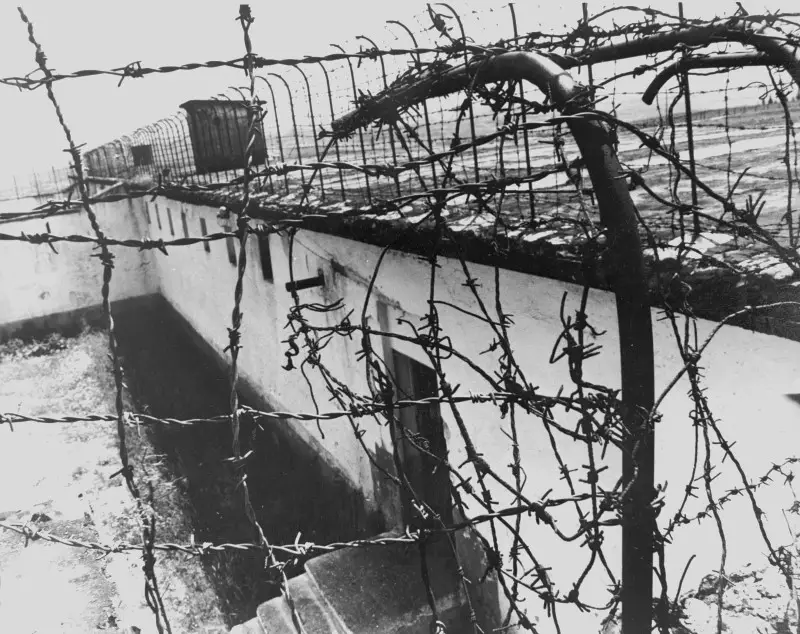
Many of the escapees report having served sentences in Albanian prisons on political charges. Professor Stavrou, himself an escapee who is an ethnic Greek, concluded in a (richly documented) essay in 1983 that Hoxha’s regime held “a total of 40,000 political prisoners” – about 2,500 of them former members of the Party of Labour or regime officials suspected of being “pro-Soviet” or, in smaller numbers, “pro-Chinese.”
In recent years, only 35 percent of Albania’s annual volume of more than $600 million in foreign trade has been with Soviet Bloc countries. But Tirana has selectively sought to expand its exchanges with some states, including Romania, whose somewhat independent foreign policy is close to Albania’s, and with Hungary.
The highest-ranking Eastern European official received in Tirana recently was Romania’s Foreign Trade Minister, Vasile Pungan, and last November. Noted scholars such as Dr. Albert and Milutin Garashanin from the University of Belgrade report a greatly heightened sense of national identity in Albania.
The West Germans sensed a conscious effort to remove evidence of Turkish rule, including the replacement of Turkish words with “pure” Albanian words. Dr. Garashanin, a professor of archaeology at the University of Belgrade who specializes in the pre-Christian Illyrian period, noted that: “Every nationalism has its romantic phase and its aggressive, explosive phase. For now, this is the Albanians.”
The emphasis on nationalist themes is quite recent. Only in 1968 was a statue erected in Tirana in memory of Skanderbeg, the 15th-century prince who fought the Turks and nearly liberated the country, becoming the undisputed hero of all Albanians. And only last year was the National Historical Museum opened.
However, national costumes are rapidly disappearing from daily life and can be seen mainly in performances by folk ensemble troupes or, on ceremonial occasions, such as funerals. In contrast, members of the Albanian minority in neighboring Yugoslavia use national costumes as common elements of dress.
Visitors, including Dr. Albert, say they were amazed by the degree of group work under the communist system in Albania. But also the power of the clan, Albania’s most notable tradition, remains strong.
The United States government, which once thought it had enough information to overthrow Mr. Hoxha – between 1947 and 1952, the United States, together with Britain, sent a series of agents into Albania who tried, without success, to organize an uprising – has remained deeply unconcerned with the Albanian issue.
In April 1973, for example, Deputy Secretary of State Kenneth Rush was authorized to take a step from Washington to Tirana, saying that the United States was prepared to discuss the beginning of relations. Months later, Washington learned that at the time of the offer, Mr. Hoxha was conducting another purge of pro-Western and pro-Soviet elements.
From more than 40 volumes of his published speeches and memoirs, it appears that Mr. Hoxha is particularly embittered by American and British support for his immediate predecessor, King Zog I. Born in 1895, Ahmet Bey Zogu took power in 1925 as president and crowned himself king three years later, and fled at the time of the Italian invasion in 1939. He was declared deposed by the communists under Mr. Hoxha in 1944 and died in exile in France in 1961.
Two years ago, Mr. Hoxha wrote: “There are some imperialists and their lackeys who say that we are isolated from the ‘civilized world’. These gentlemen are mistaken. Both the bitter history of our country in the past and the reality of the ‘world’ they advertise have convinced us that it is not at all a ‘civilized world’, but a world in which the biggest and strongest oppress and strike the smallest.
And the weakest, in which money and corruption make the law, and injustice, betrayal, and stabbing in the back triumph.” Nevertheless, it is under the iron rule of Mr. Hoxha that Albania has begun an attempt to extend its hand, sending students to France, Austria, Sweden, and Italy, and seeking new trading partners. After his death, another kind of Albania may emerge.
For at least 1,000 years and perhaps for 3,000 years, this remarkable people has managed to preserve a sense of identity rooted in epic poetry and folk customs. In the last century, it began to come into its own – undoubtedly with the help of foreigners, Germans (for linguistics and Albanology), the great powers of the time for their statehood, but finally, with the will of the Albanians themselves.
Mr. Hoxha has instilled in Albanians the idea that their isolation from the world and especially from the great powers is their primary form of national security. The fact that Tirana’s leadership has begun to seek more engagement with neighbors and other foreign powers, even while Mr. Hoxha is still in power, seems to foreshadow another kind of Albania in the coming decades. Memorie.al