



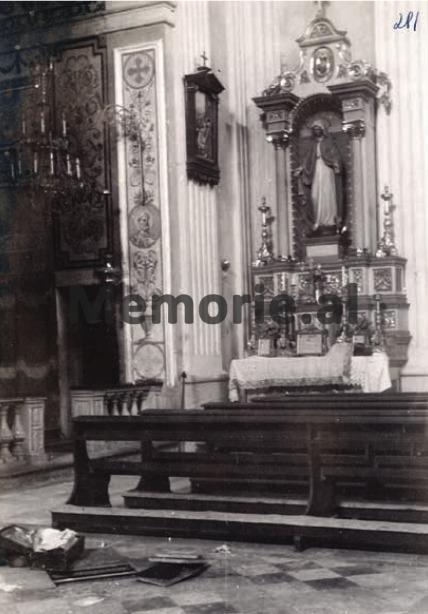
By Father Zef Pllumi
Part One
– Father Zef Pllumi: “Duli used to tell me: I was a steelyard man, who weighed in the market with a balance scale and lying is my profession; some called me ‘Blind Dul’, others ‘Dul the Liar’. Whereas today, the Party has made me an honourable man!”
– OTHER SACRIFICES ARE NEEDED –
Memorie.al / These triumphs of the “People’s Democratic Power” caused great euphoria among the new rulers. They thought they had succeeded in deceiving all world public opinion with that farce of “free elections” that ended with 90% and so many other such violent manipulations: they were completely blinded, or had always been blinded, in order to seize and hold power over their own Albanian brothers, towards whom they showed no brotherhood at all, but acted like blind dogs of Belgrade: The new master of Albania – Belgrade – would take great revenge on the Albanians, who until then had been stubborn. First, the national pride of a sovereign state had to be destroyed: what use did Albania have for foreign representatives in Tirana?!
Albanian politics were planned in Belgrade. Therefore, the diplomatic representative missions of England and the USA were expelled, declaring that they had organised espionage in Albania. As symbolic consular representatives, only those of France and the Soviet Union remained, one for the West, the other for the East. The “brotherhood of the Albanian-Yugoslav peoples” reached the peak of euphoria.
This “brotherhood” necessarily required two sacrifices: the Catholic Clergy and the Albanian intelligentsia. The war against them had been waged since 29 November 1944, but somewhat covered up with various pretexts, trying to give it a legal appearance: with accusations of being either collaborators with foreign armies, or participants in anti-national-liberation political activities. Those who had overdone it had no stain; nevertheless they had to be eliminated: who knows, perhaps in the future they might become dangerous, because they thought with their own heads, not with foreign ones.
The year 1946 was the year of the most furious hunt. It was no longer the hunt for witches as before, but for “witch-men”. Everyone was accused as if they had been recruited into the espionage networks of the countries where they had studied. Moreover, even all those who had studied at the American Technical Schools in Kavajë and Tirana were thrown into prison as American spies: as “agents of Fultz”.
At the same time, a merciless war developed among the brothers in power against the “Group of Deputies”, which ended with the physical elimination of all those people of name who had taken part in leading what was called the “National Liberation War”.
WEAPONS IN THE FRANCISCAN CONVENT
Based on the government declaration for the surrender of weapons, the convent’s guardian, Father Çiprian Nika, reported that there were 3 weapons in the Franciscan Museum and one three‑barrelled hunting gun in the Franciscan Convent, which had once been used at Cape of Rodon until 1929. At the same time, the so‑called “Agrarian Reform” was being implemented, and thus the lands of the Franciscan Church in Lezhë had been nationalised, as had those of the Troshan Convent.
Father Çiprian set out for Tirana to request the return of those lands, since the Franciscans had no means of living without them. As soon as he returned from Tirana, in the convent courtyard, the arrest officers were waiting for him: they immediately handcuffed him and asked for the weapons he had reported. Father Çiprian sent them to the museum, while the three‑barrelled hunting gun and another with “A. Zog” had been placed under the wooden floor of his own room.
Ahmet Zog, knowing well the Albanians’ desire for beautiful weapons, had ordered from a foreign weapons factory a quantity of revolvers decorated with the name “A. Zog”, which he gave as gifts to his friends. That weapon had once been kept in the Franciscan Museum, but since it could be used, Father Çiprian removed it from the museum and hid it in his own room. They took the weapons and sent Father Çiprian to prison.
A few days later, they came and arrested Father Pal Dodaj. After him, the Superior of the Albanian Franciscans, Father Matí Prendushi, was also arrested. Every day reliable news came that in the city they had arrested almost the most well‑known and best people. After the arrest of Father Pal, Father Çiprian and Father Matí, Father Donat Kurti remained as Superior: they came and arrested him too. It was clear that they would arrest all of us.
Father Aleks Baqli, who was now serving as the economist of the Franciscan Convent, said to me one day: “Brother Zef, look, they will arrest me too: this is clear. We are in God’s hands. They might arrest you too; nevertheless, we two must coordinate our statements, because we are close friends: in case they arrest both of us, do not make the mistake of admitting when they tell you that Father Aleks has deposed such and such about you. I will not admit anything either.”
– “Not even the truths?” I asked.
– “The truths… the truths would have to be admitted; however, they distort them so much and completely change their perspective.”
– “Then what shall we do? What are we preparing for?”
– “No, I just wanted to tell you that we have not yet experienced torture, but when we see and hear others in that miserable state, my soul shudders. Who knows, we might admit even uncommitted things. You stand firm.”
– “How can I stand firm?! Do you think anyone can resist torture?!”
– “Anyway,” he said to me, “we will try to stand firm: May God help us. But the thing is, none of us should believe the words they will tell us.”
– “I don’t know what they can accuse me of.”
On 14 November 1946, the Franciscan Convent of Gjuhadol was surrounded from the earliest hours. Usually we friars in the Convent woke up very early, before dawn, so much so that in Shkodër they used to say: “The friar’s wake up earlier than the devils”! When Father Ferdinand Pali and Brother Ndou tried to open the doors, they found partisan guards who did not let them out or open the doors. Before 8 o’clock, Officer Dul Rrjodhi arrived with a squad of soldiers. They ordered us all to gather in the refectory. They themselves began searching the Convent. After they finished the first search, around midday, they ordered us not to leave the refectory without permission, not even for personal needs.
At the refectory door they placed a guard and another in the corridor. Father Aleks Baqli acted almost as the one most capable. He spoke with Duli about religious services in the Church and about the community’s living. Duli decided that we would each sleep in our own room. After waking, according to the schedule of religious functions known to the people, the Church would be closed, we would stay all day locked in the refectory, with police at the door and corridor, and in the evening we would return to sleep in our rooms. This we would do until the government wanted otherwise.
So it was done. For buying food, Father Aleks would go to the market accompanied by a policeman: never alone. In charge over us was a certain Smajl Sheme: Forgive us, O Lord, but he was half animal, half human. We never asked where he was from. But often he sang: “Kurvelesh, oh my heart”. When he wanted to insult one of us, he would say: “Christ! Hey Christ!” One day I asked him: Do you know what Christ is? He replied: “A rotten fascist, like you.”
After about 3-4 days, there in the refectory where we were gathered, officers of the Sigurimi would come to visit us, such as Nesti Kopali, Zoj Shkurti, Fadil Kapisyzi and many others whose names I have now forgotten, as well as many others we did not know. They would criticise us, even insult us as bourgeois, chauvinists and fascists, as if only we were to blame for what had become of Albania!
Duli had taken possession of all the keys of the Convent, not only for entry and exit, but also of all offices, the Archive, the Museum, the Library, the Fishta Museum‑Room, other cultural and recreational premises, as well as the keys to the rooms of the friars who were in prison.
Several people could be heard moving and working around the Convent, while he had the habit of coming for an hour or so and staying with us downstairs in the refectory. One day he brought some large photographs he had taken from albums that were in the archive. The photographs showed the reception of Victor Emmanuel. Among those people dressed in beautiful national costumes was also he himself. He turned to Father Marin and said: “Did you keep these to accuse us?” Father Marin explained that if it were to accuse, they would not have left them in the archive.
From the Fishta Museum‑Room, he would take, as if nothing wrong, fountain pens, pencils and other trinkets and keep them in his breast pocket with pride. We had nothing to say to him, because now he was master of the house. One evening, Duli came and took me, accompanying me to an office room. After making me sit down, he took out that precious fountain pen of Fishta and said: “We are going to write an official interrogation record, because the comrades at the section ask for it. You know that Father Pal is in prison. We are asking him for his diaries: we have taken all of them, but the last 3-4 years are missing, and he says he gave them to you to hide. What is the truth about them, and you hand them over.”
I replied that: during the searches the Brigades carried out around the beginning of 1945, he had given them to me, I took them and put them in the pipe of a stove that was not going to be lit, and when the search was over, I took them back and returned them to him.
– “He says you still have them.”
– “He is old. He has forgotten where he left them.”
– “Look,” he said to me, “this matter carries responsibility, because I will confront you with him.”
– “Confront me.”
– “You will put your signature here.”
– “Yes.”
“Do you know how it is?” he said to me. “This business of yours is finished. In fact, how do we appear to you?!”
– “Why are you asking me? Do you think I swallow that olive pit? Do you want to put me in prison with my signature?!”
– “No, my good lad,” he said to me, “it doesn’t even cross my mind to put you in prison; because I have the means to put you were not even an ox can bring you out. But we have developed a certain trust and we can speak these words sincerely. I am not going to write anything, just like this, as friends, to know. We also need orientation.”
– “Just as friends,” I said to him, “I must tell the truth: as far as I and the people are concerned, you are worse than the devil.”
– “Speak for yourself, not for the people, because we are the people.”
– “Didn’t you say we are speaking as comrades and sincerely?!” You are not the people, but its murderers. You talk about the Germans, but they were gentlemen of gentlemen compared to you! You kill people without any guilt.”
– “And when do we kill these innocent ones?!”
– “I am not mentioning everyone, because perhaps I am wrong, but I will present you only that of my uncles in Gurzë: 10 people were executed. Ten people for one man, whom they themselves did not kill! Not even the Germans did what you have done.”
– “Anything else?” asked Duli. “Do you know anything else?!”
– “Why do you ask for anything else? Do you not see that you are not like the rest of the world? Who else beats the people with a stick and then tells them: ‘You are an enemy, if you don’t love me’! Don’t you know that love is not imposed by force?! You know well the saying of our people: ‘Love me and fear me, is not said to anyone’.”
– “I am glad,” said Duli, “I am very glad for your sincerity: this is how we like young men: Bravo – Zdravo!”
He did not write any record that night, but after two days he called me again and said:
– “This record must be signed.”
– “Shall I read it once before signing?”
I read it. He had put in what I had said about Father Pal and also that discontent I had expressed about the killing of my uncles without any guilt.
– “But you told me you wouldn’t write it in the record!? Weren’t our words like that, yes or no?!”
– “Yes, yes, yes,” Duli told me. “Only the matter of Father Pal is required here. The rest have no importance.”
– “Listen, Dul, I am signing my own arrest” – and I put my signature.
– “No, my good lad,” Duli said to me, “it doesn’t even cross our minds to arrest you. This is how we like people: to tell us the truth to our face. We are sincere. But this record, this statement of yours, we will confront again with Father Pal. We want the truth.”
During those days we learned that Father Bernardin Palaj had died in prison. No one doubted that he perished under torture. I prayed to God.
After about four or five days, Duli came and took me again. He sent me to that office of his he had set up in the Convent and said:
– “Zef, you are young, don’t take the burden on yourself. Father Pal does not accept the record we made together. He says it is true that he returned them once, but since the searches were frequent, he then gave them to me again and never asked for them back, except he told me: secure them well so they don’t find them.” I told Duli that: Father Pal was old and didn’t remember anything: I do not have those diaries you are asking for. I thought to myself: where would I put other people’s writings?!
Then Duli took me with him. We went outside. It was night. We walked together along the road. He took me to the State Security section, in the house of Pjetër Çurçia. I saw that he intended to arrest me. He stopped before going up the stairs and spoke with a soldier. I waited there standing for nearly a quarter of an hour. Duli came back, and we went up the stairs. At the top of the stairs there was a short corridor where two people covered with blankets could be seen, and four doors. He opened one of them and we went inside. At the table was a man dressed in military uniform. I sat on a chair. I waited for them to put the handcuffs on my hands. The soldier spoke:
– “What is your name?”
– “Zef Pllumi.”
– “Zef?”
– “Yes.”
– “Listen, Zef, I tell you: you must not play with the government, but must tell the truth, because you Catholic priests have left nothing undone against the government and the people. Today your end has come. Tell the truth and you will be saved.”
– “I tell the truth, but you too must believe the truth, because if you do not believe the truth, then you may take me by the neck, along with others.”
At that moment the door opened and Dul Rrjodhi entered, and after him, Father Pal. He could barely move his legs: not even half of him remained, they had turned him into half a man. Behind him a soldier, holding him by the arm. Then Duli began to speak:
– “Father Pal, I believe you know Zef Pllumi well. I ask for your diaries from the years 1939, 1940, 1941, up to 1945. One of you will hand them over to me: either you or you,” and he pointed with his hand at him and at me. “You speak, Father Pal, how is it between you?!”
Father Pal said that during the first search, around the beginning of 1945, he had given me 3 or 4 notebooks that were the diaries of those years; he gave them to me to hide, because I am young and lively, while he would be caught by the search.
– “Speak, Zef,” said Duli. “Where did you put them, and how did you save them from the search? But tell the truth.”
I then recounted that indeed Father Pal gave them to me on that difficult day of the first search. Fortunately for me, among the officers conducting the search was also Halil Bala. I had him not only as a classmate in the Franciscan gymnasium, but we had gotten along well. He had left after the semi‑matura exams. After several years, we met during this search. We embraced with the affection of early youth: we had missed each other, for we had not seen each other in years.
He asked me: where is your room? I showed him. He went inside the room, took paper and pencil and wrote: “This room has been searched by me, Officer Halil Bala.” He stuck this paper on the outside of the door, which he then locked and gave me the key. Only this room was allowed to be entered. – I then went into that common room where the unlit stove was, took out Father Pal’s diaries and put them in my room, which would not be searched. But later, I returned them to Father Pal: what did I need them for?!
Then Duli turned to Father Pal:
– “Do you hear or not? Tell where you have the diaries!”
Then Father Pal, who could barely stand, turned towards me as if seeking mercy, and with that weak voice said to me:
– “Son, do you see how I am? … If you want to save my life, hand them over! … Do not kill me yourself, with your own hand!…”
At that moment, I died. There was no longer any look, any resistance of mine. Why should Father Pal die for his diaries?! It was an extremely urgent moment of my life. I could not endure Father Pal suffering. I decided for his life, not for his papers. But my honour, my besa?! If this is life, everything will be erased and healed. Life has many wounds: today, perhaps, you would say it was a mistake?! Let others judge: Nemo Judex in causa sua! (No one can be judge of himself).
In these rare moments, the hot heart works more than cold logic. All these actions happened in only one second: that was it. I decided for life and not for papers!
I said: Yes! I have the diaries.
The murderers around us had their eyes light up with joy. Duli laughed loudly. He said to that officer sitting at the table:
– “Do you know where he is from?” – From Mali i Rrencit (Mount of Lies): and he thinks he can lie to us! – I must make a parenthesis. Mali i Rrencit is the mountain above Shëngjin. Its etymology: Mali i Lorencit (Mount of Lawrence), but in Albanian the shortening of the name gives – rencit (liar).
Duli then grabbed me by the arm and said: “Let’s go!” We sat down on the steps: down there the partisans were singing, dancing: “Sofo, flower of a boy, Sofo, flower of a boy”. Duli started teasing me: “Zef, oh flower of a boy, Zef, oh flower of a boy”! Side by side, we went out into the street. Then he began to speak.
– “Zef, do you know what I used to do?!”
– “No.”
– “I was a steelyard man. A steelyard man, who weighed in the market with a balance scale. Lying is my profession, because if I didn’t lie with the scale, I would go bankrupt. And how did you think you could lie to me?!” – “Look,” he said to me, “I was a despised man by everyone: some called me ‘Blind Dul’, others ‘Dul the Liar’. Whereas today, the Party has made me an honourable man: Do you see me? Dressed and shod like a king, eat and drink whatever I please: so, why should I not work for the Party?”
“Do you think at all that these evasions you have done to me, or that you have done to the Party, are punishable by prison?! Let’s see what the comrades will say. You are used to confessing sins, where they give you penance of five Hail Marys, but we confess differently: we give you five years in prison. Do you also want to go to prison like the others? Do you want prison?”
– “No, I don’t want it.”
When we arrived at the Convent he said:
– “Where are the diaries? Go ahead. Call also a guard with a lantern.” We went up the stairs that led high into the attic above the archive ceiling. There I had placed those two metal boxes: one with the manuscripts of P. Ambroz Marlaskaj and the other with the manuscripts of P. Shtjefën Gjeçovi. Into this second one I had also put Father Pal’s diaries. They were padlocked. The keys I had left under the boxes. I took them and opened them:
– “Here are Father Pal’s diaries.”
– “And these others, what are they?”
– “Manuscripts of P. Shtjefën Gjeçovi,” I said.
– “Who was this maskara?”
– “What are you saying! This is a scientist of world fame: the one who collected the Kanun of Lekë Dukagjini.”
– “The Kanun of Lekë Dukagjini? I have that book too, full of mountain nonsense. Where is he now: where is he?”
– “The Serbs killed him, in Zym.”
– “Well they did: accounts need to be settled. And the other box, whose was it?”
– “P. Ambroz Marlaskaj, professor of philosophy in Rome.”
– “An even bigger maskara,” said Duli. “Where is he?!”Memorie.al