


By Skifter Këlliçi
Part Three
Memorie.al / One day in early March 1950, when together with Luan, my twin brother, we had turned 12 years old, along with other friends from our neighborhood in Tirana, we learned from the newspaper ‘Sporti Popullor’ that a new football team had been created with the name ‘Dinamo’. With such a name we had read in the same newspaper that there were teams in the Soviet Union (‘Dinamo’ of Moscow and Kiev, of Tbilisi), and even in Yugoslavia, ‘Dinamo’ of Zagreb. And lo, apparently, following their example, a team with the same name, ‘Dinamo’, was being created in Albania too; not only that, but it would play directly in the first category, alongside ‘Partizani’, ‘Tirana’, ‘Shkodra’, ‘Durrësi’, ‘Kavaja’, and other teams.
Thus this match too would be played at the ‘Dinamo’ stadium, today ‘Selman Stërmasi’, far too small for the demands of the sports fans of both teams. Let us not forget that televised sports broadcasts were still a dream for Albanians, although a year earlier an experimental television center had been set up near Radio Tirana. But it had only one old camera… (Even when in 1966 a test was made that surprisingly coincided with the ‘Partizani’-‘Dinamo’ match, this camera during the second half began to emit… smoke and the broadcast was interrupted).
But let us continue with the match. Before it began, entering the corridor, where a sleeping room for the ‘Dinamo’ footballers, adjacent to the stairs by which the leaders went up to the central tribune, was being converted into a broadcast booth, a police captain stopped me rudely, although I explained that I was a commentator for Radio Tirana. He didn’t take a liking to me. I was saved by the bureau member Spiro Koleka, who was climbing the entrance stairs to the tribune reserved for the leadership, who ordered the poor captain to let me enter the match commentary room.
The first half, balanced and extremely fierce, ended without goals. So did the second, while Lubonja was stopped by Maliqati, who seemed to have hypnotized him. The 2 x 15 minute extra time began. Even in the first 15 minutes the nets remained untouched. Then the second extra period began. This time it was Qoshja who blocked Pano. And lo, a few minutes later, Resmja shot. Tokazi from the right of Qoshes. The ball had not yet crossed the goal line and the shout “goal”! Was followed by the cheers of the Partizani fans. (A friend of mine who had heard the commentary on the radio congratulated me that I had sensed the goal when the ball had not touched the net); but, less than a minute later, Lubonja equalized.
Then I saw that Resmja collapsed to the ground and remained motionless for a while. His teammates brought him round. What sportive fervor this was, passion and the desire to win! The match thus ended in a 1-1 draw. A few days later the second final match was played. A twin of the first. The defenses are stronger than the attacking lines. First half 0-0. So was the second. The nets seemed drowsy and, to wake them, they needed to be shaken by goals, even one, to brighten the horizon, just as “a lone sail whitens in the horizon,” to paraphrase a line of the Great Russian poet Lermontov.
Thus the second half also ended. The 2 x 15 minute extra time comes. Ismet Bellova and I take turns in this radio marathon. The sports fans move through the stairs, seek to drink orange juice, just like us, but the bottles are hard to find. The bureau members in the tribune are not at ease. On one side Kadri Hazbiu and Feçor Shehu, and on the other, Beqir Balluku and Petrit Dume, that is Security and Army. They defend the communist order, but here they are opponents! Even the officers of both ministries on the stadium stairs…!
The final 15-minute extra period comes. According to the regulations drafted by the FSHF [Albanian Football Federation] on the suggestion of Anton Mazreku (the father of Albanian football journalism), the game would continue until one of the two teams scored; otherwise the winner would be determined by lot. (UEFA put this new article of the football regulations into practice for the first time in the final match of the European Championship Germany-Czechoslovakia (2-1) on 30 June 1996, thus many years later than in our football championship of 1961).
…And lo, a return ball from the left wing of the ‘Partizani’ attack, a stop of the ball by Pano, who without hesitating a jot, shot from about 18 meters and scored. After 242 minutes including the first final match too!… It fell to me to commentate these historic moments. Then I left the microphone to Bellova. I felt extremely tired. And it fell to him to describe the triumphal lap of the ‘Partizani’ footballers with the cup in their hands, in which Maliqati, Deliallisi, Papadhopulli, Dingu, O. Mema, Merja, Ndini, Kraja, Resmja, Pano, Jashari etc. had distinguished themselves, with Coach Rexhep Spahiu.
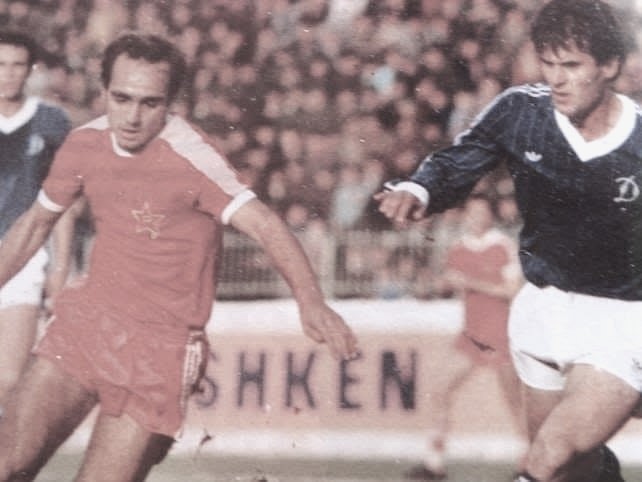
‘Partizani’, thus in five years, 1957-1961, repeated the success of ‘Dinamo’ in the years 1950-1955. It was proclaimed champion four times and would continue this march until 1965, when the duel between these two teams would be broken by ’17 Nëntori’, which would mark a new epoch in our football. Since 1950, when ‘Dinamo’ was created, a team of the Ministry of Internal Affairs, the duel for the championship title that until then had been fought between ‘Partizani’ and ‘Vllaznia’, became the property of two military teams – namely ‘Dinamo’ and ‘Partizani’. Their directors were also the directors of the Ministry of Defense and the Ministry of Internal Affairs. Their fans were also members of the Politburo of the PPSh [Party of Labor of Albania], with the exception of the trio Hoxha-Shehu and Kapo.
These state and sports leaders, with unimaginable high-handedness, thanks to the law of “compulsory military service,” snatched the best footballers from ’17 Nëntori’ of Tirana and from the teams of other cities. And, after they completed this service, they kept them, luring them with better material benefits, giving them apartments, jobs with good salaries, as clerks or non-commissioned officers, even without working, as if they were professionals. Typical, as he himself told me, is the case of Simon Deda. In 1950 he played for ‘Vllaznia’. He had finished secondary school and had been appointed a teacher. According to a law in force, teachers were exempt from military service. But General Petrit Dume broke this law.
Deda was called up as a soldier and after this service was kept by ‘Partizani’. They gave him a house for himself and his family. He never played for ‘Vllaznia’ again. Likewise, as I mentioned above, it happened with Pano. When he finished his service, the red generals did not let him return to ’17 Nëntori’. They too lured him with material benefits. The old story continued, begun with Boriçi, Llambi, Spahiu, Parapani, Resmen, Karanxha, Maliqati, Deliallisi, G. Merja, Haxhiu, Ndini, Kraja, Jashari, Shllaku etc., at ‘Partizani’, and Vogli, Dashi, Jareci, Shaqiri, Vila, Bakalli, Rreli, Duma, Lubonja, Halluni, Bushati, Vorfi, Çeço Halili etc. at ‘Dinamo’.
The case of Skënder Halili, as I have recounted in a paper, also published in the pages of Memorie.al, was tragic. Through the intervention of Kadri Hazbiu, the Minister of Internal Affairs, he was assigned to perform his military service in the Border Forces and began to play for ‘Dinamo’. In this there was nothing extraordinary, but after two years, when the time came to be released from the army, the heads of the Ministry of Internal Affairs sought to keep him in the ranks of ‘Dinamo’, but he refused and returned again to his friends of ’17 Nëntori’.
And lo, the unexpected: in August 1966, when Halili was only 27 years old, he was arrested and imprisoned for 11 months, allegedly for having engaged in buying and selling watches and for having 57 American dollars found in his home. He was sentenced to 11 months, which he spent in very heavy labor in the Bulqiza mine. And, just like Qemal Vogli, he was sentenced never again to set foot on football fields.
SOME CONCLUSIONS
Until 1950, mainly two teams had fought for the championship title, ‘Vllaznia’ (twice winner in 1945 and ’46), and ‘Partizani’ three years in a row in 1947, ’48 and ’49, followed mainly by the team of ’17 Nëntori’ and ‘Flamurtari’. Then, from 1950 until 1964, this duel was fought between the two military teams of the dictatorship, ‘Dinamo’ and ‘Partizani’.
However, every evil had a good after it. It is true that these two ‘Tirana’ clubs absorbed and also impoverished the other clubs and thus benefited at their expense in order to become champions. But it is equally true that in these clubs, thanks to good material conditions, the footballers who came from the district teams, under the guidance of the most experienced coaches, noticeably raised their skill. In these teams the technical level of all the players also rose noticeably. The tactical variants also underwent a noticeable change.
Only at ‘Dinamo’ of the ’50s, as I mentioned in the first pages of these memoirs, was the WM tactical system perfected, that is with three defenders, two half-backs, two inside-forwards and three forwards. Moreover, with the move of Loro Boriçi to a withdrawn center-forward, in the second half of the ’50s, an action that Hidegkuti had made with the Hungarian national team back in 1953, in the England-Hungary match 6-3 (London, 1953), the 3-3-4 scheme also began to be applied in our football, which in the early ’60s turned into 4-2-4, the scheme with which Brazil triumphed at the Sweden 1958 World Cup. And this for the simple reason that 3 defenders cannot cover 4 forwards.
In practice, when Loro Boriçi consciously withdrew into midfield, because he had not seen matches of the Hungarian team after 1953, Resmja was repositioned from inside-forward to a genuine forward. Then even Verria of ‘Dinamo’, the half-back who covered him, was forced to return as a fourth defender. (This scheme was then applied by other teams too, somewhat modest compared to ‘Partizani’ and ‘Dinamo’). I have noted these phenomena extensively in my two books “History of Football” (1980) and “From 2-3-5 to 4-4-2” (A historical view on the evolution of tactical systems in Albanian football, 1930-1987, publication of the football chair of the IKF ‘Vojo Kushi’, 1987).
And it is very much to be regretted that in the spring of 1996, this book, entirely scientific, with 75 sketches and 101 references, also from foreign literature, which I presented at the IKF ‘Vojo Kushi’ to obtain the scientific degree ‘Doctor’, was rejected by a commission of 5 people set up by B.I., head of the football chair at this institute, in which two of his friends were also members who were specialists in other fields—A.K., lecturer of the theory of physical education, and A.Sh. of athletics. It was a tendentious and absurd action, because in this institute or in the FSHF there were lecturers and specialists of football. And precisely these three carried out this unprecedented scandalous act.
EPILOGUE
From the ‘Dinamo’ of 1950, we come to the ‘Dinamo City’ of our days. Between them lies a distance of 76 years. There are some differences. The first, because a few months after its creation that ‘Dinamo’ became champion. And not only that year, but as we saw, until 1961 five more times, whereas ‘Dinamo City’ is climbing to the Olympus of our football. Moreover, after 1992 that is after the fall of the communist dictatorship it was even at risk of disappearing by taking the name ‘Olimpik’.
But, like the Phoenix, that bird of mythology, it rose again and as a giant bird soared high to the highest pedestal of our football, managing in the 2024-2025 season to win the Cup of Albania and today stands among the best teams of Albania.
Thanks to the efforts, perseverance and passion of its current president, Adrian Bardhi, thanks to the talented coach Ilir Daja, this duo that has created a harmonious ensemble with the aim that in this championship this ‘Dinamo City’ not only be in the quartet of the strongest, but also remain a soloist, as it has 18 times in the history of our football. It will not be a dream. The victory of the Cup of Albania in the 2024-’25 seasons proves it.
The same story happens with ‘Partizani’, 17 times champion of Albania (for the last time in the 2022-23 seasons). It now fluctuates somewhere in the middle of the standings. But I believe temporarily. It too will rise. According to tradition it will aim for the honored four. Then higher. For it too it will not be a dream. I have thus conveyed to readers my memories about our two best teams, ‘Partizani’ and ‘Dinamo’ in the football championships of the period 1950-1961, because this is the period when these teams marked the most beautiful pages in the annals of Albanian football.
Afterwards a new name is inserted between them, ’17 Nëntori’ of Tirana, which from 1965 to 1970 rises ‘to the lectern’ and becomes the ‘dean’ of Albanian football, winning 4 championships and deserving the fifth, in 1967, had it not been cruelly excluded by the savage communist dictatorship. More extensively with the history of this team and the championships after 1961, the reader can become acquainted through the books of Besnik Dizdari, undoubtedly the best journalist and historian of our football and sports of all times, after the legendary Anton Mazreku. / Memorie.al
Boston, USA, October 2026