By Luan Rama
– Muntaz Dhrami, between the height of the name and the forgetfulness of power! –
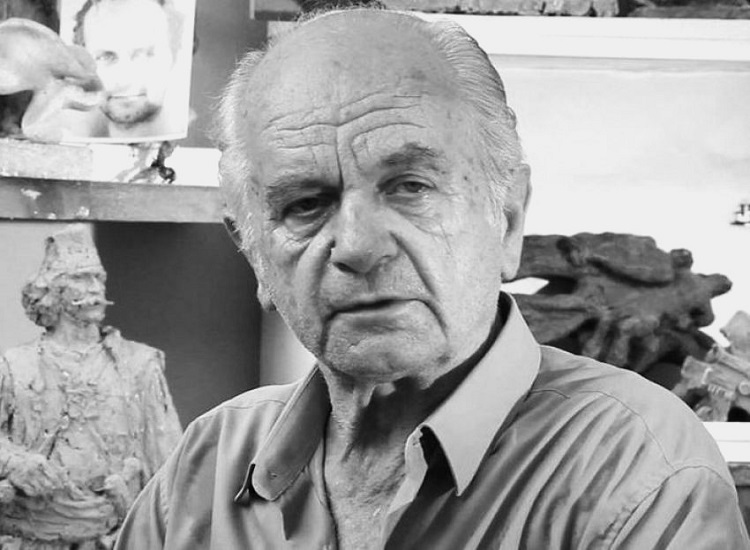
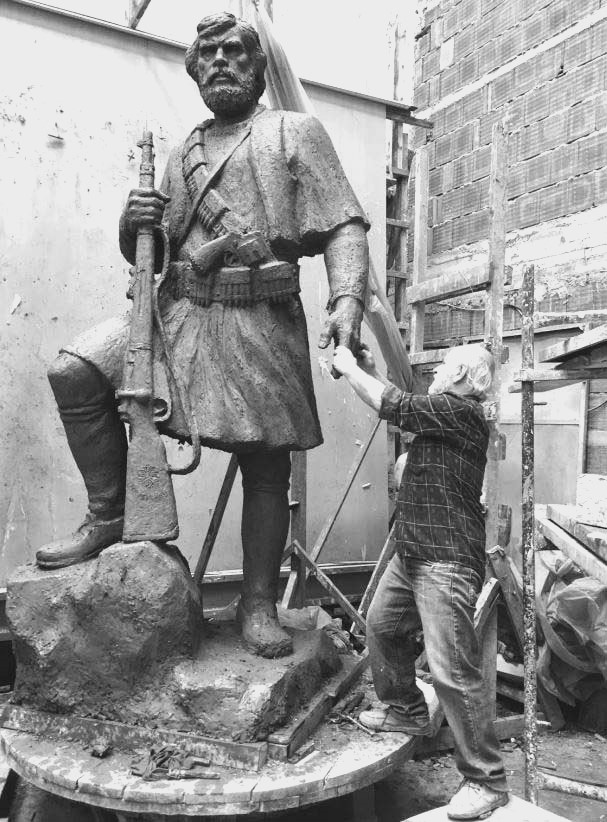
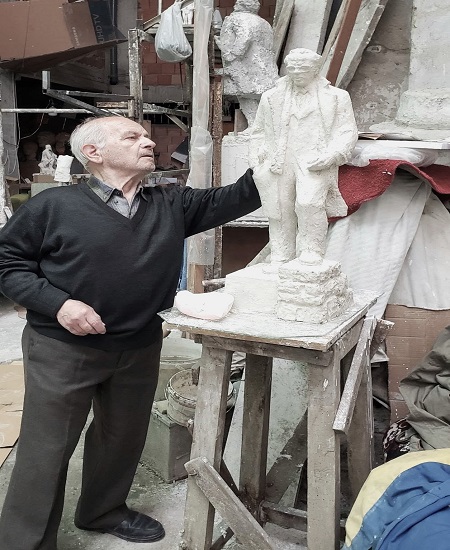
Memorie.al / There is a coincidence that, beyond its beautiful randomness, carries a special meaning in the cultural history of Gjirokastra: Ismail Kadare and Muntaz Dhrami were born in the same year, in the same neighborhood of the city of great name and history, and learned in the same class of the same school. They grew up together and remained good friends, each in his own creative universe. Both became the greatest creators that Gjirokastra gave to Albania and among the most distinguished representatives of Albanian culture. Kadare gave the Albanian experience the dimension of a literary universe, making it an inseparable part of world literature; Muntaz Dhrami gave historical memory the form of a sculptural universe.
This comparison has nothing to do with a hierarchy between them, but with the weight of their influence and the representative height of their creativity. In my assessment, Muntaz Dhrami is a Kadare in his own field of art. But the dimension of Muntaz Dhrami goes beyond his creative universe. It extends into a special relationship with time and society, where the artist demonstrates the height of his personality both as a first-rate intellectual and as a citizen who feels and takes upon himself his responsibility precisely when society has the greatest need for the courage and voice of intellectuals.
This intertwining does not constitute an addition to his identity, but expresses his very creative and human nature: the conviction that the artist’s responsibility does not end where the work ends, but continues also in the public space, in the relationship with truth and with the fate of the society in which he lives. In the special relationship with time, history and man, one of the most essential values of Muntaz Dhrami’s creativity must be sought. What distinguishes him as an artist is not only the ability to give matter a stable form, but especially the mastery of plastic language, through which the figure gains character, expression and inner life.
In his creativity, man does not remain an external image or an illustration of a predetermined idea, but takes on individuality, human dimension and emotional charge.
Even when he treats historical and monumental themes, Muntaz Dhrami does not lose this essential relationship with man. He does not aim simply to reproduce reality, but to select it, to process it and to recreate it according to his artistic vision. Precisely in this ability to penetrate beyond appearances and to transform human and historical experience into a plastic language with an independent life lies one of his most important merits as a creator. I have the privilege of knowing Muntaz Dhrami also beyond his work and his name. My meetings with him are always moments of special pleasure for me.
What has always made the deepest impression on me is not only the greatness of his name and his creativity, but especially the extraordinary simplicity with which he represents this greatness, the kindness he conveys and the naturalness with which he communicates. Muntaz Dhrami is not only the artist who expresses the world through the language of sculpture. He is also the intellectual who experiences his time as responsibility and the citizen who does not separate his fate from that of society. At certain historical moments, this responsibility takes on a special meaning: it requires not only the ability to judge, but also the courage to express that judgment publicly.
Precisely at this point, the dimension of Muntaz Dhrami’s personality exceeds the boundaries of artistic creativity and takes on a greater significance and value connected with the dignity of the intellectual and his role in the life of a nation. Muntaz Dhrami’s engagement in public life, throughout his entire activity, but especially on the eve of the great changes of 1989–1990, constitutes a significant testimony of his intellectual integrity. At a time when Albanian society was emerging from a long period of closure and when the demand for change was gaining ever more strength, he appeared as a forerunning voice, publicly articulating, as few others did, the need for openness, transformation and political change.
The weight of these ideas is determined not only by their content, but also by the historical time in which they were articulated. For there are moments in the history of a society when the word of the intellectual takes on a weight that surpasses its very author: it becomes a sign of a new moral and historical threshold. It is not simply the courage of his public stances that distinguishes Muntaz Dhrami, but also the unassuming manner, without self-praise and without seeking gratitude, with which he has exercised his civic responsibility. Here lies one of the most precious signs of his intellectual and human integrity.
The great figures of culture do not define their importance only through the work they create, but also through the way they influence the formation of a society’s consciousness. They become part of its memory not simply for what they have created, but also for what they represent. In this sense, Muntaz Dhrami embodies a personality in whom artistic creativity, intellectual integrity and civic responsibility do not stand apart, but constitute different expressions of the same human greatness. The code of honor marks the spirit of the consciousness of a people and of a nation. It is one of the most significant indicators of their civilization and is expressed in the way they perceive and evaluate history, how they appreciate values and how they keep in memory the people who have left their mark on their historical journey.
Honor is not simply an act of courtesy. It is an expression of historical gratitude, of collective conscience and of a society’s ability to recognize and appreciate what constitutes its enduring wealth. A society’s relationship with its great figures is, in a certain way, also a relationship with itself. The way it recognizes them, appreciates them and keeps them present in its memory testifies to the degree of civic culture and to the ability to discern value beyond the circumstances of the moment. Honoring them is neither a ceremonial act nor a protocol obligation; it is a form of awareness of what an individual has given to his time and of what remains beyond it.
The 90th anniversary of Muntaz Dhrami’s birth was a special occasion to honor the name, life and work of one of the greatest personalities of Albanian art. This anniversary constituted not only a beautiful event in the life of our great artist, but also an event of significance for all of us: an occasion to express the gratitude and honor of a people. It was also an opportunity for power to demonstrate its own culture of honor. However, the power, more precisely the people at the head of power, forgot Muntaz Dhrami on the 90th anniversary of his birth, proving to us not only spiritual poverty, but also the deep shortcomings of their character.
I do not wish to dwell on the President of the Republic, whose previous public stances and appearances, as far as the culture of honor is concerned, have demonstrated a miserable and painful level. But it is unforgivable that the Prime Minister and the Minister of Culture, both with artistic training in the field of visual arts, expressed not even a formal congratulation for the great citizen, intellectual and artist. By honoring Muntaz Dhrami, they would not have added anything to his name and work; they would have done honor to themselves.
The height of a personality has no need for the approval of power. The culture of power is measured precisely by the ability to recognize and honor it. A nation demonstrates its greatness not only through the great people it produces, but also through the culture it creates to recognize, honor and keep them alive in its memory. In this memory, Muntaz Dhrami has won his place. / Memorie.al