By Besnik Dizdari
Part One
Memorie.al / Sports euphoria will reach its peak in a few weeks with the successful appearance of the USSR at the Rome Olympics. The special Albanian lead article is entirely dedicated to the “ancient and eternal Albanian–Soviet friendship”, culminating in this original apotheosis of servility of an unprecedented absurdity: “A friendship that our people, even back in the time of the Turkish occupier, found with the Russian people.” From the outside, the year 1960 seemed a “bright” year. Likewise for us young people, who had just finished high school, nicely caught between the three main entertainments: sports, cinema, and inevitably, books…!
Naturally, we were in a full year of the Sovietisation of the country, when the new Soviet films released in Moscow would take no more than a month to arrive in Tirana. Tirana was more cinematic than ever with five cinemas: “Partizani”, “17 Nëntori”, “Republika”, “Brigada”, “Agimi”. Soviet films of de-Stalinisation and art, such as “A Man’s Destiny”, “Ballad of a Soldier”, “White Nights”, culminate with the Franco‑Soviet film “Normandy‑Niemen” – about World War II, dedicated to USSR‑France cooperation, one of the first signs of the so‑called peaceful coexistence, which the PPSH and Enver Hoxha would soon denounce as deeply revisionist.
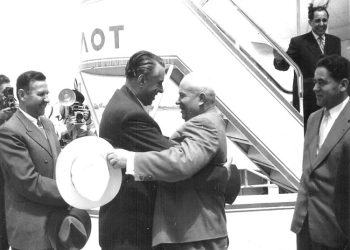
And it is no coincidence that for several days the cinemas “Partizani” and “17 Nëntori” block “art” to show with great fanfare the long documentary “Meeting with France”, dedicated to Nikita Khrushchev’s visit to France – a year earlier declared “Honorary Citizen” of Tirana. Then, on Saturdays, and especially Sundays, thousands of people filled the “Dëshmorët e Kombit” Boulevard and at the Lana Bridge turned right to reach the “Dinamo” Stadium (today “Selman Stërmasi”), which since 3 April 1960 had become the epicentre of the matches of the Albanian Football Championship.
Thus, because the “Qemal Stafa” National Stadium had closed its doors for a renovation mainly of its pitch, for the first time since its inauguration in 1946… This was the atmosphere of the 1st European Championship, otherwise the Nations’ Cup, in Albania of 1960.
It was said that no one in Tirana watched the EURO 1960 matches on television. It was the one‑sided Albanian press, as we mentioned, that only dealt with the resounding victory of the Soviet Union, which automatically became the “team of the heart” of Albania as well. As never before, sport had become extremely important, international and political, even in Tirana of Communist Albania. Extreme developments would appear later. We will show them in the next issue…!
THE RARE LETTER OF THE USSR FOOTBALLERS TO THOSE OF SPAIN!
The history of the founding of the European Football Championship preserves one of the rarest, most extraordinary gestures known in world football history. After General Franco’s decision that his Spain would not play against the Soviet Union team, the Soviet footballers published an open letter addressed to the footballers of Spain, a letter of “regret”, “humanism” and “friendship” unheard of, also condemning the “Cold War”, which, as they claimed, was fuelled only by the other side, the capitalist one.
At a time when the Soviet one was precisely a master at fuelling this “Cold War”. A demagogy of theirs, of course. It is known, however, that the propaganda gestures of communist society are always as masterful as they are paradoxical. Their letter, which to this day has remained unprinted in historical football publications, is published here for the first time, taken from the Soviet press of 1960. Short, “meaningful” in its entirety, it says verbatim:
“To the footballers of the Spanish national team. Respected athletes – members of the Spanish national team! We learned with regret that the Spanish authorities have prevented you from playing against the USSR national team, for a sports competition on the football fields of Moscow and Madrid, matches valid for the European Cup.
Not only we and our sports community, but also the wider circles of football lovers in all countries, cannot be outraged by this savage interference of the fascist dictator Franco, the disruptor of one of the greatest European football competitions. The act of the Francoist government shows that it is implementing the will of its American masters, who are trying to involve even sport in the ‘Cold War’.
We had gladly prepared for your arrival and were preparing the long‑awaited meeting and the reception you deserve. It is not your fault that it does not take place with you. We know that you sincerely wanted to come to Moscow and to host us in your country. We do not doubt that all football lovers so interested in sports competitions feel regret with us for the non‑occurrence of the matches.
The footballers of the Soviet Union believe that the idea of friendship and peace is as dear to you as it is to us and that no barrier and no force can disrupt the cooperation and friendship between athletes.”
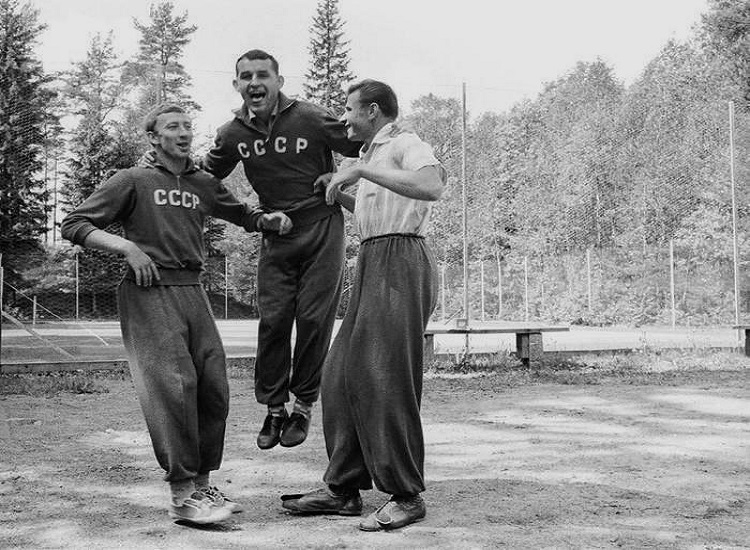
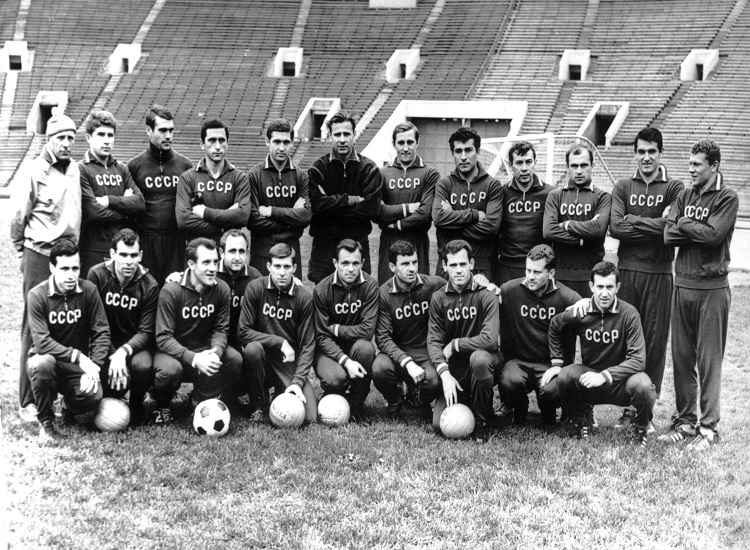
Participants of the USSR national football team: Honoured Masters of Sport I. Neto – team captain, J. Vojnov, B. Ivanov, B. Kuznetsov, A. Maslenkin, V. Tsarev, L. Yashin; Masters of Sport of the USSR – B. Batanov, V. Bubukin, Z. Kaloev, V. Kesarev, S. Kotrikadze, A. Krutikov, V. Maslachenko, M. Meskhi, S. Metreveli, J. Mosalev, V. Ponedelnik. Team coaches – Honoured Coaches of the USSR – G. Kachalin, N. Gulyaev.
Of course, few could yet imagine that most of these signatories of this “open letter” – a perfect model of the “working class” style – unique to this day in the history of the European Championships would become the first European Champions a few weeks later. For us, they were all very well known, because their names never ceased to appear on the pages of the Albanian sports press.
Of course, just as the Soviet footballers were ordered by their authorities to write this letter, so the Spanish footballers were ordered not to reply to it. And it was precisely the Soviet Union, which kept Hungary militarily occupied and had under its strict rule all the communist states of Europe, and thus also Albania, more Sovietised than ever, that spoke of peace, friendship and liberty…!
IN FRANCE OF 1960, JUST LIKE TODAY…
Meanwhile, UEFA had decided that the finals would be played among the best 4 in the country of one of the qualifiers. None could be more suitable than France. It had invented the European Championship with its Henri Delaunay, had a wonderful football tradition, had the conditions, and had a rare team, third in the World…!
And the great, historic matches of continental football would be played in the stadiums of Paris and Marseille. It is July 1960. The audience is missing. In all four matches there would be only 18,637 spectators, on average per match. Even the French found it hard to guess what this “first championship of the nations of Europe” could be.
One way or another, on 6 July 1960 in Paris, 26,000 spectators would watch the first semi‑final, France‑Yugoslavia, with almost indifference. The third best in the world is without the stars of Sweden, the great Kopa, Fontaine and Piantoni. But suddenly the match takes a completely spectacular course, marked by an unstoppable fury of goals. France reaches 3‑1, after the Yugoslavs had started 1‑0 with Galić as early as the 11th minute.
It looks like a done deal, but just as suddenly the Yugoslavs begin to transform the match into a completely unpleasant event for the French. Zenetić reduces to 3‑2 in the 5th minute, but 7 minutes later, Heutte takes France to 4‑2. This kind of fate almost seems to resemble the French fate of the Portuguese on that 10 July 2016. And 13 minutes later, Knez starts the series that to this day has been called “the series of fatal errors of goalkeeper Lamia”. These are among the worst mistakes a goalkeeper could ever make in all the finals of the European Championships.
The Slavs benefit in a row: in the 77th and 78th minutes, Jerković cannot contain himself: 5‑4! The first to jump for joy are the Yugoslav coaches, three in total, a very rare case: Tirnanić, Nikolić and Lovrić. Tirnanić had also been the coach of Yugoslavia at the 1946 Balkan Games in Tirana, from which little Albania had snatched the Balkan title! But now this is a Yugoslavia that wins 5‑4, and for France this championship is no longer an event worth dedicating time to. Never until today has it happened again that in a European Championship semi‑final within four minutes – 75, 77, 78 – three goals are scored and a result is overturned from 4‑2 to 5‑4!
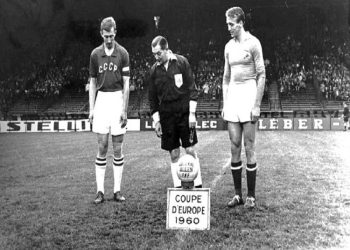
Meanwhile, in Marseille, on that same day, 6 July, the Soviet Union team faces Czechoslovakia; Yashin, Voinov, Neto, Ivanov, Ponedelnik, Metreveli, Meskhi – the above‑mentioned signatories of the said letter. And a great coach, the greatest of the Soviet Union of all time: Gavril Kachalin. And Soviet Union‑Czechoslovakia 3‑0! Something irresistible, a typical Russian storm, although Meskhi and Metreveli belong to the southern republics of the Euro‑Asian giant. Ivanov scores twice and Ponedelnik once. Shrojf, Novak, Popluhar and Masopust would write their great history only two years later in the stadiums of Chile for the World Cup…!
On 9 July in Marseille, the match for third place, the so‑called “consolation final”, would take place. France and Czechoslovakia. In the Marseille stadium, indifference has reached its peak. Only 9,000 spectators! And Czechoslovakia‑France 2‑0. “It is the worst match of the last 30 years,” declares the French coach, Thephot.
Now it was Paris’s turn, where the first “Henri Delaunay” Cup would be awarded. And yet, football Europe did not have its mind set on this first final. Especially Western Europe. This championship, of an “almost entirely Slavic content”, nevertheless had one “camp” that lived with emotion for this first European final.
It was the “socialist camp”. Today it seems like a passage of prehistory even for us Albanians, who had not had our national team for more than 7 years (only two friendly matches). Just like today, it would be 10 July. Thus the 15th jubilee edition of the European Nations’ Cup – otherwise the European Championship – coincides day for day with its 56th anniversary, also in Paris: 10 July 1960 – 10 July 2016!
Gavril Kachalin faces the trio of Yugoslav coaches; A. Tirnanić, D. Nikolić, Lj. Lovrić, of whom Aleksandar Tirnanić had been one of the footballers participating in the first World Football Championship in 1930 in Montevideo. Recently, Serbia has made a wonderful historical film dedicated to that participation of Yugoslavia in the 1930 Championship, featuring Tirnanić as a character – their subsequent legendary coach…!
In any case, it would be almost like a repeat of the Olympic final 4 years earlier, in 1956 in Melbourne, when the Soviet Union had snatched the gold medals precisely from Yugoslavia. Moreover, both sides have many names from that final: Yashin, Maslonkin, Netto, Shekularac…! It would be a football drama for which 90 minutes would not be enough. And for history, it is known that Melbourne had healed the great wound of the Soviet loss at the Helsinki Olympics in 1952, which Stalin had not forgiven at all. The event is worth telling here as well, to understand what political influences sports events had back then.
WHEN STALIN CONDEMNED AND DISSOLVED CSKA MOSCOW…!
The dissolution of CSKA Moscow, although happening after the dissolution of the 1948‑’49 Albanian Championship, also constitutes a world case in the sports policy of communist countries. I am recounting here this Soviet case, so very similar to the Albanian one. Everything is related to the participation of the Soviet Union team in the Olympic football tournament at the Helsinki Olympics in 1952. On 20 July 1952, the USSR draws 5‑5 with Yugoslavia, although it had been losing 1‑5, but two days later, the match is replayed: 22 July 1952.
Yugoslavia wins 3‑1 and eliminates the Soviet Union. This was a Yugoslavia that would win the silver medals (the gold was snatched by Ferenc Puskás’s Hungary), featuring its legends; Čajkovski, Horvat, Mitić, Vukas, Bobek, against whom Albania had twice triumphed by snatching the Balkan Champion title in ’46, as well as the 0‑0 in Belgrade in 1948.
In Yugoslavia, the elimination of the Soviets sparked an indescribable political euphoria. Even in the Prishtina garrison, the victory was celebrated with artillery fire! Meanwhile, the defeat was not tolerated by Stalin and his men. The Soviet press, as if in mourning, published no photos from the Soviet team’s matches, nor showed the documentary of the participation. The leaders of the Soviet delegation were summoned lightning‑fast to Moscow, not being allowed to take part in the closing ceremony of the Olympics held on 5 August 1952.
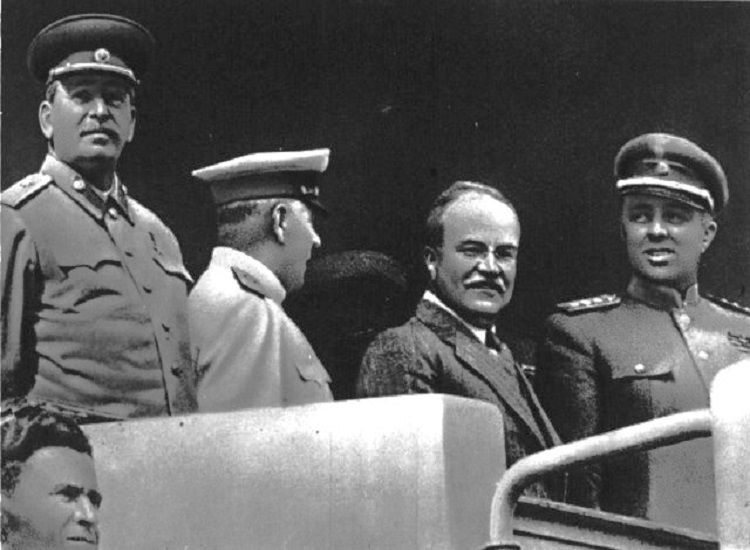
The Secretary of the Central Committee of the Political Bureau of the Communist Party of the USSR, Malenkov, summons to the Kremlin the leaders headed by the President of the USSR Olympic Committee, Romanov. After a face‑to‑face discussion with Stalin, Malenkov returns with the merciless decision of the supreme leader. The main culprits are the players of the Army club CDSA (CSKA), who made up the majority of the national team players. Hence also arises Decision No. 793 of 18 August 1952, which states:
“Considering that the CDSA (CSKA) team has not behaved satisfactorily, losing the match against Yugoslavia, and causing serious damage to the prestige of Soviet sport and the Soviet state, orders: 1. Due to the failure in the Olympic Games, the serious damage caused to the prestige of Soviet sport, the CDSA (CSKA) team is excluded from the USSR Football Championship and it is dissolved.”
On 18 August 1952, the next match CDSA (CSKA) – Dynamo Kyiv is not played and the teams in the Championship go from 15 to 14, i.e. without the Red Army team. Stalin had to die so that, only one year later, in the autumn of 1953, the Minister of Defence Nikolai Bulganin would decide to re‑establish the dissolved club, CDSA (CSKA) of Moscow!
This is the unbelievable Stalinist event, very similar to many events that began to happen in Albania as early as 1948‑49. And which would be repeated quite a few times in years such as, for example, 1967, with the great expulsion of “17 Nëntori” and “Partizani” – which we will soon return to in order to tell the story that many are distorting with extremely hasty writings…! / Memorie.al
To be continued in the next issue