
By Vepror Hasani
Memorie.al/ At that moment when I was with him, I did not know that I was having coffee with the sole surviving witness of the Borova massacre, a village located not far from the town of Erseka. As soon as I found this out, I asked him: “So, how did it happen?… Do you remember anything from that day?… How old were you then?… Are you able to accurately describe those moments when the village of Borova was engulfed in flames and 107 people were left killed and burned?…”
While I had asked the questions, I was anxiously waiting for Koço Prifti, the man who had seen the massacre with his own eyes and had remained alive as the sole witness, to answer me…
Koço Prifti, now 69 years old, a resident of the city of Korça, sat in thought for a moment, then replied: “Others have asked me this question too, but I was only three years old then, so I both know how to tell the story and I don’t know. If I had been older, I would have a more precisely accurate version, whereas I, to this very day, only retain images…!”
“Tell it to me just as you remember it,” I said.
“I will try,” he said, “but I don’t know if you will understand me in what I am about to tell, because more than words, I have only vivid imaginings, strange, inexplicable sensations, because I was only three years old…!”
“Tell it to me,” I urged him again.
After a moment of silence, the 69-year-old, Koço Prifti, began to tell me his story…!
KOÇO PRIFTI: “WE DID NOT WANT TO LIE TO THE GERMANS…”!
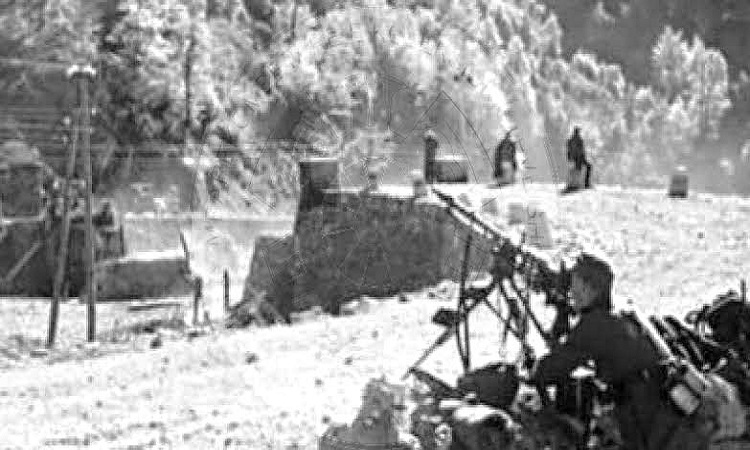
“I was only 3 years old,” Koço Prifti began his story, “I knew as much as a child of that age could know. I now know that the massacre happened on July 6, 1943. The Germans were coming from Korça and heading south. A German motorcade entered our village. It was a long motorcade; it seemed as if it would never end. The whole road was soldiers, cars, and weapons. I don’t remember if there were tanks too…!
A tall German got out of the car and asked to speak with one of the village men, but no one could speak with him, because none of them knew German. In truth, everyone had understood that the German wanted to talk with one of the villagers. Then they remembered that someone who had just returned as an emigrant from America knew English. They went to his house, got him, and brought him before the German. The German also knew English.
The two men stood facing each other. Everyone else was watching to see what might happen. There was anxiety.
The German asked him:
– Are there partisans in the village?
– No – replied the emigrant from Borova, who had just returned from America.
The German was serious, he seemed extremely proper, but I cannot say that there wasn’t a sense of friendliness and trust in his eyes.
– Thank you, – said the German.
After that, he shook hands with the man he had spoken with, stepped away from him, and got into one of the cars that had stopped at the head of the column. When the motorcade started to move, the German waved to us once more. We did the same. The movement of the motorcade resembled something extremely heavy and terrifying. All the men of the village gathered around the emigrant—I don’t remember his name.
– What did he say to you? – they asked him.
Then the emigrant began to explain everything he had discussed with the German.
– He asked me, – he said, – whether in our village or along the road there were partisans or not, and I told him that in this area there are no partisans.
– You did well to tell him that, – said the village men.
In truth, we had not lied to the German and we didn’t want to lie to him, but the fact is that we did not know that at the Barmash gorge, a little farther from our village, the partisans had set an ambush for the Germans. If we had known this, perhaps we would have told the truth to the German, perhaps not…! I cannot say this for sure, because I was only three years old, but what I know precisely concerns the fact that we did not want to lie to the Germans. Not much time passed when gunfire was heard; the partisans had fired upon the motorcade.
For the Germans, who had trusted us, everything had been unexpected. The German had spoken with the Borova man as man to man, but when the Germans were fired upon by the partisans, it seems they felt offended, disappointed, and perhaps worse than that. The motorcade, whose tail end was still in the village of Borova, stopped. Within a single instant, the soldiers got out and began firing upon every person they found in the street. It was an utterly horrifying scene. Borova began to burn in flames…”!
“THE MASSACRE”
“All of this I have already told,” Koço Prifti begins again, “what I remember myself, I will tell afterward, when it is their turn. The people of Borova began to flee, they were leaving the village, but even escaping from the village was not easy. The houses were burning and bullets struck every corner of the village. Nevertheless, those who could, fled, while the others remained there, killed. I remember that my mother, Kleanthi, said: – Quickly, let’s go to grandfather’s house, to Archimandrite Grigori!
We trusted that the Germans would not shoot at religious people, so we went to him. In the yard of his house, our entire family gathered, as well as other Borova villagers, 24 people in total. I was with my mother, Kleanthi, and with my two sisters, Marigo and Sofika. With us was also one of my brothers, Iloja. The Germans, offended and disappointed by our emigrant, entered the yard of Archimandrite Grigori’s house and opened fire. At that moment, I was in my mother’s arms.
I remember, as if through a fog, that my mother fell down and could not get up again. Around me came my two sisters, Sofika and Marigo, but they too lay stretched out, neither speaking nor moving. Within that instant, no one was left standing, not even my grandfather, Archimandrite Grigori. It seems that only I had survived, but until that moment I was not fully conscious of what had happened. I had remained alive among the dead bodies. Perhaps after this, the Germans had left and everything had remained amid the fire and smoke…”!
“ALONE”
“I am not able to tell everything accurately, but as if in a dream, I remember that I went to my mother, but she did not answer me; I went to my two sisters, but they did not move from their place. Then I sought help from my grandfather, Archimandrite Grigori, but he too could not say a word to me. I did not know what had happened. I suspected that they might all have died, even as I believed they would move, perhaps a little later.
However, nothing of the sort was happening. The flame of the fire coming from the rooftops of the houses was drawing closer to me too. I would never have left my mother and my two dead sisters, but it was the fire that was forcing me to go further. I began to move. I was three years old and completely alone. As I moved away, the flames of the fire followed me behind.
Sometimes a sleeve would burn, sometimes my arm, sometimes my leg, and sometimes sparks of fire would fall upon my body. Perhaps the instinct for survival drove me to get out of that inferno of fire that burned and scorched. I was only three years old. I don’t know how far I walked, sometimes on my feet and sometimes crawling, until finally night fell, everything went dark, and I had been left somewhere that, to this very day, I do not remember….”!
“HOW I REMAINED ALIVE…”!
“One of my brothers, Ligori, had gone to Erseka and had not yet returned, and at that moment my father, Janaq, was not there either. I was alone. Even today I cannot say exactly how long I stayed there. I had been left completely shocked and senseless.
Suddenly I felt someone grab me by the arms, lift me up, and take me in their arms. Then they shouted: ‘I found a living child…. I found a living child…’ — this voice I heard sometimes and sometimes not, sometimes I believed it and sometimes not… I did not know who it was or who was calling out: ‘He’s alive… he’s alive…’.
Later I learned that some people from the village of Taç i Poshtëm in the Kolonja district had come. They had come there to see if anyone had remained alive or not. Passing from one burnt house to another, they had found me. They were still shouting: ‘he’s alive… he’s alive…’. They took me and brought me to their house. Suddenly, word had spread throughout all of Kolonja that from the massacre 107 people had died, but one small child had remained alive and was now in the village of Taç i Poshtëm. Precisely at this time, all the people from Borova who had not been in Borova on the day of the massacre came, one after another, to Taç. They came and went. They looked at me, took me in their arms, kissed me, laughed, cried, but still left me there….”!
“MY BROTHER LIGORI”
“Suddenly my brother, Ligori, who had been in Erseka that day, arrived. He saw me and began to cry. He took me in his arms and would not let me go. I did not feel well. I both remembered and did not remember that he was my brother. Nevertheless, he seemed like a dear, familiar face, a man who had held me in his arms other times too.
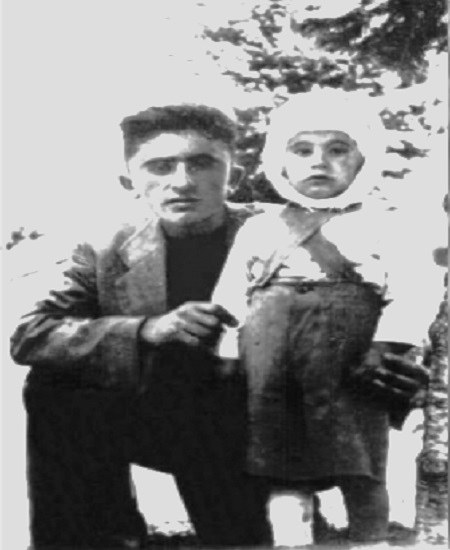
I felt like a person who had been in another world, but who was now returning to my own world. My brother took me and took me to the hospital of Korça. After him, I also met my father, Janaq. My sister, Vasilika, who was married in Boboshtica of Korça, also came there. After a long stay, I came to my senses. Even today I have the burn marks all over my body. I also have the photograph from that day…”!
“I DID NOT GO BACK TO BOROVA, BECAUSE…”!
“From that day on, we did not go back to Borova to rebuild our house. My father remarried, and we stayed in Korça. I completed the first years of primary school in the village of Boboshtica. I will never forget my first teacher, Kristaq Manço.
All the time, he stayed close to me, just as if I were his own son. I spent the other years in the city of Korça, where today the ‘Sotir Gura’ school is located. Later, I finished the polytechnic of Medicine as a dental assistant, and in 1963 I went to the University, to the Faculty of Medicine, Department of Dentistry. I worked my whole life in this profession.
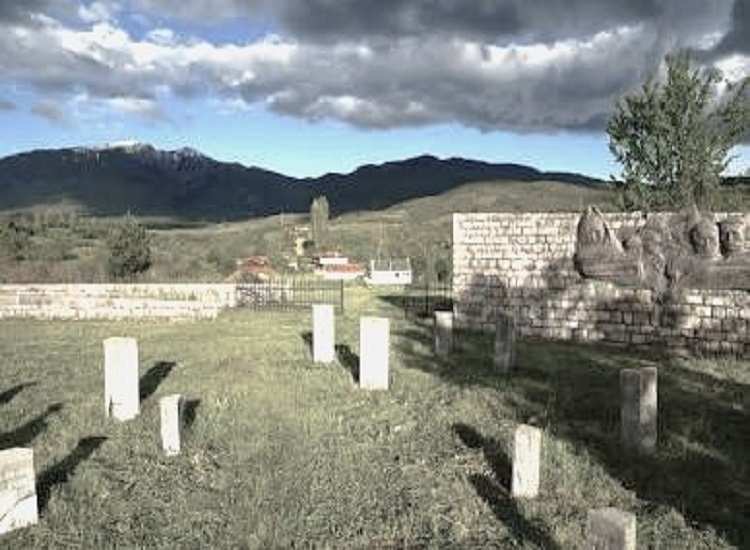
I am now retired. Nevertheless, every year I go to Borova to see the grave of my mother, my two sisters, my brother, and my grandfather, Archimandrite Grigori. I sit before their graves and remember those days. Often I feel like crying, as if I were small again. If my mother had remained alive, she would have told me everything that had happened those days in Borova. I was small and cannot tell everything….,” – concludes, with pain, his story, the sole surviving witness of the Borova massacre. / Memorie.al