From Sheradin BERISHA
First part
Memorie.al – It is estimated that during the war in Kosovo (1998–1999), Serbian military and paramilitary forces killed, executed, or massacred in the most brutal ways around 15,000 Albanians, of whom 90% were unarmed civilians. During this period, nearly 20,000 Albanian women were raped. Furthermore, it is reported that over 3,000 Albanians were abducted, of whom some were found after the war in mass graves in Serbia, while the fate of 2,087 others still remains unknown. According to one calculation, during the period from March 1998 to June 1999, Serbian criminal units and heavy artillery partially or completely destroyed and burned around 1,100 Albanian settlements, looted, burned, and destroyed over 200,000 houses, residences, commercial premises, craft workshops, factories, schools, libraries, cultural-historical monuments, cultural, scientific, religious, and other facilities.
After the end of the war in Kosovo, in a research article on the Qyshk massacre (May 14, 1999), published by Michael Montgomery and Stephen Smith, the UN war crimes investigator Dennis Milner emphasized that (quote): “…The work of his team will continue to focus almost entirely on the high-level ranks of the regime of the chief accused war criminal, Yugoslav president Slobodan Milošević.” “It could be said that the Tribunal (of The Hague – my note), was never established or never intended to go after prosecuting perpetrators of crimes at lower levels”…
“We will insist,” Mr. Milner said, “that those at the top are the responsible persons… and that they, being implicated, pulled the trigger.” Furthermore, M. Cherif Bassiouni, another UN war crimes investigator in Kosovo, supports the Hague Tribunal’s focus solely on Slobodan Milošević and his top associates. Mr. Bassiouni, surprisingly, declares (quote): “The fundamental issue is not in punishing past crimes, but in preventing future crimes”…!!!
If we rely on the statements of these UN “fact-finders” regarding the crimes committed in Kosovo, we can easily draw the conclusion that: hundreds of criminals from Serbian military and paramilitary formations, including local Serbs, who were directly involved in the killing of Albanians, the looting, burning, and destruction of their property, as well as the forced expulsion from their ancestral lands… will never be arrested to face international or local justice.
Even eight years after the end of the war, it seems that the International Court of Justice in The Hague, as well as the local courts in Kosovo, have done very little (if not nothing at all) to arrest the criminals, who freely roam in Serbia, Montenegro, throughout Kosovo, and all around the world. Although in my writings I have touched upon this very serious topic in a fragmentary manner, below I will bring forward some further arguments that precisely concern the crimes and criminals, whose names are already known worldwide, but surprisingly, no one is dealing with them.
How were 45 Albanians executed in Reçak?
On the morning of January 15, 1999, the inhabitants of the village of Reçak woke up surrounded by Serbian militant and paramilitary formations. According to witnesses who survived the crime, the Serbian forces positioned in several places around the village first shelled Reçak with heavy artillery, while the infantry began to move into the village. In this dramatic situation, many villagers, while trying to flee the village, were captured by the Serbian criminal units and gathered in the yard of Sadik Osmani’s house. Witnesses report that the Serbian criminals, after identifying the captured men, laid them on the ground and began to beat them brutally using rifle butts, kicks, clubs, chains, and other hard objects.
During the merciless beatings in Sadik’s yard, the groaning and screams of the men could be heard from afar, while in the basement of the house, the women and children locked inside were crying and wailing terribly.
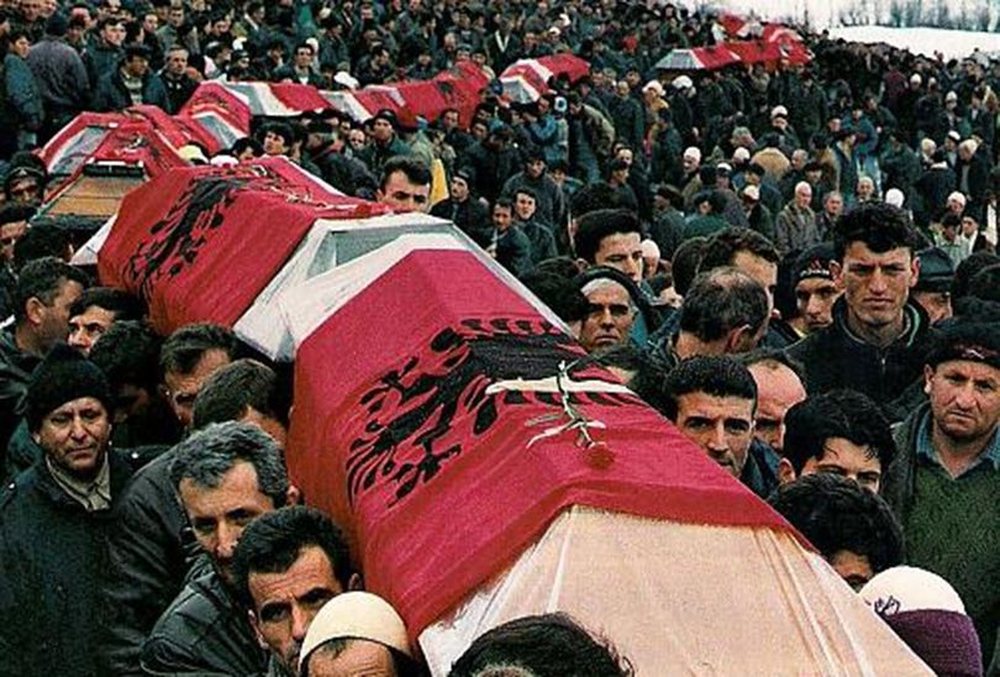
After an hour and a half of beatings near death, the barbaric Serbian units (sometime around noon) lined these men up in a column, ordering them to walk towards the mountain, and at a place called “Gropa e Bebushit” (Bebush’s Pit), they were stopped by other Serbian criminal units. Precisely at this spot, the barbarians executed 45 people with automatic rifle fire (at close range), among whom was also one woman.
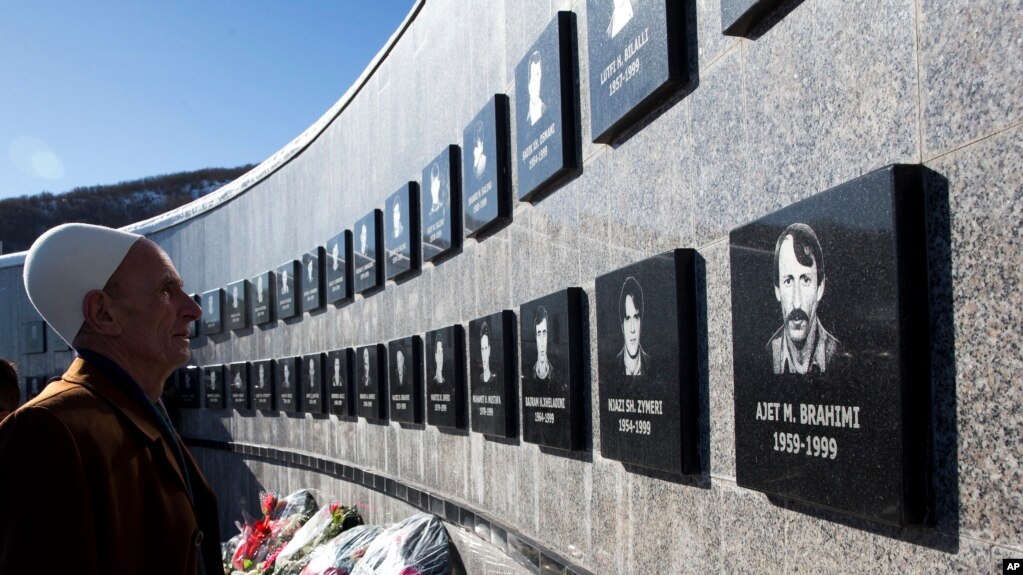
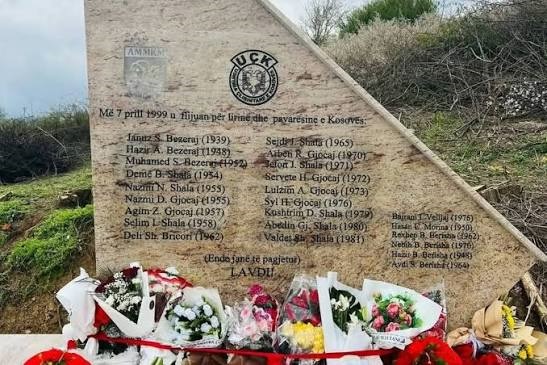
On that fateful January day, the following were killed: ….ASLLANI, Banush AZEMI, Ragip BAJRAMI, Halim BEQIRI, Rizah BEQIRI, Zenel BEQIRI, Lutfi BILALLI, Ajet EMINI, Bujar HAJRIZI, Myfail HAJRIZI, Skënder HALILI, Haqif HYSENAJ, Hajriz IBRAHIMI, Hakip IMERI, Murtez IMERI, Nazmi IMERI, Mehë ISMAJLI, Muhamet ISMAJI, Ahmet JAKUPI, Eshref JAKUPI, Hajriz JAKUPI, Mehmet JAKUPI, Xhelal JAKUPI, Jashar JASHARI, Raif JASHARI, Shukri JASHARI, Fatmir LIMANI, Nexhat LIMANI, Salif LIMANI, Bajram MEHMETI, Hanumshah MEHMETI, Arif METUSHI, Haki METUSHI, Ahmet MUSTAFA, Asllan MUSTAFA, Muhamet MUSTAFA, Sadik OSMANI, Jashar SALIHU, Shukri SALIHU, Bajrush SHABANI, Ahmet SMAJLAJ, Sheremet SYLA, Shyqëri SYLA, Bajram XHELADINI, Njazi ZYMERI.
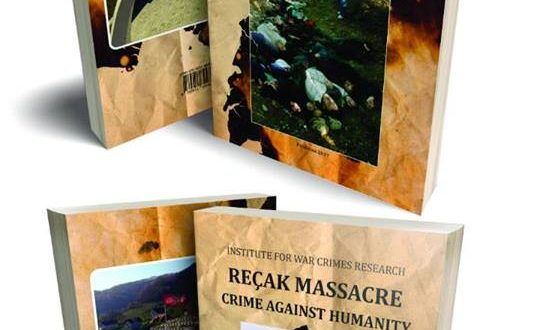
On January 16, 1999, the head of the OSCE mission, American Ambassador William Walker, during a visit to the scene, did not hesitate to declare that: “This is a crime against humanity…!” (Read the book “The Reçak Massacre – Crime against Humanity”, Shtime 2004)
Who are the Serbian barbarians who participated in the Reçak Massacre?
According to witnesses who survived the crime, besides the Serbian military and paramilitary units, local Serbs who worked at the post office, in the Shtime municipal assembly, etc., also participated in the killing of their fellow villagers. On June 10, 2005, the KAN Movement (now the “Vetëvendosje” Movement), together with the families of Reçak, published through a banner (placed in front of the UNMIK headquarters) several names of Serbian criminals who participated in the Reçak massacre.
On this banner were inscribed the names of these criminals:
- Bizhidar Markoviç
- Çedomir Aksiç
- Zhivorad Stojçetoviç
- Bogdan Nojiç
- Jovica Stojkoviç
- Momir Ristiç
- Zvonko Ristiç
- Ljubomir Nojiç
- Nenad Marinkoviç
- Pavle Marinkoviç
- Zoran Nedelkoviç
- Sllavisha Marinkoviç
- Vojisllav Janiçijeviç
- Milivoje Çanoviç
- Jovica Jovanoviç
- Stojan Aksiç
- Millorad Kostiç
- Dragisha Kostiç
- Dragan Tasiç
Who are the 35 Serbian criminals who participated in the killing of 750 Albanians and the abduction of 680 others from Gjakova?
On May 7, 2005, the “KAN” Movement (now “Vetëvendosje”), together with the organization “Thirrjet e Nënave” (Mothers’ Calls) from Gjakova, placed a banner with dimensions 20m x 4m near the UNMIK buildings and Kosovo institutions, on which they inscribed 35 names of Serbian criminals accused by the victims’ families as responsible for the killing of 750 Albanians and the abduction of 680 others from the municipality of Gjakova.
The names of the criminals are:
Stanojeviç Momçilo
Çamoviç Sreten
Stanojeviç Milan
Çoliç Rade
Slavkoviç Milan
Stanojeviç Sava
Kovaç Slobodan
Stojanoviç Sava
Dekiç Milan
Dekiç Momçilo
Raçiç Dragan
Mirkoviç Vuk
Vujoviç Vaso
Vujoviç Nikotin
Ragiç Darko
Simiç Bozhidar
Stefiç Nikola
Stefiç Bojan
Obradoviç Ljubisha
Pantoviç Radovan
Pantoviç Miliç
Jovanoviç Aca
Bozhoviç Çedomir
Jovanoviç Sava
Ristiç Predrag
Jovanoviç Goran
Shqepanoviç Millosh
Krstiç Srgjan
Dikiç Milan
Dikiç Momçilo
Dimiç Zvezdan
Jovanoviç Sinisha
Rajkoviç Gojko
Drashkoviç Laza
Lazareviç Doka
The organization “March 26, 1999”: 56 local Serbian criminals participated in the killing and massacre of 113 males of Krusha e Vogël!
On March 26, 2005, the organization “March 26, 1999” from Krusha e Vogël, in cooperation with the “KAN” Movement (now “Vetëvendosje”), on another banner placed in front of the UNMIK Headquarters and the Government of Kosovo, inscribed the names of 56 local (native) Serbian criminals accused by the victims’ families for the killing, massacre, and burning of 113 men and boys of the village of Krusha e Vogël. The organization “March 26, 1999” from Krusha e Vogël also prepared a several-page document (with photographs, etc.), clarifying the massacre that occurred on March 26, 1999 in this village, and submitted this material to:
– The Public Prosecutor’s Office – Prizren,
– The Public Prosecutor’s Office – Prishtina,
– The UNMIK Department of Justice – Prishtina,
– The UNMIK Police War Crimes Unit – Prishtina, and
– The Hague Tribunal Liaison Office – Prishtina.
But surprisingly, none of these justice bodies have taken the initiative to start investigations into this brutal massacre, in order to arrest the barbarians and give them their deserved punishment. It seems as if these justice mechanisms have made a pact of “understanding” with the barbarians, exercising a form of “positive discrimination” towards them.
Who are the barbarians who massacred 19 members of the Imeraj family in the village of Padalishtë?
In a report by the KMDLNJ (Council for the Defence of Human Rights and Freedoms) based in Prishtina, issued on April 6, 2000, it is stated: In Skënderaj, the names of all the criminals who on March 26/27, 1999, in Padalishtë massacred 19 members of the Imeraj family (among whom 11 were women and 5 were children aged 2–16) have been identified. The massacred are: Afrim IMERAJ (2), Ardiana IMERAJ (13), Arijeta IMERAJ (11), Avdyl IMERAJ (67), Bekë IMERAJ (53), Feride IMERAJ (21), Fetije IMERAJ (42), Florije IMERAJ (19), Hasan IMERAJ (63), Mihane IMERAJ (72), Mona IMERAJ (72), Muhamet IMERAJ (19), Nexhmidin IMERAJ (?), Rab IMERAJ (30), Rustem IMERAJ (73), Sabahat IMERAJ (21), Shehide IMERAJ (70), Violeta IMERAJ (17), and Xhyfidane IMERAJ (14). This list of names was also submitted to the representatives of the Hague Tribunal.
The criminals who brutally executed the Imeraj family are Serbs who came from several villages of the municipality of Burim (formerly Istog).
They are:
– Predrag Belosheviq (Participant in the wars in Croatia and Bosnia-Herzegovina); brothers Grujica and Lubisha Belojeviq, Zharko Belosheviq, Zhika Belosheviq, brothers Malisha and Çeda Tijaniq, Goran Tijaniq, Dejan Tijaniq, Vedran Tijaniq, Obrad Tijaniq, Zhivan Vuçiq, Mirolub Vuçiq, Dushan Vuçiq, brothers Rade and Milisav Ivanosheviq, Igor Shapiq, Gradibor Radunoviq, Ivan Gajin and Zoran Shlaniq – all from the village of Cërkolez; Dushan Shapiq and Zharko Shapiq from Belica; Dragan Cvetkoviq from Uça and Sllobodan Petkoviq from Zhakova. After the war ended, most of these criminals have been seen walking freely in Cërkolez, a village that was guarded by Spanish KFOR troops.
How many Albanians were killed on March 28, 1999 in Izbicë, Skënderaj (?!?)
It is well known that after the start of NATO bombings against Serbian targets, Serbian military and paramilitary forces undertook an offensive of exterminating proportions against the Albanian population, and this campaign was carried out as part of the operation codenamed “Horseshoe” (Patkoi). In these extraordinary developments, starting from March 25, Serbian forces shelled with heavy artillery and then burned several villages of Drenica, such as: Klladernicë, Qirez, Leçinë, Turiçec, Vojnik, etc. According to witnesses, during this operation, the barbaric Serbian units captured several women and children in the village of Qirez and herded them into a corn barn. On that occasion, several women were sexually assaulted, 8 of whom were brutally killed and their bodies thrown into three wells in the village.
In this extermination campaign against Albanians, on March 27, 1999, large Serbian military and paramilitary forces also shelled the village of Izbicë in Skënderaj, where about 5,000 inhabitants (mainly women, elderly, and children) from surrounding villages had taken refuge during the preceding three days. On March 28, the Serbian criminal forces surrounded the place where this population was concentrated and, after severe physical mistreatment, the men were separated (into two groups) from the women and children.
The first group was sent to a nearby hill, while the second group was gathered in the bed of a ravine and, according to plan, fired upon them. On this occasion, 147 people were killed and brutally massacred. That same day (after the massacre in Izbicë), the women and children who had been gathered on a meadow were forced to leave and walk on foot towards Klina, Gjakova, Prizren, and eventually ended up in Albania.
On March 28, 1999, in Izbicë, the following were barbarically executed: Jetullah ALUSHI, Asllam (Q) AMRUSHI, Asllan BAJRA, Bajram BAJRA, Bajram C. BAJRA, Bajram S. BAJRA, Brahim BAJRA, Fazli BAJRA, Ilaz BAJRA, Sami BAJRA, Bislim BAJRAKTARI, Hajdar BAJRAKTARI, Demush BEHRAMI, Muhamet BEHRAMI, Nuredin BEHRAMI, Asllan DAJAKU, Dibran A. DANI, Sali DERVISHI, Bajram DERVISHI, Ilaz DERVISHI, Musli DOQI, Hamdi DOQI, Ali DRAGA, Cen DRAGA, Hajriz DRAGA, Ismet DRAGA, Murat DRAGA, Rrahim DRAGA, Rustem DRAGA, Zade DRAGA, Avdullah DURAKU, Bel A. DURAKU, Dibran DURAKU, Rexhep DURAKU, Muhamet EMRA, Lah FETAHU, Ibrahim GASHI, Ramë GASHI, Halil HAJDARI, Halit HALITI, Fejz HAXHA, Hazir HOTI, Qerim HOTI, Rifat HOTI, Rrustem HOTI, Tahir HOTI, Muhamet HOTI, Sadik HOTI, Shefqet A. HOTI, Vehbi HOTI, Zenel ISUFI, Beqir JETULLAHU, Kajtaz D. KAJTAZI, Bajram KELMENDI, Jetullah KELMENDI, Ramë KOTORI, Brahim KOTORI, Hajzer KOTORI, Deli KRASNIQI, Mustafë KRASNIQI, Rrahim KRASNIQI, Azem KUQICA, Sami LOSHI, Jashar LOSHI, Selman LOSHI, Halil MORINA, Sokol H. MURSELI, Beqir MUSLIU, Ilaz MUSLIU, Shaban MUSLIU, Halit MUSLIU, Naim MUSLIU, Mehmet MUSLIU, Hasan MUSTAFA, Azem OSMANI, Fatmir OSMANI, Hetem OSMANI, Muharrem OSMANI, Pajazit D. QAKA, Sabit QALLAPEKU, Ismajl QELAJ, Rexhep QELAJ, Metush QELAJ, Hamz QUPEVA, Ramadan RACI, Halit RAMAJ, Mujë REXHEPI, Mustafë SEJDIU, Azem SHABANI, Hysen A. SHALA, Idriz SHALA, Isuf SHALA, Isuf SHALA, Mujë SHALA, Sali SHALA, Zymer SHALA, Halim SHALA, Hijraz SHALA, Sadik SHERIFI, Zeqir SHPATI, Riza SPAHIU, Ramë SYLA, Brahim TAHIRI, Gani TEMAJ, Hamdi TEMAJ, Hami B. THAQI, Ramë H. THAQI, Ajet D. THAQI, Sheremet THAQI, Ukë UKA, Zenel VELIQI, Idriz XHEMAJLI, Qazim XHEMAJLI, Jahir ZEKA, Milazim ZEKA, One unidentified male…(..) On March 28, 1999, during the journey towards Albania, in the trailer, the following were burned alive: Zyre FEJZA (61) and Zoje OSMANI (70). (This list is not complete) / Memorie.al