From Besnik Fishta
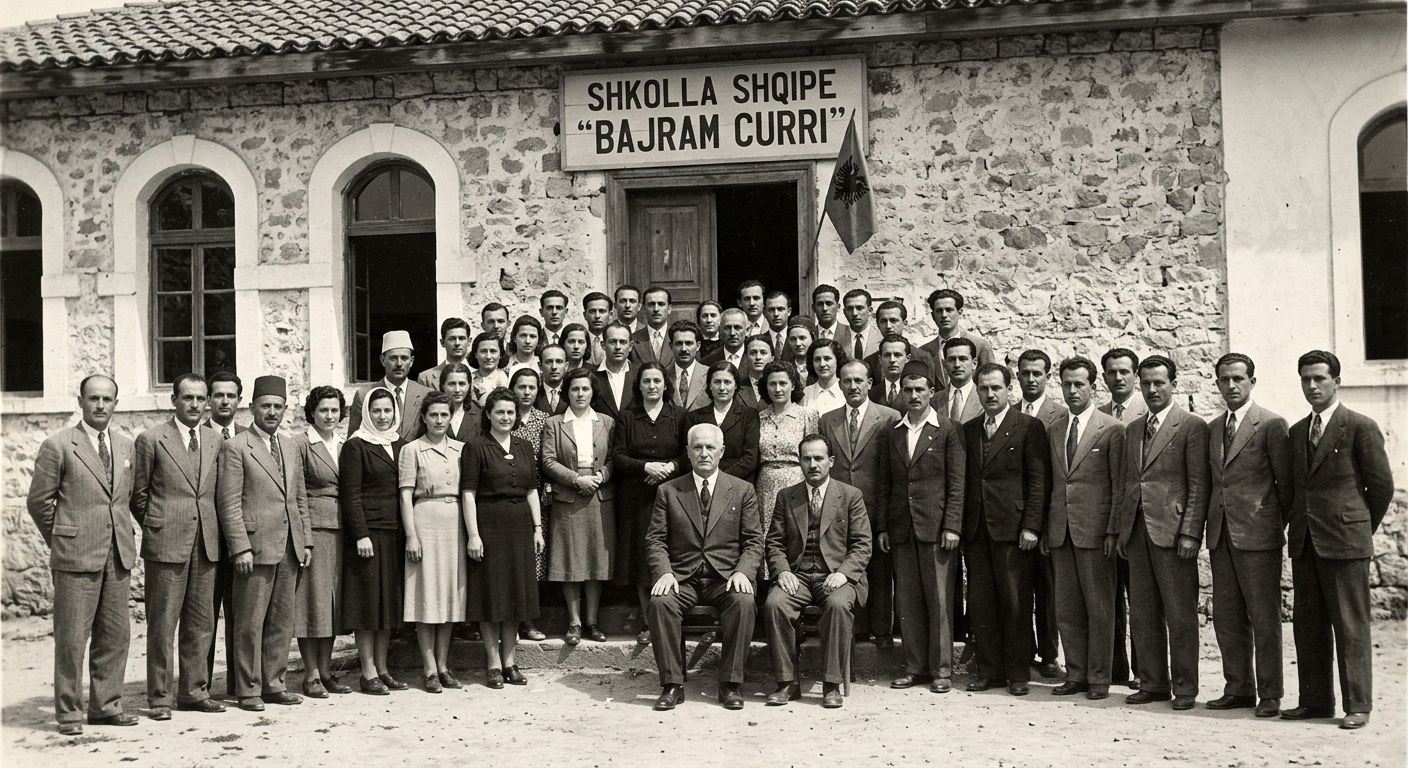
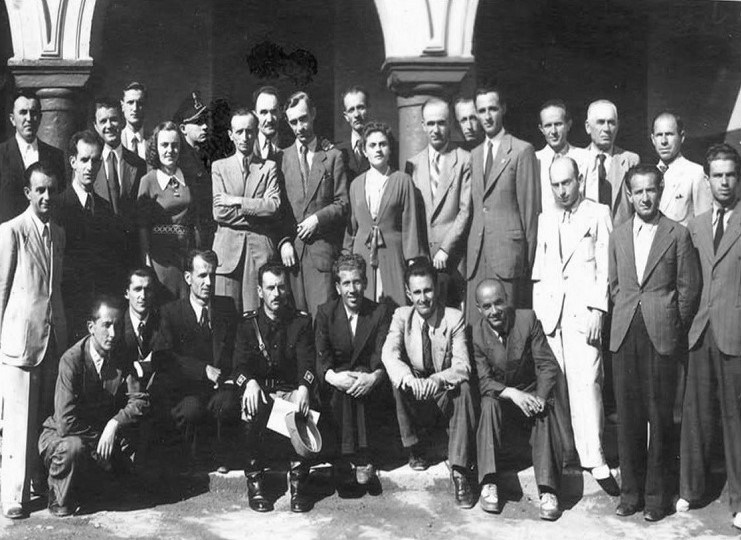
Memorie.al – There are cases when a photograph manages to show more than an entire archival document. It stops time, preserves faces, names, and memories, but above all, it preserves the ideals of a generation. A photograph taken in Prizren on July 13, 1941, in front of the “Bajram Curri” school (now “Lidhja e Prizrenit”), is one of those rare testimonies that survive time and continue to speak even after more than eighty years. It shows teachers, education leaders, and Albanian intellectuals gathered on the eve of a historical mission.
Among its ranks, names that would leave their mark on the educational, cultural, and political life of Kosovo stand out: Ali Hashorva, head of the Extraordinary Educational Mission; Mehmet Gjevori, Sulejman Drini, Zija Roshi, Talat Paçarizi, Shefqet Veliu, Fadil Hoxha, Shirin Fishta (Shehdula), Xhavit Nimani, Nuri Sherifi, Jonuz Blakçori, Abdurrahim Buza, Flora Pali, Shaban Arra, Zef Pali, Beqir Kastrati, Tajar Hatipi, Abdullah Laçi-Shabanaj, Ilmi Duli, and many others, whose names could not be fully identified from the photograph.
But this photograph is not just a depiction of people. It is the portrait of a generation that took upon its shoulders one of the most important national missions of the 20th century: the re-establishment of Albanian-language education in Kosovo. The years of World War II remain among the most complex periods of our history. Books have been written, debates have been held, and various political interpretations have been raised about this period. Often, events have been viewed through ideological lenses, dividing people into camps and judging their actions according to later developments.
However, beyond these divisions, there is a historical truth that can hardly be denied. The vast majority of Albanian teachers and intellectuals who served in Kosovo during 1941–1944 were not driven by the interests of any ideology. They were, above all, patriots. They belonged to that large group of Albanians who opposed foreign occupation, but who simultaneously saw in Albanian-language education a historic opportunity to save national identity from oblivion and assimilation.
In Kosovo, for decades, the Albanian language had been excluded from schools. Entire generations of Albanian children had been forced to learn in foreign languages. Therefore, the opening of Albanian schools after 1941 was experienced as a national rebirth. For many Kosovar families, the arrival of teachers from Albania was welcomed as the arrival of people who brought light after a long period of darkness.
At the request of the Minister of Education, Ernest Koliqi, the Extraordinary Educational Mission in Kosovo was established. Hundreds of teachers (over 200 according to various sources) were sent to the cities and villages of Kosovo. They left their families, birthplaces, and ordinary lives to dedicate themselves to a duty they considered a national mission.
Alongside the opening of schools, they organized numerous anti-illiteracy courses, Albanian language courses for adults, and cultural activities aimed at strengthening national consciousness. In these courses, literacy, national history, patriotic songs, Albanian literature, and Albanian culture were taught.
One of the most respected figures of the time, Ibrahim Fehmiu, emphasized in a speech delivered in Prizren: *”Kosovo needs capable, honest, and unyielding people. The spread of the light of education is the greatest duty of our time. The fight against ignorance is a fight for the future of the nation.”* These were not just words; they were turned into action.
In Prizren alone, the summer courses included about 1,200 children, students, artisans, and citizens of various ages. Throughout Kosovo, over 15,000 adults and thousands of students learned to read and write in Albanian. Among the teachers who worked in Prizren and its surroundings are mentioned Mëhill Shala, Jorgji Huta, Sulejman Aliu, Hajdar Shedulla, Idriz Fishta, Minush Lipoveci, Xhafer Xyrxa, Myrteza Shedulla, Shirin (Shehdula) Fishta, Xhevdet Doda, Mustafa Tepshi, Dhimitër Mino, Qamil Graceni, Veli Çela, Sebë Mateja, along with dozens of other educators who made valuable contributions to the spread of Albanian education.
Their work went beyond teaching letters. In the classrooms of Kosovo, students learned about Gjergj Kastrioti-Skanderbeg, the Albanian League of Prizren, the League of Peja, Ismail Qemali, and the history of the Albanian nation. For children who had until then known only texts in the Serbian language, this was a new and exciting experience. The memories of the time often describe students hearing the history of their people for the first time, children writing their names in Albanian for the first time, and parents following the progress of their sons and daughters with tears in their eyes.
Of course, the war also brought political divisions. Some of the intellectuals joined the anti-fascist communist movement, viewing cooperation with other Yugoslav forces as necessary to defeat fascism. Others, aligned with the nationalist camp, opposed this cooperation due to mistrust of Serbian and Montenegrin circles. These conflicts would deepen over the years and leave severe consequences on Albanian political life.
But the photograph of July 1941 precedes these divisions. It presents a moment when the main goal was education and national upliftment. It preserves the memory of a time when people of different beliefs could unite around a common ideal. Therefore, today, when looking at the portraits of Ali Hashorva, Mehmet Gjevori, Talat Paçarizi, Sulejman Drini, Flora Pali, Abdurrahim Buza, Fadil Hoxha, Xhavit Nimani, and dozens of their colleagues, one should not see only individuals from a distant era.
One should see the generation of intellectuals who understood that the most powerful weapon for protecting a nation is knowledge. This photograph is more than a document. It is a silent monument dedicated to the Albanian teachers of Kosovo and Albania. A monument to those who opened schools, taught children and adults, spread the Albanian language, and kept the national spirit alive in turbulent times.
Let this memory remain a token of gratitude for that brilliant constellation of educators and intellectuals who, despite the differences that history brought, united in one of the noblest missions of the Albanian nation: the spread of knowledge and the preservation of national identity in Kosovo. Their legacy continues to live in every Albanian school, in every book, and in every generation that learns its own free language. / Memorie.al