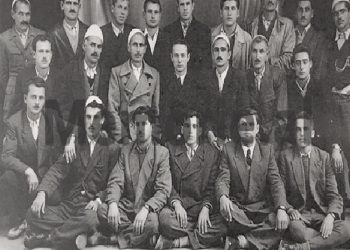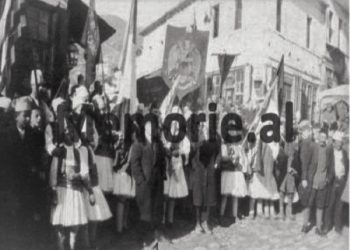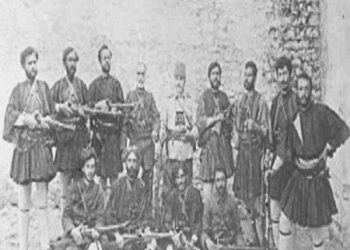

– The rare photographs of 1937 by the German anthropologist Reimer Schulz, featuring the men’s gjamë (lament) at the funeral of Ujk Vuksani, during his journey in Northern Albania –
Memorie.al/In 1937, the German anthropologist Dr. Reimer Schulz (died in 1941), commissioned by the “Office for Racial Studies” in Weimar, Thuringia, set out with a German-Italian expedition to the Alps of Northern Albania. During a long stay in the Theth region of Dukagjin, within the framework of the science of races – now abandoned and infamous – he researched the body shapes and physiognomic features of the local inhabitants. He also took over two hundred photographs, the fate of which is now unknown. As described below, Schulz also attended a burial, on which occasion he took the rare photographs shown below.
Nik Ndou, our interpreter, came to camp earlier than usual. It was six in the morning. Since early dawn, the echo of a long call had resounded through the valley. It had started from the north, bounced from slope to slope, until it died away at the end of the valley.
“The Albanian telephone.” That is what the Austrians called the masterfully devised method of transmitting news by means of calling and exploiting echoes, used by the highlanders, the usually Catholic inhabitants of the Northern Albanian Alps. And now, he wanted to explain to us why he had come earlier today than on other days. But he was not in a hurry: the Albanian never hurries.
From Niku, we learned that Ujk Vuksani, a wealthy villager in the northern neighbourhood, had died during the night and would be buried today. Niku wanted to go to the funeral; we went as well. Among the highlanders, the burial and its accompanying ceremony last all day, often until late at night. They come from near and far, even the clan’s relatives, to offer condolences to the deceased’s family and to take part in the funeral feast.
We arrived at the deceased’s house late in the afternoon. Together with Niku, we went to the house of the deceased’s brother, where in the courtyard food had been gathered for many participants. At the door of the house, the deceased’s brother awaited us.
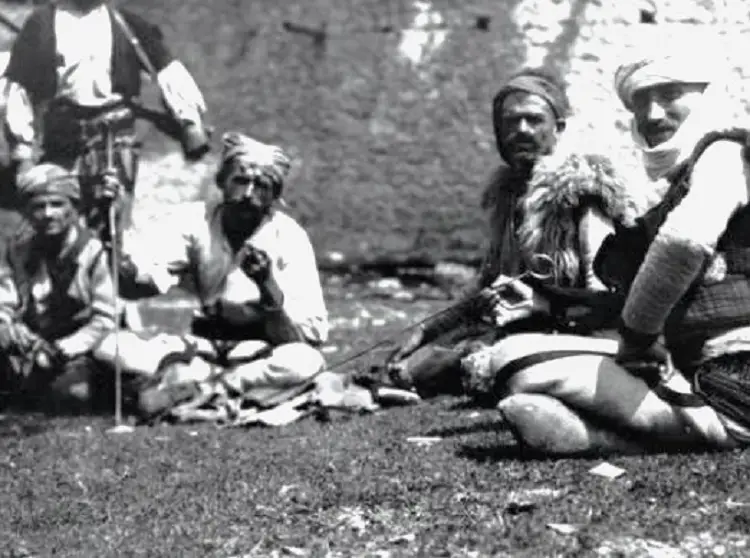
We offered him and his son our condolences with the words: “May it be well for you, men!” The man replied with the same formula and led us from the hall to the first floor, up into the tower, into the sitting room. In the hall, on the stairs and up in the tower, participants stood or sat cross‑legged (galiç). In the tower, five low tables were laid out. Around each table, ten men sat cross‑legged. And to take up as little space as possible, they brought only their right side to the table.
Corn bread and cheese were brought. One of the men at the table divided the large round loaf of bread and the cheese. A pitcher of water went around. Then they brought kaçamak (cornmeal mush) with melted butter on top. At each table, a large wooden dish from which they had to eat together. Each had brought his own spoon. Finally, they brought yogurt. After the meal, cigarettes were lit – the Albanian smokes almost only during meals and before sleep.
After the meal we went to the house where the deceased was laid out. From outside we heard the wailing of the women, which continued even after we entered. The women sat around the corpse. One woman at the head shooed away flies with a bunch of fern. The deceased was dressed in his good clothes. His upper body was covered with a generously embroidered xhamadan (woollen vest), such as nowadays only the elderly wear.
His head was wrapped in a clean white cloth that also covered the new woollen fez. Over the xhamadan, the deceased’s decorations – a Turkish medal and an Austrian one – hung on fine filigree chains. Beside the body lay a cartridge belt, fully loaded, a pistol beneath it, and on the other side a rifle. A long, off‑white shawl was wrapped around the body.
White woollen tirq (trousers) with black braid, masterfully knitted socks, and pointed Albanian opinga (leather sandals) completed the dead man’s attire. A cigarette holder with a cigarette was placed between his fingers. Three apples, a bunch of tobacco leaves, a tobacco box and a bottle of raki lay near the dead man’s arm. As a sign of the deceased’s generosity and hospitality.
In the afternoon, the corpse was taken to the cemetery, placed on a narrow bier. Two planks lay next to a tree. The deceased was placed on them, together with all his belongings. The women of the clan once again adjusted the dead man’s clothes, straightened the head cloth and shooed away flies with the fern bunch. Then some men began to dig the grave. Meanwhile, twelve men stood to one side.
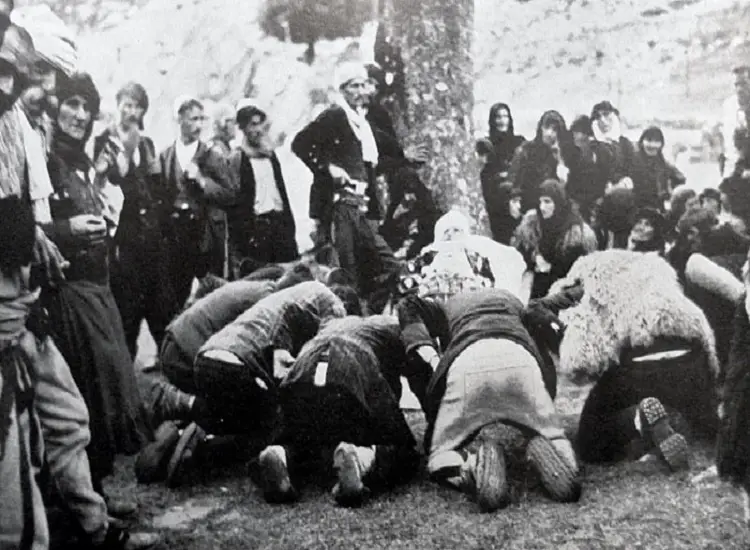
About a hundred metres away, they lined up in two rows, facing each other. The leader stood in the middle. He bent his knees slightly, filled himself with breath. The *gjamë* (lament) of the clan members began. A high moan: “Woe, -o, o, my brother, woe -o, o, eh, eh”! The call was repeated loudly and strongly. The *gjamë* was accompanied by gestures: beating the chest, scratching the temples. Then the men covered their noses and moaned: “Eh, eh, eh”!
The group approached the deceased a few steps and repeated the same sequence of gestures and lamentations. Until the men came right up to the deceased. They formed a semicircle, repeated their gjamë once more, then fell to their knees, bent forward, leaned on one hand and pressed the other against their body: “Woe, o, o, o”!
The gjamë was repeated several times, louder, more powerful. Then the deceased’s brother came forward. He put his hand on the shoulder of the lamenters, indicating that enough was enough. The cousins ended the gjamë and stood up. Serious, they stepped aside and lit cigarettes.
Then it was the women’s turn to gather around the deceased. A young girl covered her face with her scarf and began the women’s lament. Each phrase she uttered was accompanied by the other women’s moans: “Eh, eh, eh”!
The girl wept for her good father who had now gone forever, spoke of his life, told of his family, his children, his virtues, his hospitality, his sufferings and his death. The women’s lament lasted about half an hour and ended with shouts and moans.
We returned to our tents. Until midnight, we heard the wild cries and the men’s gjamë cutting through the darkness of the night. Then the deceased was placed in the grave, lined with leaves; the two planks were laid over him and the filling with earth began.
The gjamë of the highlanders – mostly Dinaric inhabitants of the Northern Albanian Alps – presents a touching picture of the blood bond among villagers and simple shepherds. Each of the relatives taking part in the gjamë feels himself a bearer of a cultic rite.
Each individual of the gjamë community is serious and self‑aware, devoted and zealous, but by no means falls into ecstasy or demonism. The bearer of the cult is not some community of men, nor a secret society, but the clan, which quite openly bids farewell to its deceased member. / Memorie.al