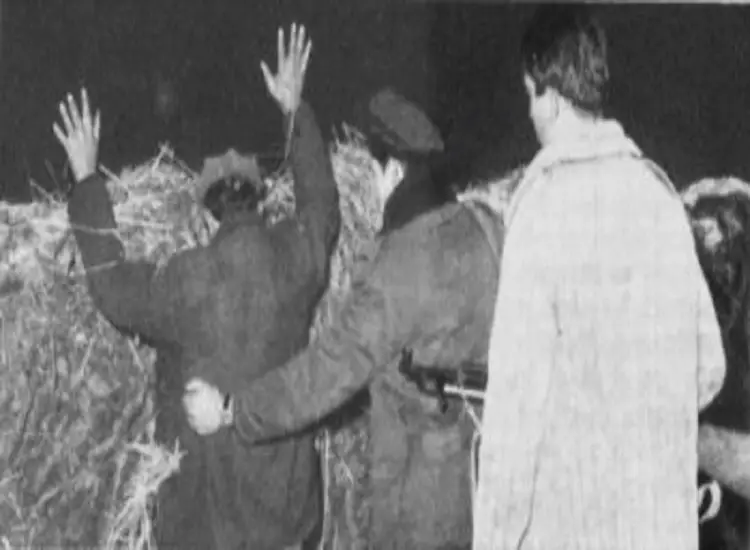
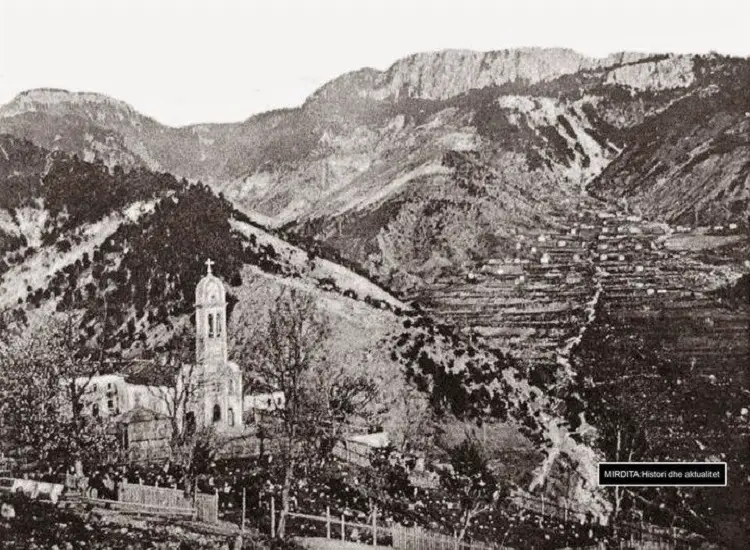
Memorie.al / The House of Llesh Moli were surrounded by the Security forces on the night of April 25, 1951, but the owners of the house could not betray the two friends whom the communists wanted to drive out. That night marked 5 victims: a Security officer; the father of the house, Llesh Moli; his 23-year-old daughter, Liza; and the two friends. Meanwhile, the persecution of the Moli family continued for years, experienced even by children who had not been born at that time. One of them, Gjovalin Moli, told the author of this article, Kristina Oroshi, about the events of that night as passed down in their family generation after generation, and about the persecution they endured for 40 years and perhaps even longer. In the struggle for the protection of Albanian national honor and dignity, Albanian women have played an important role alongside men.
One of those heroines who defended her home’s threshold and died like a lioness was Liza Llesh Moli from Mirdita. She not only defended the threshold of her home but also protected the guests who were freedom fighters who had sought refuge and found support in the house of the patriot Llesh Moli. Very little has been written about Liza Moli’s national contribution.
It is interesting to note that we also have very few documents regarding the killing of this heroine. But historical truth has never been lost. It has been passed down through generations with the narratives of family members about the pain of their relatives. An exclusive account, given with arguments and indisputable evidence, is the account of her nephew, Gjovalin Moli, who told me:
“The House of Moli is known throughout the entire region of Mirdita as a house of besa (pledge of honor) and bread. The House of Moli used to be one house; now we are thirty-something houses. Our origin is from Gjakova, we came down to Has, from Has we moved to Kaçinar. We have some cousins over there in Kosovo: they are called Nikollaj and Gjinaj, they are from Klina in Kosovo. My grandfather, Llesh Kolë Moli, had six children: two sons and four daughters. In 1946, his first son, Gjoka, was forcibly sent as a partisan.
He deserted from the partisans and went to the mountains together with the nationalist forces. Then they came and burned the house in 1946, taking all the property; they took the entire wealth, but there were no victims. However, they burned the house completely. Then came that amnesty for those who had not stained their hands with blood. We were repairing the house for the second time.
My father went as a soldier in his place (my uncle’s place); my father was younger. He (the uncle) was born in 1920, whereas my father, Nue Llesh Moli, was born in 1926. So he went as a soldier in his place. But despite the fact that they killed my uncle, it wasn’t the state per se, but completely the state’s cunning. You know the state’s agencies. But one of his comrades… because he was deep inside the State Security.
So, in 1949 my father went as a soldier in his brother’s place. In 1949, my uncle was killed. The house remained with my grandfather and with this Liza. Liza was unmarried and was born in 1928. Liza was killed at the age of 23, on April 25, 1951.
So, that night we had as guests two friends of the house who were in the mountains. They were from Mnela, Mesulak, but settled in Mnelë: one was my aunt’s brother-in-law, Gjergj Nikollë Suli, and the other was his cousin, Gjin Suli from Mnela. On the evening of April 25, 1951, the State Security agencies went to our house and surrounded it. My grandfather was elderly, over seventy years old.
‘Are so-and-so and so-and-so here?’ asked the Security. ‘Yes,’ said Aunt Liza, ‘they are here.’ ‘Bring them outside, because you are under a state of siege.’ She told them: ‘It is not our custom to throw our guests out. Tomorrow, when daylight comes, they will come out themselves and surrender.’ ‘No,’ they said, ‘both of them must come out immediately.’ But then the gunfire began. Those two friends had no weapons at all; only Liza had a pistol. Only that pistol was left. When the rifle shots started, she opened the door and killed the Director of State Security, Hajdar Nana.
They shot her with two bullets and she did not fall in the yard. My aunt’s brother-in-law came out to the door without saying a word; they killed him too, by the wall in the yard. My grandfather came out later; they killed my grandfather as well. The other friend went in between the chest and the wall and was alive. The next morning they came in to do a search and to burn the house. He came out and said to them: ‘It’s in your hands and God’s, o men,’ but the Security killed him without saying a word.
So on April 25, 1951, four people were killed in our house, among them my 23-year-old aunt. My grandmother at that time was in another village, in Arrës, and when she arrived she saw only the house burning. They took all the livestock. From that time on, only the walls and the ruins remained; we never built a house there again, because too much blood was shed there.
They took those two men from Mnelë and buried them in Smirë, but they buried my aunt in a different place, not in the cemetery of Kaçinar, but somewhere else, far away from the graves. Her grave existed until recently, but they did not allow us to take the body, even though my father tried to retrieve it.
They put up a lapidary (memorial plaque) to this Hajdar Nana at the house, and every May 5 they would come and commemorate him. I myself, the second brother, was there at 10 years old, and Hajdar Nana’s family from Skrapar would come and say: ‘Here is where the little criminal is.’ And at that moment my father was a soldier for three years in Gjirokastër… one month before finishing his military service, when this event happened, they caught him in Gjirokastër and sentenced him to ten years in prison.
After he was released from prison, my father came here and got married. From that marriage, we five children were born: two brothers and three sisters. Then my father worked in the sawmills of Pukë. They did not give us the right to education; we children learned on our own.
I longed to have a single funeral meal or a wedding meal with my own people, until democracy came. So when Democracy came, we were among the first, along with Gjomarku (who had also been imprisoned), to take part – more than any other patriotic family – in the toppling of the busts of communism, such as that of Bardhok Biba and the false heroines that were in Rrëshen.
I did not agree to get involved with the state, because my father, during his imprisonment, had learned to write and read – as he had stayed with philosophers who had studied abroad – and he told me: ‘Do not get involved with any party, because this is not democracy.’ ‘Why,’ I would ask him, ‘is it not democracy?’ ‘Because,’ he said, ‘since they formed an association of the persecuted into a party, but did not allow others to do so, they are the sons of communists, those who formed the party.’
About my father’s imprisonment and the two killings that were carried out without trial, I spoke to Kurt Kola, who was the head of the association in Tirana. They have split into four or five associations, in order not to form a party. We were in communism and we are even more in communism today. That is, it is a disaster for this nation. Later, Liza was decorated by President Sali Berisha as a ‘Martyr of Democracy’, but we have never found her grave.
They leveled the football field. She had been buried behind a hill. Not in the cemetery. Construction work was done; a sports field was made. That is why we have suffered all our lives. Now, supposedly we are free in democracy; I mind my own private business. I don’t want to hear that they are alive. Now we live in Balldre near Lezha, near the church of Shën Prenë (Saint Veneranda).”
This, then, was the chilling account of Gjovalin Nue Llesh Moli, the nephew of Liza Llesh Moli, about his aunt. This account should serve to place this heroine in her deserved place. The Court of the Mirdita District, with Decision No. 306 of April 30, 1993, established the legal recognition of the fact that Liza was killed without trial for political motives on April 25, 1951.
Writings of others about Liza Moli
Despite the attempts of the communists and neo-communists to make this heroine forgotten, she was never forgotten. Even though very briefly, the researcher of Albanian sufferings, Fatbardha Mulleti Saraçi, the publicist and historian Leon Molla, and the researcher Gjon Mark Ndoj have written about this heroine. She is also recorded in the Encyclopedic Dictionary of Victims of Communist Terror – V (Tirana: ISKK, 2016).
Researcher Fatbardha Mulleti Saraçi, in her book ‘Dhimbje 2’ (Pain 2), (p. 240, printed at “Ilar” press), gives some short notes about Liza Moli, writing: “Liza Moli was born in 1928 in Kaçinar (Mirdita). Her house was a welcoming hearth for resistance fighters who did not accept the atheist-communist rule.
To protect the sheltered fighters, the young girl was killed together with her father – Llesh Moli, the host, the bread-giver, the golden-hearted man from Mirdita…! The Pursuit Forces also burned their house, which was an anti-communist hearth… only stones, walls, and ashes remained, they were witnesses to this tragedy… but from the ashes the Phoenix was reborn, and father and daughter remained in eternal immortality…”
Meanwhile, another researcher from Mirdita, who wrote many books on the resistance and the fight against communism, Gjon Mark Ndoj, in his book “Mirdita Freedom Fighters” (publisher “Mirdita 2002”), on page 80, writes about Liza Moli: “Liza Moli – Born in Kaçinar and received her first lessons there (as much as time allowed). Her house was surrounded by the Pursuit Forces. In order not to betray her guests, at barely over 20 years of age she was killed along with her father. They burned her house.”
Similar accounts are written by publicist and historian Leon Molla, who, in an article about six heroines from Mirdita, mentions Liza Moli as follows: “Liza Moli – Born in Kaçinar of Mirdita, received her first lessons there. The State Security surrounded her house. To save the friends she had in her home, and to protect the honor of the house, she was killed at the age of 23 together with her father by communism. Then they also burned her house.” / Memorie.al