
By Agim Xh. Dëshnica
Part One
Father Gjergj Fishta and the miserable professors of socialist realism
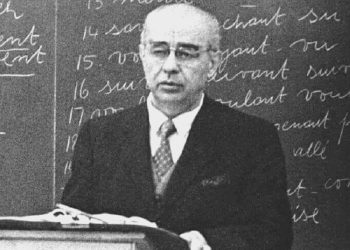
Memorie.al – In the book “History of Albanian Literature – 1983”, the aim was to discredit the work of the national poet Father Gjergj Fishta with words such as these: “The main representative of the clergy, Gjergj Fishta (1871–1940), poet, publicist, pedagogue, politician, for a long time directed the press of the Franciscan order and the cultural and educational activities of this order. For him, the interests of the church and of religion stood above the interests of the homeland and the people – something he declared and defended with all his demagoguery, but also with cynicism, and he made it the foundation of his literary work. His main work, the epic poem *’The Highland Lute’*, propagated anti-Slavism and relegated the fight against Ottoman rule to the background.
It sang hymns to patriarchalism and chieftainism, to religious obscurantism and clericalism, and speculated with patriotic feelings when it came to exalting events and figures of our national history from the period of our Renaissance. His other works, such as the satirical poem *’Babatasi’s Donkey’*, where secularism of the school and democratic ideas were furiously attacked, were characteristic of the fierce struggle waged by the Catholic clergy to preserve and increase its influence in the intellectual life of the country. This art was served by a form that stood close to folklore. It was often accompanied by prolixity, forced effects, rhetoric, brutality of expression and style, even to the point of banality, their false arguments that tried to impose themselves forcefully, as well as a markedly conservative stance in the field of language. Fishta ended his days as an academician of Fascist Italy.”
This hostile stance towards Fishta would not have been enough, nor had the barbaric banning of his books, but the voice of a man outside Albania named Rexhep Qose also to be heard. In the book *”The Rarified Pantheon”* of 1985, now only valuable for the archive, perhaps even for the trash bin, he writes: “Gjergj Fishta, as opposed to Naim Frashëri, wrote for the Catholic part of Albanians, spoke in their name, and the two most frequent words in his vocabulary were religion and homeland: always religion first, then homeland. In Naim Frashëri’s big heart there was room for all Albanians and, finally, for all people, whereas in Father Gjergj’s small heart – for a part of Albanians, therefore also for a part of people. His works today are enjoyed with more difficulty than when they were written, even by Ghegs, and we may believe that after a few decades they will be translated like those of De Rada…”!
Likewise, those who wrote that the name of Gjergj Fishta was forgotten after 1944 were also wrong. On the contrary, his books were kept as treasures in private libraries everywhere in Albania. Reading or reciting by heart in closed circles lived on with greater zeal. Even in cases when the newspaper *”Zëri i Popullit”* published malicious and offensive writings against the great poet, in the majority of readers they aroused contempt and opposition, just as the ridiculous judgment of the dictator Enver Hoxha around 1949 was not approved, when at an ordinary meeting he said that; “Fishta with his satires is not a patch on Shefqet Musaraj’s ‘Epic of the National Front'”(?!) However, he was among the first who, with his own verses, resolutely reprimanded the vices of society, or as a poet of patriotic feelings that boiled in his heart, sang praises to the defenders of the homeland.
Nowadays, here and there, it can be noticed how some so-called Prof. Dr., against all rules, violently damage with unscientific corrections the sweetness of the language and the rhythm of the golden verses of Father Gjergj Fishta, or someone else, wandering from door to door, collecting mouldy letters from years ago, without address and translated, i.e., fabricated, publishes them with subtleties to dim the light of Fishta’s work, or of Noli now honoured, and with smoky inspiration, swims hopelessly through waves, in search of patriots exiled in moments of tragedy.
Fishta’s published work
Fishta published his first poem in 1900, in Faik Konica’s magazine “Albania”. Throughout his life, he appeared as an epic and lyric poet and prose writer. In his multifaceted work, besides the epic poem “The Highland Lute”, are listed the works: “Folk Songs”, “Spiritual Verses”, “Drops of Sorrow”, “The Cliffs of Parnassus”, The Fairies’ Meadow”, “The Dance of Paradise”, “St. Francis of Assisi”, “Babatasi’s Donkey”, “The Deceptions of Patoku and The Evil Thinker”, “St. Anthony of Padua”, “Judas Maccabeus”, “The Brotherhood”, “Odyssey: Iphigenia in Aulis”, “The Civilized Albanian”, “St. Aloysius Gonzaga”, “The Shepherds of Bethlehem”, “Mojsi Golemi of Dibra and Deli Cena”, “Jerina or the Queen of Flowers”, and others. In the volume “The Fairies’ Meadow”, is also included the poem “Autumn Flower”, one of the most painful and most beautiful in our literature.
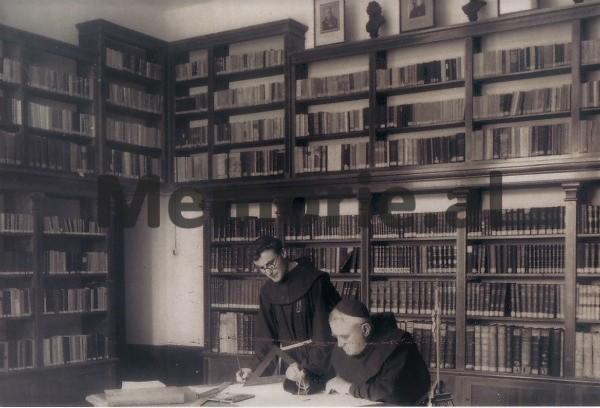
With his fluent prose, Fishta distinguished himself in polemical-political, philosophical, literary, and aesthetic writings in newspapers and magazines, especially in the monthly “Hylli i Dritës” (The Morning Star). During the dictatorship years, when Fishta’s work was banned, such an act did not happen anywhere, not even in our northern neighbour countries. His name had crossed borders. In the encyclopedias of the world, he was mentioned with the designation: “Father Gjergj Fishta, Albanian National Poet, etc…”
Fishta and “The Highland Lute”
During the dictatorship, no matter how much some dared to insult the great poet and cover the light of his work with the fog of slander, its radiance pierced the darkness: “So shake off the dust, Albania! Raise your brow like a queen!/ Because with the young men who warm you,/ You cannot be called, no, a slave”! Verses like these in the consciousness of the youth kept alive the feeling of nation and freedom, the hope and faith for salvation. Fishta’s works as a whole are a treasure for our language. According to Maximilian Lambertz, “Fishta’s work is the backbone of the Albanian Nation. As much as Greece can be understood without Homer, Italy without Dante, Germany without the Nibelungenlied, England without Shakespeare, so much can Albania be understood without ‘The Highland Lute’ of Father Gj. Fishta.”
About Father Gjergj Fishta have written Norbert Jokl, Erich Stranik, Gustav Weigand, etc. Weigand, besides special works, would translate it into German (Lahuta e Malcis von Gjergj Fishta, Balkan Archiv, Leipzig 1925), and Lambertz also into German (Die Laute des Hochlandes), Verlag R. Oldenbourg, Munich, 1958. In Italian, by Papas Ignazio Parrino (Il Liuto Della Montagna, Palermo 1968, 1970). After the fall of the dictatorship, “The Highland Lute” became known in English, translated by Robert Elsie and Janice Mathie-Heck (The Highland Lute, London, New York, 2005).
Fishta began the poem “The Highland Lute” in 1905, with the first song “The Rebels” and finished it in 1937, with the thirtieth song “The London Conference”. In his notes, Fishta recalls that once during the summer holidays he had been sent to the village of Rrapsh in Hoti to replace the parish priest Leonard Gojani. In that quiet place, he befriended an elderly man, Marash Uci from Hoti. They spent evenings together. From Marash, Fishta heard various accounts of the early battles of Albanian and Montenegrin highlanders, also of the fierce battle at the Rrzhanica Bridge, in which Marash himself had participated. Fishta continued to publish and republish the expanded poem in 1912, 1923, 1931, and 1933. “The Highland Lute”, with its language rich from the sources of the north, elevated to art by Fishta, was presented in full in Shkodra during the celebrations of the twenty-fifth anniversary of the Declaration of Albania’s Independence.
The poem, in octosyllabic verse, despite its colourings of a rhapsody of legendary frontier warriors, is a verse history of the war for the Freedom and Independence of Albania, with real heroes, such as Ali Pasha of Gucia, Ded Gjo Luli, Oso Kuka, Marash Uci, etc. Suddenly, in moments of inspiration, the poet with the gasps of frontier warriors addresses the Good Fairy, or the troubled – the Mountain Nymph. The rhymes are sometimes coupled, sometimes crossed. The songs created in youth are impetuous, while later, near the end, meditative and philosophical, with concerns for the fate of the homeland on the eve of freedom, after the First War and international conferences. From this epic masterpiece, we are giving only excerpts from five songs. / Memorie.al
THE HIGHLAND LUTE
THE REBELS
“Help, O Lord, as you have helped me!
Five hundred years had passed
Since this lovely Albania
The Turk held in slavery,
Leaving the wretched in blood,
Taking her breath away little by little,
Not leaving her, no, to see light:
Always doing evil without fail:
Beating her and not letting her cry:
To take pity, yes, on a wall,
For a snake under a stone to take pity!
But like a yoke-ox in a clay pit,
Which the collar and the harness wear down,
Where the goad cannot reach it,
It doesn’t heed the pull on the ploughshare;
And tossing its head side to side,
Causing much trouble to the ploughman,
Refusing to bend to the furrow
Or to go forward with its mate:
So the Albanians, who did not know how
To stay slaves under a foreign yoke,
To leave peace and health to another:
But to go forward freely in time,
Only knowing God over themselves,
And to no one in their own lands
To ever say hello,
They never fell into step with the Turk
Nor ever gave him their gun;
But they fought him and killed him,
As if killing Slavs.
And so when the Fates began
To weaken the Turk,
And his momentum began to break,
With Moscow daily clinging to his neck:
And those Balkan tribes
Began to betray the Sultan,
The Albanians began to think,
How to free Albania
From the Turk’s yokes: so that as in the days
Of Gjergj Kastrioti,
She would be completely free, and to no one,
Be he a King or a foreign Prince,
To ever say hello again,
Never to leave peace and health again:
And the Flag of Albania,
Like the wings of God’s Angel,
Like that flame of the purifying fire,
To wave again on Albanian soil.
Now there was that Prince of Montenegro,
Prince Nikola, a wretch:
A wretch, but a troublemaker:
He gathered cannons, he gathered armies
And he came and fell upon Albania,
To subdue these mountains and wilds,
As far as the Drin River stretches
Up to the Rozafa Fortress,
Where he wanted to plant his ‘troboynitsa’ (trumpet call),
He wanted to put a ‘cap’ (capitulation) on Shkodra:
To turn Shkodra into Karadak (Black Mountain),
After he had left it once in blood!
VRANINA
“The word went to Çetina:
– What is Vranina doing to the Slavs!
What is Vranina doing to the Slavs?
Taking captives and cutting down people,
Cutting down people, taking loot,
Ever since that Oso Kuka came out!
Oso Kuka, a man from Shkodra,
In Shkodra, they say, he has left no equal
In terms of loyalty and bravery,
Which Albania has been given as a gift.
With his grey horse and bloodshot eyes,
Huge moustache:
The mountain thunders, they say, when he speaks,
The field trembles where he shouts,
And where he turns his dark rifle,
You’d think fire flashes all around,
Such a roar he gives!
MARASH UCI
“At a meadow, at a pasture,
Three shepherds had gathered,
Two with sheep and one with goats,
One old and two young:
Marash Uci and Cali’s sons:
Two lads as swift as mountain birds.
Marash Uci, son of Uc Mehmet,
He had wandered from side to side of the sea,
He had seen the properties of the King
Starting from Hoti
To where bread ripens in the sun;
Because, when Marash was young,
He had gone out to the King’s army
With weapon in hand, with fire in his breast,
As is the custom in Albania.
A strong man and brave as a Fairy,
Weapons were to him father and mother:
Father the rifle and mother the cannon,
Brother and sister two pistols,
Two snakes from Istanbul.
He was sought and found,
He was called and summoned
To the call and battle of the standard,
And he had plundered Karadak;
And wherever the front line appeared,
There he also displayed his bravery.
But, like frost falling on a fig tree,
His foot and his hand left him,
And his loyal weapons lost their shine:
Those weapons which in the prime of life
Had been the honour of Albanian warriors:
And he came out a shepherd of the mountain,
Respected, with Cali’s sons,
Yet Marash, to the young men of Hoti,
Would recount the deeds of the past,
Deeds of the past, deeds of bravery:
How the Albanian for freedom,
For loyalty and the white Faith,
Embraces death as if giving his life;
And he remembered the Fates and the Fairies,
And told them many great things,
About the vampire when the moon rises,
And about the battle, which with lightnings,
The dragon wages in its own lands;
And he knew better than anyone
How many lightnings are in a man’s arm?
Thrown upon the Sand and at the Vizier’s Bridge.
That’s why all the shepherds loved him
And listened to his words,
Both in matters of the gun and in wisdom.
But what, O Lord, is wrong with Marash today,
That he is wounded and does not make a sound?”
AT THE CHURCH OF SHINJON
“The sun set, the moon came out in the sky,
At Veleçik the Fairy is walking:
Eh! You mountains of Albania,
In which the eagle of freedom nests,
In the white times that have passed,
Never letting an enemy approach!
The sword knows it, and the torrent knows it,
The land knows it, and the stone knows it,
Albania, far and wide,
How much blood of the enemy then
Flowed in streams from white steel,
That flamed in the Albanian’s hand
Like lightning on the peak of Sharr.
Could it ever have happened in that blessed time?
(With tears of blood today to be wept!)
That even one piece of Albanian land
Could be taken by a greedy hand?
Ah! Never: even if the whole world rose up…
Because some Lekë, or Gjergj Kastrioti
Would have come out, to cut off that seizing hand
With his field-burning weapons,
Which for centuries will be mentioned?
Like the moon and sun wandering the skies.
But the times and seasons have changed today,
For the frozen ground, where the ‘martina’ (hail) strikes!
Wretches, burdened with extinguishing tears,
Who moisten with sweat the moustache of ancestors?
Now rolling down the rumbling cliff,
Now falling upon the foaming wave at sea,
To keep a woman in the house
Whose children beg for bread,
And she leaves them perhaps to cry,
Because the poor wretch has no bread:
Wretches, for whom gold is God,
The black land that the unfortunate Albanian
Acquired at the cost of his blood,
If someone grieves, they are cursed!
Today they want to divide it piece by piece:
And why? Because Europe wants it…
Happiness, oh Fairy of Veleçik,
If you can hurl curses at the enemy,
If you can bless the young men of the Highlands,
If you can lament the plight of Albania;
This Albania, which in the past,
In the voice of the gun, the loyalty, and the faith in God,
Was esteemed by all the tribes
From where the sun sets to where the moon rises”!
AT THE RZHANICA BRIDGE
“Riza Pasha comes out on the fortress:
‘Great God, what am I to see!
A great fog must have fallen
There at Rrzhanica, under Podgorica.
It won’t last long, it’s going to rain:
A great blessing for the peasants!
Long may you live!’ says the Mufti to him.
‘It’s not fog that has fallen from the Highlands,
From Rrzhanica and Podgorica;
It is the smoke of gunpowder that has risen,
The young men of Gruda and the Lekë of Hoti
Are fighting with Montenegro.'”