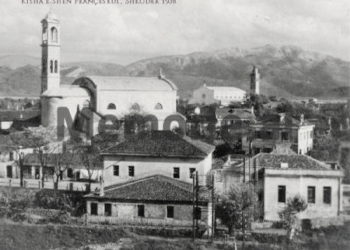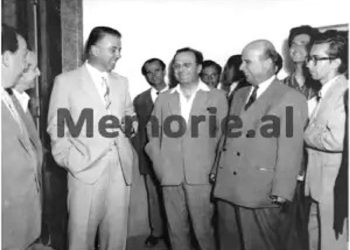
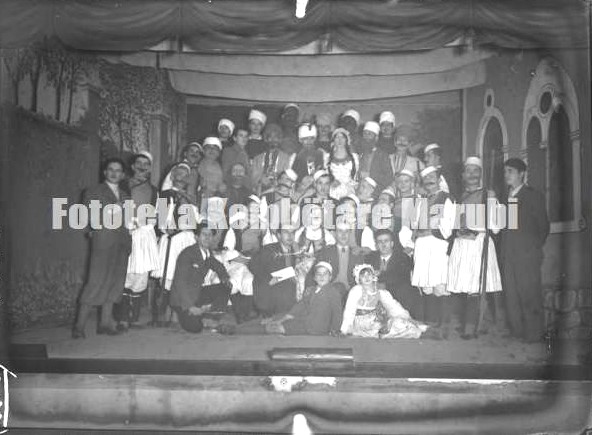
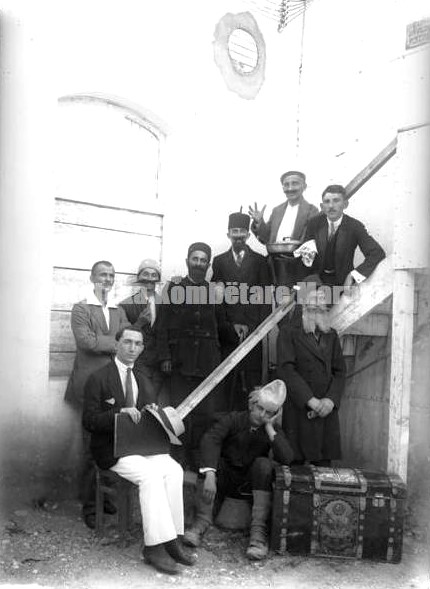
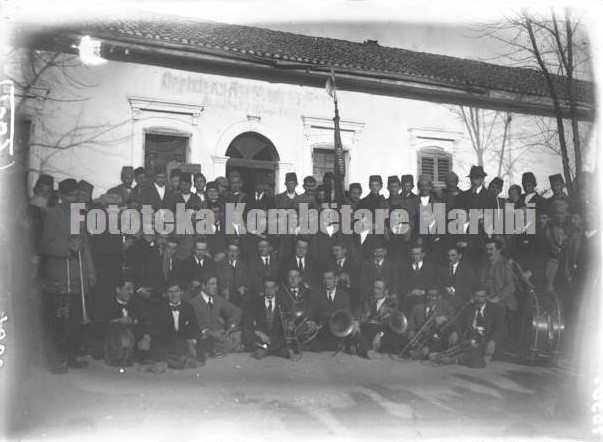
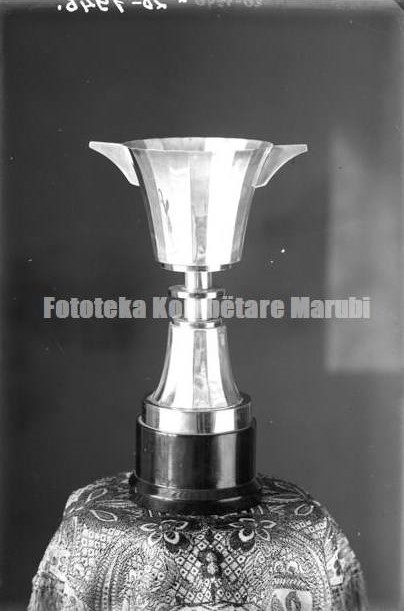
Memorie.al / It was a rare event in Shkodër, when in February 1919 a group of intellectuals decided to gather to found the society “Vllaznia” (Brotherhood), which came from the merger of the societies “Vaso Pasha” and “Mustafa Pasha”. The historian Romeo Gurakuqi introduces us to this history, drawing from the family archive the diary of one of the founders of the society, Karl Gurakuqi, who also christened the name of the club society “Vllaznia”. The younger Gurakuqi also makes available to us period photographs of the “Vllaznia” society, taken by Kel and Gegë Marubi. Below we publish Karl Gurakuqi’s diary about this event, entitled “Lest We Forget”:
Excerpts from Karl Gurakuqi’s diary
“….. Albania belonged to everyone without distinction……..; we would all strive for her, we would all enjoy her…! For this reason I came to an agreement with the exponents of Shkodër’s Catholic youth, with Hilë Mosi, Tush Kakarriqi, Terenc Toçi, Kristo Floqi (the latter two were lawyers, the first an Italo-Albanian, the second from Korçë) with Mati Logoreci, with my brother Lazrin (Lazer Gurakuqi, my grandfather, R.G.), with Kolë Mjeda etc., as well as with those of the Muslim youth, with Omer Ruzhdi, Ismail Anamali, Shefqet Muka, Ali, Shyqri and Kadri Borshi (three brothers) etc.
Both sides were ready for an agreement and for merging the two societies into one. It was decided to hold a general meeting to discuss the union. The meeting was held on 16 February 1919, in the great hall of the Municipality, with the permission of the French commander, Bardi de Fortou, which I obtained, since I had become friends with him because I gave him Albanian lessons twice a week.
Hilë Mosi opened the meeting and then gave the floor to me. I spoke about the benefits brought by union, about the need for a common hearth around which everyone could gather, where the problems of the moment and the time could be discussed in a brotherly manner. Albania needs everyone’s help, according to each person’s condition and ability, but all must aim for the common goal: the Progress of the Homeland, the fight against the outdated mentality that Albania could not stand on its own feet.
The youth had to take matters into their hands as soon as possible, since the enemies eagerly waited to see us incapable of managing our own house, and they would profit from our disunity and internal quarrels. The enemy is inside our house, and he is all eyes and ears; he rubs his hands when he sees one hitting the nail and another horseshoe.
I finished my speech with the Latin saying: Concordiâ parvae res crescunt, discordiâ maximae dilabuntur, i.e., with union small things grow, with disunion even the greatest go to the devil, or, as we say in Shkodër, ‘the wolf eats them!’
The applause was endless….; ‘Long lives the Union’! ‘Long live Gurakuqi’! – The hall resounded so as to be heard in the street. A commission was set up to draft the society’s statute, which was immediately baptized ‘Shoqnija Vllaznija’ (The Vllaznia Society). The commission consisted of Hilë Mosi, Kristo Floqi, Omer Ruzhdija, Ali Borshi and I.
At the end of the week, the general meeting was called (more than 150 people). The statute was read article by article and accepted without any change by a show of hands. Immediately after the acceptance of the statute, Hilë Mosi was elected president of the society. I was elected secretary by acclamation and with continuous applause.
As director of the literary section, Kristo Floqi was elected by vote.
As director of the theatre section, Kolec Deda.
As director of the music section, Lec Kurti.
These five constituted the Council of the Society.
It was also decided to publish a monthly review. Someone proposed that it be called ‘Vëllaznija’ (Brotherhood), but, after my proposal, the title ‘Agimi’ (The Dawn) was accepted. The publishing expenses would be covered by the members. Those present contributed on the spot for the publication of the first two issues.
The director of the review was appointed Kristo Floqi, and I was the editor. The first issue appeared in May 1919 at the ‘Nikaj’ printing press. In the second year, the directorship was entrusted to me (May 1920), which I held for two years until it closed (April 1922), and I had Ali Borshi as editor. (My second publication: The review ‘Agimi’ – its director from May 1920 to April 1922).
The theatre section needed plays. I also devoted myself to this task with continuous work: I turned night into day. First of all, based on the novel, I prepared the five-act drama ‘Gjenovefa’, which was presented with great success. It was the first time that women took part in a public theatrical performance. The role of Gjenovefa was played by Tusha Brahimi, who later married Rrok Maloku.
The second drama, entitled ‘Erminja e vorfën’ (Erminja the Poor), was a translation from Italian, made by Kolë Gurakuqi, alias; Kola i Shaqes.
***
It is worth noting that for the publication of the drama ‘Gjenovefa’ I bought the printing paper, while the typesetting and printing of the book was done by my brother Luigji, in his after-work hours at the ‘Nikaj’ printing press, where he worked.
For the theatre section I also worked on three comedies, which unfortunately remain manuscripts: ‘Fatakeqi’ (The Unlucky One), a five-act comedy, which shows the life of an official who remained un-promoted his whole life, and so he was a worn-out worker, but he was a man of his word and everyone profited from him: he did the work and others drank the wine.
‘L’homme malade imaginaire’ (The Imaginary Invalid), by Molière, three acts, adapted to Albanian circumstances. This comedy was played three times in Shkodër, later twice in Tirana, twice in Durrës and once in Shëngjin.
‘The Miser’ by Molière – adapted to the country’s situation.
The French army left Shkodër, 11 March 1920. Ahmet Zogu in Shkodër. Shkodër joins the government of Tirana.
The joy of the people on the occasion of Shkodër’s unification with the rest of Albania.
The society ‘Vllaznija’, as seen in its statute, had received permission to be founded as an Albanian cultural society, not a political one.
However, it was forced to act also in a patriotic-national perspective, because the Serbian army was not leaving Shkodër, pretending to keep it for itself along with the districts as far as the Bregu i Matit.
The Paris Conference was in session, where the question of Albania’s borders was being discussed and debated: Greece demanded the whole prefecture of Korçë and Gjirokastër; Italy wanted Vlorë and the mandate over the remainder of Albania. The Tittoni-Venizelos agreement of 29 July 1919 had assigned the southern Albanian lands to Greece.
Faced with this miserable situation, the Society ‘Vllaznija’ could not stand idly by, at least not without organizing a popular demonstration. However, demonstrations were forbidden, because Shkodër had two armies inside it: French and Serbian.
A favourable opportunity was awaited to undertake such an action. November 28th was approaching…! The Council of the Society, in secret meetings, took measures for a magnificent celebration with the participation also of the highlanders. In this effort we were helped especially by the Franciscans Father Anton Harapi, Father Vinçens Prennushi, etc.
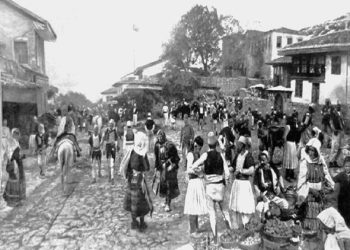
On that day, 28 November 1919, according to the instructions given, in the early hours of the morning, the society’s band went through the city streets to gather the people; another group moved here and there to prevent the shops from opening; national songs echoed on all sides. The highlanders also arrived, armed, with Father Anton Harapi at their head. Shkodër had never seen such a multitude of people. The Serbian army had withdrawn into the barracks; for fear that disturbances might occur.
Led by the society’s council, which had been joined by Father Anton Harapi and Father Vinçens Prennushi, and by the band, the whole people (some 10,000 people) headed towards the fortress ‘Rozafat’, where the French and Serbian flags flew, but not the Albanian one. The French army had orders not to stop us. Measures against us would be taken later.
When we reached the castle, Father Prennushi, climbing onto a rock, gave a fiery speech, which enthused everyone. The cheers were endless; the band played national songs, accompanied by the whole people.
The climax came when, in the place of the Serbian flag, next to the French one, we raised the flag of Skanderbeg, which had been made by the Stigmatine nuns on the orders of the Friars.
Late in the afternoon we came down from the castle shouting: ‘Shkodër is Albania’s!’ We had prepared memoranda for the Great Powers gathered in Paris. On the Field of Drûvet (Drueve), the people signed these (thousands of signatures). A commission elected on the spot, of which I was a member, was charged with presenting the memorandum to the French command and the Italian consulate in order to forward it to the Conference in Paris.
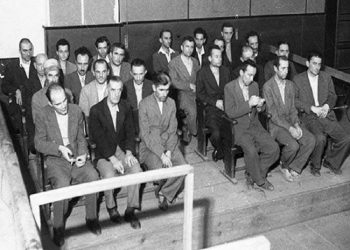
After completing this task, we all gathered (about 50-60 people) at Rasku’s ‘Great Coffee House’, opposite the Public Garden, to continue the celebration of November 28th with songs and drinks. However, around 10 o’clock in the evening, a French captain, accompanied by two armed soldiers, entered the cafe and arrested about 30 of us, escorting us to the police station, which was under the orders of Captain Billes.
There they put us in rooms as prisoners. I will list some names, as they come to my mind after 38 years: Mati Logoreci, Kel Marubi, Lec Kurti with his brother Salvatori, Kolë Krajni with his brother Gjoni, Luigj Naraçi, Tush Kakarriqi, Gegë and Simon Gurakuqi (two of my cousins), Omer Ruzhdija, Shefqet Muka, Shyqri and Ali Borshi with their brother Kadri, Ismail Anamali, Lec Çurçija, Guljelm Luka, and myself along with many others.
They kept us for five days and then released us. Rumour had spread that the French army would hand over Shkodër to the government of Tirana. The Serbian army began to move out its belongings.”