

From Agim Xh. Dëshnica
Part Two
– Father Gjergj Fishta and the miserable professors of socialist realism –
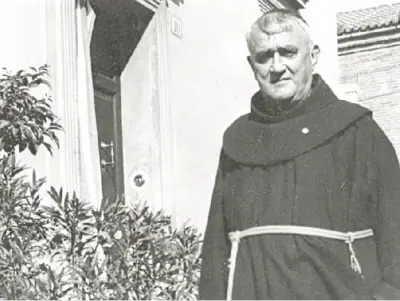
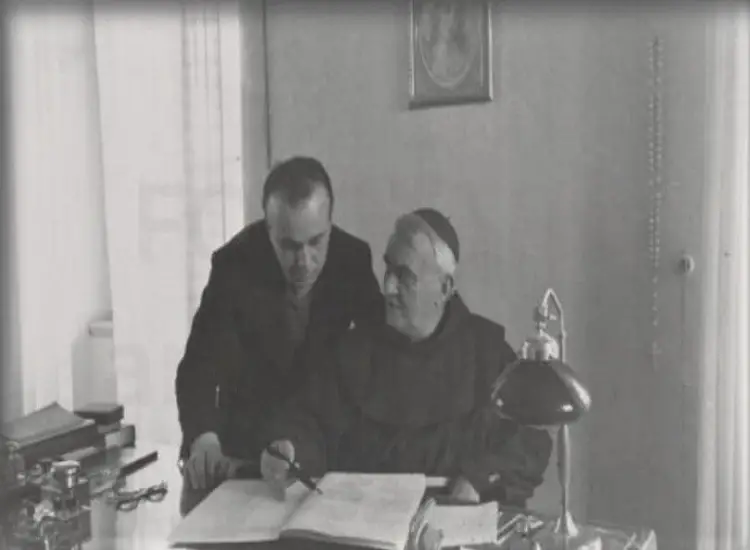
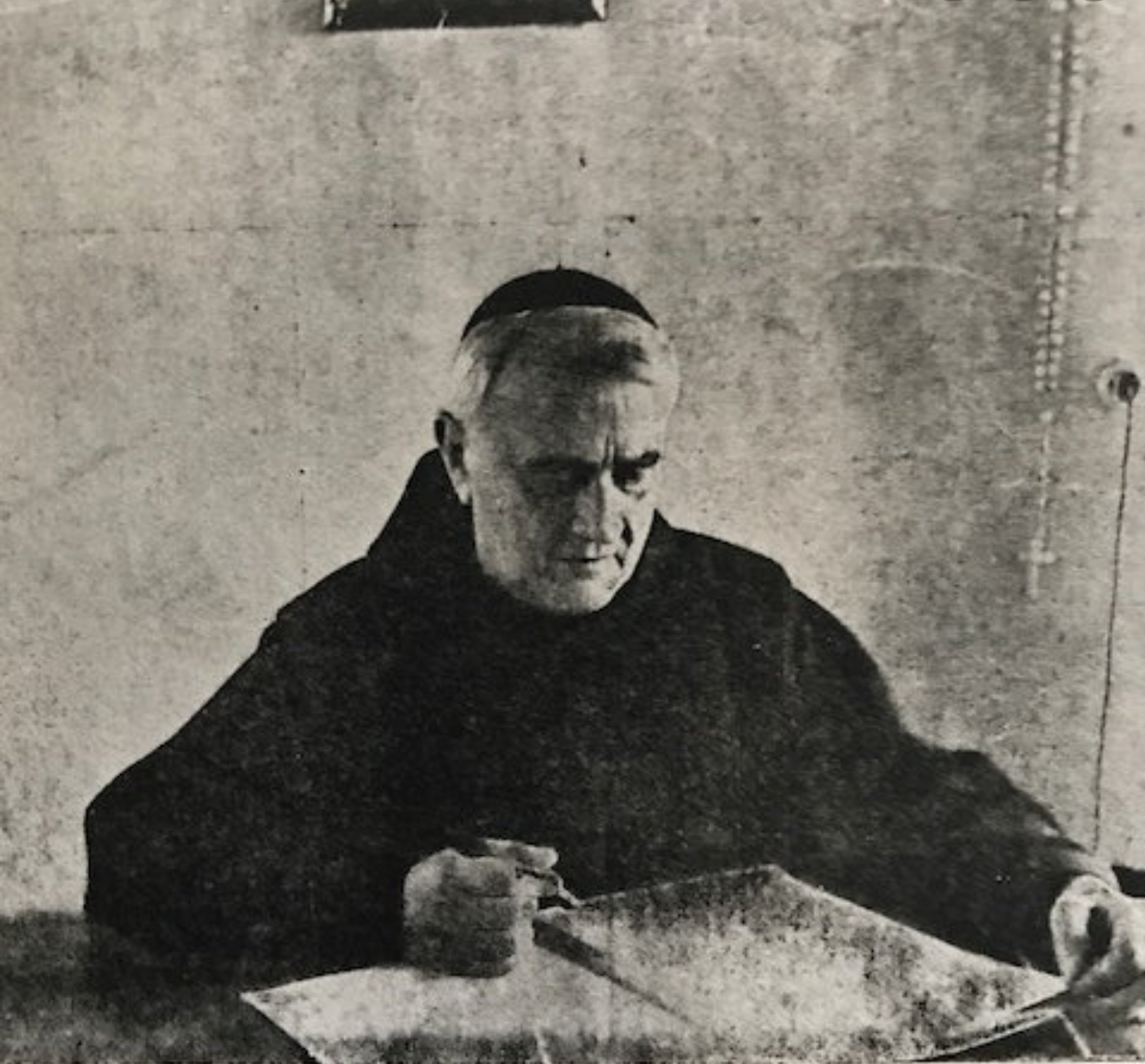
Memorie.al – In the book “History of Albanian Literature – 1983”, the aim was to discredit the work of the national poet Father Gjergj Fishta with words such as these: “The main representative of the clergy, Gjergj Fishta (1871–1940), poet, publicist, pedagogue, politician, for a long time directed the press of the Franciscan order and the cultural and educational activities of this order. For him, the interests of the church and of religion stood above the interests of the homeland and the people – something he declared and defended with all his demagoguery, but also with cynicism, and he made it the foundation of his literary work. His main work, the epic poem ‘The Highland Lute’, propagated anti-Slavism and relegated the fight against Ottoman rule to the background.”
Continued from the previous issue
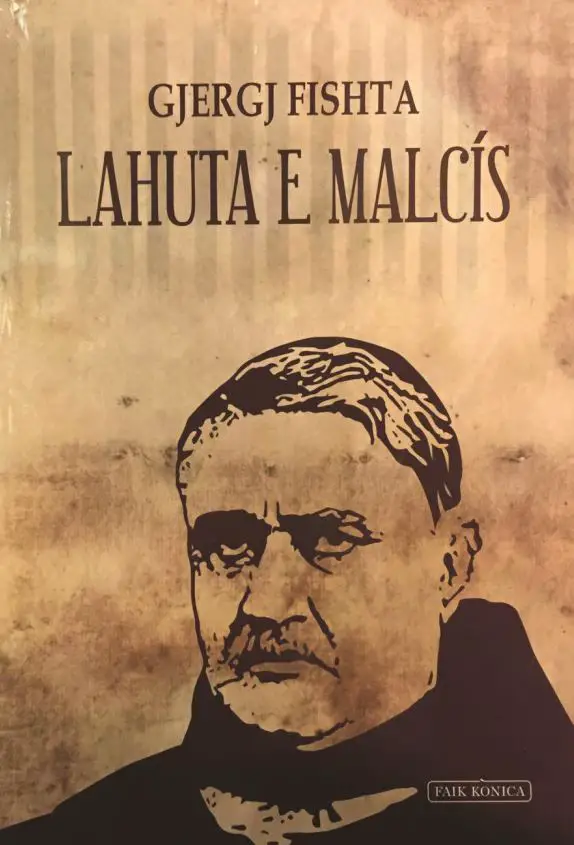
After the Second War, “The Highland Lute” and other creations of Gjergj Fishta were forcibly banned by the so-called people’s power. Meanwhile, it was reprinted in Rome in 1958, in Ljubljana in 1990, and again in Rome in 1991. After the overthrow of the dictatorship, Fishta’s works and commemorative writings are published continuously under the title “The Highland Lute”.
Studies on Gjergj Fishta are now deeper, genuinely scientific, because they are linked to the ongoing appreciation and memory of our national poet. Researchers of the new generation, such as Arben Marku, have now gone further, assigning, for instance, the highest place to the epic poem “The Highland Lute” in comparison to the poem “The Mountain Wreath” by the Montenegrin poet Njegoš.
With “The Highland Lute”, our poet tells the history of the Albanians, awakens and issues the call for the unification of the nation regardless of religion, in the fight against the occupiers of the homeland with the help of Europe, whereas Njegoš sought the unification of Montenegrins in one faith, in the war against the Turkish occupiers, with the support of Russia. With the rare thirty-year creation “The Highland Lute”, Fishta gave the Albanian nation a golden history, and Europe a clear lesson on unresolved national issues, as a consequence of the injustices of the times.
Therefore, he deserved the title of National Poet. In particular, “The Highland Lute” resembles a classical symphony, where, in the flow of events, the verses, rhymes, and rhythm are its notes. Sometimes gloomy, sometimes an expression of pain, sometimes like a curse, and in moments of triumph, the joyous shriek of the warriors. Then, the voice of beautiful Albanian nature and of fairies, the echo of the mountains, the gurgling of springs and streams as they tumble downhill. Within this epic poem, we also find lyrical verses, rare in their beauty and meaning, dedicated to the Albanian girl, such as these:
“A girl there is, a girl like none,
Such a girl in Janina dwells,
Her like you’ll find not under the sun,
As evening sun her beauty tells;
Her eye the sun, her brow the moon,
Her stature like the cypress tall –
Efrua her mother named her soon,
For Albania’s good omen, that she be all!”
Eminent authors on Fishta
The well-known Albanologist Fulvio Cordignano wrote: “Few in world literature succeed like Father Fishta as a satirical poet. As such, with a strange fury, he slashes and cuts where it burns.” Meanwhile, the world-famous Italian poet Gabriele D’Annunzio said: “Father Fishta is known as the most popular poet of the Albanians, the most heartfelt poet of this people…! Alongside him, we have another great: Rabindranath Tagore.” At one time, Fan S. Noli would express himself in lectures: “Fishta is great.” Whereas Faik Konica expressed: “Fishta is not only a great poet, but also a first-rate intellectual! In vain do today’s Greeks try to find in their literature a more complete work than Gjergj Fishta’s ‘Lute’?”
Meanwhile, Lasgush Poradeci would respectfully call Fishta: “Our national poet! The rock of the Albanian land and the rock of the Albanian spirit”! The distinguished scholar Eqrem Çabej, while analyzing our Romanticism, which was linked to the struggle for freedom and independence, between Jeronim De Rada and Naim Frashëri, also includes Gjergj Fishta for his epic power.
Alongside him, Engjëll Sedaj emphasized that: “The comparison of Fishta’s epic poetry with Naim’s poetry is made not only in specific works on Fishta, but also in other works of Eqrem Çabej, focusing attention more on these two poets than on comparisons between Fishta and other Albanian poets. Thus, for example, in his work ‘Romanticism’, although he does not specifically examine Fishta, but mainly De Rada and Naim, he has compared Naim and Fishta, saying that ‘this epos (‘The History of Skanderbeg’) could not become a national epos, because Gjergj Fishta later gave that to the Albanians’.”
Aurel Plasari writes: “The half-century that has passed since Fishta’s physical death has proven the longevity of his literary work, despite the specific difficult conditions in which it has had to survive.” Meanwhile, some elderly professors, with scant knowledge of the life and work of the poet Gjergj Fishta, continue to publish and republish the corrected studies from before the 1990s.
Fishta for the Homeland
Fishta welcomed the Declaration of Independence of Albania with joy, but also with sorrow, due to the Balkan War and the unjust decisions of the London Conference – 1913. Such a state of mind is expressed in the poem “The Highland Lute” and in the articles published in the magazine “Hylli i Dritës” (The Morning Star), founded by him in Shkodra in 1913. In the writing titled: “Are the Albanians capable of maintaining a state by them?”– Fishta sharply criticizes, on one hand, the predatory actions of the neighbors and, on the other hand, the stance of the European states against territorial integrity, especially that of Russia. Meanwhile, he argues with historical facts the ability of Albanians to create and run an independent state within ethnic borders.
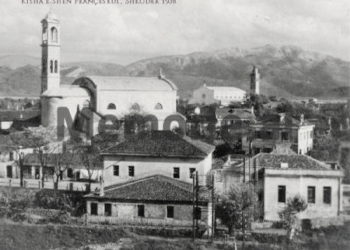
An unforgettable event in history will remain the day of October 23, 1913, when Fishta raised the National Flag at the Church of Gjuadoll and connected it with lights to the Mosque of Fusha e Çelës. This was a courageous act for the unity of Albanians of different religious faiths. In the years 1916-1917, under Austrian occupation, he published the newspaper “Posta e Shqypnisë” (The Albanian Post). After the end of the First World War, from April 1919 and during 1920, Gjergj Fishta was the general secretary of the Albanian delegation at the Paris Peace Conference, to defend the territorial integrity of Albania. In one of his speeches in 1919, he said: “Little known and so badly judged in Europe is our country. As old as fossils, as old as the stalactites of the echoing caves of its own wild mountains, and born, so to speak, from the very ancient roots themselves, it is today the undisputed autochthonous master of its lands. If indeed the principle of self-determination is adopted by the Peace Conference as a fundamental character for the treatment of states and for the determination of their borders, justice demands that Albania be established as a separate state, within its own ethnic and geographic borders. But also, according to the Wilsonian theory, for a people to be able to govern itself, besides nationality, its national consciousness must also be taken into account. Now, if by national consciousness we mean the feeling for freedom, as well as that desire that a people may have to develop, always within the sphere of their own forces, I say that even from this perspective, the Conference must recognize Albania’s independence as well as its sovereignty. And if you ask, which people in the Balkans has deeper feelings for its freedom than the Albanian people? If they do not want us as a single state, because they say Albanians are Muslims, then we Christians will melt our crosses and make them into bullets, to defend our Albanian Muslim brothers!” This is an expression that came from the soul of Father Gjergj Fishta, which speaks volumes about the religious harmony among Albanians. It also testifies that, eternally, among the heads of religious faiths in Albania, there has always existed a wonderful religious harmony.
In 1922, Fishta was received in Washington as a known cultural figure. He successfully met and spoke with Republican senators regarding the issue of Albania’s borders. Invited in 1930 to New York, he was accepted as a member of the International Union of Poets from 60 countries of the world. Fishta also represented Albania in international meetings, in 1930 in Athens, in 1932 in Istanbul and Bucharest.
With his excellent prose, he described the journey to Turkey, while he would narrate the sailing through the waves of the turbulent ocean with humour-filled prose, depending on the change of weather and his state of mind, even appealing to saints. Careful reading of Fishta’s prose reveals that it flows just like his poetry. Both Fishta’s poetry and prose are sources of inspiration for poets and writers, indeed for all those who want to speak beautiful Albanian.
Fishta’s activities in the 1920s–1930s
In the 1920s, Fishta also took part in political activities. In December of that year, he was elected deputy of Shkodra. In April 1921, in the first meeting of the Albanian parliament, he was elected its vice-president. That same year, he founded the Franciscan Gymnasium in Shkodra. In the events of June 1924, he sided with the democrats. Then he left the homeland and settled in Italy. There, in 1925 and 1926, he created, published, and republished tirelessly. The majority of his dramas, tragedies, etc., belong to those years. Returning to the homeland, as mentioned above, he finished the epic poem “The Highland Lute” in 1937.
In 1939, Fishta was a candidate for the Nobel Prize, a member of the Italian Academy of Sciences and Arts, among poets, writers, composers, and world-famous scientists. Towards the end of his life, in 1940, the unsuspecting Fishta would declare: “Since Roman times, throughout the course of centuries, various conquerors have passed through Albania, but not one of them could subdue or conquer the spirit of the Albanian.” This voice resounds powerfully even for the professors who toil and rummage in vain through the dark corners of archives; to find any crack in the sacred monument of patriotic Catholic fathers with Fishta at the head and their fabricated letters – no one believes them.
But what do the documents say about his life and activity?
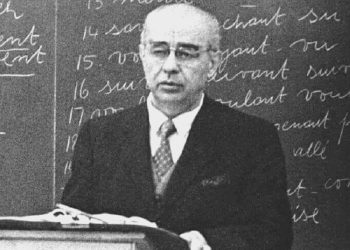
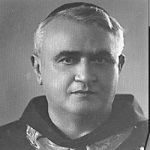
Father Gjergj Fishta was born in the village of Fishtë in Zadrima, in 1871. Fortunately, his first lessons were received from the teacher and poet Leonardo de Martini. He completed his secondary education in Troshan, Shkodra, and his higher studies in theology, philosophy, and foreign languages at the Franciscan institutes and seminaries in Sutjeska, Livno, and Kreševo in Bosnia.
After completing his studies in 1894, he was ordained a priest and accepted into the Franciscan Order. In 1899, together with the Abbot of Mirdita, Preng Doçi, with the first Albanian novelist Dom Ndoc Nikaj, Father Pashko Bardhi, etc., he founded the literary society “Bashkimi” (The Union) in Shkodra. In 1902, as soon as he was appointed director of the Franciscan school in Shkodra, he introduced the Albanian language into lessons.
In 1908, he represented the society “Bashkimi” at the Congress of Manastir (Bitola) and chaired the Alphabet Commission. At the close of the Congress, Fishta performed a noble act when he gave the floor to announce the decision to Mit’hat Frashëri, at that time a young man. The desire for and support of the Albanian language emboldened the director of education in Shkodra, Luigj Gurakuqi, to found on August 3, 1916, the ‘Literary Commission’ under the protection of the military command headed by General Trollman, also influenced by Dr. R. Nachtigal, a renowned European scholar of our language, and by Dr. Gjergj Pekmezi.
The Literary Commission included, with their always valuable works, Father Gjergj Fishta, Dom Ndre Mjeda, Aleksandër Xhuvani, Sotir Peci, and many others from the North and South. As a result of malicious distortions of the life and work of Father Gjergj Fishta, few readers of literature experienced moments of confusion. The genuine scientific criticism of all times unites in one opinion: his work is a shining peak that rose majestically, for about forty years, above the space of Albanian literature in service to the homeland.
Honours from home and abroad
Father Gjergj Fishta holds an important place in the history of Albania as the continuer of our National Renaissance and as an exponent of patriotic and democratic ideals in the first half of the twentieth century. Entirely contrary to the writing in the book “History of Albanian Literature” – 1983, Fishta was known everywhere as a poet, writer, playwright, literary critic, satirist, essayist, linguist, educator, painter, architect, high leader of the Franciscan faith, publicist, and democratic politician, etc.
In 1941, the distinguished writer Karl Gurakuqi wrote: “Fishta brought honour to the Albanian name everywhere. Not only did the Albanian world exalt him, even while alive, giving him the title ‘National Poet’, but also the outside world, after tasting and appreciating the fruit of his pen, acknowledged his worth and honoured him with praise, decorations and titles. The ‘Albanian Language Club’ presented him in 1911 with two symbolical bas-reliefs crafted masterfully and a silver wreath; in 1917, the city of Berat sent him a golden pen, in memory of his literary and political activity. The Ottoman Empire gave him the decoration ‘Mearif’ 2nd class (1912); the King of Austria-Hungary decorated him with the ‘Ritterkreuz’ (Knight’s Cross) (1912); Pope Pius XI honoured him with the ‘Medal of Merit’ (1925); the General Curia of the Franciscan Order with the title ‘Lector Jubilatus’ (1929); Greece with the decoration ‘Phenix’ (1931), etc.”! / Memorie.al