
Second part
Memorie.al /The country is communist, but almost nowhere, not even in Ronald Reagan’s America, have such wild caricatures been published, both of Brezhnev and of Mao. The national hero Skanderbeg, whose name graces the central square in the capital Tirana, a football club, and an alcoholic beverage. He was a practicing Catholic, chosen by the Pope to lead a crusade to the Holy Land. But Catholicism, like any other practice of religion – even possession of the Bible – is punishable by death, by firing squad. Taking foreign loans is forbidden by the constitution. Nevertheless, 200 million dollars came into the country from the Soviet Union, and even five billion – according to Beijing – from China.
Continued from the previous issue
What is considered a success in Albania is that the population has doubled within 30 years. In the past, only one in seven inhabitants had primary education, while today, only one in two peasants has less than eight years of schooling since Enver Hoxha came to power. The country has 38 academics and since 1957, Tirana has had a university, currently with 16,000 students.
A “Garden of Eden” in terms of material development, albeit created and cultivated with the sweat of the brows of its inhabitants. But they do not seem to thank their Stalinists enough for the material progress. Be that as it may, Enver Hoxha is currently exercising the most draconian dictatorship in Europe against his own people, the characteristics of which – propaganda plus police – are evident everywhere.
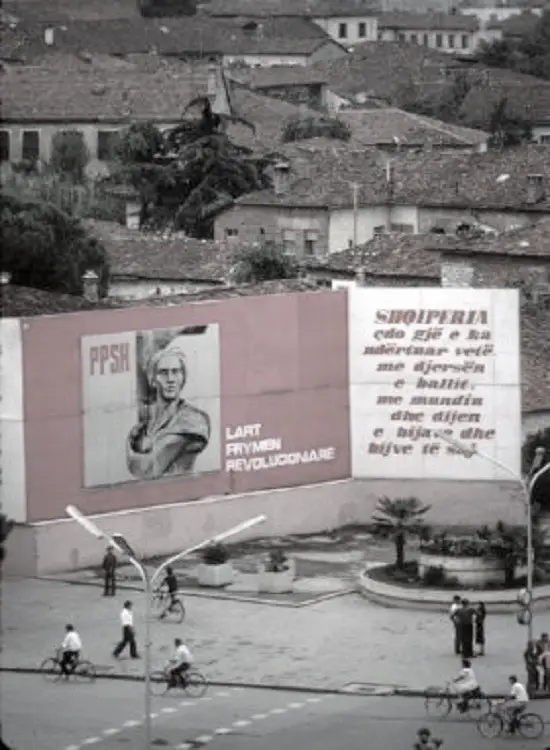
As if they didn’t know the difference, Albanians are constantly reminded to whom they owe their standard of living. Apart from street signs and shop windows, there is only one inscription in the entire country, on every building, on plaques every few kilometres along the village road and in letters ten metres high, even on the walls of the mountains: “Rroftë udhëheqësi ynë, Enver Hoxha” (Glory to Comrade Enver Hoxha), sometimes supplemented with slogans for the glory of the Party or of the “saints” Marx, Engels, Lenin, and Stalin.
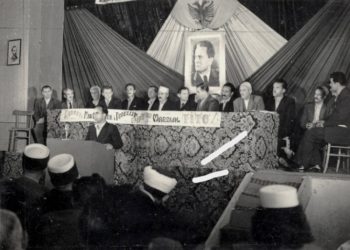
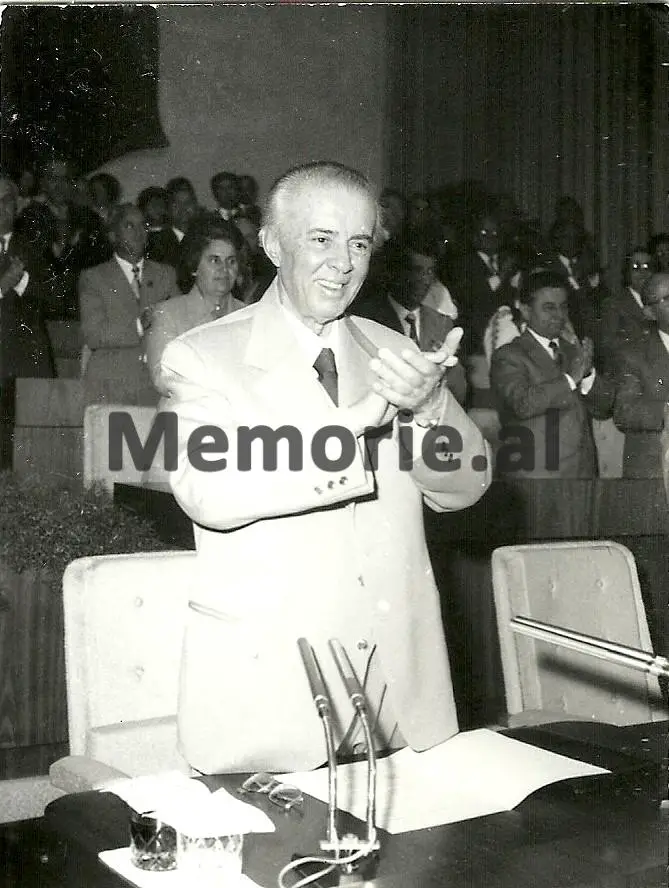
The only, but massive, pictorial advertisements show the leader, not in a Stalinist rubashka, Mao jacket, or general’s uniform, but in pinstripes with a waistcoat and tie. As we can see, he is the only Albanian who wears a Western European hat.
The bailiff enforces loyalty to the state and order on every street corner. Only when an official hits a cyclist with a car can no police officer be seen. After trying in vain to steer the bicycle, the gentleman simply continues on his way.
According to statements from escapees, who in no way deny the rise in the standard of living in the country, peace is also ensured by a totalitarian surveillance system, which is also being promoted under the motto “Raise high revolutionary vigilance”!
Even on a quick visit to Enver Hoxha’s empire, camps appear with watchtowers equipped with machine guns and, just before Shkodra (Scutari) in the north, even two hundred teams of forced labourers with shaved heads, who were digging a drainage canal, were guarded from a hundred metres away by a chain of riflemen in military uniform, all in full readiness.
Those intellectuals whom Enver Hoxha once exploited as polyglots and cosmopolitans are now particularly affected by repression. They are completely cut off from the rest of the intellectual world, and censorship does not allow any printed text that might be disturbing to pass.
Shadows of the past: in the century we left behind, reactionaries poisoned a teacher who had smuggled ABC primers from abroad into Albania. The Durrës Theatre bears the name of the Berlin actor of the 20s and 30s, Aleksandër Moisu, whose father came from Albania.
However, none of the plays in which he appeared under director Max Reinhardt have ever been performed in Durrës. The only bookshop for international literature in Tirana offers about 50 titles, a quarter of which come from abroad: specialised books from the German Democratic Republic.
Just as in China’s Cultural Revolution, every high school graduate must do physical work in a village or a factory before, during, and after their studies, at the same time testing their political allegiance. No matter how talented he may be in his subject, he is not allowed to continue learning if he proves ideologically unreliable to the collective.
Mao’s “Great Proletarian Cultural Revolution” offered Hoxha the opportunity for an act of terror against the religious needs of the people, which the regime apparently could no longer cope with except by attacking churches and mosques. The different religions, explains an observer, in Albania “where unity” of the people is endangered, as if conditions like those in Lebanon had been declared.
On February 6, 1967, while the world watched the rage of the Red Guard in China, Enver Hoxha, without attracting much attention outside Albania, called on high school students to attack religious objects. They occupied the country’s 2200 houses of worship, turned some into dance halls, museums, warehouses, and razed most of them.
It was an outburst for the Durrës high school students! They were the first to be allowed to drag mullahs and priests through the streets and mock them, put them to “productive work” or bring them before a “people’s court”. This too has tradition. In Roman times, the first Christians were thrown to the lions in the amphitheatre of Durrës.
Enver Hoxha’s Albania – an isolated country where when he came to power in 1944, over two thirds of the inhabitants were Muslim and the rest were Orthodox and Catholic Christians – no longer has a single place of worship. Hoxha’s Albania is (according to its own assessment) “the first atheist state in the world”.
Some art monuments remained standing: chapels from the Byzantine period, the Haxhi Et’hem Bej Mosque in Tirana. But they are difficult to access. Even when the chief Albanian archaeologist wants to show the treasures to a group of scientists from the West who have come specifically for this purpose to the old city of Berat, there is a fierce debate with the local State Security officer.
After an hour, perhaps after they consulted the ministry, the gates opened – only for the Byzantinists to encounter ruins and rubbish in front of the uncovered frescoes.
The Albanian agitator proudly shows off the Cathedral of Shkodra, which has been converted into a “beautiful sports hall”. The tall arched windows have been bricked up, the towers cut off, and corrugated iron now covers the nave. The local Franciscan monastery was burned down by atheist communists in 1967, and the Bishop of Shkodra, Çoba, earned his living as a cart pusher.
In Shkodra, there is also an “Atheist Museum”, not as furnished with stolen church property as the one in the former Leningrad Cathedral of Our Lady of Kazan, but in the same style as Der Stürmer: posters, photos, discovered and confiscated weapons, devotional objects and so on, Bibles smuggled in under the words of Marx, revealingly misquoted: “Religion is opium for the people”.
(Marx: “Religion is the sigh of the oppressed creature, the heart of a heartless world, and the soul of soulless conditions. It is the opium of the people.”)
The exhibitions teach the besieged believers of Shkodra that religion is unscientific, contradictory, and dishonest; “The Church, that international drug trafficker, justified violence and exploitation, enriched itself at the people’s expense, and time and again collaborated with the fascists”.
An idol still considered valid, whose ideology had similar flaws and whose party committed at least the same sins, stands in granite, a few metres from this chamber of horrors: Stalin.
Following his example, this red state is also striving for a strong national socialism as a substitute ideology for the abandoned religion, and celebrates the national heroes of the past, such as the feudal prince Skanderbeg, who resisted the Turks 500 years ago (ultimately unsuccessfully). And while the national flag showed a red cloth with the black eagle on it.
Skanderbeg’s successor, Enver Hoxha, has recently extended the history of his people back to Roman times, similar to his Romanian colleague Ceaușescu, who for this purpose declared the Dacians to be the direct ancestors of today’s Romanians.
In Hoxha’s case, it is the Illyrians, who disappeared from history no later than the fifth century AD, but some of their completely unknown language is said to live on in modern Albanian. As with the Dacians of Romania, it is important that the Illyrian ancestors (rediscovered in the 19th century) were not Slavs.
Daily life in Enver Hoxha’s Socialist People’s Republic of Albania continues to remind us of the past, particularly the Muslim past. According to good old customs, heavy agricultural work and road construction are reserved for women. Under massive white headscarves that look like shadows, they bend barefoot in the fields and hand over the harvest to the supervisor at the edge of the field, to be weighed and credited to their personal budget.
In the middle of the day, able-bodied young men loiter in groups along the streets and populate the cafés (which have no women). Apparently, they are shift workers – an explanation also heard in Yugoslavia and China before mass unemployment was acknowledged there. At the party conference in November, Hoxha admitted structural errors. Efforts must be made to create jobs “where the people are”.
In the cities, they live in unplastered, wood-heated dwellings that resemble slums even when completed. A family with two children gets two rooms. According to the plan, on average five people live in each new apartment.
Since the family bond is still intact, relatives gather when possible: for example, two brothers take a larger apartment with their relatives, and if all the adults earn money, they buy a television together. It is classified as a luxury item on the official goods table and costs the average wage of two years’ work.
The Albanian worker struggles on average per day for a pound of meat, three hours for a kilogram of fruit or a toothbrush, and a week for a pair of plastic shoes – the same amount of time as for a month in a nursery (food included).
Every year, he spends one or two wages on one child’s schoolbooks. The state pays tuition fees only if the student’s parents are underprivileged. As in all socialist countries, medicines cost money – and not a little; patients queue in front of the Durrës hospital.
Mothers receive up to 36 days of leave per year if a small child gets sick, as well as time off from work every three hours to breastfeed their infant. The emancipation of women is shown – as everywhere in real socialism – mainly in their participation in paid work. Albania’s achievement: uniformed girl recruits, with a red bow on their cap as a gender sign, march on Albania’s gravel roads under the command of a (male) sergeant with a carbine.
It is hard to imagine that this way of life is the desired goal of the rebellious students in Priština, the capital of the “Autonomous Province” of Kosovo in the Yugoslav Republic of Serbia. It is hard to imagine that they would want to exchange their rights as citizens of Yugoslavia – such as freedom of travel and private agricultural land – for the social-totalitarian security of Albania.
It is also hard to imagine that Albania – as Belgrade claims – truly desires them: The reunification of two socialist states, one strictly Stalinist and the other with a more social-democratic orientation, would bring Albania the benefit of a dangerous protest potential. Because in Yugoslavia live about half as many Albanians as in Albania itself.
It sounds believable when Enver Hoxha insists – as he did recently at his party conference – that Albania is not striving for unity, but that it is up to the Kosovars themselves to fight for their rights and form their own Albanian republic within the Yugoslav state.
“Albania is not thinking of a violent solution,” explains the academic Aleks Buda. This means: “In any case, the Third World War will not break out here. The bunkers, according to Buda, wait and ‘do nothing’.”
A Greater Albania in fact would have to start from scratch, that is, re-educate every third citizen away from Allah and toward Hoxha. The loyalty of the Albanians, who have been subjugated for 35 years, is already uncertain.
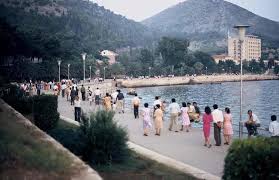
When evening falls, in the housing estates of the “Sons of the Eagles”, Albanians seek their freedom. Married women walk next to their husbands (lovers are not seen), with red lipstick and high-heeled shoes – not exactly conforming to the system.
On November 1, Hoxha called it “a great ideological problem” and “a great evil”, “the mentality and ways of thinking as petty-bourgeois, which have deep roots in our country”. Above all, “the great masses of young people have not yet been hardened by the seriousness of life”.
Under the cover of darkness, the foreigner is carefully asked if he would like to sell his watch. Ragged adolescents beg for chewing gum and quickly disappear down a side street before the nearest police station, only to reappear a hundred metres further on to ask again.
In the housing blocks of a workers’ settlement in Durrës, most television antennas are not pointed east towards the government transmitter in Tirana (four hours of politics and sport every day), but towards Italy, towards the West.
Even if everything else is different in Albania – Albanians are not different people from anywhere else. In the town of Saranda, the district party secretary is organising a party for 200 guests. Half sit on the hotel terrace in the background – only men. The boss, in a striped suit, greets them one by one with a gracious handshake.
But the selected couples sitting on the dance floor, eating and drinking, receive kisses on the cheek from their employer. After a song that exalts the cult of Enver Hoxha, they move on to tango, syrtaki – the Greek border is not far – and the Serbian kolo, where the driver of the district party secretary is allowed to dance in a tuxedo.
The district party secretary’s car, a “Mercedes”, is parked in front of the hotel.
Marx: “Religion is the sigh of the oppressed creature, the heart of a heartless world, and the soul of soulless conditions. It is the opium of the people”! /Memorie.al