


By Msc. Selami Zalli
Second part
-Shkodra during the years of the establishment of the dictatorship, 1945-1953, from the perspective of the History of the State Security –
Memorie.al /Without delving into the historical role of Shkodra as a political, economic and cultural center over the centuries, I will try, through this study, to focus on: “Shkodra during the years of the establishment of the dictatorship, 1945-1953”, from the perspective of the History of the State Security, concentrating on several key issues.
With the entry into force of Law 45/2015 and the start of activity by AIDSSH (Authority for Information on the Files of the former State Security), upon taking possession of the existing Archive, composed of a considerable fund of documents. Documents important for the study of this period, an integral part of this fund are the “History of the State Security” and the “History of the Department of Internal Affairs of Shkodra”, selected as the main reference material for conducting an analysis, on the manner of organization and functioning of this structure, without prejudice and reminiscences in the legal, analytical and comparative view, pointing out and stripping away hyperbolizations (megalomania), without aiming to ignore or denigrate it, but only through the optics of the time, in a comparative plan.
Continued from the previous issue
Official documentation on anti-communist resistance in the North
Today, we inherit and have historical studies regarding the Albanian Secret Service of Ali Pasha Tepelena, of the period of King Zog, but an official study or investigation for this period, we have not encountered so far.
In reflecting the picture of the establishment of the dictatorship in Shkodra, I have relied on materials from the revised “History of the State Security”, and the “History of the State Security Arm of the Department of Internal Affairs of Shkodra District”, for the years 1941-1975, without delving into the depth of the concrete archival documentation of the events of the time.
The first material, “History of the State Security” published in 1974, when studied carefully, yields considerable data about the dictatorship such as its organization, progress, forms of intelligence and striking work, and its trend.
The examples of brutality and the consequences they brought upon Albanian society in general are countless, but I will try to present some of those that concern and involve the city of Shkodra and the northern area as a whole.
I have tried to see the communist persecution in the northern area, in the center (and forefront) of which Shkodra lies, on several levels;
On the historical level, Shkodra had not only not been subjugated, but had also not erred in its history of existence, always placed on the right path, taking the responsibilities and role that befits it.
On the geographical view, the presented external enemies, especially the Slavs, the oracles and factual administrators of the elite in power. Along the entire linear perimeter, they bordered Shkodra, had contributed to the suppression of all popular movements and revolts, especially in Kelmend. Together they had concluded Tivar and other “twinnings and common partnerships”, known and still unknown, and the possibility is not excluded that there have been and are long-term contracts or agreements in continuity.
On the religious aspect, according to the state security documentation, the Italians and Turks are presented as dangers and enemies, to justify the striking of the clergy as a whole, as indeed happened.
On the class aspect and social stratification, merchants, those educated abroad, former members of administrations, the rich, supporters of fascism, all anti-Slav, etc., are determined as targets.
In 1951, the general identification was made throughout the country, of the opposing element and contingents of enemy discoveries, a process that in Shkodra had started earlier.
Cleansing operations were developed throughout the country, but the harshest and with the most forces was in the North, in the city of Shkodra. The main targets of the security were the escapees, their family members, their relatives and those of the convicted, those affected by the reforms, former officials, merchants, etc.
From this documentation, the tendency to compromise the insurgents is noticeable, by proclaiming their hopes in the allies (external reaction), avoiding equal treatment with their allies (Slav brothers), massively present on our state territory with military troops, in several punitive operations, such as in the suppression of the Kelmend revolt for the elimination of Prek Cali, whom they could not forgive the issue of the establishment of the northern border.
This is the time and moment when the clergy, especially the Catholic one, is targeted for breaking its ties with the Vatican. Violence and persecution against the Clergy in this period coincides with the violent changes in the statutes of religious communities.
In this period, although formally the existence of functioning institutions and laws had been declared and propagated. On the ground, things were done differently: people were shot without trial, houses were burned, food and livestock were looted, the free population was taken and held hostage, massively imprisoned and interned, making the situation worse than any war.
On the cleansing operations in the period January 14 to February 16, 1945
It is said that the strike on Kelmend was carried out from 5 directions, achieving the annihilation of the reaction, disarmament, compulsory military mobilization (this same situation as OZNA in Kosovo and especially in Drenica, after the murder of Shaban Polluzha and the violent mobilization of the population to send them to Srem and Tivar). To this phase belong the murders without trial in Vukël, the internments in Kamëz, Berat, Porto Palermo, to end up in the “Albanian Gulag”, in Tepelena.
During this period, the forces of the State Security and the People’s Defense began the concentrated strike against the northern area, with the special objective of Kelmend.
In the official documentation of both security histories, the central and the local, there are contradictions regarding the form of the strike and the forces used.
While it speaks of an attack in 5 directions, upon careful observation and concrete analysis, only 3 directions result for us, two with concrete names of leaders, as 2 known directions are missing, from which the forces of Kelmend were struck from behind in Vermosh.
A moment I want to stop at and emphasize especially, from the clarification of which light is shed on many truths, spoken and bitter, but undocumented, from the attack on Kelmend (Vermosh).
What draws attention in particular are the contradictions in the documentation of H.S.SH. and H.D.P.B. Shkodra, on the number of directions of the attack on Vermosh and the participating forces in this attack, the role of Yugoslav officers within the SEMP, assistance with troops from across the border (from behind) or with permission to cross (use of territory), by the partisan troops. The reasons for covering up this fact are unclear and debatable, which must be deeply compromising. What intrigues me in this regard is the persistence and insistence on hiding this moment, which researchers, participants and eyewitnesses to the event have constantly spoken about.
According to HSSH, the attack would be given in five directions, three directions are specified, while only two names of commanders are presented.
According to HDPBSH, the attack in three directions presents the permission to use Yugoslav state territory through Tuzi, to come behind the insurgents, which in fact is also half-truth, since the forces that managed to damage and destroy the insurgents, according to contemporaries, entered from the side of Plavë and through the village of Martinaj and Gusi to come out in Vermosh.
In this so-called historical documentation, with special use, limited only to the trusted and secret, for which the compilers never thought that it would ever enjoy this status, that it might fall into the hands of the public and the “enemy”, they are unable to be concrete in figures, names and real events, using spirit and ideology as an argument.
It concerns the trial of dozens of criminals on May 14-19, associates of Jup Kazazi and Llesh Marashi, where everything is stagnant and unclear, without date, names or chronology.
It speaks of criminals (Ballists) from the South, without any explanation or analysis of how and what happened, compromising and creating the impression of trickery regarding this documentation.
It speaks of the execution of dozens of persons (spies and criminals), as if it were about damage to crops or livestock, from the presence of some major force. The killings and annihilations are not presented with individual names, or with numbers, but with parties, dozens and hundreds, which need to be verified and documented.
The contradiction and confusion in these documents are endless, while cleansing is claimed; the fact of the existence of reaction in some areas of the north is admitted, where there are still 1850 persons as armed insurgents.
The vast majority of the facts and circumstances presented, in this official documentation, which sheds light on the manner of activity and the “successes” of the security arm, reinforce the conviction and need as a necessity, for opening the process for the revision of history.
I find it necessary to dwell on the fact of how communist historiography, and precisely the structure holding the monopoly of secrets in its documentation, has treated the event known as the “Tivar Massacre”. If what happened in Tivar had not happened, and these hostages had been allowed to return home, this event would not have remained nameless, but would have been called the “Tamarë Bridge Massacre” (500 killed) or the massacre of any area, an event and killings that occurred on Albanian state territory, which was finalized in the most cruel way in Tivar, after which it is named.
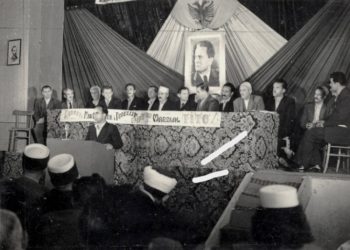
Regarding this event, this history sufficiently shows how “ignorance” is claimed and information and truth are deformed through a phrase; “…the Titists of Belgrade, with the aim of provocation, passed in…(January 45) 7000 Kosovars through the county and city of Shkodra…White Guard units…”, a treatment and description that speaks thousands of words, with the aim of “placing horns”, since the relationship between the CPA and the CPY at that time is a universally known fact, “in the honeymoon phase”, so much so that in rallies and offices the slogans and portraits of the Enver-Tito binomial dominated.
Through this historical documentation, approved by a special scientific council and the minister of the time, placed in storage and use based on special rules, for the first time its materials can be used for study and acquaintance. It added to this reasoning the way of functioning, the dependence, and the obligations for reporting and accountability of the security arm itself. Even alone, this history text answers every insinuation, removing the possibility for anyone to claim the ignorance of the Party, the leader and the main leaders, members of the Secretariat and the Political Bureau of the Party’s Central Committee, about what would happen and did happen in Tivar, seen in the spirit of how this event is treated and presented in the documentation of the time.
The passage of the Kosovars through Shkodra and the rude behavior of the escorts, during the passage through the city, not allowing the citizens of Shkodra to give them bread or water and if someone reacted they were punished, lead us to think and study, that the event at the Tamarë Bridge did not happen by chance. Its concealment and deformation by the authorities of the time does not allow them to come clean and leads us to think that the ominous plans may have been heavier and why not turn Shkodra into a “gladiator arena” where the patrons would entertain themselves with the “slaves”, their defeated, as if to show that from now on we will rule peacefully, and that, on the foundations of their power (occupation), they were pouring pure Albanian blood, until now shed in wars for freedom.
The organization of the People’s Defense organs, the SEMP in Shkodra, their tasks
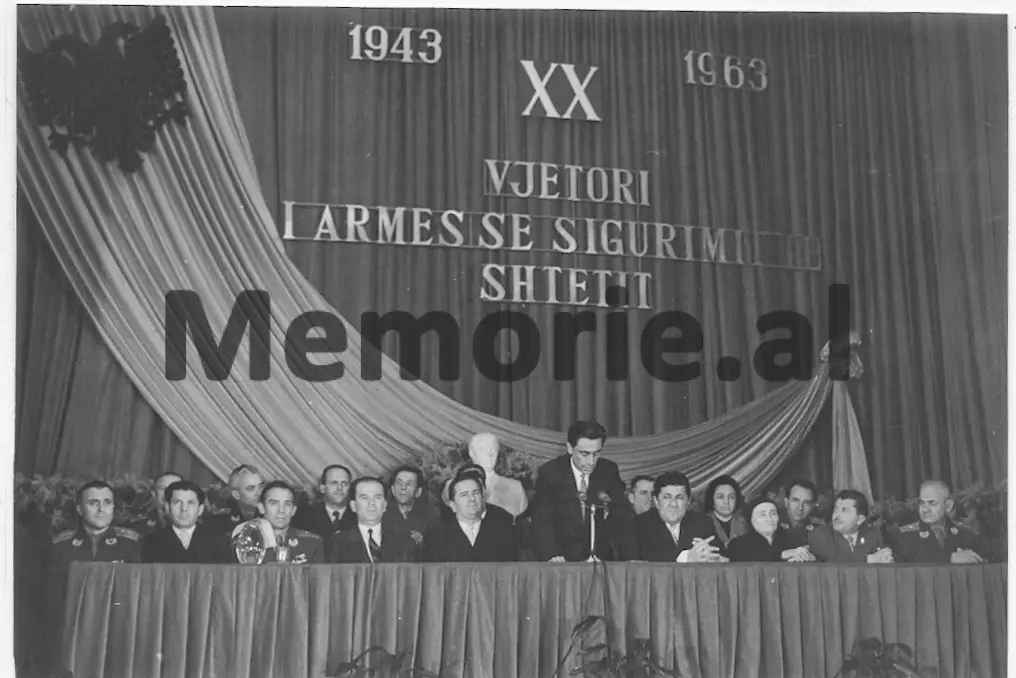
With Circular no.20, dated September 24, 1944 and November 16, 1944 of the General Staff, in December 1944 the People’s Defense Sections (SEMP) were created, which depended on the Directorate of People’s Defense. The SEMP for Shkodra was created in March 1945.
Under the SEMP were the Local Commands, placed in the city and in the centers of localities.
In the city of Shkodra, these commands were established in Kiras, Rus, Manxhar, Ballabane, Old Bazaar, Perash and at Dugajt e reja. Regarding how they were organized and whether each had prisons, we have no documented data up to this moment. We hope in the future!
In the villages, they were established in the centers of localities such as in Mjedë, Gur i Zi, Bushat, Velipojë, Oblikë, Vrakë, Mes, Shllak, Dajç, Shirokë and Zogaj.
According to this structure, the People’s Defense Sections (SEMP) were established throughout the county of Shkodra, within which were included the districts of Koplik, Pukë, Dukagjin, Lezhë and Mirditë.
The head of the People’s Defense Sections (SEMP) for Shkodra was Major Zoi Themeli, Deputy, Captain Nesti Kopali (escaped later?!) and Fadil Kapisyzi.
Agent work was directed by the officers: Rasim Dedja, Zoi Shkurti, Bashkim Kacaruho, Dul Rrjolli, Mit’hat Bushati, Fahri Kraja, Hysni Ndoja, Neki Ahmati, etc.
For the city alone, the officers were Brahim Shpori, Kasem Troshani, Niko Pistulli, Ferit Mandia, Vehbi Fishta, etc. In the secretariat of the SEMP worked comrades Niqi Kosta, Vasfie Tepelena (Kraja).
In the districts, the trusted directed. Xhemal Selimi – Koplik, Bilo Bregu – Lezhë, Idriz Çoba – Pukë, Xhevat Gavoçi – Dukagjin, Mat Deda – Shpal of Mirdita, Ndrek Nallbani – central district.
The SEMP had the task of cleansing the territory of war criminals hidden in the cities and highlands of the north.
For this purpose, on December 28, 1944, in Shkodra, the “Commission for the determination of war criminals and for the examination of war profits by merchants” was established. Simultaneously, opponents were eliminated and wealth was looted, a process under the direction of Shefqet Peçi.
According to the documentation (text HDPB Shkodra), the loss suffered by the first battalion of the First Assault Brigade, on January 15, 1945, at the Tamarë Bridge (37 partisans), is justified not by the resistance of the uprising, but by the impossibility of inserting proper agents within the enemy ranks.
- On January 18-19, two battalions were sent, which on the 20th were forced to retreat. The echo of this event (uprising) spread throughout the north.
To cope with this situation, at the head of the cleansing operations in Shkodra, Kukës and Dibër, was placed Mehmet Shehu, known for his brutality and proven as a bloodthirsty man.
Although the uprising was taking place in Vermosh, the operation was decided to start in Shkodra, a city which was named the head of the reaction, for which reason on January 28 a state of siege was declared in the city.
Despite the state of siege being declared on January 28, the operation had started already on January 26 and 27, 1945, by military and MP forces, checking every house, arresting every suspect and member of the compiled list of the enemy element, arresting 120 persons out of the 240 that the list contained, without specifying who and what these arrested represented.
The Koplik uprising failed due to the lack of coordination and incoherence between the insurgents north and south of Shkodra. This was followed by the movement of the group of deputies in Tirana to limit the opposition through the “Democratic Union” and the “Technical-Intellectual Organization” and the two organizations of Shkodra “Demochristian Organization” and “Albanian Union”, as the security documents testify.
During the Postriba uprising, 33 insurgents were killed, 8 were tried and executed, and 200 were arrested and put on trial. From the military forces, one was killed and two officers were wounded.
With this period coincides the cleansing within the framework of the strengthening of the army, the compilation of lists for all suspicious persons from April 7, 1939 – January 1945 (differentiation). Surveillance systems were established, through infiltration into the ranks of the suspects, where as an example V. Daragjati is brought, accused of connections with clerics, bands, Anglo-American missions, etc.
As is tradition in ideological regimes, with the passage of time and years, the mistakes and failures are found among those who fled the defeated and the dead. For Kelmend, Koplik and Postriba, Tuk Jakova, Zoi Themeli and Koçi Xoxe were declared guilty.
Afterwards, the war continues for the discovery and destruction of the clandestine organizations “Albanian Union” and “Demochristian Organization”.
The “Demochristian Organization” was created on November 18, 1944 in the Franciscan convent. The organization “Albanian Union” was created on February 17, 1945, by the Catholic clergy by order of the Vatican, from enemy elements of the people’s power without ideological and religious distinctions, centered in the Jesuit seminary. In case of disobedience and failure of members, it is said they would be punished by the “black hand”? and cursed by the Pope. The number of members was large and spread to Tirana, Durrës and Krujë with the objective of all of Albania. On November 27, 1945, all the leaders of this organization were arrested.
What impresses and I think is a creature and conspiratorial science fiction, remains the fabrication and presentation of the terrorist organization “black hand”, a product of fantasy and the assistance of Yugoslav specialists, where this organization originates from and has exercised its activity, which has infinitely harmed Albanians, especially during its activity in Kosovo.
Tasks and preventive measures for the future
Great question marks, important to study and once and for all put an end to the confrontation, is the clarification of the truth about many figures with great contributions to the history of Albania, presented as “traitors – enemies”, even though they fought and were killed with the Serbs and communists?!
Great and uninterrupted work is needed, to shed light with documents on this period and the dense events that belong to the uprisings (Kelmend, Koplik, Postriba), the Shkodra High School, the spies brought from the districts as boarders and their abuse, the Role and activity of individuals of Slavic origin and their political and military dominance in the city, the Organizations, Groups and Rebel Individuals.
The harshness and depth of the strike against Catholicism, which in its principles also has the ritual of “Christian peace”, but not to such an extent as to forget its own martyrs, moreover by falling into the lap and positions of cooperation with the most violent and persecutors, who still have not even formally asked for forgiveness. This circumstance would legitimize the violence exercised and repetition would be justified, the same as a lie the second time, taking positive models from the Swedish experience and not the “known syndrome”.
We must contribute to the clarification of the truths and shedding light on this part of history, for the purpose of awareness, memory and the creation of conditions and premises, so that these phenomena are not repeated in the future. Through proper and factual documentation, honest and scientific identification, it should become clear who are the reasons for the creation of this situation, the structures, the authors, the organizers, the executors, the assistants and its victims.
Within this process, to be identified and brought to light:
– The Suppression,
– The Resistance and the resistors,
– The Solidarity,
– The perpetrators of the crimes and their accomplices.
It remains a duty and necessity that this documentation be consulted and examined before any promotion or decoration, especially for those who did not suffer in the dictatorship, held posts and lived a comfortable life, be they public persons, writers, artists, professors, etc.
For each of these phenomena, there are special provisions in Law 45/2015, which despite its shortcomings, has room and opportunity for improvements, but even in this state, efforts must be made to utilize every space and opportunity, starting from the good will and purpose.
The topic and object are quite broad, despite the desire and possibility to continue this endless communication. With the belief that in the future we will have enrichment and innovation in this treatment, for the “Guardian Angel” of the land and the Albanian Cause. /Memorie.al