



By Dashnor Kaloçi
Part thirty-one
Memorie.al / Fully 43 years ago, as dawn broke on December 18, 1981, the Albanian Prime Minister Mehmet Shehu, who had held that position since 1953, was found dead in his bedroom (according to the official version, from a pistol bullet), in the villa where he lived with his family, at the entrance of the “Bllok” of the PPSH’s high leadership, just a few meters from the Central Committee building and also from Enver Hoxha’s Villa 31. Even though more than four decades have passed since that day, considered one of the most serious and sensational events of that regime, even today there is no clear and accurate version of what happened to the former Albanian Prime Minister, Mehmet Shehu, on the night leading to dawn of December 18, 1981! But, even though after the 1990s dozens of testimonies and archival documents regarding that event have been made public, “the murder or suicide of Mehmet Shehu” continues to is the subject of many debates and discussions, even wrapping the truth about it in even more mystery!
Based also on this fact, within the framework of publishing dozens of testimonies and files with archival documents from the secret fund of the former State Security and the Ministry of Internal Affairs, or also of the Central Committee of the PPSH, which we have published in these three decades after the collapse of the communist regime of Enver Hoxha and his successor, Ramiz Alia, Memorie.al has secured the voluminous file “of the enemy and poly-agent Mehmet Shehu”, which has been taken from the secret fund of the former State Security within the Ministry of Internal Affairs, where, with small exceptions, most of them have never seen the light of publication and are published for the first time, complete with their respective facsimiles.
In the said file, besides the investigative testimonies of witnesses or defendants, the full expert report of the operative-investigative group set up immediately on the morning of December 18, 1981, is also found, headed by Koço Josifi (Chief of Investigation of the Tirana Internal Affairs Directorate), forensic doctors Dr. Fatos Hartito and Docent Bashkim Çuberi, the Prime Minister’s doctors, Milto Kostaqi and Llesh Rroku, the criminalistics expert of the Central Criminalistics Laboratory of the Ministry of Internal Affairs, Estref Myftari, assisted by senior officials of that ministry, Deputy Minister Xhule Çiraku, the head of the Investigation Directorate at the Ministry of Internal Affairs, Elham Gjika, and the deputy head of the Tirana Internal Affairs Directorate, Lahedin Bardhi.
Also in the aforementioned voluminous file that we are making public, there are the testimonies of the family members of former Prime Minister Mehmet Shehu, the service personnel and his escort group, as well as all other persons who were summoned and deposed about that event.
But, even though we are dealing with archival documents, it must be emphasized that; knowing now how the communist regime before the 1990s functioned, we cannot by any means claim absolute truth about what is written there, since not only from the witnesses and defendants who gave their testimonies, but also from some of the investigators of this case (mainly after the 1990s), it has been made known that they were obtained under duress, pressure, intimidation, and torture and physical and psychological violence, even going further, where some of the investigators wrote them themselves and the witnesses or defendants only signed there.
Moreover, for some of the defendants in this investigative process, specifically in the case of Fiqret Shehu, the questions were drafted by Enver Hoxha himself (in his own handwriting) and sent to the investigators through the Minister of Internal Affairs, Hekuran Isai (which we have made public with the respective facsimiles in previous writings), and all of this, to make possible the “discovery of the hostile group of the poly-agent Mehmet Shehu”, in order to justify his suicide (according to the official version), both in domestic and also in foreign public opinion!
In this context of dictator Enver Hoxha’s paranoia, the following were arrested and put in the dock: Kadri Hazbiu (former member of the Political Bureau of the PPSH Central Committee and Minister of Internal Affairs and Defense), Feçor Shehu (former Director of State Security and Minister of Internal Affairs), Nesi Nase (former Minister of Foreign Affairs), Llambi Ziçishti (former Minister of Health), Llambi Peçini (former head of the Physical Protection and Security Branch of the PPSH high leadership), Elham Gjika (former head of the Investigation Department of the Ministry of Internal Affairs), Gani Kodra (former head of the Physical Protection and Security Branch of the PPSH high leadership and of Mehmet Shehu’s family), Kristofor Martiro (former investigator of the “hostile group of Beqir Balluku”), Ali Çeno (former head of Prime Minister Mehmet Shehu’s escort group), Xhavit Ismailaga (former barber at Hotel “Dajti”), Idriz Seiti (former State Security colonel, head of Internal Affairs Branches in Kukës and Lezhë, and branch head at the Ministry of Internal Affairs for the guarding, security, and execution of anti-party persons), Lirim Pëllumbi (former head of the Internal Affairs Branch of the Durrës district), Qamil Mane Islami (former colonel in the Camps and Prisons Directorate within the Ministry of Internal Affairs), Duro Shehu (Mehmet Shehu’s brother, former commissar in the Combat Aviation Directorate of the Ministry of Defense), Fiqret Shehu, Mehmet Shehu’s wife, with their two sons, Bashkim and Skënder, etc., etc., where in the investigative process and their trial, there were a total of 275 witnesses.
From this “hostile group”, the first four (Kadri Hazbiu, Feçor Shehu, Llambi Ziçishti, and Llambi Peçini) were sentenced to death and executed by firing squad, while the others were sentenced to heavy prison terms, from which they were released only in 1991, with the exception of Fiqret Shehu, who died in prison in 1987 under mysterious and still unclarified circumstances, and of the eldest son of the Shehu family, Vladimir, who also died under still unclarified mysterious circumstances in the town of Gramsh (official version: suicide), where he had been interned with his family since January 1982. For more about this whole event, etc., the said documents inform us, which we are publishing in full, together with the respective facsimiles and photos.
Continued from the previous issue
PROTOCOL OF THE INTERROGATION OF LIRIM PËLLUMBI, FORMER DEPUTY DIRECTOR OF STATE SECURITY AND HEAD OF THE INTERNAL AFFAIRS BRANCH OF THE DURRËS DISTRICT, WHO WAS SERVING A 10-YEAR POLITICAL PRISON SENTENCE IN SPAÇ, CONDUCTED BY THE INVESTIGATOR OF THE MINISTRY OF INTERNAL AFFAIRS, FLORIAN KOLANECI
PROTOCOL
(Of the witness interrogation)
Tirana, May 30, 1983.
I, Florian Kolaneci, investigator at the Ministry of Internal Affairs, interrogate as a witness, Lirim Ismail Pëllumbi, born 1943, higher education, married, Albanian nationality and citizenship, sentenced to 10 years of imprisonment, serving his sentence in Unit 303 in Spaç.
The witness was warned of the criminal liability he has, under Article 202 of the Penal Code of the SPRA (Socialist People’s Republic of Albania), for false testimony.
WITNESS
Lirim Pëllumbi
In response to what I am asked, I have to say:
When Feçori [Feçor Shehu] spoke against the Party Committee and the Executive Committee, Bato Karafili was not present, so the opening of the conversation on January 10, 1982, first by Bato Karafili and then by Feçori, impressed me and I understood that these two, before coming to Durrës, had discussed how to open the conversation and who would speak first. The path followed by Feçori and Bato, to verify the movements or work of the assistant to the Central Committee Secretary, I understood from that moment as a flagrant action, in violation of the Party line, for this reason I did not tell them the truth, and on the other hand, for this, I informed the Party that same day. I add that, as above, since Bardhyl Çuçi arrived late, I also informed him.
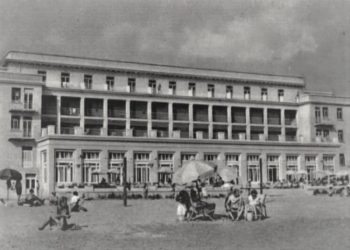
As Hasan Caslli, Mehmet Sejdarasi, and others have told me, Feçor Shehu has frequented Durrës (Hotel “Adriatik”) since 1967, the time when he came from Shkodra with a transfer to Tirana. In those years he came rarely to Durrës, but he began to speed up his arrivals when he became deputy minister and especially when he became minister. Even during the last five years that I have been head of the Branch in Durrës, Feçori came every Sunday to the beach around 9 – 10 in the morning and stayed until 13 – 14:30. There were cases when he came also in the middle of the week in the afternoon (after 15:30). Throughout the time I have been with him, we have eaten together, each paying about 10-12 times.
Feçor Shehu, in the winter period which was hunting season, came very rarely to the beach, almost once every two months, since he went fishing in Velipojë (Shkodra) and Divjakë (Lushnje). There have been cases when he came accompanied from Tirana by Bato Karafili and Elham Gjika, how many times these were, I don’t remember. In a couple of instances, he also came with Tahir Mala. When he came in spring, after a walk by the sea for about half an hour, we would enter a lounge of Hotel “Adriatik” and start playing cards. When he came in summer, we did not walk at all, but went to the room given to us by the receptionist, undressed, and went out to the deck to sunbathe. There we also played cards.
Feçori went into the sea very rarely, as he complained that he was sick in his left hand. After finishing sunbathing and playing, we showered in the rooms and left, Feçori for Tirana and the rest of us for Durrës. For all the facilities made available to us, such as the room, showering, resting in some cases, etc., we did not pay. These favors or privileges were given to us by the tourism workers because of the functions we had, because if we had been four ordinary civilians, they would not have come near us, let alone been treated in this way like us. This action of ours, in fact, constitutes abuse of duty, by Feçori, by me, Bardhyli, and Hasani.
I do not remember any case where Feçor Shehu came to Hotel “Adriatik” to play cards during working hours; he may have come, but I may not have known about it. Notification of Feçor Shehu’s arrival in Durrës was given to Hasan Caslli by Feçori’s driver, Leonard Steria, and Hasani would notify me and Bardhyl, and all three of us together would go ten minutes earlier and wait at Hotel “Adriatik”. Whereas when he came with Bato and Elham Gjika, his driver gave us the notification through tourism. Besides the conversations I explained above, which Feçor Shehu had with us on the beach (Hotel “Adriatik”), he also had some other ordinary conversations, or he held incorrect stances that, given his function, he should not have allowed himself, such as:
In the years 1980-1981, he asked me about the moral conduct of …………. without telling me the reason why he asked me the question; on another occasion he told C.H., “I’ve heard that you…………” and such a thing I have also heard about T.F. C.H. objected and demanded that the matter be clarified, but Feçori backed off, saying: “Perhaps what I was told is not true, thank God it isn’t.” And he did not ask me to follow this matter to the end, nor did he tell me from whom he had the signal; on another occasion he asked Bardhyl Çuçi how …………… of “Dinamo” behaved, “because I have been told that his hand trembles,” (he asked this question to Bardhyl, because he had accompanied …………… of “Dinamo” to the 1980 European Championship in Italy, West Germany, and Czechoslovakia).
On another occasion, with the Minister of Internal Trade present, Feçor Shehu stated: “these ………… have thickened from …….. why don’t you replace them with ……………. as you have in other hotels, like at the fifteen-story building in Tirana”; on another occasion, Feçori, seeing a minister and a deputy minister, said: “they have it good, they close the office at 14:00 on Saturday and think about work on Monday at 7:00,” despising the work of others; at the time we were playing cards one Sunday in the cafe lounge of Hotel “Adriatik”, Feçori saw the son of a leader and a Central Committee member approaching to enter the lounge, and he told us: “Leave these cards, because these will see us and will say that we’re wasting time playing cards.”
I was impressed by this shyness of Feçori, since we were not doing anything irregular, but he showed this shyness out of fear that his name would be raised in the Party leadership, and from that time (1980), we played in a room on the first floor, where no one could see us. While he began to get close to me and Bardhyl to play cards from mid-1979; with Hasan Caslli, he had fifteen years of association and always played the game of five-hundred together. There were cases when he learned that Hasani was not in Durrës, Feçori would not come; likewise, there were cases when he took Hasani with him to Tirana and Shkodra, combining work so that they would spend their free time together.
On January 5, 1982, when I sent Feçori an operational note about the son-in-law of a leader, he told me: “But this one, at the Political Bureau meeting (on December 18, 1981) sold us vigilance, but in reality, where has he gotten himself into with this in-law relationship”? Feçori had no reason to say this expression to me about a leader, and then Feçori began to tell me that: when I engaged my eldest daughter, I asked the Party, since the boy’s uncle, Vango Mitrojorgji, had been condemned by the Party in Koci Xoxe’s time. In June-July 1979, Feçori asked me on the beach: “Will comrade Mihallaq move from Durrës”? (it was the time when the Minister of Internal Affairs had begun to be taken into the Ministry of Defense); he began to ask me this question with a certain concern, and I understood that Mihallaq might be made Minister of Internal Affairs, and I answered Feçori that: “there are club rumors, but nothing concrete has been discussed in the Plenum or the Bureau”!
From the beginning of 1980, Feçori asked me again: “Hey, why are we hearing bad things about Durrës? Mihallaq, why does he allow this situation? When he was in Korçë, things went well for him; with one word he spoke there, everyone would rise to their feet; but age does its work, he’s dragging it out in vain, he should retire and end it with honor.” After Feçori had made the criticism at the Central Committee Plenum in January 1980 that the cadres of the Durrës district go too much to lunches and dinners, one day on the beach he told me: “Don’t tell comrade Mihallaq that I come here to the beach on Sundays, because he will say, ‘how did this Feçori find the time to meet us once'”? I told him that we do not report to the First Secretary who comes and who goes to the beach, but he has a son who works in tourism and sees you when you come. But in fact, when I met with Mihallaq and we chatted, I would tell him that Feçori had been at the beach.
From the conversations Feçori had with me about Mihallaq and from the fact that, during the five years I have been in Durrës, Feçori only once met with him in his office (Mihallaq’s), as I have explained above, I have formed the impression that Feçori had old reservations against Mihallaq, otherwise Feçori’s stance towards Mihallaq cannot be explained. During 9 years of work in the Security organs (4 years as deputy director in the Ministry and 5 as branch head in Durrës), I have often been linked by work with Feçor Shehu, in whom I have noticed displays of prepotence, arrogance, haughtiness, revenge, and his lack of mass-mindedness. For all these, I will give the following explanations.
In 1973, I and Hajrullah Topollai (both deputy directors of the First Directorate), after finishing work in the afternoon, left the office. The next morning, Feçori called us and said: “Hey you, why did you leave the office before me last night? I might have had work with you; it is not good for subordinates to leave before the responsible person”! We told him that we left for our own work, we had nothing to do with you, but he continued: “No, no, what I am telling you, keep it well in mind.” So other times, we either waited for Feçori to leave, or we went to his office and told him we finished work, did he have anything with us, or should we leave? With this action, Feçori showed his prepotence and put us under tutelage. In 1978, in my office in Durrës, the staff for the security of the Eighth Women’s Congress had gathered, which was chaired by Feçor Shehu himself.
He requested that he be reported to in turn by the service heads, and the first to speak was the Police Director, but before he had spoken two minutes, Feçori interrupted him arrogantly, saying: “You have been Police Director for twenty years and you haven’t learned how plans are made, so sit down and write down what I tell you” – and began to dictate to him some tasks that the Police Director had reflected quite well in the plan. He remained so offended by this intervention of Feçori that he wanted to leave the service altogether! From the position of deputy minister, he did not have the right to make evaluations about the cadre of the Durrës district, let alone express it in front of the whole collective; another case: a young investigator, because he had unbuttoned a button of his jacket and was uncombed, Feçori told him: “You have no shame, you look sloppy at me, you know that I can throw you out the window and put you behind bars”! He also told the Operational Worker of Tourism: “If you don’t take measures to keep the tourist area clean from the entry of Albanian citizens, I will put you in prison, because you’re surprised because you come from civilian life, but know, if you don’t obey my orders, you will end up there.” To Bardhyl Çuçi, who was deputy branch head, at a collective meeting, he said: “Sit there and don’t make noise, because I brought you from Gjirokastër to Durrës, so keep your head down and work,” and many other cases of this nature.
The first moment that left me with the impression that Feçor Shehu must not be right was the hostile expression about the Party Committee and the Executive Committee in October 1981, which I have explained in detail above. The second moment is the regret Feçori expressed about the self-criticism regarding the engagements and weddings of the leaders’ children, an expression which I realized was wrong at the end of October 1981, when I learned about the in-law relationship that Mehmet Shehu had made with the family of the declassed Qazim Turdiu. The third moment that determined in my mind that Feçor Shehu is not right with the Party line was the listening (recorded) by me of the Political Bureau meeting where Mehmet Shehu’s faults were condemned. There it was said that Mehmet Shehu made an alliance with the class enemy, that by making an in-law connection, he is for two lines in the Party.
When I learned that Feçor Shehu had not informed the Party about Qazim Turdiu’s biography, but had approved the in-law relationship, I immediately judged that he is on Mehmet Shehu’s positions, whom Feçori, not only copied in detail for his working method, stances, and behavior, but also followed him in his hostility towards the Party. This opinion of mine was further consolidated by some stances and faults that Feçori himself made in relation to me, such as: the denial of the operational note, the lie that he had reported to the main Party leader about Mehmet Shehu’s children that I had informed him about, and the Trotskyist action of January 10, 1982, when he came with Bato Karafili to verify the reason for the arrival in Durrës of the assistant to the Central Committee Secretary for the Internal Affairs organs, which I have explained in detail above.
Regarding Mihallaq Ziçishti [Llambi Ziçishti’s brother? Actually Mihallaq is Llambi? The text says “Mihallaq Ziçishti” – likely referring to Llambi Ziçishti? Or a relative? The context suggests it’s Llambi Ziçishti, the minister, but note: earlier the minister was Llambi Ziçishti. Here it says “Mihallaq Ziçishti” – possibly a mistake or another person. I will keep as is], I have to say these: When he was head of the delegation in Spain, 2-3 years ago, and when he returned, he explained to me; that he had been taken for a visit to the Ebro field, where the main battle between the international brigades and Franco’s fascist forces took place. In this battlefield, Mihallaq had taken with him a small plastic bag of soil, a stone, and I think a small tree branch. He placed all three objects on a wooden base and all the other sides were glass, and told us that; he would take them as a souvenir to Mehmet Shehu, who had been in that battle in Spain.
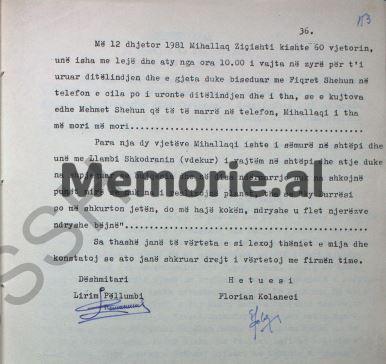
In December 1979 or January 1980, when I raised before Feçor Shehu and Mihallaq Ziçishti some problems about Marjeta and Bashkim Shehu, Mihallaq, regardless of the stance that Feçori took, should have informed the Central Committee of the Party, this he did not do! On December 12, 1981, Mihallaq Ziçishti had his 60th birthday; I was on leave and around 10:00 I went to his office to wish him a happy birthday and found him talking on the phone with Fiqret Shehu, who was wishing him a happy birthday and told him, “I remembered Mehmet Shehu to put him on the phone with you,” Mihallaq said: “He called me, he called me!”
About two years ago, Mihallaq was sick at home and I with Llambi Shkodrani (deceased) went to his house and there, while explaining to us that agriculture and some enterprises are not going well, that they are not fulfilling the plans, he said: “this Durrës is shortening my life, it will eat my head, you talk to people one way, they act another”!
What I have said is true, and as I read my statements and find that they are written correctly, I confirm them with my signature. Memorie.al
Witness Investigator
Lirim Pëllumbi Florian Kolaneci