By Prof. Gjon Sinishta
Part Three
Memorie.al / The following material is a document not very well known to Albanian readers, a scan of the persecution of the clergy and religious faith in Albania, written by Prof. Gjon Sinishta in 1983, an Albanian anti-communist of Montenegrin origin, imprisoned in former Yugoslavia in the 1950s. At the time of the material’s publication, he was a professor at the University of San Francisco in the USA. Mr. Sinishta himself had studied at the Jesuit Seminary of Shkodra until 1946, with the desire to become a priest, therefore his approach to the violation of believers’ rights in communist Albania is unique and of particular importance.
University of San Francisco (1983)
Continued from the previous issue
To show that it did not agree with this “kindness” toward religion, the communist government of Albania adopted a new Constitution in 1976, Articles 37 and 55 of which proudly declare that: “the state recognizes no religion and prohibits all religious activities and organizations, while encouraging atheism.”
Article 37. The state recognizes no religion and supports and develops atheist propaganda to instill in people a scientific materialist worldview.
Article 55. The creation of any organization of a fascist, anti-democratic, religious, and anti-socialist character is prohibited. Fascist, anti-democratic, war-mongering activity and propaganda, as well as incitement of national and racial hatred, are prohibited.
With these articles, Albania became the only country in the world where the suppression of religion and the spread of atheism have been turned into a state policy mandated by the constitution. In June 1977, the new Albanian Penal Code was issued, point 55 of which provides the penalties to be given for religious activity.
It states that: “religious propaganda, as well as the production, distribution, or storage of literature of this kind,” shall be punished by imprisonment from three to ten years. In time of war or if the acts are considered serious, imprisonment is no less than ten years, and the death penalty may be imposed.
Before the adoption of such official acts, the government manifested the same pressure on religion. Fr. Shtjefën Kurti was executed in 1972 for baptizing a child in a labor camp at the parent’s request. In 1974, the government also sentenced three remaining Catholic Bishops in detention camps for performing religious services privately. After religion was constitutionally outlawed, in 1977, Fran Mark Gjoni of Shkodra was brought to trial for possessing Bibles.
Gjoni admitted, when presented with the Bibles taken from his home that he had found them in parks and on the seashore, where tourists had left them or they had come from the sea. For this “crime,” Gjoni was sentenced to 12 years in prison. Despite the total silence regarding the case by the media monopoly controlled by the government, everyone in Albania was aware of the trial and was very interested in it.
Ironically, the trial helped to demonstrate the continuing existence of religious faith in Albania, as well as brought to light the scandalous reactions of the Albanian government even to the mildest expression of this faith! For religious criminals like Gjoni, according to reports from recent refugees, the government has at least six prisons, nine concentration camps, and 14 internal exile zones.
An even more horrifying example of the Albanian government’s ongoing anti-religious campaign is that of Catholic Bishop Ernest Çoba, Apostolic Administrator of Shkodra. Bishop Çoba, isolated since 1974 in the labor camp at Papër near the city of Elbasan in Central Albania, celebrated a secret Easter ceremony in 1979 at the request of his fellow prisoners.
Unfortunately, the police were informed, and at the beginning of the service, the prison guards entered the barracks. Some began attacking the Bishop, tearing his clothes and breaking his cross, while others began beating the prisoners who had gathered for the feast. The venerable and elderly prelate, nearly blind, was seriously injured during the scuffle and died the next morning. His body was immediately removed and buried by the police in an undisclosed location.
One of the latest victims of the Albanian government’s war against religion is Fr. Ndoc Luli, S.J. After a long hesitation, in May 1980, Father Luli – at his sister-in-law’s request – baptized her newborn twins in the Mali i Jushit Agricultural Cooperative, near Shkodra, where he was isolated. The event was discovered, first by the secretary of the communist cell, then by the police. Father Luli was immediately arrested along with his sister-in-law, and both were interrogated and treated harshly.
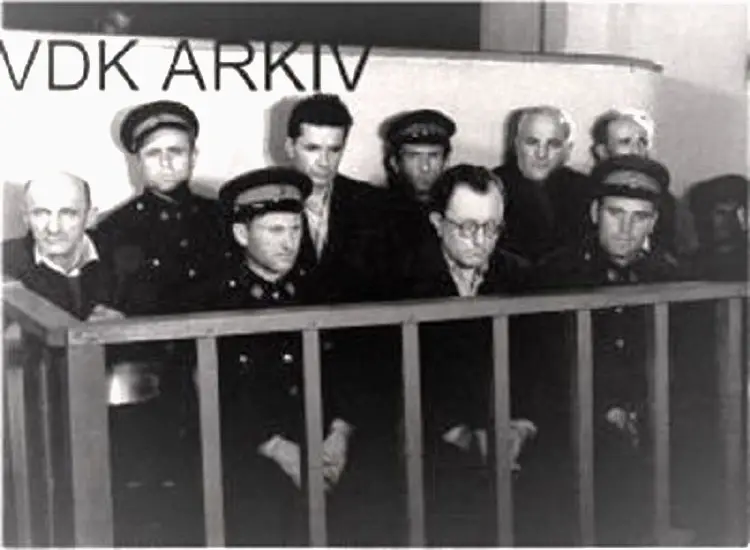
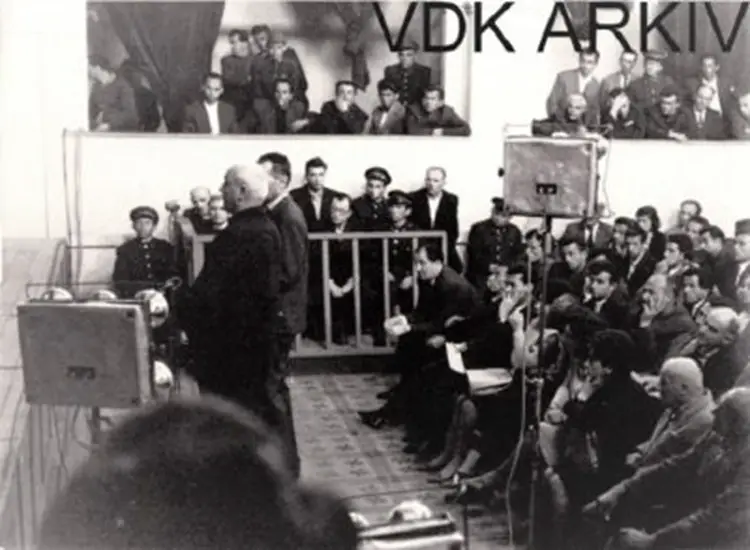
In the public trial, held in the recreation room inside the Cooperative, Fr. Luli’s sister-in-law was sentenced to eight years in prison with hard labor, while his sentence was vaguer: “life until death.” His fate is unknown, and many believe that Fr. Luli died at the bottom of some mine, a victim of the feared Sigurimi (Albanian Secret Police).
With the death of Bishop Çoba, the only remaining Catholic Bishop in Albania is 70-year-old Nikoll Troshani, Titular Bishop of Cisamus and Apostolic Administrator of Lezhë and Durrës. He is isolated in the labor camp at Tepelena, near the seaport of Vlorë. The third among the surviving bishops, who was arrested in 1974, Antonin Fishta, died a few years ago while still in isolation.
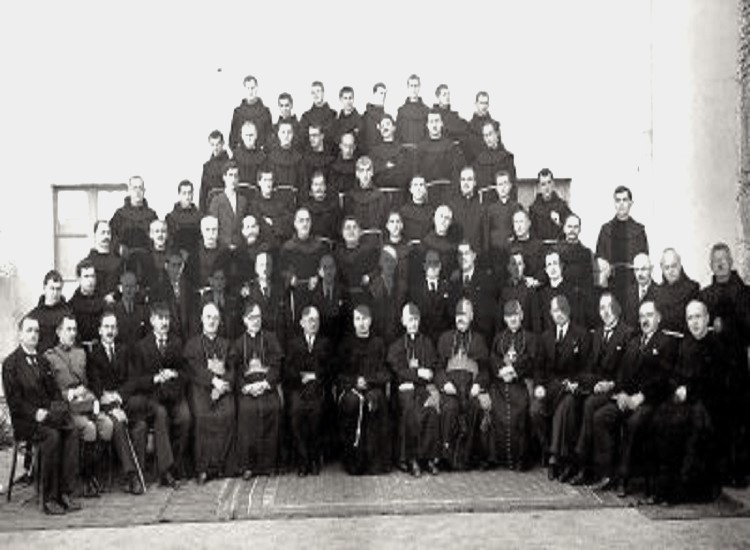
Those few priests and religious still alive remain in prisons and forced labor camps. Among them is Mark Hasi, who is serving a long prison sentence for the second time “for performing religious services.” Imprisoned in the labor camp in Southern Albania are Fathers Injac Gjura, Rok Gjuraj, the Jesuit Gjergj Vata, Simon Jubani and Simon’s older brother Lazëri, and two Franciscans.
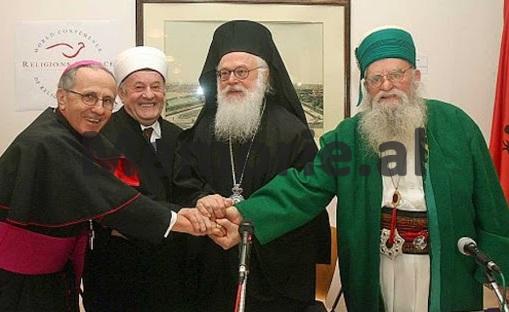
Amnesty International has mediated in vain for the release of Bishop Troshani and of other priests and lay believers who are held in prison solely for their faith. In 1977, Cardinal Humberto Medeiros of Boston, together with the Albanian Orthodox Bishop Mark Lipa, issued a “Joint Appeal for Religious Freedom,” which condemned Albania’s anti-religious laws.
On November 28, 1981, once again Medeiros and Lipa issued a “Declaration on Religious Freedom,” on the sixty-ninth anniversary of the creation of the independent Albanian state. In the declaration, religious leaders demanded “respect for human rights and especially for religious freedom in Albania.” They called on the Albanian government to allow the reopening of churches, mosques, and other religious institutions.
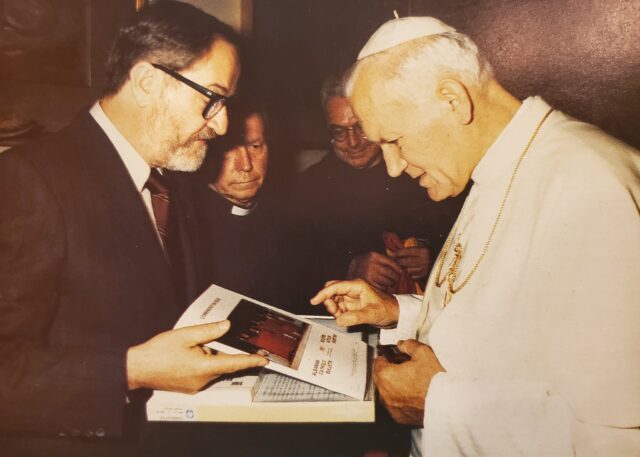
They also expressed their conviction that the life of the church and faith in God “promote good social order.” On October 5, 1980, Pope John Paul II, referring to the many martyrs of present-day Albania, asked all believers to pray for Christians and other believers who are persecuted for their faith. He reminded listeners that “to be spiritually close to all those in Albania who suffer violence because of their faith is a special duty of all Christians according to the tradition inherited from the first centuries.”
Moreover, he urged everyone “to pray also for their persecutors, repeating the cry of Christ on the Cross addressed to His Father: ‘Forgive them; for they know not what they do.'” The Pope also defended the accused martyrs, that they were guilty of political crimes, drawing attention that Christ Himself was condemned on the political charge of claiming to be King.
In 1981, the Bishops of Greece also denounced religious persecution in Albania, emphasizing especially the fate of Orthodox believers. However, their appeal had chauvinistic overtones, as it claimed that 400,000 Albanian Orthodox were Greek citizens. Unfortunately, their distortions, instead of helping, harmed the Orthodox believers in Albania, giving Hoxha a pretext to continue his efforts against religion.
Recently, another positive indicator has come from Eastern Europe that world opinion is becoming interested in the plight of Albanian believers. On October 7, 1982, in Bucharest, Romania, an international, interfaith colloquium was held under the auspices of the Conference of European Churches of the World Council of Churches. The Ecumenical Press Service of the World Council of Churches published a portion of the document from this colloquium that addresses the religious situation in Albania.
The document reports the radical suppression of all organized religious activity in Albania. While denouncing the current pressure on religion, it suggests that Christians outside Albania use this period to prepare the ground for a possible dialogue with the Albanian government regarding the fate of Albanian believers.
Current Religious Activities in Albania
Religion continues to secretly influence the lives of Albanians of all faiths, despite the brutality of the anti-religious campaigns. Evidence of this has been provided by official government agencies, including the government press, and even by Enver Hoxha himself.
Hoxha has recently declared that: “religion has not yet been uprooted in our country,” “religion is still alive in our working class,” “the enemies of people who believe in God do not sleep; they continue to look with sympathy and hope toward the Vatican; these kinds of enemies are within our party lines and active in our organizations.”
These statements verify reports coming from Albania that some religious practices there are alive, that major feast days are still respected, that religious symbols are kept “disguised,” and even that participation in religious pilgrimages occurs. Some young Albanian refugees who have arrived in the United States of America during the last two years have given details of how people continue to practice their Catholic faith in the secrecy of their homes.
It is almost certain that the remaining Catholic priests are still alive in prison. People now rely on lay leadership for their religious services. The eldest member of the family is chosen to lead the prayer service and to perform the rites of baptism and marriage. Religious medals, crucifixes, photographs, and rosaries are kept hidden by families due to the threat of raids by the Albanian State Security (Sigurimi). Since 1975, by decree 5339, giving children religious names is prohibited.
In 1980, the government complained that children at home had begun to be called by their saint’s name. Such comprehensive repressive measures against religion are seen by refugees as incompatible with the Albanian heritage. The parents and grandparents of those who remain in Albania recall that even during the Ottoman rule of Albania, when forced conversions occurred, there were no such attempts to completely eradicate Christianity.
A further indicator of the continuing influence of religious beliefs in Albania is a recent survey conducted in 1980 by a sociologist of the Albanian government. The survey showed that there is an extremely low rate (less than 4%) of marriages in Albania between people of different religious backgrounds. According to this study, Albanians prefer to marry within their religious group.
This rate of mixed marriages is very low compared to other European countries and is also much lower than it was before communist rule. This means that anti-religious pressure, not only has not removed religion’s influential role in Albanian life, but on the contrary, the rate of maintaining religious unity within one’s faith has increased among the vast majority of Albanians.
How We Can Help Religious Freedom in Albania
The total war against religion being waged by the Albanian government has now lasted nearly 40 years. Albanians are still being subjected to extraordinary suffering, simply because they choose to believe in God. Thanks to the Albanian people, there are many signs that religion is still alive in Albania, as evidenced by the martyrs, the religious prisoners, and even the communist leaders. But there have been many unknown victims in this war against religion.
For example, there are those who are not allowed to hear even the message of the gospel because of the rampant persecution of priests and other leaders of religious communities. Or there are those, like the case of a young refugee from Albania, who are tempted to repent and not believe because believers outside Albania seem unconcerned about the nation’s plight.
Religious freedom in Albania is a matter of justice to which civil and religious leaders must turn their attention. Until now, heads of state have continued to bypass, disregard, ignore, and remain silent in the face of the Albanian government’s actions against citizens who wish to practice their religion.
In doing so, world leaders call into question their commitment to the Charter of the United Nations, where the choice of religion is so fundamental that no government has the authority to discriminate, let alone completely deny it. Religious leaders and all believers have the duty to help those suffering from persecution and to speak in their support.
Failure to do so shows a lack of charity toward those in need. Our silence regarding religious persecution in Albania implies that our belief in religious freedom touches only our immediate environment and that we do not value the religious freedom of others as much. Certainly, our generous and courageous commitment to religious freedom in Albania will help increase freedom and justice throughout the world and preserve the values of religion for future generations – values without which we are less than human.
Religious leaders, organizations, and individual believers should urge their elected officials to speak out against religious persecution in Albania and for the right of Albanians to freely practice their religion.
Protests against the Albanian government should be registered with the United Nations and human rights organizations, drawing particular attention to those sections of the Albanian Constitution and Penal Code that concern the abolition of religion, which are in contravention of Chapter IX, Article 55, of the Charter of the United Nations.
Religious organizations, which have often expressed concern for human rights, should bring this issue to the public forum and turn the attention of their members toward coordinated actions on behalf of Albanian religious believers. / Memorie.al
Taken from George Fox University’s “Occasional Papers on Religion in Eastern Europe,” Volume 3, No. 5.