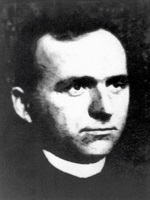

By Prof. Gjon Sinishta*
Part Two
Memorie.al / The following material is a not very well-known document for Albanian readers, a scan of the persecution of the clergy and religious faith in Albania, written by Prof. Gjon Sinishta in 1983, an Albanian anti-communist originally from Montenegro, imprisoned in former Yugoslavia in the 1950s. At the time of the publication of the material, he was a professor at the University of San Francisco in the USA. Mr. Sinishta himself had studied at the Jesuit Seminary of Shkodra until 1946, with the desire to become a priest, therefore his approach to the violation of the rights of believers in communist Albania is unique and of particular importance.
Continued from the previous issue
The Catholic Church
Although the communist government of Tirana directed its anti-religious campaign against all three religious groups, the Catholics felt the main weight of the attacks. Despite being a minority, Albanian Catholics and especially their clergy were admired and liked by Orthodox and Muslims for their traditionally strong patriotic and cultural dedication. Because of jealousy of the strength and influence of the Catholic Clergy and from fear of unity among their believers, the government used all kinds of legal and illegal means to erode and destroy the foundations of the Catholic Church.
For centuries, the Catholic Clergy had taught and worked with all people without religious distinctions. Many visitors to Albania noticed how they cared for and served people with self-denial, sharing daily joys and sorrows. It was this religious tradition that the new government sought to destroy. By the end of 1946, almost half of the Catholic Clergy were imprisoned, all foreign clergy were expelled and 20 priests and believers were sentenced to death. At the same time, Enver Hoxha, then General Secretary of the Party and Chairman of the government, tried by all means to incite discontent against the leaders of the Catholic Church.
The Church, however, stood firm and united against the government’s plan to create a new church organization, detached from Rome, which would serve the purposes of communist indoctrination throughout the country. The actions of the Albanian government and party to eliminate Catholicism from public and private life can be divided into three main periods: 1944-1948, 1949-1967, and 1967-1983.
The period 1944 – 1948
Enver Hoxha’s plan to create a Catholic Church detached from Rome began to take shape in May 1945, when he expelled the apostolic delegate to Albania, Archbishop Leone G. B. Nigris. Then, hastily summoning the metropolitan archbishop of Shkodra, the Primate of the Church, Gasper Thaçi, and the Archbishop of Durrës, Vincent Prendushi, a poet and writer of national fame, he demanded that they break away from Rome, create a new national church, and remain loyal to his new regime.
In return, he offered the government’s “conciliatory stance” and material aid for the maintenance of the Church’s institutions. Both prelates bravely refused and paid for this stance with their lives. Thaçi died in 1946 under house arrest. Prendushi was sentenced to twenty years of hard labor and died in prison in 1949, after enduring terrible torture.
The government’s attack then turned against the priests. On June 21, 1945, two Jesuit teachers, Frs. Jak Gardin and Gjergj Vata were arrested and, after a trial filled with illegal procedures, where even their defenders withdrew from the court in protest of the process, they were sentenced to many years in prison.
Immediately after the first elections, on December 31, 1945, in which no opposition party was allowed to participate, the police arrested Frs. Gjon Fausti, vice-provincial of the Jesuits, and Daniel Dajani, rector of the Papal Seminary of Shkodra. A month later, the government ordered the immediate expulsion of all non-Albanian members of religious orders.
The number of those expelled exceeded two hundred. During a sham trial on January 30, 1946, the Jesuit fathers Fausti and Dajani, the Franciscan father Gjon Shllaku, and seminarians Mark Çuni and Gjergj Bici, were sentenced to death along with 13 laypeople. The execution took place on March 4, 1946, outside the Catholic Cemetery in Shkodra, and their bodies were thrown into a common grave.
Their last words were forgiveness for their persecutors and praise for God and Albania, while crying out “Long lives Christ, Long live Albania”. Exactly one month later all Jesuit institutions were closed and the Order was declared illegal.
As soon as the shock from the executions had produced its effect, Enver Hoxha summoned Bishop Frano Gjini to Tirana, to order him, as he had done a year earlier with Bishops Thaçi and Prendushi, to break ties with Rome and push the clergy and Catholic population to the government’s side. Gjini had become Vice-Apostolic Delegate and the leading leader after Thaçi’s death.
Enver Hoxha threatened him with a fate similar to his predecessors if he did not give in; Bishop Gjini refused, saying: “I will never separate myself and my flock from the Holy See”. However, fearing severe reprisals against those under his care if no compromise was reached, Gjini tried to reconcile the government and the Catholic Church in Albania.
Frano Gjini bravely wrote an open letter to Hoxha, in which he offered the Church’s cooperation in “rebuilding the nation, closing the wounds and overcoming existing difficulties”. He had “hope for the realization not only of material advantages, but also of spiritual benefits for all Albanians”.
Hoxha ignored the message and ordered Gjini’s arrest on the charge of spreading anti-communist propaganda. After a year of torture and many humiliations, Bishop Gjini was executed on March 8, 1948, together with a group of eighteen clerics and laypeople.
Just one month earlier, another Bishop, Gjergj Volaj, had been executed along with other priests and laypeople, without trial, on the charge of being “enemies of the people”. By now the persecution had reached its peak. Besides the Jesuits, the Franciscans were also disbanded, along with all similar religious orders. Their property, even their personal belongings, was confiscated. The hierarchy was completely destroyed and only one Bishop remained alive.
The period 1949 – 1967
In 1949, external and internal pressures forced the Albanian government to slow down its efforts against the Catholic Church and religion in general. The expulsion of Yugoslavia from the Cominform by Stalin’s order, in June 1948, had created an unexpected danger for the Albanian leader and his Party.
Groups of pro-Tito sympathizers and Albanian exiles in Yugoslavia were being organized by Yugoslav secret services to overthrow the Hoxha regime. To preempt the challenge, Hoxha launched an offensive against Yugoslavia, publicly blaming Albania’s neighbor for all of Albania’s misfortunes since “liberation”.
As a tactic to prevent Catholics from joining forces against him, Hoxha delegated Deputy Prime Minister Tuk Jakova to meet with his (Jakova’s) former schoolmate, the Franciscan priest Marin Sirdani, in the marshes near Elbasan (Central Albania) where Fr. Sirdani was serving a long sentence of forced labor. Jakova blamed and condemned Yugoslavia for the brutal policies against Catholics and their clergy during the past years and assured Fr. Sirdani of the government’s desire for rapprochement with the Church.
Surprised by Tuk Jakova’s statements, Fr. Sirdani nevertheless rejoiced and immediately accepted his invitation to mediate between the government and the Catholic hierarchy, which was now reduced to one elderly Bishop, the venerable Bernardin Shllaku, and Ordinary of the Diocese of Pult.
Fr. Sirdani informed the Bishop of the government’s approach and both the Bishop and the government agreed to begin negotiations. Some organizational charters for the governance of the Catholic Church were prepared between 1949 and 1951.
Bishop Shllaku and his assistants tried their best to meet the government’s demands and conditions, while at the same time taking into account the canons of canon law. Satisfied with the good will of the Church’s leaders, the government pressed for the complete separation of the Church from the Vatican. For the sake of persuasion, other “unacceptable” priests were arrested.
Stubbornly, the Catholics refused to surrender despite the fact that the government’s statutes for the Muslim and Orthodox faiths had already been elaborated and approved by the government several years earlier. Finally, after long and painful discussions, a compromise was reached in which the government allowed the Church to retain its spiritual sovereignty and ties with the Holy See.
However, the official communist press falsified the original text of the Charter and announced that all ties between the Albanian Catholic Church and the Vatican had been broken. The Catholic Clergy were angered and saddened by this betrayal. They denounced the lies and misinterpretations concerning the Charter and reiterated their strong loyalty to the Holy Father.
During the signing of the Charter, the government promised that it would allow the reopening of churches and seminaries and would provide a subsidy for their maintenance. The government also agreed to allow parents to bring their children to church for religious instruction.
When these promises were not kept, the Church tried to adapt to the government’s wishes in order to carry out religious duties towards Albanian Catholics. The Catholic believers, who understood the communists’ hatred for them and for religion in general, suffered greatly.
They witnessed in silence the destruction of Catholic institutions, the imprisonment and execution of their priests. In the midst of this turmoil and despite the repression and plunder directed against the Catholic minority, Catholics filled the churches for regular services. This was an open and eloquent testimony of their dedication to the Church and its clergy.
The Church leaders and believers were certainly aware that the government’s attempt to nationalize the churches was only a temporary measure to prevent the growth of discontent. With clear conviction they refused to submit to this kind of constitutional pressure and blocked any compromise if it touched upon the fundamental teachings of the Catholic Church. Consequently, a new wave of persecution swept the Church.
Between 1955 and 1965, more than a dozen priests and religious were shot. Many others were either imprisoned or sent to forced labor camps. Among the executed priests were fathers Ded Malaj, Zef Bici and the Franciscan Konrad Gjolaj, who was sentenced to long years in prison. Diocesan offices and parishes were constantly harassed and religious services were obstructed by government agents.
Bishops and titular pastors were forced to work as street cleaners and public bath attendants, dressed in scarecrow clothes, wearing paper signs on their chests reading: “I have sinned against the people”. The entire Catholic Church was slowly being martyred.
The years 1967 – 1983
This period is the final intensive effort of the Albanian Communist Party and the Albanian government to eliminate the church and all religious activity. Enver Hoxha again prepared the ground for action with his infamous speech of February 6, 1967, asking Albanian youth to fight “religious superstitions.” This was followed by a merciless campaign against all religion.
Everywhere churches were burned or converted into sports arenas, dance halls, cinemas, apartments, etc. Priests and bishops were beaten publicly. The Franciscan church of Arramadha in Shkodra, together with the monastery, was set on fire one evening and four elderly Franciscans were burned to death. During 1967, according to the Albanian writers’ magazine “Nëntori”, about 2,200 mosques, churches, chapels, monasteries and other religious buildings were vandalized and closed.
Of this number, 327 were Catholic. On November 22, 1967, the government published Decree no. 4337, ordering the annulment of religious charters and all laws concerning state-church relations. All religious rites were prohibited and violators received severe punishments. The remaining priests were sent to forced labor camps for “re-education”.
The Albanian party and government boasted that they had become the first completely atheist state in the world. Their actions violated Article 18 of the country’s 1946 Constitution, which states that all citizens are guaranteed freedom of conscience and belief and that religious communities are free to exercise their faiths and practices. The decree also violated the Universal Declaration of Human Rights (UN), which guarantees religious freedom.
The ban on religion in Albania passed almost unnoticed abroad and aroused little protest, except for the Vatican daily “L’Osservatore Romano”, which published reports on anti-religious violence. The “Free Albania” Committee, based in New York, protested strongly on behalf of the silenced Albanian people before the Secretary General of the United Nations and demanded that immediate steps be taken to stop the savage religious persecution in Albania.
Unfortunately, these steps were not taken and this plea was not heard by the religious and civil leaders of the world. Since that time, Cardinal Humberto Medeiros of Boston, Pope Paul VI, and Bishop Mark Lipa of the Albanian Orthodox diocese of America, John Paul II and the Conference of European Catholic Bishops have defended the right of the citizens of Albania to freely practice their religion.
Despite their efforts, today, nearly two decades after the creation of the first atheist state in Albania, the Albanian leaders continue to attack religion and proudly defend the destruction of churches, monasteries and mosques; the killing of hundreds of priests and religious; the inhuman persecution of believers.
They forcefully attack the Soviet Union, China, Poland, Yugoslavia and other Eastern countries for their “anti-revolutionary” stance towards religion. It is superfluous to say that all these communist governments that Albania criticizes do persecute religion. However, they at least officially guarantee religious freedom in their constitutions and allow, with restrictions, the private and public exercise of religion. / Memorie.al
*University of San Francisco (1983)
Taken from the book of the University “George Fox”, “Occasional Papers on Religion in Eastern Europe”, Volume 3, No. 5.