
By Ndue Dedaj
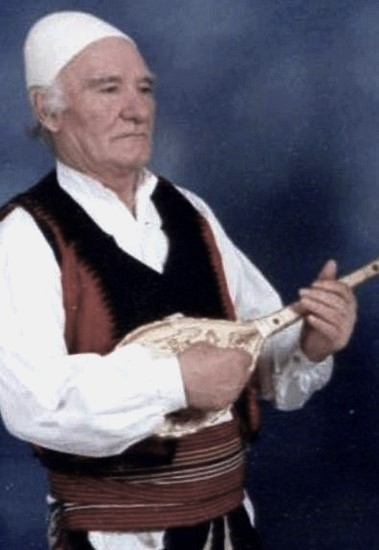
Memorie.al / It happen that you meet people very late, people you had set out to meet long ago! That is what happened to us with the “People’s Artist” Ndue Shyti, decorated a few years ago with the high title “Honour of the Nation” by the former President of the Republic, Bujar Nishani. This occasion could have been the impetus to travel to him, as could the artist’s age of around 80, or the “debt” left unpaid for years. If it was said of Mozart that he was music itself, of Ndue Shyti it can be said that he created his musical symphony solely with the çifteli (a two-stringed lute) made of mulberry wood and the nightingale (flute) made of chestnut wood. Two such simple strings sufficed to light his melodic lamp, eternally unextinguished.
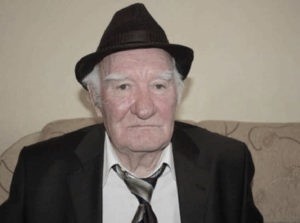
We knocked on the door of his house together with researcher from his region, Mark Mesuli, writer Salvador Gjeçi, and publicist Gjon Marku, who would also conduct an interview with the master for a book in progress. We did not travel towards Gojan, where Ndue Shyti’s old tower house is located, but towards the city of Durrës, where he lives in a private villa, far from the breeze of the pines of Munella, Suçel and Terbun, but near the sea waves. We spoke with Ndue for about three hours – cheerful and courteous – and at the end he got up to take some photos with us, even though he has been paralysed in his legs for over ten years.
True, it is the beginning of November and we are friends in his house, but before us there have also been the well-known musicologist Sabrie Nushi, Esat Ruka, Sulejman Sula, Fran Vukaj, who a short while ago produced a programme dedicated to him on Albanian Radio-Television, or Riza Tafilaku, who has published a book dedicated to him. Ndue Shyti, this unparalleled bard of our mountains, has created his own era, as rarely an artist has in this country, thanks to his extraordinary talent. “In 42 years, from 1960 to 2002, I gave 450 concerts within the country and many others abroad, in 18 countries, 4 continents,” he says, specifying that he has not been to the fifth continent, Australia, but an emigrant who came from there told him: “I had sought your çifteli by radio-mail, back when the country was closed”!
His çifteli has sounded in France, Italy, Norway, Austria, Yugoslavia, Turkey, Switzerland, America, China, Cambodia, etc. “In Italy, the trio with the cream of the nation’s artists – Gaqo Çako (classical music), Vaçe Zela (light music) and Ndue Shyti (folk music) – was maximally appreciated as Albanian top performers,” writes Sulejman Sula. Ndue Shyti has 60 years on Radio and Television, with his instrumental pieces. In his collection, he has 17 national and international awards, orders and medals, and 4 local awards, while he himself is now an award, since for several years the “Ndue Shyti” Prize has been given to folk instrumentalists.
The alphabet of the çifteli had long existed, as had its “words” (if we may figuratively call the melodies that), but he with his incomparable talent created the language of this instrument, giving it a Western international passport. He included the çifteli of the Mirdita region in a whole family of modern musical instruments that until then had not paid it any attention, even placing it at the forefront at times, creating a kind of Northern orchestral polyphony. Back then and thereafter, the çifteli would be the first, the banner of tradition that would play alone in wedding chambers but also the leader of an orchestral formation of a dozen instruments. And all this was happening in the century of the flowering of folklore, but also of its decline.
The conversation with Ndue has no protocol; in fact he does not easily “obey” the course along which the journalist’s questions want to lead him; he wants to take things calmly and in order, as in the assemblies of Mirdita. Regarding political people – as a staunch democrat – he mentions Sali Berisha, not only as the doctor who cured his heart, but also as a politician; Azem Hajdari; and also Rexhep Mejdani, whom he met in Pukë at a cultural event. He strongly praises Mark Mesuli, with whom, he says, we know each other without parties, so to speak, beyond politics. “He was the mayor of Gjegjan municipality in the 2000s, when he came to my house; he did not mind that I was a democrat. Mark has also come to me in misfortune, therefore on the human side he has shown himself as a brother and has treated me as a brother. I feel honoured, because I have always received appreciation only from art…”!
The miracle of the “symphony with two strings”
Ndue Shyti was born on 10 September 1934, and as a child he played the çifteli in his birthplace in Gojan, by the Fan i Madh river, never imagining that the two-stringed instrument would make him one of the greatest artists of his nation. Likewise the flute that his great-great-grandfather had played, among those mountains where Munella is ever a vigilant helmet. He would be not only the number one instrumentalist of the çifteli, this magical instrument, in the entire Albanian world, but also the creator of a small orchestra of 100 folk instrumentalists in the “Puka” ensemble. The çifteli would transform him into a myth, but he would also give another instrumental weight to this instrument, so fragile in appearance. The çifteli would lift Ndue onto the most prestigious stages of the world, would raise him to the height of “People’s Artist” (1979) and finally to “Honour of the Nation”.
He was as much a çifteli player of his valley of Fandamadh and of the folk formations of Pukë, as a proven artist of the State Ensemble in Tirana. Gjirokastra had no meaning without this unique master at its festivals. Everything of his was the çifteli; another northern ensemble bore the name “Çiftelia” (that of Lezhë), while this instrument was also the main one of Mirdita, etc. In the 1970s, this born virtuoso told the young modern music musician, Sabrie Nushi, newly appointed to Pukë: “Leave the piano, girl, and learn the çifteli,” surprising her for a moment, but in fact drawing her towards a musicological world of tradition that was inexhaustible.
He was one of those brilliant virtuosos who knew how to make music even with a leaf, a stone, a sorbus fruit, a horn, and wood – any object that the nature of those mountains would generously give. Suffice it to see one of his students today, Gjovalin Ndreca, playing original melodies on the pipëz, zumare, flute, etc. And wherever the word goes, Ndue Shyti will bring it back time and again to the beginning, with special respect for his çifteli teacher and predecessor, the Mirdita native Gjin Shkoza (1900-1980), a distinguished instrumentalist of this instrument and its carver. Shyti came from the lands of Prendush Gega and Mat Dod Pepa, Gjin Shkoza and Tom Nikolla, Frrok Haxhia and Fran Pali, Preng Kotica and Simon Beleshi, Fran Vorfi and Mark Nikolla, Nikoll Preçi and Gjergj Pacani.
From those lands would also preach Dava Gjergji and Vitore Rusha, Zojë Pali and Vitore Matoshi. Rhapsody was fading, giving way to a new song with civic kneading. It was foreigners who, when they saw on stage a rush of 104 people with çifteli in their hands and a motley array of other instruments, called it: “the symphony with two strings”. The miracle had already happened. The mulberry wood had for a moment challenged the olive wood, if that might be a consecrated wood, or other cult woods of humanity.
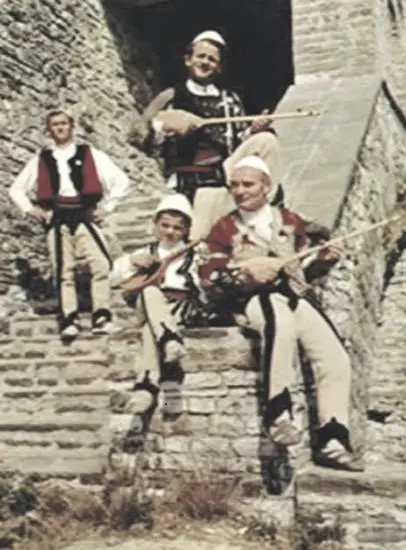
His çifteli began its journey in the 1950s, when for the first time, after his village, he played it in Durrës for the volunteers of one of the railways then under construction. It was 1958, when he stepped onto the folk stage of Pukë, where day by day he trained himself as an interpreter on five other musical instruments as well: the sharki (a type of lute), two kinds of whistles, the zumare (a double-reed wind instrument), and the flute – to one day become the creator and conductor of the largest folk music orchestra in the country. He did not use sheet music; his notes were written in his mind, just like the customary laws of the mountains. He was fortunate because the world had not yet emerged from the muse of folklore. In 1957, in Moscow, Tom Nikolla received a “Gold Medal” with a song, Gjin Shkoza a “Silver Medal”, while the meteoric brilliance of the çifteli, under a distinct name, would await France fifteen years later.
The 1960s institutionalised work with folklore, and he has many impressions from that time. “We were in Shkodër for a concert, staying at the ‘Sporti’ Hotel; I was playing the çifteli in the lounge, and many Shkodra citizens would gather and listen.” He saw that his çifteli was resounding in places that had long been the blessed land of the piano. Ndue has played the flute both in the highlands of his birthplace and on the Champs-Élysées in Paris in the 1980s. Our ambassador at the time was Misto Treska. “Arriving with a flute, I amazed France; that had never happened before,” says the master, who made the flute himself from chestnut wood. “This instrument was unknown there, which is why I say that even today we should not leave folklore behind, for it is one of the distinguishing elements of the nation, just like the language.”
And he continues to recall episodes: “Because of that flute, they called me together with my son, Mark, to go to an ensemble in Switzerland. It was 1996. After we played the flute there, a 90-year-old female professor stood up and said: ‘I have been to all corners of the world, but nowhere have I heard such a melody!’ In that melodic piece, I imitated the shepherd, while Mark imitated the birds of the forest. And that amazed the elderly musicologist and the Swiss public. A year later, the Swiss ambassador, during an event in Pukë, told me: ‘There is no Japanese flute that surpasses this whistle,’ asking me to make him a flute as well, and he invited me to his homeland, from which local mayors who came with the artistic group also benefited.” He believes that in the Louvre there is a portrait of him, perhaps made by some painter… in Dijon in the 1970s. Why not? Are there no other “kings” of world art like him there as well?
The “Golden Necklace” in Dijon, France – the peak of the brilliance of Albanian folk music!
He recounts that great event without pause, as if it happened yesterday – an unforgettable week, 30 August – 4 September 1970, in Dijon, France. “From that day I remember many things. It was the happiest day for me, and also for my nation. I had the artistic maturity of an instrumentalist and was at the peak of my youth. An Albanian has a distinctive artistic pride: either to do the best, or, in my case, to break the çifteli. And I succeeded. I had the artistic ambition, as well as the desire to honour Albania. Our programme was cut to 15 minutes, only four numbers: two folk dances by Besim Zekthi, a song by Ibrahim Tukiçi, and my melody on the çifteli. After the programme was shortened, I entered the stage with great anger, because they told me to shorten my part as well. I played it quickly and thus shortened it…!”
He was amazed to see that the entire scene was under the power of his sounds. He had won the artistic battle in the world metropolis of culture. How many times had he said with modesty and reverence that he would never have achieved that success if the çiftelia made by Gjin Shkoza had not been in his hands. “I would not have achieved it without Gjin’s çiftelia. There was no better çiftelia than that. The chairman of the festival jury stood up from where he was and said: ‘You take first place in the world’”!
And yet he remembers that the French examined the çiftelia with great interest, but also with observation, as if it had a heart inside, which tuned those magical melodies of its own. But they found no mechanism in its body; it was as light as a feather, without anything foreign inside. Renowned instrumentalists, laureates from the best in the world, gathered around him, of the Greek bouzouki, the Egyptian nightingale, Spanish folk instruments, etc. It was no joke; the Albanian virtuoso had received the “Golden Necklace” of the Dijon festival, which, for the curiosity of the reader, weighed 3 kg and 860 grams. He brought it to his country as a rare artistic trophy. It was still early, but other Albanian news from France would not be delayed. The writer Ismail Kadare was getting ready to knock with his literature, just two years later. The French would surely be amazed at how this people had overcome so quickly, from traditional folk, to the modern novels of an author nominated for more than 20 years, for the ‘Nobel’ Prize.
The creator of the folk orchestra, with 104 instrumentalists
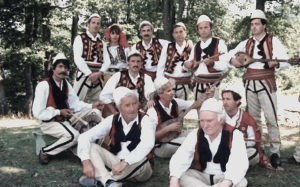
Ndue Shyti did not keep the couplet to himself. It was an unprecedented leap, from a traditional monophonic çifteli player, since this instrument was invented, to a “company” of çifteli players, barely occupying the stage. This showed the power that this instrument could have in the conduct of a master like him, who some call not only of Albanian, but also world-class proportions. And we really don’t know of a çifteli player like him anywhere in the Balkans. We reached our peak as an orchestra at a concert in 1979, where the number of players set a record of 104, 6 of them women. “Enver Hoxha asked me; how could you have put together such an orchestra? The Minister of Education, Thoma Deliana, intervened and said: ‘Ndoi did it himself, on his own initiative, without any support”!
He says that Mirdita, the art of musical instruments, was poor, they could barely make a fyll and a çifteli together, let alone an orchestra with 13 folk instruments. In his orchestra, the following were used: çifteli, fiddle, whistle, sharkia, lahuta, zumarja with two pipes, bagpipes, gjethja, drum, accordion, guitar, tempered çiftelita, etc. The path of this artist was not easy, he, by social status, was simply a sawmill worker in the beginning, then an instrumentalist in the palace of culture in Puka, for 28 years.
He says that there was no preference from the leaders of the State Ensemble, to take him with them, but as a master of the çifteli that he was, he made his own place in performances abroad.He gave a concert and played instrumental pieces, not only in front of the audience of the country’s leadership in Tirana, receiving several congratulations from the country’s leader himself, but also before Mao Zedong in Beijing, in 1966. At the end of the concert, Chairman Mao shook hands with the Albanian artists, but our rhapsody did not immediately distinguish him among those five or six leading men in the box, all dressed in the costumes of the Chinese working people!
Albanian folk music is authentic in melody, instruments, and interpretation
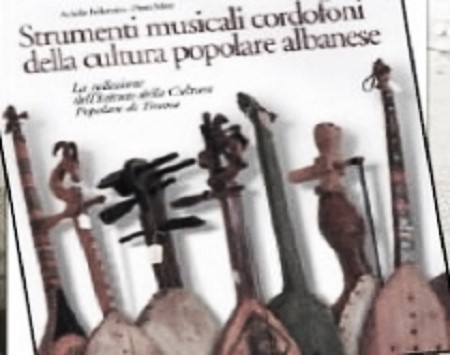
Ndue became the master of the çifteli. He says that he spent six months near the workshop of the well-known craftsman of çifteli making, Mark Zef Përshefa, in Bisakë (Fan i Vogël) in Mirdita, as if to say he was there to apply the musical “notes” to them. The entire “clan” of Përshefa was çifteli makers, a tradition that continues to this day. The çifteli has its bowl and pegs made of mulberry wood, the soundboard of fir, the tailpiece of beech, and the “bridge” on which the brass strings rest. The insignia “M. Z. Përshefa” on the çifteli masterfully carved by their craftsman not only adorned the Albanian folk stages in Gjirokastër and everywhere else, but also travelled abroad as a gift. In the 1980s in Shkodër, Kosovo students who had managed to come to visit the Higher Pedagogical Institute would first ask for the çifteli of patriotic songs at the “Pazar”.
Ndue insists on the miracle of the çifteli, the flute, the zumare, constantly providing examples. “Look, after the 1990s, the ‘Puka’ ensemble took first place in Europe, with instruments made by our own hands, with melodies from our regions, with our authentic Albanian interpretation.” It is no wonder that throughout the conversation, he has so many stops in Europe where Albanian folk music has set foot, and he as a distinguished voice of it. It happened that one of his çifteli strings broke in 1974 in Turkey, but the melody did not break. “The main string broke, but I carried the melody to the end with the other string,” recalls Ndue.
It was not the strings and mulberry wood that created the sounds, but his fingers – the “strings” of his soul. Dritan Haxhia, the son of his friend and colleague, the well-known rhapsodist Frrok Haxhia, writes: “This heritage of interpretation and sound has raised Ndue Shyti, for many years now, to the heights where only eagles climb. So, he is an ‘eagle’ who sees everything from above. The very sound of his instruments is divine, original, melted with nature, bringing you a breath from the highlands of Mirdita, where this great, original, ‘self-taught’ artist would bring us every time he touched the strings of the çifteli, or the flute? And the whistle, the zumare and the leaf”!
We ask Ndue about the concept he has of the rhapsodist. “A genuine rhapsodist,” he says, “is one who creates, accompanies himself with a musical instrument, and sings the song. But also one who performs only one of the functions – either creates the song (lyrics and melody), or only sings it. I am called an instrumentalist, but I can also be called a rhapsodist, because I create folk melodies with the çifteli, whistle, etc. I have created 13 instrumental pieces and several songs.” We also ask him about the region he comes from, and he says: “For me, the greatest thing that Mirdita had was that when one person spoke, everyone else listened. Not only Mirdita, but all of Albania had this custom. But now things are no longer as they once were; you are surprised when a son interrupts his father, a younger brother his elder brother, a friend his friend, and so on.”
You sit and listen to this master in his house, now in his time of memories, and you say to yourself: perhaps the Gjirokastër Festival would have been better off if it had been held not as a competition between districts, but between ensembles of regions, because taking as an example the musical culture of Mirdita, it was divided among several musical ensembles – of Mirdita, Pukë, Shkodër, Lezhë, Burrel, Kurbin, etc. It should have been represented by only one genuine folk unit, as should Luma, Malësia e Madhe, the Plain of Dukagjin, Elbasan, Korça, Dibra, Myzeqe, Labëria, Chameria, Dropull, and every other ethnological region, whether more or less numerous than the 26 administrative districts of that time! Memorie.al