
By Luan Rama
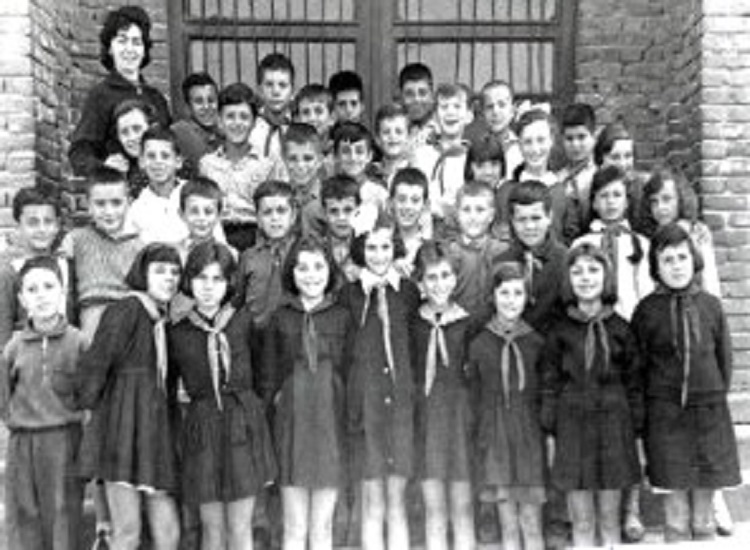
Memorie.al / Some time ago, my old friend, Dr. Arben Kavaja, showed me a photograph of our elementary school class at the “10 Korriku” school in Tirana, right in the center of the capital, signed 1963 – a school where I had the opportunity to see and recognize once again a good portion of the students I studied with, and where even today I can still hear the bell that used to call us into the classrooms. The apartment building where I lived was on “Stalin” Boulevard, and it took me about two hundred meters to walk to school every morning. My sister, Iliriana, had also attended elementary school there, followed by my brother and, much later, my two daughters. It is a school deeply ingrained in our memories, with its large yard, trees, low school wall, red-brick walls, and classrooms filled with our voices.
Looking at this photograph again, my eyes first rest on the image of our homeroom teacher, Vlefta Paparisto, whom we all adored. She was beautiful and noble, yet gentle in her demeanour. Opposite her stands the inner iron gate of the school.
In the front row, I recognize Jorgo Fështi, and right next to him, Pranvera Qirjako, who also lived on the boulevard above the MAPO store; next is Sheqeri…; Merita Demiri, Engjëllushe Zyberi; above her, in the second row, Lumturia (we never saw her parents, as they were assigned to an embassy and at that time diplomats were not allowed to take their children with them – Lad Bandilli and I were in love with her in our own childish way, seeing her as a future wife for both of us); next is Astrit Alimehmeti (Guga, as we called him), Rruzhdi Topulli, from the family of Çerçiz Topulli; Vladimir Tartari, Arben Kavaja, Ilir Balliu.
Above them am I, further along Edi Dhimitri, Andon Nano (half of my heart)… In the third row on the right is Ilir Shehu, Aida Dobi, and further to the left, Pirro Nini and Arben Bakllamaja, and behind him, in the middle, Nexhat Pasholli, who, like me, collected stamps…!
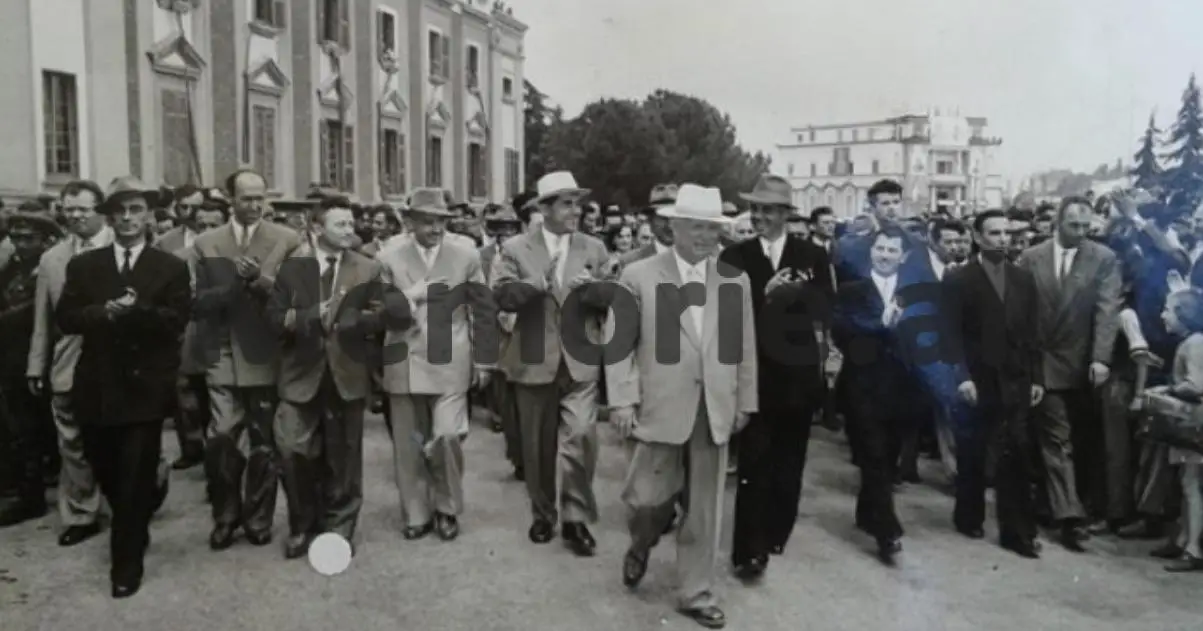
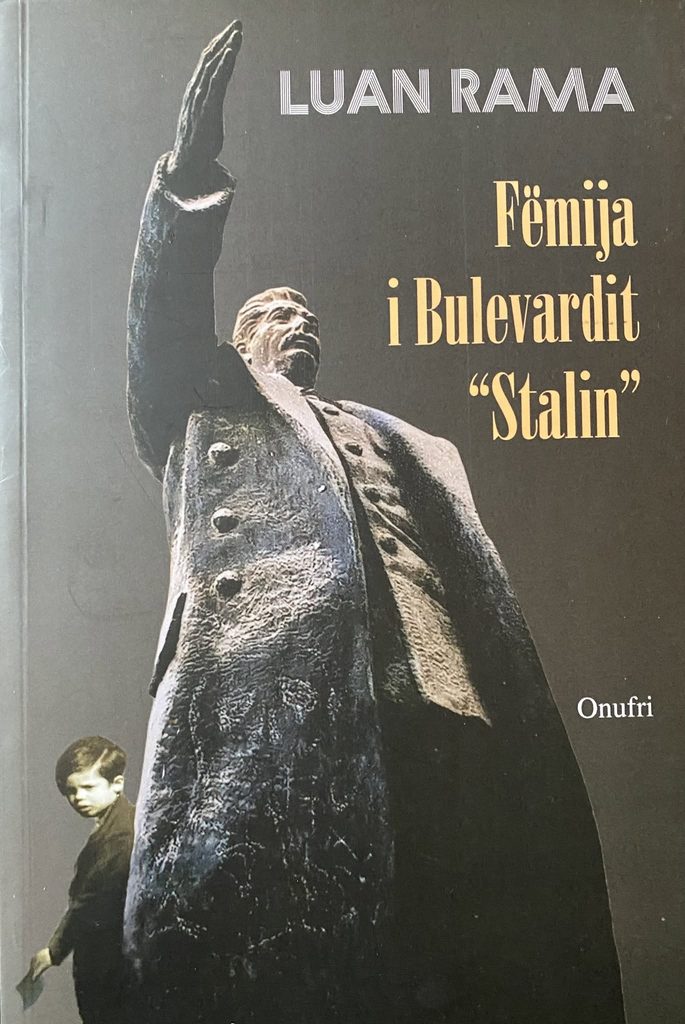
Many of them were the children of “Stalin” Boulevard – a boulevard that inspired me to write my childhood memoir, The Child of “Stalin” Boulevard, a boulevard connected to the city square 100 meters away, where major historical and official events took place, such as the oath taken when Stalin died, Khrushchev’s visit and rally, the arrival of Zhou Enlai and his rally, and many other events of the totalitarian era. I have forgotten some names, and naturally I couldn’t remember everyone, but that school now appears to me like a dream.
Here is an excerpt from my book, The Child of “Stalin” Boulevard:
When I was a child, I used to dream a lot. Perhaps this was because, when I was very little, they used to give me hashish in the form of tea – something that seems astonishing and absurd to us today. In truth, I was a baby who cried a lot, so a friend of my mother’s suggested giving me hashish tea to soothe me and that is what they did. Before I went to sleep, they would give me the hashish tea. Indeed, I calmed down and became much more peaceful.
However, as the years went by, I began to have many dreams. Almost every night. Eventually, I realized I had turned into a sort of sleepwalker. One night, near dawn, I got out of bed, walked out the door, and went down to the courtyard, where I sat alone on a bench. Then I went back upstairs. When I came in, my mother heard the door. She got up and saw me slipping back into bed.
“Where were you?” she asked, worried.
“I went outside,” I told her, and then turned over onto my side in bed.
When I started first grade, my mother bought me a beautiful schoolbag. I felt so grown up, and the school, my new classmates, and the teacher were a whole new world to me. A few months passed, and one morning, I was found sleeping in front of the locked doors of the school.
What had happened? In fact, around midnight I had gotten up, dressed in my school clothes – a black smock with a white collar – taken my bag, which I had prepared beforehand, and set off like that, and sleepwalking, toward the school.
I had walked down the stairs, crossed the quiet, empty boulevard to the other side, and taken the winding alleyway that led straight to the “10 Korriku” school – named as such to commemorate the formation date of the National Liberation Army on July 10, 1943. And so, still asleep, I had walked up the school steps, sat down in front of the locked door, and fallen asleep.
Still sleeping, I was found by the school janitor, who was the first to arrive to open the doors and do the morning cleaning. Naturally, she was astonished to see a child dressed for school sleeping there at the break of dawn. Who on earth had brought him? What did this mean?
This was an unusual incident and my parents were worried, but to me, it felt as though nothing extraordinary had happened. In fact, I would have other small episodes like this later on, and this sleepwalking condition only stopped as I grew older and went to high school.
The “10 Korriku” school was built of red bricks. Its façade was unplastered, with the bricks left exposed as decoration. It had a sort of tiled roof shelter, a large courtyard, and spacious classrooms with high ceilings.
That was where I spent my first years of elementary school. I always fondly remember my teacher with the beautiful name Kornelia, who had graduated from the “Nëna Mbretëreshë” (Queen Mother) school before the war. She was the mother of the painter Edison Gjergo. She was remarkably patient and affectionate toward me. She loved me very much. I even remember her house, located near the turn toward the Gastronomi and Hotel “Internacional”. In truth, that was a time when I had become quite a rascal, constantly up to mischief.
Ladi, a friend from my apartment building who was in the same class as me, and I were both in love with the same girl from our class named Lumturi. She was a quiet girl with long, loose chestnut hair. She seemed introverted, and her parents were not in Albania because they served in a diplomatic mission abroad. But she looked at us with a bit of fear and kept her distance, which is why, when I remember her now, she seems like Alice in Wonderland to me.
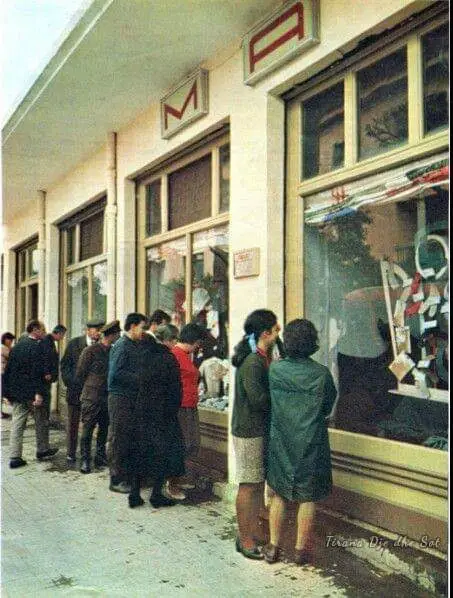
Nevertheless, we were fond of her and would follow her around, teasing her. In fact, when school finished around 12:00, we would walk down the alleyway, and as soon as we reached the boulevard, right in front of us was the MAPO department store selling apparel and fabrics. Once, Ladi and I stopped in front of the display windows, where we saw a silk nightgown on display alongside a bra and women’s underwear. After admiring them for a few moments, I said to my friend:
“When we get married, I’m going to buy her this silk nightgown!”
To which he replied:
“And I’ll buy her the bra and underwear!”
We both laughed happily.
“But where will we put her in bed?”
“Right between us,” he answered. “Me, her, and you…”
And so, filled with joy, we walked away, without realizing that this was an overactive fantasy drawn from the world of adults.
Just like Lumturia, other children also had parents serving in Albanian embassies abroad. In those days, diplomats were forbidden from taking their children with them – a madness in itself that caused psychological distress due to the prolonged absence of parents, which lasted for four or five years.
Near the school, at the corner of the alley, stood a two-story building – a villa of sorts built, by the look of it, in the late 1930s – which the state had confiscated from its owners and turned into a dormitory for these children living without their parents, cared for by state-assigned guardians. I remember that in my class back then, we also had Kastriot, the son of Ambassador Lik Seiti.
At that time, it was customary to ask children: “What do you want to be when you grow up?” It was a question always being asked, and naturally, parents would talk to them about the professions they envisioned for them.
Yes, I remember. It is strange, but back then, whenever people asked me, I would answer: “An assembler!” (Montator). Perhaps because I used to climb onto the roofs of the apartment buildings and enjoyed being high up. In those days, along the streets and squares, you would see large banners depicting steel assemblers working on construction scaffolding. It was the era of building plants and factories.
Even the word “assembler” felt grand to me, perhaps because those workers were always up in the heights of the smokestacks, appearing to me like celestial beings. Downstairs from our apartment lived the Gjermeni family. They had a son, Edmond, who grew up to become a doctor. One day, when his father came upstairs to visit us, he asked me:
“What are you going to be when you grow up?”
And I immediately replied:
“An assembler!”
Everyone laughed. But soon enough, that dream faded away.
During school days, around half past ten, we had our recess break. Bursting with shouts, we would pour out to play in the courtyard, which hummed with our voices. Street vendors would gather near the gate: sometimes an ice cream seller with cones, sometimes a vendor selling apples coated in a bright red sugary glaze – which we called “red apples” – mounted on a wooden stick to hold in your hand.
From time to time, the halva vendor would appear with a two-wheeled cart, selling gurabije (sweet biscuits), as well as cut pieces of hard, very sweet, dark-brown halva. He also sold colorful candy canes, which we loved, though you needed strong teeth to eat them.
These were classic products made by local artisans that would later disappear once all private enterprise was banned. On Saturdays and Sundays when we had no school, we would go out into the courtyard holding a slice of bread sprinkled with sugar and a few drops of water so the sugar wouldn’t fall off, or very rarely, with olive oil instead.
What truly delighted us was “paparja” – the poor man’s bread soup made from stale leftover bread, hot water, salt, and sometimes cheese. It was a simple dish that warmed our bellies. That was why it was called “papare”, because it cost nothing – literally, “without money” (pa pare). Often during the winter, my feet were constantly wet, as I ruined my shoes very quickly.
Our parents would buy them a size too big so they would last another year, but with the way we played, within six months they were completely destroyed and our feet were always soaked – shoes with wide open gaps that I would later recognize in the stories of Migjeni…! / Memorie.al