By Besartë Elshani
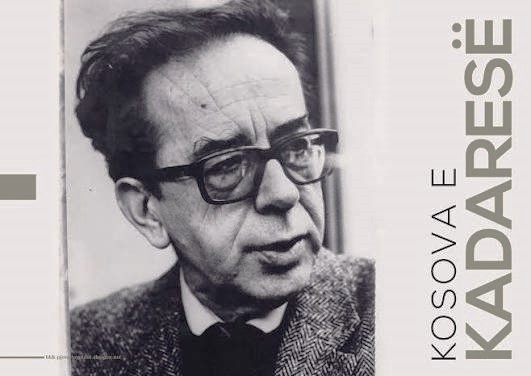
Memorie.al / A part of the writer’s personal fonds, rare letters, manuscripts, publications, and objects that testify to his connection with Kosovo, have been brought together in the exhibition “Kosovo of Kadare,” opened at the National Library of Kosovo. From the poem “Kosovo,” written above the sky of Kosovo, to the cry of the students suppressed in the 1981 demonstrations, and to the tragedy of the war, Kosovo became one of the themes that accompanied the creativity and intellectual engagement of the world-famous Albanian writer. He saw Kosovo from the sky, but for a long time could not descend into it. The political border of the time had denied him this meeting. The longing for it, Ismail Kadare transformed into verses, while it’s history into literature, essays, articles, interviews, and letters that he would address to international personalities and institutions.
From the poem “Kosovo,” written above the sky of Kosovo, to the cry of the students suppressed in the 1981 demonstrations, and to the tragedy of the war, Kosovo became one of the themes that accompanied the creativity and intellectual engagement of the world-famous Albanian writer. This entire connection of Kadare, perhaps the most intimate experience to date, has been exhibited in Pristina.
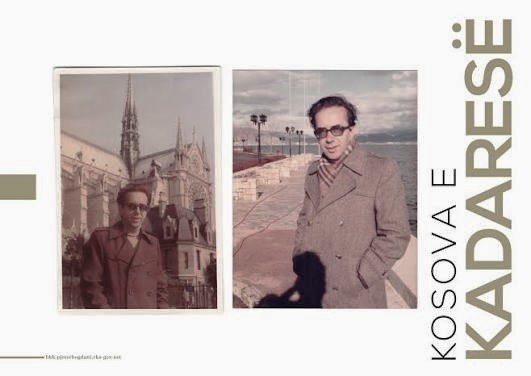
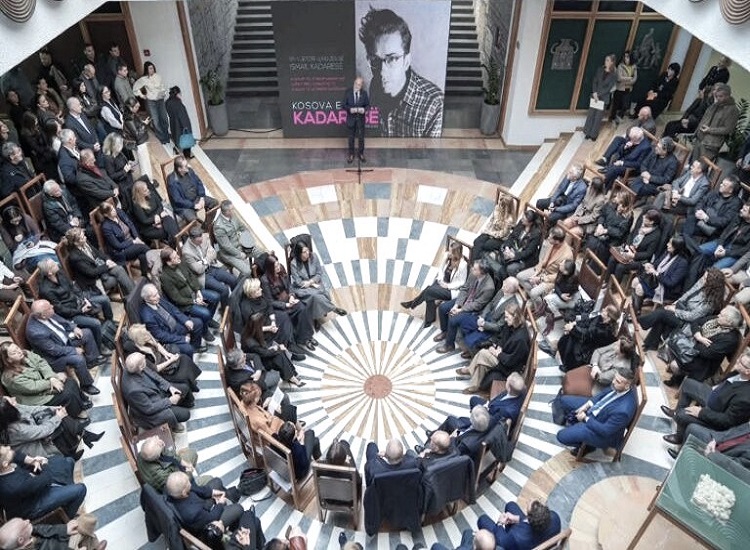
In the year when Ismail Kadare would have turned 90, the National Library of Kosovo has honored him with the exhibition “Kosovo of Kadare.” On Friday, a part of the writer’s personal fonds, rare letters, manuscripts, publications, and objects that testify to his connection with Kosovo were exhibited there.
“In 1966, a young Albanian poet was flying over Kosovo. The border of that time did not allow him to descend. He met Kosovo then only from the sky. And he wrote: ‘Whenever I have passed over your sky, Kosovo, among your heavy clouds…’! That poet was my father. Thus began his connection with Kosovo, from a distance, like a longing that had nowhere to land,” said the writer’s daughter, Besiana Kadare.
“Kadare wrote to Kosovo in verses, then in a novel, then through letters addressed to presidents and international institutions, through articles in the world press, interviews, questions sent beyond the iron bars of a prison and, finally, in a diary,” she said. Kosovo would enter his literature also through the events that shook Albanian society in the ’80s.
In the autumn of 1980, when “Rilindja” published Kadare’s works in ten volumes, he came to Pristina. “Pristina received him as its son. The spring that followed was cold. The students of Kosovo took to the streets and were brutally suppressed. He wrote ‘The Wedding Procession Turned to Ice’ (Krushqit janë të ngrirë). The book was also published in French and English, and the cry of those students thus crossed the borders that aimed to stifle it,” said the heir of Ismail Kadare.
These traces have become part of the exhibition, which has brought protest letters addressed to heads of state and high-ranking world officials, including letters on the Kosovo issue, as well as documents related to Pope John Paul II, alongside other materials of diplomacy and the press of the time.
Among them is the letter Kadare had sent to academician Rexhep Qosja regarding the Rambouillet Conference, as well as protest letters for the imprisonment of professor and intellectual Ukshin Hoti. The collection also includes publications of Kadare’s works by the “Rilindja” publishing house from 1980, the press of the time in Kosovo, manuscripts, and books he had received as gifts from Kosovo’s creators.
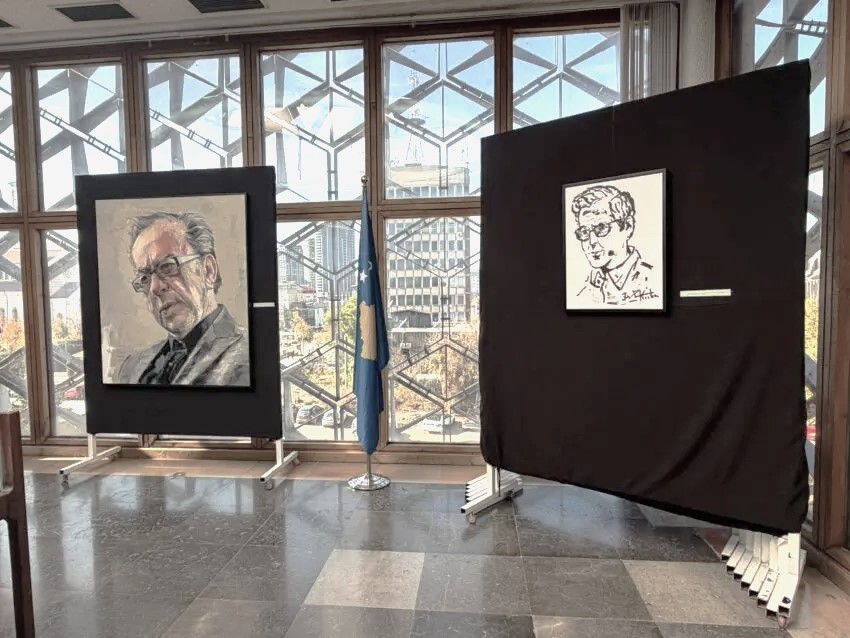
Among them are publications by Flora Brovina, Ali Podrimja, and Rexhep Ismajli, which had taken their place in the writer’s personal library. His portraits are another part of the exhibition, including an original work by Ibrahim Kodra, preserved in the fonds of Kadare’s publisher, Bujar Hudhri.
The director of the “Shtëpia Studio Kadare” museum, Anisa Ymeri, said that preparations for the exhibition had begun more than a year ago, when the museum team in Tirana had started researching the fonds for activities that would mark the 90th anniversary of the writer’s birth. “We had no dilemma that one of the fundamental activities of this year should be held here, in Pristina.
While searching the museum’s fonds and discovering letters, signatures, notes, newspaper articles every day, we had started intensive work for this event that has brought us together today, there was no doubt that the title should be ‘Kosovo of Kadare,’ because Kadare and Kosovo seem to have never had a border, even when he saw it from afar,” said Ymeri.
She explained that publications and books signed by Kosovo’s creators had continuously arrived at the writer’s house in Tirana, which had a special place in his library and are still preserved untouched. Ymeri emphasized that the documents collected from the museum’s fonds, Albanian diplomacy, and the National Library of Kosovo testify to Kadare’s continuous engagement in the defense of Kosovo. The protest letters addressed to heads of state and high officials, according to her, are historical evidence of a mission that the writer had taken upon himself beyond literary creativity. For the director of the National Library of Kosovo, Blerina Rogova-Gaxha, the documents related to Kosovo constitute one of the most significant parts of the exhibition.
“Beyond their historical value, each document reminds us of the power that the public word carries, especially when history places man before great moral choices. For the National Library of Kosovo, the realization of this exhibition, in cooperation with the Embassy of the Republic of Albania in Kosovo, ‘Shtëpia Studio Kadare,’ and the National Library of Albania, is an act of documentation and our effort to preserve cultural memory,” said Rogova-Gaxha.
According to her, besides preserving cultural memory, the exhibition aims to offer new generations the traces of one of the most important creators of Albanian literature.
“The exhibition aims to offer the public the opportunity to see Kadare through documents, to know him through the traces of his hand, to discover what the documents preserve, and to reflect on the meaning that time gives them,” she said. For the Ambassador of Albania in Kosovo, Petrit Malaj, Kadare belongs to that rare category of creators who have managed to transcend time and the borders of their country.
“Through the power of the word, he made the Albanian language part of great world literature and the historical experience of Albanians part of universal memory. He gave our Albanian literature an extraordinary international representation and echo, while remaining at the same time always connected to our roots, identity, and history,” said Malaj. He stated that Kosovo had a special place with Kadare.
“For Kadare, it was not a distant reality or simply a literary theme. It was part of his historical conscience and his intellectual responsibility. In his creativity and public engagements, Kosovo was present as a matter of dignity, freedom, and identity. He was among the voices that helped convey the truth of Kosovo beyond its borders, proving that the freedom and dignity of a people can never be separated from each other,” said Ambassador Malaj.
The Deputy Minister of Culture, Nora Arapi-Krasniqi, said that for Kosovo, Kadare was more than a great writer, as he had put his authority and international fame in the function of the country’s liberation and the denunciation of discriminatory and cleansing policies against Albanians of the former Yugoslavia. “Kadare did not separate the Kosovo issue from his intellectual engagement.
He defended the right of the people of Kosovo to freedom and used his authority as a writer to make this issue heard even beyond the Albanian space. The exhibition we are opening today brings letters, photographs, manuscripts, publications, and objects from the writer’s personal fonds, as well as from the fonds of the National Library of Kosovo and the National Library of Albania,” she said.
But, beyond the documents that testify to Kadare’s political and intellectual engagement, the exhibition also features memories of his meetings with Kosovo. One of them is the first Book Fair in Pristina, held in November 1999, in Kosovo just emerging from the war. His publisher, Bujar Hudhri, remembered that event as one of the most special moments of his professional life.
“In 1999, the first Book Fair in Kosovo was held. It was night, Mrs. Helena and Gresa accompanied him. The next day, the book promotion took place. I remember that thousands of readers came to our stand, I have never seen a more beautiful event. Their faces shone with love for Kadare. Professor Qosja spoke there and said: ‘I have written two thousand pages for Kosovo, but these two hundred are more important,'” recalled Hudhri.
On this same visit, “Koha Ditore” quoted Kadare in its headline. “Kadare: The Albanian book is one, just as Albanian culture is one,” wrote “KOHA Ditore” in the issue dated November 19, 1999. A day earlier, the Fair had opened. That year, Kadare had promoted his work “Ra ky mort e u pamë” (The Dead Was Seen), which coincided with his visit to Kosovo just emerging from the war. “Kadare for the Kosovo of the backwards year” was another article in the same issue describing the promotion event.
For academician Mehmet Kraja, the issue of Kadare’s affiliation should not be confused with the claims of politics. “To whom does Kadare belong? To states, powers, politics, or literature? This question I just posed cannot be a dilemma, but, for the moment, there are many voices from the field of politics and powers who want, in one way or another, to claim that they have a share in Kadare. But, if we insist that Kadare belongs only to literature, little by little the audiences will be left without a part of the public. Because someone might think that they loved Kadare, that he was needed, and that they had him as necessary for a time. So, they use him to exercise power and politics,” said Kraja at the opening of his speech that preceded the opening of the exhibition, which will stay at the National Library of Kosovo until November 15.
He also recalled his acquaintance with Kadare, which had begun in 1980, when as a culture journalist at the “Rilindja” newspaper he had received the task of conducting a written interview with the writer. They had started the conversation in Pristina and finished it in Tirana, in December of that year, during a visit by a group of writers from Kosovo. The first meeting at the 1999 Fair would not be the last. Kadare returned to Kosovo in June 2023, as a special guest of the 23rd edition of the Book Fair in Pristina.
This would be his last visit to the country. Earlier, in 2009, he was honored with the “Rexhai Surroi” award for literature, for the novel “The Wrong Dinner” (Darka e gabuar), while in 2017 he received the international award “Albanian Literature,” which he had described as one of the evaluations that had given him the most pleasure. “I am happy when I think that I am receiving this award here at the Library of Kosovo,” he had said in April 2017.
Ismail Kadare passed away on July 1, 2024, at the age of 88. Born on January 28, 1936, in Gjirokastër, he left behind a body of work that made Albanian literature heard in more than 40 languages of the world. But, in Pristina, the memory of him is not limited to the books that bear his name, nor to the photographs of meetings he had with readers.
It is also preserved in the letters he sent to Kosovo, in the books he received as gifts from its creators, and in the lines where he turned the pain of a people into literary testimony. The exhibition “Kosovo of Kadare” brings these traces together in one place, making tangible the relationship with Kosovo that, although it began from a distance, was never interrupted. / Memorie.al