By XHEVAT LLOSHI
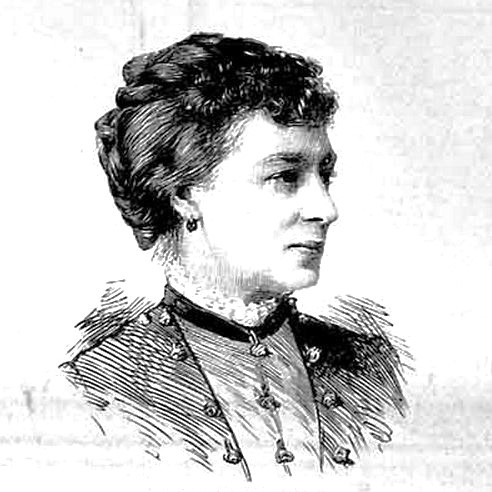
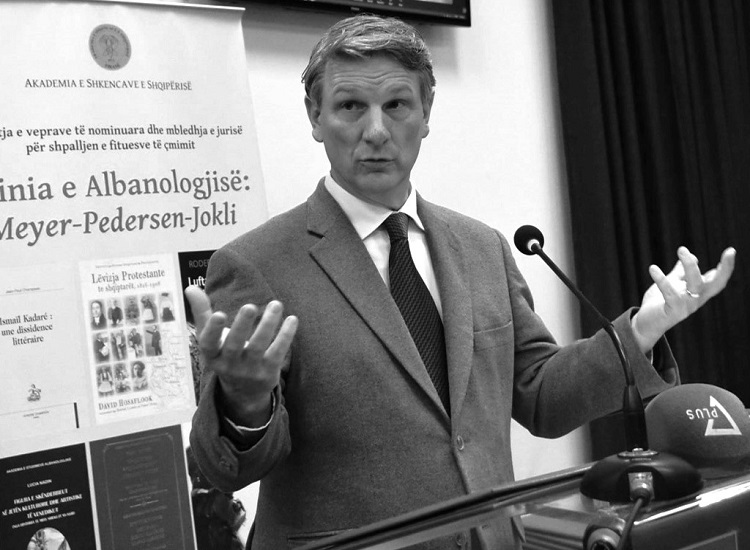
Memorie.al – From a notice by the researcher David Hosaflook, the translator into English of “The Siege of Shkodra,” I learned that in 1864 a book was published in London under the title *The Eastern Shores of the Adriatic in 1863*. Due to this title, which does not mention the name of Albania, this work has not been mentioned to this day by Albanologists, or in bibliographies concerning Albanians. The origin of the book lies in a typically English occurrence. Miss Emily Anne Beaufort Smythe published in 1862 two volumes describing the burial sites of Egypt and the sanctuaries of Syria during the time of the Ottoman Empire, accompanied by her own sketches.
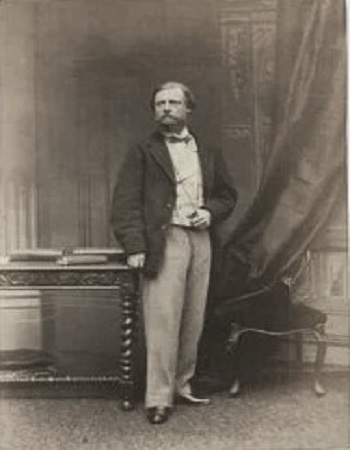
Mr. Percy was the eighth Viscount Strangford (1826–1861), a philologist and ethnologist who knew several Oriental languages, and who had been appointed attaché in Istanbul as early as 1845. He would later become the chairman of the Royal Asiatic Society of England. He read Emily’s book and wrote a review in the London press, in which, with characteristic English humor, he criticized the book considerably.
After this, they met and decided… to get married. Strangford wished to have a description of the southwestern side of the Balkans presented, and he told Emily that he trusted only her to give a fair portrayal.
Thus, now the Viscountess Strangford undertook, in 1863, a journey along the eastern shores of the Adriatic and, with the help and supplements of her husband, completed the book, which was published a year later. The Viscount himself also made a trip to Albania in 1863, which is why he wrote the last three chapters of his wife’s work. The book has 386 pages.
At the beginning of May 1863, Emily arrived in Corfu, and on June 1, a group of three English men and three English women, along with a cook and two servants, set out for Ioannina, which throughout the book she calls the capital of southern Albania. In Sarandë, only a few ruins remained of the former Venetian castle.
In Delvinë they lodged at the house of the mudir (local governor), then took the road to Ioannina, recalling the verses of Byron and the monastery of Zitsa, which could not even be compared to the beauties of the surroundings of Delvinë and Romatani.
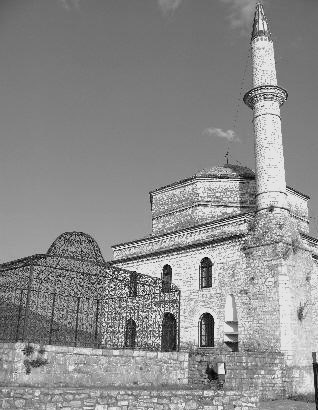
Ioannina appeared to them from afar as a white marble city. There they visited the castle, the tomb of Ali Pasha’s body, and at the foot of the hill of St. George they remembered Bohemond, who there in 1082 had broken Emperor Alexios I Komnenos.
In the bazaar, they were attracted by the quilts with gold thread, which were the finest anywhere, but the city had become so impoverished that peasants now went all the way to Vlorë to buy clothing. The silverwork was also of good quality, reminiscent of the shops that still exist today in Ioannina.
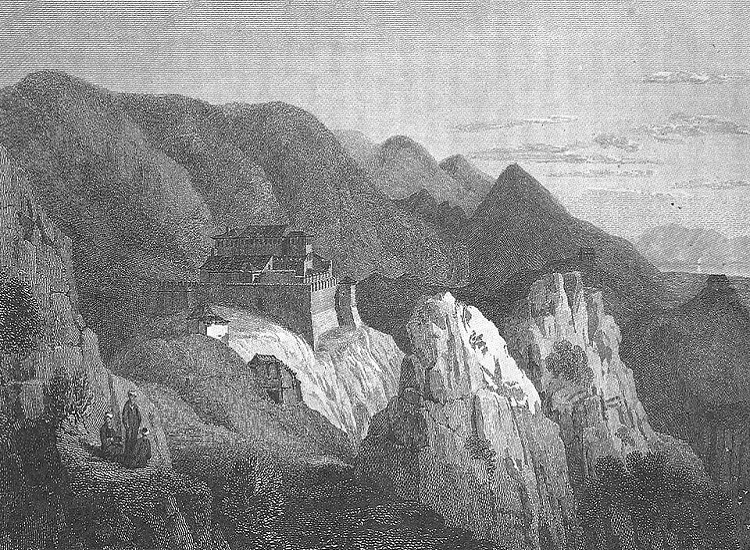
On the island of Ioannina, they found 7 monasteries, but without a single monk. They entered the Monastery of Panteleimon and went up to the room full of bullet holes in the floor, where Ali Pasha was killed and Vasilikia was seized, who was in the adjacent room. She remained two years in Istanbul was allowed to go to Patras, and there she died in misery in 1855.
“The Albanians are a distinct people, not merely a tribe, but a nation in them,” she writes. “Under the general name of Albanians, they are divided in the north into Ghegs and in the south into Tosks. The majority of them became Muslims in the 15th century.”
The author quotes the words of the historian Finlay that their morals were not such that they would turn into greater wrongdoers by becoming Muslims, and that they are less fanatical than the Turks, but also have fewer prejudices than the Greeks. But Emily calls the peasants lazy and ignorant, while among the townspeople she has also noted bright, intelligent faces.
From Ioannina, the group set out towards the mountains of Souli, of which she has given a romantic picture full of light. She particularly notes the peak of Tripa, from which the Souliotes threw themselves down in order not to be taken captive; the other peak was called the Mountain of Lightning, and in the center was Qafa, the peak on which Ali Pasha had built a large castle.
The Viscountess calls the Souliotes a Tosk tribe, a “seed,” that had transformed into a military caste, which also engaged in banditry. In 1792, they had become a kind of small republic, which fielded 1,500 fighters.
The author insists that the Souliotes were simply Albanians and not Greeks, and that the Orthodox Chams joined them. Ali Pasha destroyed them through cunning, by dividing them, and with attacks from time to time – events which she has summarized according to Martin-Licq and Finlay.
In Parga, she saw the most beautiful garments, with cheerful, light colors. She ends this section with 9 pieces of advice for those who want to go as tourists to the Albanian regions of the south, among which the seventh demands: “It is better to have with you a servant who speaks Albanian.”
(It would be interesting if these pieces of advice were reproduced today in tourist guides as a curiosity!) Furthermore, she has noted the game animals that can be hunted in Vlorë, Sarandë, Butrint, etc. – a list that is perhaps among the first regarding the fauna of Albania.
The second chapter of the book is devoted to the political complications concerning the possession of Corfu and the Ionian islands. In the third chapter, titled “Ragusa,” the journey through Dalmatia is described. On June 23, the group disembarked at Vlorë, and the next day, from there, they stopped in Durrës just for a stroll. But they found the city a miserable center, with many Turkish soldiers of terrifying appearance.
The next day they arrived at Tivar (Bar). This was a town with only 250 houses, with about 4,000 Albanian inhabitants, two-thirds of whom were Muslims. Here lay the dividing line between Turkey and Austria, and the group continued further towards Dalmatia. The fourth chapter is dedicated to Montenegro.
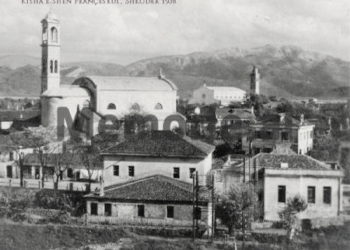
During the return journey, in order to leave Montenegro, the Viscountess came to Shkodër. She states that the city got its name from the hill of the castle, meaning it is “on [sh]kodër” (upon a stony place?) and adds: “If this derivation is correct, it is curious and valuable, because it shows that the modern Albanian language is capable of interpreting a name which dates back as early as the days of the Republic of Rome.”
This reminds her of an interpretation by the German historian J. Fallmerayer, according to whom the epithet for Achilles, “swift-footed,” in the language of Epirus was “aspete,” meaning “fast” (i shpejtë). The city had 4,500 houses, but they were surrounded by high walls, so that you could hardly see a window. The summer heat was scorching, which is why many Shkodër residents had a country house in Drisht. The Catholic inhabitants, about 12,000, did not have a single church, while the Orthodox had one small church and one school.
She calls the bridge over the Kir exceptional, “like a spider stretching from one bank to the other,” built in 1768. She has also mentioned Ulcinj, inhabited entirely by Albanian Muslims, with a fleet of over 200 ships, whereas once these seafaring pirates were the terror of Italy and the Adriatic.
Regarding the language, she observes: “In Shkodër, Albanian is spoken. It differs from the language spoken in southern Albania. In the mountainous regions, Albanian is spoken by Catholics and Serbian by Orthodox, while very few among the Muslims speak Turkish. Italian is spoken quite a bit in the cities, but not at all in the villages.”
The Muslim citizens wore the fustanella, just like the Albanians of the south. The silkworm was raised only in northern Albania, while she notes that the potato was not grown in Albania. Because of the heat, during that short stay she was not able to make any drawings. After a total of two weeks, she finally departed from the eastern shores of the Adriatic.
The Viscountess’s description lacked northern Albania. Therefore, the Viscount Strangford supplemented this with the following three chapters. According to him, only two Englishmen had visited the north of our country until then. One was the son of T. S. Hughes (who had been in Albania before 1814) and the other was Dunn Gardner, but they had not published travel notes.
The author was also familiar with the work of the Albanologist J. G. von Hahn, but thought that his book needed to be cleansed like the Augean stables. He presents the inhabitants of Shkrel as Muslims, who are said to have taken their name from Saint Kerli (St. Charles) and continued to take part in church festivities.
There is no doubt, the Viscount emphasizes, that Albanians have a distinct physical and mental nature, which expresses itself strongly and which is common to all of them, to a greater or lesser degree. They think of themselves and magnify themselves together as Albanians, in contrast to their neighbors; they all speak one language, or rather a group of unwritten dialects, full of borrowings. They have learned from experience that foreign rule is the greatest evil.
Under the rebellious or semi-independent rule of their own countrymen, they have been able to preserve their Albanian individuality intact. All these tribes are practically independent of Turkey and maintain their own privileges with arms in hand. But the lack of a cultivated language and literature, as well as of a single religion, prevented the consciousness of political unity and the achievement of a political structure.
The Albanian’s hostility to the Porte was old, but now the greedy and corrupt bureaucracy of Istanbul made it a mortal enemy of it. For the Viscount, the most notable fact in Turkey is the awakening of the subject nations and the increasing cultivation of their languages. In the notes at the end of the book, he has given in detail the war of the Souliotes according to Finlay. In the year of her husband’s death, the Viscountess published in two volumes the Viscount’s writings on political, geographical, and social matters.
She became involved in healthcare and devoted herself to aid for the victims of wars, even founding several hospitals and relief centers in various places. Her year of birth is not known, but she died in 1887. David Hosaflook has promised to compile a book with the Strangfords’ passages on Albanians, providing supplementary explanations and necessary notes. When the book in English is ready, it will be my duty to translate it into Albanian. / Memorie.al