By Dr. Nikoll Loka
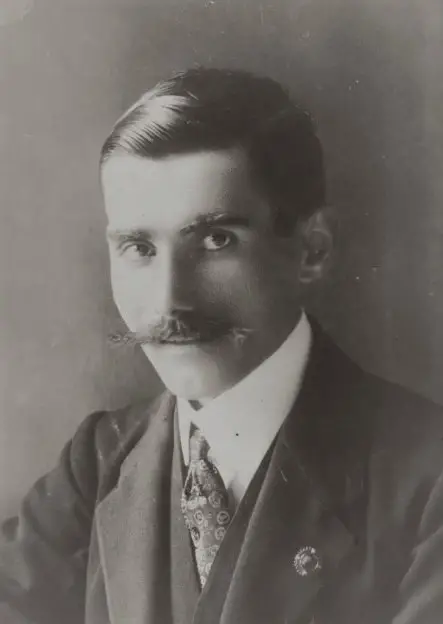
Memorie.al – Although Albanian nationalism recognized the attempt to replace every other religion with the religion of the nation, it has been noted that the movement for independence was not lacking in impetus from religious figures, one of whom was Monsignor Nikollë Kaçorri, from Lura – a region of model coexistence, the son of a Catholic father and a Muslim mother. Kaçorri prepared himself to serve his homeland wherever it was most needed, placing himself fully at the service of the national cause, according to the motto “Homeland and Faith,” which means that without being a good patriot, one cannot be a true religious person either. Kaçorri had completed the best schools of his time – the Urban College of Rome and two further years at the “Zeking” University in Zurich – and he mastered Italian, German, and French,” as his biographer, Dom Mark Dushi, writes.
Although he was one of the most learned Albanians of his era, he did not choose the salons of politics and diplomacy, nor the reclusive libraries, to serve his homeland as a Renaissance intellectual; rather, as a patriot, he engaged himself to serve wherever there was a need, even in the dimension of a Renaissance warrior who fights with both rifle and pen. Under his example and with a certain silent approval from the Holy See, the Catholic clerics of Albania became involved in the efforts for the National Renaissance of our nation. Not by chance, the cells of churches were transformed into Albanian schools and hearths where the Albanian book was found.
Dom Nikolla was not appointed to Durrës by chance – the city that had many educated intellectuals and was Albania’s gateway from the West. He quickly rose through the ecclesiastical career, becoming the deputy of the Archbishop, and he used his support to serve the people in the movement for national independence. The Church of St. Lucia, where he served, became the place where all patriots gathered without distinction of religion, where Albanian books were found, where instruction was conducted in the Albanian language, and where national propaganda was organized.
Nikollë Kaçorri found in Durrës a tradition of Albanian-language instruction, which he carried further forward. Next to the Catholic Church, during the period of Archbishop D’Ambrosio, a school run by the parish priest had already been functioning. At that time, teachers were scarce, so the teaching of the mother tongue became a matter of honor and a high patriotic duty for all those who could carry out this work. Regarding Kaçorri as a teacher, Stef Kaçulini writes in the magazine “Vegim Drite”: “At the beginning of his priestly service, Dom Nikollë Kaçorri performed the duty of a teacher at the Austro-Hungarian school in Durrës.” In 1898, Stefani was Kaçorri’s assistant at that school.
The cleric Kaçorri would also teach Albanian outside the school walls, in the civic premises of Durrës, among other patriots, because Albanian patriotism demanded educated people. One of the witnesses to this work, Ymer Deliallisi, asserts that “…I learned to write the Albanian language secretly from the itinerant teacher Murat Toptani and from Nikollë Kaçorri.”
The patriotic actions of the Durrës intellectuals were met by the authorities with the authorization of a large number of foreign schools. At the end of the 19th century, in Durrës there were two Turkish schools for Muslim students, two Greek schools for Orthodox students, one Italian school for Catholic students, one full school (rushdiye) in the Turkish language, and one religious school in the Arabic language. As if that were not enough, at the beginning of the 20th century, a Romanian school was opened, which closed within the year, and in 1901 two more Italian schools were added: one for boys and the other for girls.
In that situation, the spread of Albanian-language education was a survival effort for the patriotic movement. The Albanian school became the place where Albanians would unite regardless of religious differences, on the basis of a common language and blood; it became the place where people learned and fraternized. And so that this sacred mission could be realized more effectively, the patriots of Durrës, in 1907, established the illegal society “Vllaznia” (Brotherhood), with Dr. Neki Libohova as its chairman. As a mark of appreciation, the members elected Nikollë Kaçorri as honorary chairman.
In the notes of lawyer Hysen Myshketa, the names of the principal activists of the Society “Vllaznija” are given: Mufti Mytezim Këlliçi, lawyer Hasan Haxhiu, Jonuz Tartari, doctor Neki Libohova, Andrea Konomi, Jahja Ballhysa, Abaz Çelkupa, Hysen Halimi, Kristaq Rama, as well as the younger ones: Kasem Durrësi, Mustafa Kruja, Stefan Kaçulini, Mahmut Beshiri, Sul Kadiu, and from among the judges of Durrës – the Gjirokastrites: Mustafa Nuri Pipa, Ferit Cena, Ferid Nepravishta, Sami Kokalari, and Hysen Myshketa.
According to the memoirs of the patriot Abaz Çelkupa, “The Club carried out ‘normal’ activity under conditions of illegality in the Catholic church for about six months,” but after the Turkish gendarmerie had placed the church under surveillance, the society’s headquarters moved away from there and was set up in the house of the patriotic Kërtushë family. With the election of Mufti Mytezim Këlliçi as chairman of the society “Vllaznia,” the propaganda activity of the Muslim fanatics who declared: “Whoever uses Albanian letters ‘ruins his religion and faith and uses the language of damnation’ was somewhat curbed.”
Only people with patriotic spirits like Nikollë Kaçorri and Mytesim Këlliçi could unite in that period for such a heavily attacked, denigrated, and anathematized cause as the writing and reading of the Albanian language. This fruitful cooperation caused the influence of the Society to extend even into the villages. By using the Mufti’s authority, the Durrës patriots fought against the city’s Young Turk committee and managed to preserve the patriotic spirit among the majority of Durrës’s population.
Nikollë Kaçorri had collaborated with the Austrian consulates in Shkodër and Durrës for the procurement of Albanian books. The church was the place where the books could be kept, as the Ottoman authorities found it difficult to raid it. Through the Vatican postal service, the books came to the Archdiocese of Durrës and, through Dom Nikollë Kaçorri, were distributed by Kasem Durrësi and other patriots to Elbasan, Tirana, and Lushnjë. On the other hand, Kaçorri read the books aloud to people who could not read or write and distributed those books as far as the most remote areas, including his own Lura.
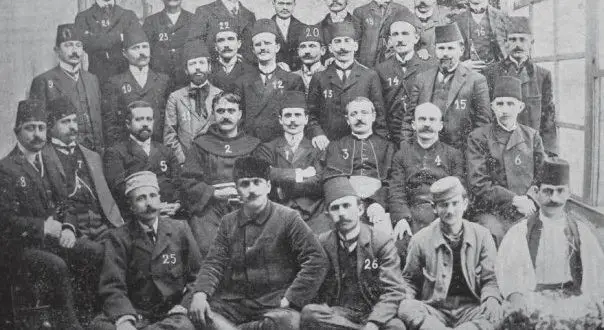
After the Young Turk revolution, the society “Vllaznia” moved into legal activity. Kaçorri connected with other patriots to coordinate their joint work. He was elected delegate of Durrës to the Congress of Manastir. From the autobiographical notes of Agustin Serreqi, we learn that the unanimous delegate elected by the group of Durrës patriots who adhered to the club “Vllaznia” was Nikollë Kaçorri. He was active during the proceedings of the Congress. In his speech, on the third day of the proceedings, Kaçorri gave a brief analysis of the alphabet issue, emphasizing the great loss that Albania had suffered until that time from the lack of a single alphabet and the importance of its determination.
Addressing the delegates, he stated: “We would adapt with the greatest courage to use that alphabet that would be determined…” As also emerges from two other discussions of his, he had concentrated all his efforts on securing unity in the Congress and bringing its proceedings to a successful conclusion. Kaçorri’s speeches had an impact on the participants, who were impressed by his high linguistic culture.
If we compare Kaçorri’s stances at the Bishops’ Conference of 1902 and at the Congress of Manastir, there appears to be a discrepancy in positions. In 1902, the Albanian Catholic prelates had gathered to designate, as a common alphabet, one of the two alphabets they themselves had drafted, and there Kaçorri publicly expressed his preference for the Istanbul alphabet, which, as is known, had nothing to do with either of the proposed alphabets. Whereas in Manastir, he showed no preference, declaring himself in favor of the solution that would be decided by all; that is, he no longer defended the Istanbul alphabet.
This change in stance is not related to personal preferences, but to the different circumstances in which the events unfolded. In Shkodër, Kaçorri, as a patriot, defended the Istanbul alphabet in order to preserve the cultural and spiritual ties among Albanians, and as a response to the ill-considered conduct of handling such a major issue as the alphabet within narrow intellectual circles. Faced with the impossibility of preventing the Albanian school, the Young Turks thought to prevent the use of the Latin alphabet, in order to keep Muslim Albanians culturally tied to the Turks, as well as to preserve cultural divisions among Albanians, in service of their chauvinistic policy and the doctrine of Ottomanism.
The insistence of the Young Turks at the Congress of Dibër on the alphabet issue was the last attempt they made to fuel division between Christian and Muslim Albanians. Although he was appointed a delegate to this Congress, together with the patriots Neki Libohova, the city physician, and Mytesim Këlliçi, the mufti of Durrës, they did not participate in its proceedings due to obstacles created by the Young Turk committee of Durrës. As a counter-response to the Young Turk efforts to hinder the cultural progress of Albanians, a few days after the Congress of Dibër, the society “Vllaznia” ceased to exist, and with its membership and others, the club “Bashkimi” (Unity) was established.
In the new club, there was a collective leadership. According to the memoirs mentioned above, it appears that in its presidency were Dom Nikollë Kaçorri, Dr. Neki Libohova, Abaz Çelkupa, Sotir Veveçka, and the treasurer Stefan Kaçulini. The newspaper “Bashkimi i Kombit” writes that the chairman of the club “Bashkimi” in Durrës was Jahja Ballhysa. Agustin Serreqi, in his memoirs, singles out two leading figures: Nikollë Kaçorri and Dr. Neki Libohova. There are reasons to think that Kaçorri did not formally assume the leadership of the club “Bashkimi,” as he had previously done with the society “Vllaznija.” This was done in order to attract to the National Movement even the wavering elements of the Muslim faith, who might view with suspicion a patriotic club led by a Catholic priest.
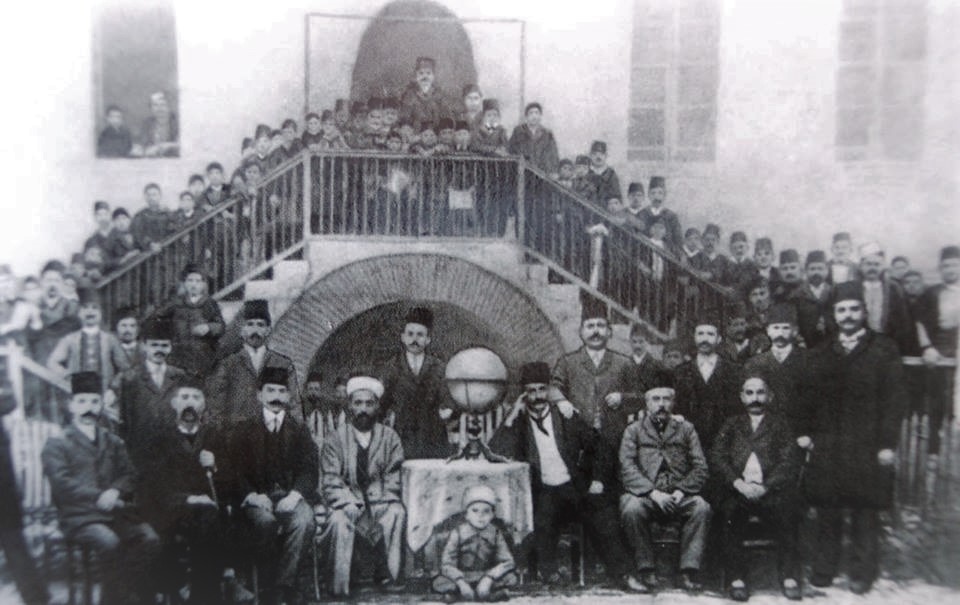
The founding of the club “Bashkimi” gave great momentum to the patriotic movement in Durrës. One of its first successes was the introduction of Albanian writing instruction in the Idadije school (the Turkish gymnasium of Durrës), whose teacher was the well-known patriot Sali Nivica from Kurvelesh, freshly graduated from the “Zosimea” school, as well as the opening of an Albanian school in Durrës that had 35 students. Alongside the day schools, night schools or courses were opened next to the club “Bashkimi” in Durrës to teach reading and writing, primarily to adults.
During an inspection visit to Durrës, the Vali of Shkodër, although without success, attempted to merge the Albanian club with the Young Turk one, with the aim of closing the club “Bashkimi” and the night courses in the Albanian language that functioned alongside it. Young Turk pressure often escalated to extreme actions, and the Albanian schools were opened and closed several times according to the prevailing situation.
The Congress of Dibër did not change the decision taken earlier by patriotic circles to convene a national congress in Elbasan, which would specifically examine the issue of the Albanian school. Kaçorri was elected to one of the congress’s commissions alongside Mit’hat Frashëri, Gjergj Qiriazi, Refik Toptani, etc., who were entrusted with several important tasks: clarifying the issue of general schools, drafting the regulations and curriculum for the Elbasan school, and formulating the Congress’s decisions. Monsignor Kaçorri was also one of the rapporteurs.
He spoke openly in defense of the decisions taken at that congress regarding the issue of Albania’s autonomy, further national development, and schooling in Albanian with the Latin alphabet, the opening of the Normal School of Elbasan, and the recognition of the Manastir club as a central club. The Austro-Hungarian consul in Manastir, in his report to the ambassador in Istanbul, also dwells on Kaçorri’s speech: “…the parish priest of Durrës, Dom Nikollë Kaçorri, gave a speech in which, after praising the patriots who had spared nothing for the national cause, he condemned the war of the old Turkish regime against the Albanians.”
After the conclusion of the proceedings, Nikollë Kaçorri, together with Jahja Ballhysa, stayed a few more days in Elbasan, where they visited the local patriotic societies, and as soon as they returned, they clarified the decisions of the Elbasan congress with groups of citizens in Durrës, Kavajë, Ishëm, Krujë, and Tirana! To assist the school that was decided to be opened in Elbasan and the school society “Përparimi” (Progress) that was founded in Korçë, Kaçorri and Ballhysa launched a campaign for monetary donations, where Kaçorri himself was the first to sign his name on the list of contributors, donating three Turkish liras.
After the declaration of Independence, the spread of Albanian-language education remained a patriotic mission, but for the first time, the state was interested in opening Albanian schools, which multiplied greatly, both through the conversion of Turkish schools into Albanian ones and through the opening of new schools. The Vlora government engaged itself in opening schools even in those areas where its control did not reach. With the opening of schools in Durrës, its villages, and throughout the north, patriots from these regions were engaged, among whom was Nikollë Kaçorri, now Vice-President of the Government. Thus, during the school year 1912–1913, an Albanian school was opened in Durrës, for whose opening Kaçorri had personally been engaged.
Through his people, Kaçorri established connections with his friends in the sanjak of Durrës and beyond, as well as with all the clergy of the Archdiocese, who, according to Kaçorri’s directive, had to engage in extending the authority of the Government of Vlora to those areas. Two of his close associates, Bibë Koçeku and Ndue Kaçorri, met in Mat with Shyqyri Koçi, who had been appointed Prefect of Dibër, but until Dibër was liberated, he was performing the duty of Sub-Prefect of Mat. Sub-Prefect Koçi went with them to Lurë and, on December 23, 1912, raised the national flag there and opened the Albanian school. In the State Archive, the correspondence of Kaçorri with Sub-Prefect Koçi is preserved. In one of the letters, Kaçorri instructs Koçi to proclaim Independence and raise the national flag in Mat.
Sub-Prefect Koçi, with the willpower that characterized him, after fulfilling the orders of the Deputy Prime Minister, informed him that, together with his comrades, they had raised the Albanian flag and opened Albanian schools in several villages. Enthusiastic about the information he received; Kaçorri thanked him and instructed him that the Albanian school should remain secular, as a condition for preserving it from divisive influences. He advised the Government’s representative in Mat that “the teachers who would work in schools should be figures who unite people; they should be secular patriots.” He himself had acted as such.
Kaçorri was born to parents of different faiths in order to be trustworthy as a missionary of Albanian unity. He had continued his education and had become an educated man, a patriot, and a renowned cleric. With the humility of a cleric, he served the Albanian nation, and by being a cleric, he served it all the more, because his opportunities were greater. His appointment as Ismail Qemali’s Deputy was not accidental, but was the result of careful political and diplomatic calculations by the powers that supported Albania’s Independence. Nikollë Kaçorri was found to be the most representative figure among Christians to stand by the Old Man of Vlora during the historic days when the Albanian state was being born.
“The members elected the leadership of this society. The Mayor’s doctor, Neki Libohova, was elected chairman; Nikollë Kaçorri was elected honorary chairman, and I was tasked with handling the education and culture branch. The center of the aforementioned society was the room where it was formed. We did not have a written statute, but we, as students of the Renaissance men, worked to expand education and culture in the mother tongue as much as possible,” writes Agustin Serreqi.
We conclude by noting that members of the Albanian Catholic clergy, in addition to their illustrious tradition in cultivating the Albanian language from its very beginnings in the Middle Ages, also distinguished themselves with significant contributions at the Congress of Manastir in 1908. At this Congress, the erudition of Father Fishta, Dom Nikollë Kaçorri, Dom Ndre Mjeda, and Prof. Dr. Jahja Drançolli was especially prominent. The contribution of the Catholic clergy at the Congress of Manastir. / Memorie.al