By Agron Tufa
Part One
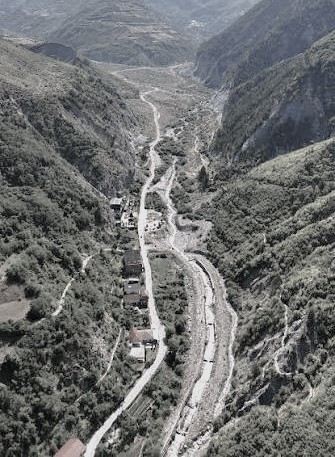
Memorie.al/ As a family, the Kastriots, the ancestors of Skanderbeg, appear in historical sources later than many of the Albanian noble families of his time, who are mentioned as minor feudal lords in the 1270s, some perhaps earlier. As was said, during the Middle Ages, Albanian nobles generally used the name of their early village as a surname. In fact, this practice continued up to the present day (Naim Frashëri, Faik Konica, Zef Jubani, Filip Shiroka, Ymer Prizreni, Isa Boletini, and many others). The Kastriots must have also used this practice. In Albania, there is only one village named Kastriot. It is located in the deep mountainous interior of Eastern Albania, 8 kilometers north of Peshkopi, in Lower Dibra, within the boundaries of the micro-region or provincial community of Qidhna, one of the nine “mountains” of the Dibra area.
The village of Kastriot, until the beginning of the 20th century – when it was made known in 1903 by a reader from Tirana of Faik Konica’s magazine “Albania,” and then a year later by the Russian consul and researcher I. St. Jastrebov (1904) – was unknown to all historians who had dealt with Skanderbeg’s biography. But even later, no historian connected the name of this village with the Hero’s surname.
It was not taken into consideration by the two Albanian historians, Athanas Gegaj and Fan Noli, in their monographs dedicated to the Hero, the first in 1937, the second in 1947. The genealogy of the House of Kastrioti would surely have remained disregarded, just as that of other Albanian noble families of the Middle Ages has remained (with the exception of the Muzakas), had Gjergj Kastrioti Skanderbeg not emerged from its fold.
However, contemporary documentary sources regarding the Hero’s ancestors do not go beyond his father, Gjon Kastrioti. Moreover, they are completely silent regarding the place from which the Kastriots came, and even more so, they do not speak at all about the place where Skanderbeg spent his childhood. The information we have about the place from which the Kastriots came is encountered in several later writings, which do not agree with one another.
As such, they have aroused suspicion. Their absence has given rise to various theses regarding the homeland of the Kastriots’ origin and the place where Skanderbeg was born. From world history, the case of Homer is very well known, for whose birthplace seven cities of ancient Hellas quarreled.
This is natural, considering the pride a city or a village feels when it knows that a great political, military, cultural, literary, or artistic personality has emerged from its bosom. This is what happened with Skanderbeg as well. Almost as many villages, if not more, have claimed in the past to have been the birthplace of the Albanians’ National Hero.
Before the mid-19th century, the erudite French traveler Ami Boué wrote that he had heard that Skanderbeg was born in the village of Kastër in Mirdita, at that time completely ruined, half an hour away from the present-day village of Vig. This legend was also heard by the Austrian albanologist J.G. Hahn during his journey in 1853 from Vau i Dejës to Koman, but he also adds the other legend he had heard in the meantime, that Skanderbeg was born in Kastrat, near Shkodra.
When Hahn was in Fierzë, the local governor told the Austrian albanologist that, according to his knowledge, Skanderbeg was born in the village of Iballë in Puka. On the contrary, when he went to Mat, he heard in Cukal of Klos that the Hero was born in Stelush. According to another legend, noted by Marin Sirdani, a tracker of Skanderbeg’s legends, the Kastriots were from the village of Shtjefën in Mat.
In the aforementioned letter written from Tirana, without an author’s name, published in the magazine “Albania” (1903), it is stated, among other things, that Skanderbeg was born in the village of Sin (Sej) in Lower Dibra. It is the same letter that first mentions the village of Kastriot. In this regard, it says that in Lower Dibra, north of Peshkopi, between the village of Suhadoll and the Drin River, there is a village called Kastriot, where the “Fusha e Thatë” (Dry Field) is also located, with some ruins of old and large houses, a place where it is also said that Skanderbeg might have been born.
We will close the chain of legends with the accounts given by the renowned Kosovar ethnographer, Prof. Mark Krasniqi. In his work dedicated to the oral traditions regarding the genesis of the Kastriots that circulated among several Albanian and Montenegrin tribes, after mentioning the legends speaking of their origin from the village of Kastrat near Shkodra, from the village of Shtjefën in Mat, from various neighborhoods of Kruja, and from the village of Guri Bardhë in Mat, he stops at the Dibra genesis tradition.
He says that, according to one oral tradition, in Shtjefën of Mat there was a neighborhood whose inhabitants considered they Kastriots, but these, according to the same oral tradition, had come there from the Dibra district, because, adds M. Krasniqi: “according to popular tradition, Skanderbeg was from the village of Kastriot, near Dibra.”
Then he continues: “The family of the Gjinëve in Kastriot of Dibra descends from the Kastriots. As the elders recount, Skanderbeg was from the village of Kastriot in the Dibra district. Here were the graves of his family. Skanderbeg was born and grew up in Kastriot of Dibra, his father was there.”
These legends have only literary value. They testify to the respect that the Albanian masses held for Skanderbeg. On the contrary, from a documentary point of view, they have no source value, as they contradict one another. Consequently, the place of origin of the Kastriots must be investigated only through the critical analysis of archival and literary historical documentation.
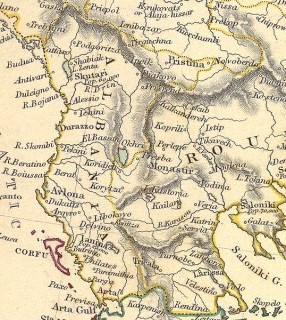
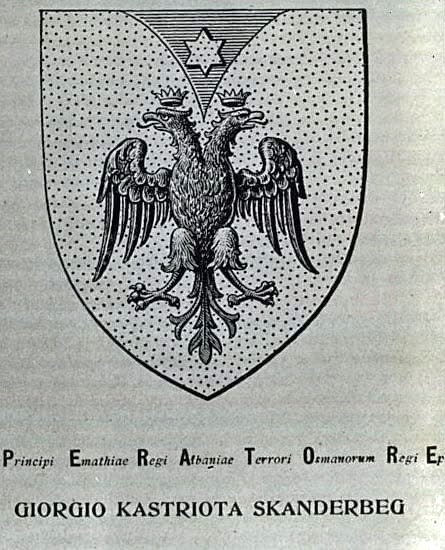
On this matter, it is worth discussing the information provided by Marin Barleti (1508-1510), who writes that; “the heads of the Kastriot tribe descended from Emat (ex Aemathia), from a noble house.” Some, for example Fan Noli, have interpreted Aemathia as the region of Mat.
Marin Barleti was a humanist. Like all humanists, he had the well-known classicist tendency to use Albanian toponyms in Latinized forms (Guri Bardhë as Petralba, Ujëbardhë as Albulena, etc.) or to revive ancient geographical designations (Lissos for Lezhë, Ascrivium for Kotor, Aoos for Vjosë, etc.).
Moreover, he used ancient and medieval geographical designations interchangeably. Thus, for example, he places Kruja sometimes in Arbëri (Albania), sometimes in Epirus (Epirus). He does the same with Macedonia, which he sometimes identifies with Albania, and other times distinguish from it. The tendency to identify Albania with Macedonia, or to include it within it, is also encountered outside Albania in the 15th century. This classicist tendency is also noticeable in Marin Barleti regarding the designation Emat (Aemathia).
In some cases, Barleti gives the designation Emat the meaning of Mat. But in other cases, he copies the classical Greek and Roman writers (Strabo, Pliny, Justin, Claudian), who called Ematia the province of Second Macedonia, which Rome created in the 1st century in the region between Durrës and Ohrid, which was later called the province of New Epirus, and in the Middle Ages was included in the designation Arbëri.
Thus, for example, when Barleti says that; “Kruja is a city of Epirus located in the plains of Emat” (Crojam Epiri urbam esse in campis Aemathia) and even more so when he also includes Petrela in the region of Emat (oppidium hoc in Aemathia est in sublimi montis cacumine), he has in mind not the present-day region of Mat, but the Roman province of Emat (Macedonia). In short, when Barleti says that the Kastriots are from Emati, we are not sure whether he has in mind the present-day region of Mat, or the former province of Macedonia, which also included the Dibra region.
So, with these determinations by Marin Barleti, the genuine origin of the Kastriots remains unlocalized. An attempt to locate their settlement was undertaken by two well-known scholars of Balkan medieval studies, L. Thallóczy and K. Jireček. In a joint work they published in 1899, that is, before the existence of a village named Kastriot became known in 1903 and 1904, they wrote that the Kastriots must have been from a place called Kastri (with the emphasis on the i), a name derived from the Latin castrum or the Greek kastrion and meaning “fortress,” the inhabitant of which was called kastriot.
But they did not take it further, although such a claim had been declared by the Albanian writer Frang Bardhi, back in 1636. The problem of the regional origin of the Kastriots became more complicated when their surname (Kastriot) was linked to a documentary act from the 15th century, in which some Kastriot descendants used a second surname—the surname Mazrek or Mazarak.
The main source for this second surname comes from the 16th-century writer Flav Komneni, who treated the genealogy of several noble families, including that of the Kastriots. As an example, he brings a certain Kostandin Kastrioti, surnamed Mazareku (Constantinus Castriota cognomento Maserechius, Aemathia et Kastroria princeps). There are also two acts issued in Naples in 1467, which speak of Constantinus Maserechius Castriota, Epiri et Albania Reguli and of their cousin Georgius Masrechi Castriota Scanderbegh, Albania et Epiri Principis. But already in the 19th century, prominent historians (Ch. Hopf, J.G. Hahn) characterized Flav Komneni as a compiler of falsified genealogies. Consequently, the information regarding the double surname Kastriot – Mazareku or Kastriot – Mazaraku seems to be the same.
This is evident in the fact that there is no documentary evidence to speak of the Kastriots as princes of Mat and Kostur. Furthermore, the acts in which Konstantin or anyone else is mentioned with two surnames – surnames which they also attribute to Skanderbeg – are late and, moreover, dubious. In fact, neither Gjon Kastrioti, nor Skanderbeg, nor his son or grandson, ever used the surname Mazrek or Mazarak, nor no one ever addressed them with these two surnames.
But even if the acts of Naples are authentic, the possibility is not excluded that the double surname was used by some Mazreka descendant, who wished, as encountered in other cases, to add to himself the honor of being a member of the already famous family of the Kastriots.
Ultimately, it must be said that no family can have its origin from two villages. Usually, double surnames are used in cases where one belongs to the paternal line and the other to the maternal line. In any case, when it comes to Skanderbeg’s family, the surname Mazarak should not be taken into consideration.
Nevertheless, the two Albanian historians of Skanderbeg, Athanas Gegaj and Fan Noli, did not disregard the second surname Mazrek or Mazarak. But the problem was complicated by the fact that in the medieval Albanian region, the toponym Mazrek or Mazarak was, as it is today, quite widespread.
Villages or ruins of villages with this name are found everywhere in Albania: there are in Shkodër and in Kukës, in Dibra and in Opar, in Tirana and in Gjirokastër; moreover, it is encountered in the Arvanite diaspora of Greece and the Arbëreshë diaspora of Italy. Consequently, the two aforementioned Albanian historians sought the origin of the Kastriots in two settlements with the names—one, Kastri; the other, Mazarak.
In the first version of the ‘History of Skanderbeg,’ published in Boston in 1921, Fan Noli, who at that time did not know that in Lower Dibra there is a village called Kastriot, accepted the opinion of Thallóczy and Jireček. According to him, the birthplace of the Kastriots with the name Kastri must have been one of the kastris (fortresses) of the highlands of Mat, but more likely in the region of Mazarak (in fact: Mazrek), between Shkodër and the Drin. / Memorie.al