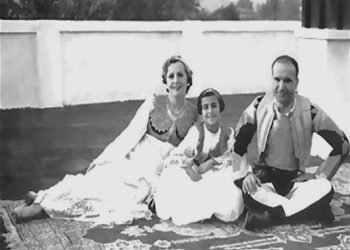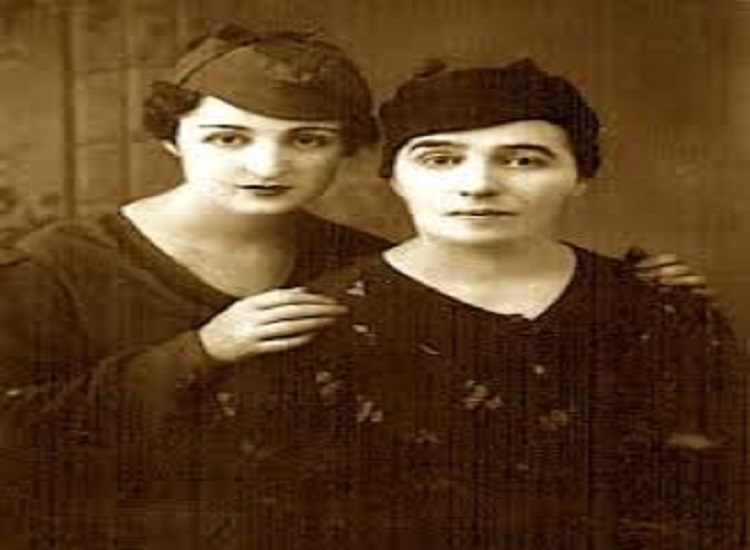
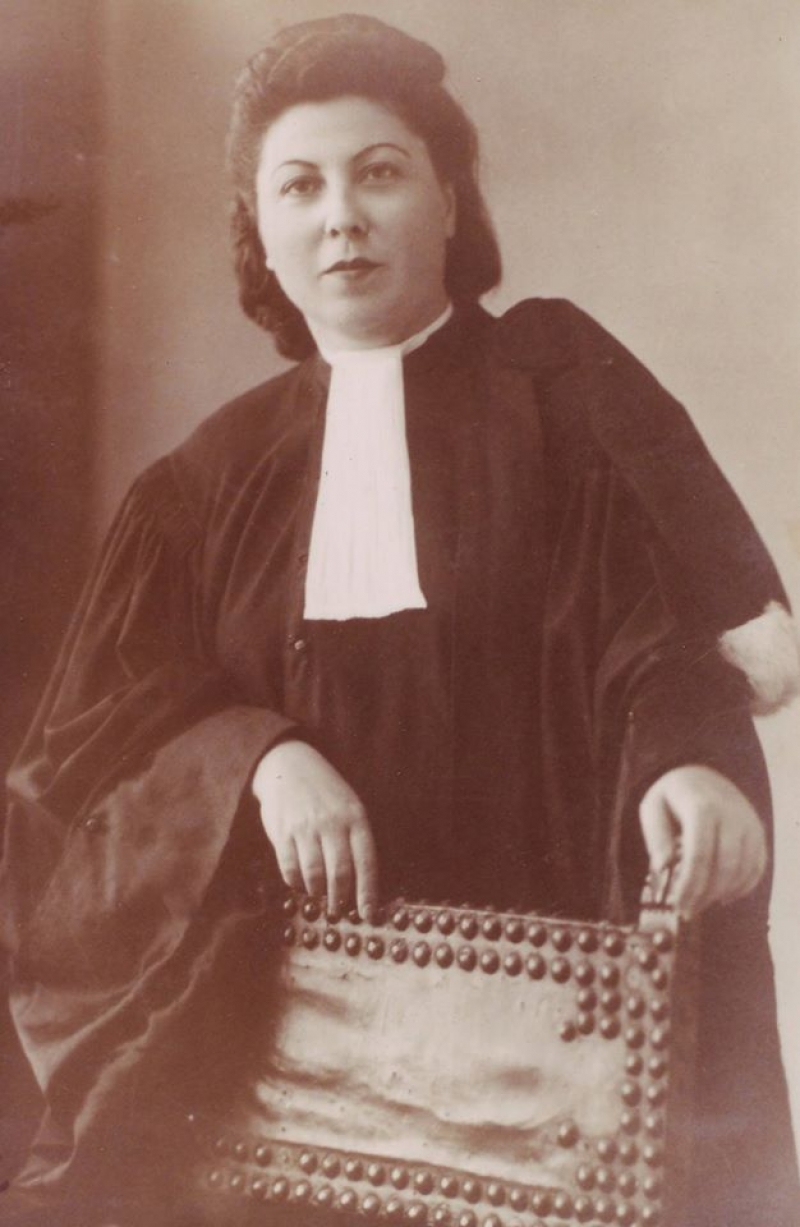
Memorie.al / The portrait of Erifili Bezhani, in the years of my early childhood – an image captured through the hushed and careful conversations of the adults – was almost ethereal. Having been raised and educated first in Greece and later in France, Erifili’s photographs in the family albums presented her to me as a captivating character from stories and novellas. These tales were told to us children by her sister, Evrinomi, on August evenings by the sea in the ‘Skelë’ neighborhood of Vlora during the mid-1960s. The vision of an exquisite horsewoman, galloping swiftly from the ‘Gorricë’ neighborhood where her grandmother lived to her aunt’s in ‘Kala’, Berat – so different from other girls her age – made her appear like a beautiful fairy from a folktale.
As the years passed and I grew old enough to join the conversations of the elders, Erifili’s portrait began to emerge as it truly was: full of vitality, dreams, and professional ambitions that were abruptly shattered for a senseless reason: the state’s opposition to her concepts and her intellectual efforts for a true democratic society in Albania.
The Family Where Erifili Grew Up
The life of Erifili Bezhani is intertwined with remarkable, yet deeply painful and tragic, stories of an Albanian family with ancient intellectual roots. Such were the lives of the children of Pavllo Bezhani from Vlora and Amalia Kolea from Berat. Pavllo was a son of the prominent Bezhani family – a large, wealthy family with extensive import-export trade activities in Albania, Greece, Italy, and as far as distant Egypt. The Bezhanis are known in the history of the development of the Albanian financial market; in 1850, they opened the first private bank in Albania, initially known as “Banka Pandeli & Lefter Bezhani.”
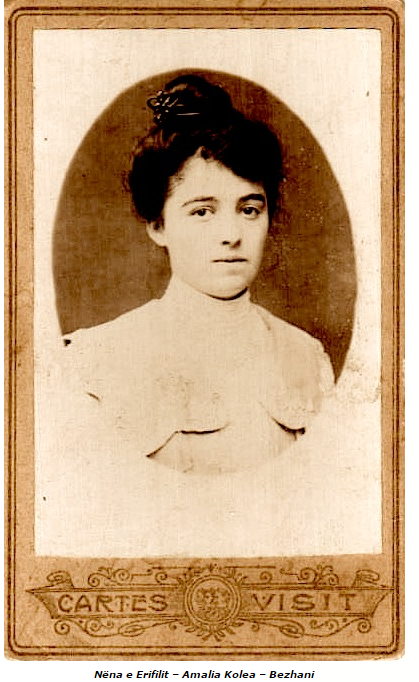
Amalia Kolea, on the other hand, was the youngest daughter of the lawyer from Berat, Kristo Kolea, a representative of the French tobacco monopoly “La Régie Des Tabacs” in the Ottoman Empire territories of Albania, Greece, and Macedonia. Amalia Bezhani was a poet, the first Albanian girl to publish her poems in the magazine “Bleta Shqiptare” (The Albanian Bee), a publication of the Albanian community in Misir, Egypt, at the end of the 19th century, while she lived there with her brother, the patriot Sotir Kolea.
Widowed early in 1918, Amalia Bezhani, with exceptional wisdom, not only managed and developed the family business at home and abroad but also ensured the best possible education for her three children. While the daughters, Erifili and Evrinomi, studied and graduated from universities in France, the son, Aleko, studied Economics in Rome, Italy, in the mid-1930s. For all three, the practice of their professions in their homeland – along with the ideal of changing and improving not just their lives but also ancient, fanatical Albanian concepts – was cut short at their most productive age with the rise of the Albanian Communist Party (PKSH) to power.
Who Was Erifili Bezhani?
Erifili Bezhani was born in Vlora on November 16, 1910. After finishing primary school in her hometown, her mother sent her to Corfu for further schooling. Upon completing high school, she went to France with her sister, where she initially studied French Literature and later attended the Faculty of Law at the University of Aix-en-Provence, graduating in 1939. She continued her studies until she obtained her “Licenciée en Droit.” She practiced law for two years in Marseille (1941–1942), where she became engaged to a prominent aristocratic French lawyer.
While at the height of her happiness, due to a misfortune involving her sister Evrinomi – who had also graduated as a “Professeur d’Études Françaises” from the same university – Erifili Bezhani left everything behind to accompany her back to Albania. It was wartime, the winter of 1943, when the two sisters disembarked at the Port of Vlora, never to leave again until death. After a stay in their hometown with their mother, the Bezhani sisters left Vlora in 1944 and settled in Tirana. They soon found themselves at the center of groups of distinguished Albanian intellectuals educated in various European countries.
In the first years of liberation, as the executions of nationalists began, Erifili realized that the Communist Party taking power was not the path toward a democratic pluralist system. Like many intellectuals educated abroad, she had – to her tragic misfortune – internalized western norms of education and the model of true democratic societies. “This is a terrifying reprisal, unlike anything seen in European countries, and it must be stopped,” Erifili told her relatives. She became active in the anti-communist movement “Bashkimi Demokrat” (The Democratic Union), which included members of the Group of Deputies, liberal-democrats, social-democrats, etc.
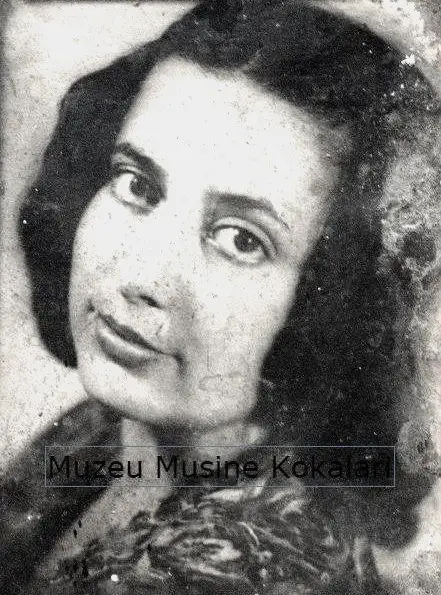
Her constant companions were well-known intellectuals of the time, such as Gjergj Kokoshi, Thoma Orogollai, Dr. Isuf Hysenbegasi, Dhimitër Pasko (Mitrush Kuteli), Qenan Dibra, and Musine Kokalari. Andromaqi Noçka, a veteran of the National Liberation War, recalls: “Erifili was a democrat in her soul, just as politicians should be today. I came from the liberated zones around 1945 when I met Erifili Bezhani again after many years; she was with Dhimitër Pasko. We sat in a café, and I remember both of them discussing politics and the paths to establishing democracy. Not just then, but never did Erifili criticize me for my political beliefs, because she knew how to respect everyone.”
The only “fault” for which Erifili was condemned was that she dared to speak openly and loudly about the establishment of democracy and the need for political pluralism in Albania. She possessed a rich vocabulary that accompanied her arguments for these ideas. This was the basis for her sentencing.
Courage and Imprisonment
For the courage and manliness that characterized Erifili, former political prisoner Dr. Isuf Hysenbegasi left this memory: “Between 1945–1946, a British representative held a meeting with the intelligentsia of Tirana. Among other things, he said: ‘We will not leave Albania in the hands of the communists.’ At that moment, Erifili Bezhani intervened, saying: ‘Look at Egypt, which is slipping through your fingers; as for the fate of Albania, it has already been determined.’ ‘Who are you, Madam?’ the Englishman asked. ‘I am an Albanian woman,’ Erifili replied.”
On May 16, 1947, following the sensational arrests of the ‘Group of Deputies’ and ‘Liberal-Democrats,’ Erifili Bezhani was arrested. By the end of the year, she was sentenced to 20 years of imprisonment by the Military Court of Tirana. She was sent to the infamous Burrel Prison, joining the history of anti-communist resistance as one of the first four Albanian women to taste the bitterness of imprisonment and inhuman torture. Former political prisoner Hysni Alimerko writes in his memoirs: “Erifili was sentenced at nearly the same time as Musine Kokalari, Shega Këlcyra, and Nurie Koculi. They were the first four women entered into the hellish prison of Burrel. Later came Drita Kosturi and Raile Luzi. All were of strong and unyielding character.”
In November 1951, while serving her sentence in Burrel, Erifili Bezhani’s name was included in the amnesty lists of the Presidium of the People’s Assembly; thanks to the intervention of old family friends like Hysni Kapo and Kadri Hazbiu, but also because her family had financially supported the National Liberation War. From this time until her death, the second stage of Erifili Bezhani’s struggle for survival began – marked by hardship, humiliation, and deprivation.
Post-Prison Deprivations
In 1952, after much intervention from friends, she joined the Tirana Lawyers’ Collective, starting work as the first female lawyer. Thoma Haxhistasa, one of the surviving lawyers of the old generation who graduated in Florence, recalls: “Erifili was the only female lawyer working in those years. She was distinguished for her calmness, courage, and excellent eloquence; as a professional, she followed a rigorous line of legal logic. Within a year, she became one of the most sought-after lawyers in Tirana.”
However, professional jealousy arose among her male colleagues. She worked for only one year before being dismissed with the motivation: “unworthy and incompetent.” On October 13, 1953, the deeply insulted but proud Erifili addressed a Pro-Memoria to the Oversight Council of Advocacy, logically refuting the dismissal: “I am not incompetent! My ability is proven by the material and moral successes I have had in my work… People who do not even know my name come to the Collective asking for ‘the stout lawyer’ [avokaten e trashë]… Furthermore, I have done translations from Albanian to French for the Ministry and from Russian to Albanian for the Collective without any compensation… I am not unworthy! Regarding my morality, everyone knows I have led an austere and monastic life dedicated to study.”
The true reason for her dismissal was that she did not have a “Front Card” (Triska e Frontit), which effectively declared her an “enemy of the people.” From 1953 onward, she was never allowed to practice law again. The right given to her by democratic France was denied to her in her homeland by the communist regime.
The Final Tragedy
Driven by the need to survive, she turned to translations. Fluent in French, English, Italian, Greek, and Russian (which she mastered in prison), she translated scientific works, legal codes, and press articles for various institutions. However, the regime’s pressure continued. Her family was moved from their villa to a damp basement in a single room with a shared corridor. After a conflict with a neighbor – a militant policeman who harassed them – Erifili took him to court. In retaliation, the communist regime handed down its final, deadly decision: she was sentenced to forced labor as a street sweeper in Tirana, working only the third shift (night shift).
After six months of such humiliating work, she fell ill with a gastric ulcer. She was rushed into surgery but died during the operation on February 15, 1959. She was only 49 years old – a lawyer graduated in France, who met a tragic fate in her homeland. Erifili Bezhani remains a rare example of emancipation and intellectual courage for the Albanian women of her generation./Memorie.al