




By DASHNOR KALOÇI
Part Eleven
Memorie.al / Even though he was the main leader of communist Albania for 40 consecutive years, governing his country with an iron fist from 1945 until he died on April 11, ’85, but also after his death and until the collapse of the communist regime in early 1991, a complete official biography of Enver Hoxha was never published, although he himself left written a series of works of about 80 volumes. Even after the 1990s and up to today, a biography of the former communist dictator Enver Hoxha has not yet been published, one that would be based on archival documents that shed light on the early origin of the family, with its genealogical tree, as well as a life story of him, from the day he was born until he died…! This apparently also due to the fact that throughout his life, there were many light and shadows, even many dark stains, which made him himself never give approval for the publication of a biography of his in a separate book, even though such biographies have actually existed. In fact three such biographies and with different authors, which are found even today in Enver Hoxha’s personal fund, in the Central State Archive in Tirana.
The first official biography of Enver Hoxha was made public in 1946, within the framework of the “popularization” of his figure, as “the main leader and first secretary of the Communist Party of Albania, commander-in-chief of the National Liberation Army with the rank of general-colonel, chairman of the presidency of the Democratic Front of Albania, prime minister of the Albanian government, minister of Popular Defense and minister of Foreign Affairs”. As can be seen also in the respective facsimiles attached to this article, this biography, which is a small booklet of 58 pages, published in the “Rinia” Printing House (former “Gutenberg” printing house), on the first page (after the dark maroon cover and the photo of Enver Hoxha in the military uniform of a general with medals on his chest), has written in capital letters: “ENVER HOXHA, A SHORT BIOGRAPHY”. That first official biography of Enver Hoxha was prepared for publication by the employees of the Agit-Prop sector (Agitation and Propaganda) at the apparatus of the Central Committee of the PPSh, but in reality its compiler and author was the first captain, Ndreçi Plasari, whose name does not appear in the book in question, but is found written in his handwriting on the first page of the typed material that was sent for printing.
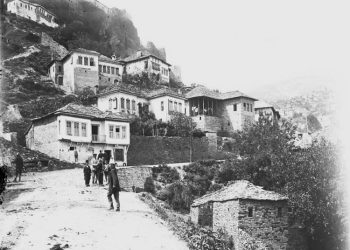
The book, or more precisely the brochure “ENVER HOXHA, A SHORT BIOGRAPHY”, begins with a description of the city of Gjirokastra where Enver was born on October 16, 1908, and continues with several paragraphs on the history of the Hoxha family (which occupies only the first two pages), while the entire remaining part is devoted to his (Enver’s) role during the period of the “Anti-Fascist National Liberation War” with some of its main events (the founding of the PKSH, the Peza Conference, the Labinot Meeting and the creation of the General Staff of the National Liberation Army on July 10, 1943, the Mukja Agreement, the Përmet Congress, etc.), concluding with January 11, 1946, with the event of the proclamation of the Republic. Even today it is not known with certainty why that brochure with the first official biography of Enver Hoxha (where a life story of him for the period of Zog’s Monarchy is almost entirely missing), which glorifies his figure and role (or that of the Hoxha family), from the period of childhood up to the time it was published, was immediately withdrawn from circulation (it is said after two or three months) and was never used again even for references, in books, albums, or other works dedicated to his figure.
Because from that time onward, Enver Hoxha began the elimination of his close collaborators (members of the Politburo, ministers, deputies, etc.), by imprisoning, interning or executing them, and the book in question with his biography could no longer circulate with the names of “enemies of the people”. The second biography of Enver Hoxha was written in 1950 (15.VI.1950) and its author is Misto Treska, a close and very trusted man of Enver Hoxha, from the period of the French Lyceum of Korça and the Communist Group of that city where he was a member, who during the War period was political commissar of the partisan Battalion “Reshit Çollaku” and after 1944, was promoted to major, being appointed as prosecutor and member of the judging body in the Special Trial of 1945, which sentenced to death former Prime Minister Maliq Bushati and the members of the Regency, Lef Nosi and Father Anton Harapi.
Just like the biography written by Ndreçi Plasari in 1946, that of Misto Treska, which has 238 pages of handwriting and the same title (“Enver Hoxha, a short biography”), glorifies excessively the figure and role of Enver Hoxha in all the time periods treated there. Perhaps this was also the main reason why that biography written by Misto Treska for Enver Hoxha not only was never published, but was not even typed on a typewriter, like the 1946 biography of Ndreç Plasari, or the other one written later. Likewise, it is not known with certainty whether this “service” that Misto Treska did to the main leader of Albania, Enver Hoxha (with whom he had acquaintance also from the period of studies in France), influenced his later career, where he served as a jurist, translator, book author, diplomat, ambassador of Albania to France, Belgium, etc., as well as chairman of the Committee for Friendly and Cultural Relations with the Outside World, where he retired in 1981.
The same applies to Professor Ndreçi Plasari, a historian and researcher who during the communist regime held important academic and political posts, being for a long time also deputy director of the Institute of Marxist-Leninist Studies in Tirana, directed by Nexhmije Hoxha. In those duties, Professor Plasari served until 1982, when he was struck by the Party, accused as “a man of Mehmet Shehu, who had been sent by him to the British archives to inflate his (Mehmet’s) cult and had hidden the documents proving that Mehmet Shehu had been an agent of the Intelligence Service”! The third biography of Enver Hoxha was written in 1969 and its author is Aqif Selfo, a close friend of childhood and youth with Enver and his neighbor in the city of Gjirokastra and later in the French Lyceum of Korça, where they studied together and Selfo served for some time also as a dormitory supervisor at that lyceum. On the first page of that biography, it is written: “Memories from the life of the Hoxha family, its origin and a life story of comrade Enver Hoxha, for the period 1908-1930 and 1931-1939, 6.1.1969, by Aqif Selfo”.
That biography, or more precisely a life story, as its author himself has titled it (it has 124 pages of handwriting, while typed 82 pages), just like those of Ndreçi Plasari and Misto Treska, from beginning to end, glorifies the figure and role of Enver Hoxha, even with distortions and falsifications of historical events and facts. (For example, on p. 46 of his memoirs, Aqif Selfo among other things writes that: “Enver set off for Belgium, settled in Brussels and began the duty of secretary of the Consulate. He stayed here partly in 1934, the whole of 1935 and partly in 1936. Alongside the duty of secretary of the Albanian Consulate in Brussels, Enver continued his studies at the faculty of law and took the exams of the second year”. While in another archival document found in Enver Hoxha’s personal fund, the Albanian diplomat Nos Qosja who served in our embassy in Paris, among other things writes: “During my visit to Belgium with comrade Harrilla Kola, we went to the University of Brussels (Faculty of Law) and asked and established: Comrade Enver is registered in the Faculty of Law for the academic year 1934-1935. In the archive of that faculty, there exists a card with these data;
HOXHA Enver
Academic year 1934-1935
Date of birth; 3 October 1908 (Gjirokastër)
Register number; 2821
His address; “Legation d’Albania 155 Rue de la Loi, Brussels”.
The card is white; it does not appear that he has taken any exam”.
Paris, 22 February 1969 — Nos Qosja
From what is said also in the archival document in question (which is conditioned with the period when the biography of Enver by Aqif Selfo was written), it results that Enver Hoxha did not take any exam at the Faculty of Law of Brussels, which refutes what Aqif Selfo writes, that “Enver took the exams of the second year”! Perhaps this was also the main reason why those “Memories” were never published as a book, since in the period they were written, many of Enver’s and Selfo’s friends and peers were still alive (in political prisons or free), from the period of their childhood in the city of Gjirokastra, that of the Lyceum of Korça, or even studies in France. But even though those “Memories” never saw the light of publication, in all likelihood they served their author Aqif Selfo as a shield for a quiet life (he worked as a teacher in Tirana at the “Qemal Stafa” gymnasium until he retired), unlike his two cousins, Riza and Syrja Selfo, whom Enver arrested and shot, even though they and the entire Selfo family had helped him with money during the War period, 1939-1944.
On the basis of these three biographies, in 1978, a book or more precisely a kind of brochure was published with the title: “Enver Hoxha, beloved leader of the Albanian people” – (Material for conversations, on the occasion of the 70th anniversary of his birth), where on the first page after the cover, it is written: “Prepared by the sector of Marxist-Leninist education, at the C.C. of the PPSh. – In aid of agitators and propagandists”. The book in question was published by the “8-Nëntori” Publishing House at the “Mihal Duri” Printing House in Tirana. The fact that these three biographies of Enver Hoxha are found in his personal fund, even with interventions and corrections by other persons, if they were not made by his order, in all likelihood they were written with Enver’s approval. Nevertheless these remain within the framework of hypotheses where there is room to investigate longer, but in this article we are publishing first the biography of Enver Hoxha, which was written by Aqif Selfo, which is published for the first time and with the respective facsimiles in several issues, by Memorie.al.
Continues from the previous issue
THE ARCHIVAL DOCUMENT DRAWN FROM THE PERSONAL FUND OF ENVER HOXHA THAT IS FOUND IN THE CENTRAL STATE ARCHIVE, WITH THE MEMOIRS WRITTEN BY AQIF SELFO, ON THE ORIGIN OF THE HOXHA FAMILY AND A LIFE STORY OF ENVER HOXHA
Memories from the life of the Hoxha family, its origin, and the life story of comrade Enver Hoxha for the period 1908–1930 and 1931-1939
By Aqif Selfo
6.1.1969
The Spanish War, led by the popular front, was followed with great interest by all progressive people of the world. It was followed with great sympathy also by Albanian public opinion and especially by progressive youth. In this war they saw a just war, a war for progress and against darkness. The victories of the Spanish people against Franco’s dictatorship were awaited with great joy by progressive youth. Every victory of the progressive forces was learned quickly and commented among them.
About the Spanish War, Enver too, one of the most progressive youth, spoke with great sympathy for it. Often at home or in the cafe, in a close circle, the conversation revolved around this war, people spoke about the aid that was going from all sides, people spoke about the formation of the international brigade where thousands of volunteers from all countries of the world took part, as well as from our country. These fought with selflessness against Franco’s army. Enver’s sympathy for the Spanish War was so great that Qemal H. Karagjozi, regarding this matter, recounts that Enver not only sympathized with this war, but he regretted that he had not taken active part in it.
This shows that the Spanish War, for people like Enver, was their war. Enver has given a great contribution also outside the Lyceum, especially in the Communist Group of Korça and of the Korça youth. Enver’s arrival at the lyceum, as a progressive intellectual, removed the notice of the members of the Communist Group of Korça. For this reason, after several weeks of his arrival in Korça, from the members of the group, Stefo Grabocka, who was charged to deal with and get to know the intellectuals, approached him and got to know him. In the first meetings that Stefo Grabocka had with Enver, according to Stefo’s saying, the essence of the conversations was brought around the issues of the time and especially the bad situation of the country and the Spanish War.
These conversations and Enver’s thoughts on these issues gave the Group of Korça to understand that Enver was an intellectual with advanced leftist ideas. After these meetings with Stefo Grabocka, Enver got to know, through him, also other comrades of the group, such as Miha Lako, Pilo Peristeri, Sotir Gura, Sotir Vullkani, etc. At first the contacts between the members of the group and Enver were rare and personal. This manner had its reasons: Enver was very prudent and did not want to attract attention, and likewise the comrades of the group did not want Enver to be too compromised.
Nevertheless Enver had his own way of meeting them and especially with Miha Lako. Enver went to Miha often at his shop, with the pretext of repairing shoes, but his purpose was to converse and exchange thoughts. Another way of meetings were also the visits that were made to each other’s homes, such as to the home of Vasil Balli, Kristo Kono, Stefo Grabocka, Skënder Topulli, etc. These visits, as the case may be, turned into political debates, where Enver also gave his opinion.
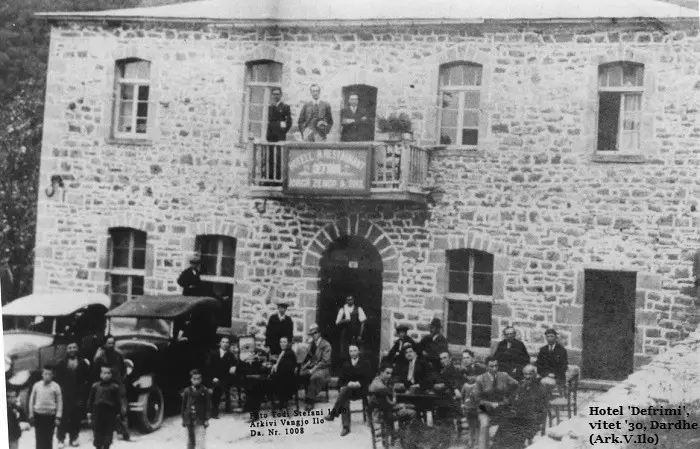
Besides visits to many people’s homes there were also walks outside the city. One of these walks is to one of the villages of Korça, to Dardhë. In this walk there were several people, among them: Enver, Kristo Kono and Ymer Dëshnica. In this walk, says Kristo Kono, we spent a very pleasant day. The whole day went by conversing, enjoying nature and singing revolutionary songs. Even, he adds, when we returned, along the whole road until we came inside the city, we were singing, only when the driver stopped the car did we realize we were in the city, but even at the time we were getting off the car, they still had in their mouths the melody of the Internationale.
Of great importance were, in 1938, the municipal elections in Korça. In these elections the municipal council, which came out of the elections held at the end of June 1938, consisted of progressive elements headed by the communist Pilo Peristeri. The great success achieved in these elections was a result of the great propaganda work that the Group of Korça had done in the popular masses of the city, propaganda that influenced them greatly. The popular masses of the city managed to understand that the Communist Group of Korça was for the protection of their interests and not the entrepreneurs, merchants and wealthy of the country. For these reasons these masses gave their votes to the candidates who appeared on the list of democratic organizations.
The new municipal council, as a council elected by the popular masses, took a series of measures of a democratic character. One of these measures was: the municipal council held its meetings open. This practice put into life for the first time in the municipality of Korça, had the purpose that the voters directly control their activity. In the meetings of the municipal council or assembly, many of the people took part. In these meetings, often, Enver also took part as a member of the people, says Stefo Grabocka and he continues: “In such meetings Enver has assisted in the last months of 1938 and in the first months of 1939. The members of the council discussed in these meetings various issues.
In the breaks of the assembly, between sessions, the issues that were analyzed were discussed also by the other participants, i.e. by the participants of the people. Enver too took active part in the discussions and in the evaluation of the discussions he gave valuable opinions on how to act and solve the various problems that the assembly raises”.
The Communist Group of Korça has done a great work also with the Korça youth. Its propaganda aimed at unmasking the fascist ideology. The fascist movement, for the spread of ideology among Albanians, took a great momentum around 1937. In Korça this movement was developed by adventurist and degenerate elements, such as Vasil Alarupi. In the war against the spread of fascist ideology the Group of Korça has done a very great work. It managed not only to greatly prevent the spread of fascist ideas among the youth, but managed to strengthen its influence also among the youth and especially in their organization, in the society “Rinia Korçare”.
Thanks to this influence, the society “Rinia Korçare” had in its direction a leadership that consisted of communist elements. The leadership of the society was liked neither by the reactionaries nor by the declared fascists, both of Korça and of the center. For this reason in 1938 measures were also taken to take over the society and to channel it for their purposes. One of these measures was the new elections that had the purpose of replacing the leading organs of the society with known reactionary and pro-fascist elements.
The preparation of the meeting for the elections of the leading organs of the youth had been done beforehand by the authorities of the country, who with a special circular had ordered the officials of the prefecture and the teachers to propagandize and support the candidates that would be presented by the special delegate who would come, on this occasion, from Tirana. On the other hand also the society “Rinia Korçare”, its leadership and many progressive elements, officials, teachers etc. were well prepared to oppose these measures, until the end.
A great contribution in this direction has been given by Enver. He, in the preparation of the youth elections, was continuously in contact with the leadership of the society, he, with his valuable advice showed them the stance that should be held on this occasion. About the preparations of the youth elections, Skënder Topulli recounts: “Around the end of 1938, the elections of the leading organs of the youth were to be held, comrade Enver, those days, was in activity, the report of the activity had been compiled by the leadership for the past and after the analysis and discussions the new leadership would be elected. One day comrade Enver comes to me at the clinic and notifies me that at 8 o’clock in the evening, I should be at the palace because the elections of the youth presidency would be held”.
At the appointed hour, in the palace of the Metropolis, a large crowd of youth and many officials, teachers, etc. gathered. In this meeting Enver also takes part. On this occasion General Aqif Përmeti had also come especially from Tirana, who dealt directly with the education of Albanian youth in the pro-Italian and fascist spirit. The delegate had information that the Korça youth, through various sports, cultural and other activities, was being educated not in the pro-Italian and fascist spirit, but in the spirit of progressive and revolutionary ideas. For this purpose the general aimed to put at the head of the society a leadership that would be loyal to the regime and able to educate the youth in the spirit of the regime in power, of complete subordination to fascist Italy.
In this hall, filled to the brim, the authorities of the country also came, the prefect and the commander of the gendarmerie, accompanied by some gendarmes as well as Stavri Skendi, Sami Bitincka and many others, who were zealous supporters of these measures against the society and enemies of every progressive idea. Stefo Grabocka, chairman of the society “Rinia Korçare” and Aqif Përmeti, the special delegate and come especially from Tirana for the elections, took their seats in the presidium. The chairman of the society opened the meeting and after presenting to the meeting the government delegate, held the report. In the meeting the government delegate also took the floor. He first greeted the youth in his name and especially in the name of the King, then added that according to the King’s order that the affairs of the patriotic Korça youth go even better, it is necessary that the youth be led by worthy people like Stavri Skendi, Sami Bitincka and others.
On this occasion Skënder Topulli recounts: “Then the whole crowd, unanimously, responded with a tone of protest that we elect the leadership ourselves. Aqifi, with composure, tried to impose himself but in vain because the whole hall began to call out the names of the presidency. The general, after seeing that he could not impose himself, slammed his fist on the table with nervousness and said: here there is a conspiracy. At this moment the gendarmes began to move but Aqifi gave the order not to touch with hands; the elections were suspended, the authorities left with their tails between their legs, while the crowd, with comrade Enver at the head, bursts into a demonstration in the streets of the city, until the late hours”.
About the development of the elections for the leadership of the society, Stefo Grabocka says: “The meeting that was held for the elections ensured us complete success, for these results comrade Enver has said: – today a great work has been done, very great. They not only did not take over the society but all the plans were overturned, while we settled more firmly in the leadership of the society. Nevertheless, continues Stefo Grabocka, the authorities of the country, after several days, ruined our society: they, relying on the statute of the society, in one of its articles, appointed, at the head of the society, a man of theirs, a man appointed by administrative route, but not elected”.
In this period Enver was well known for his progressive and leftist ideas. For his ideas Enver was known also by the French director of the lyceum, De Kurvil. Kristo Kono says that the director of the lyceum had learned about Enver’s progressive stance, but nevertheless he pretended not to know anything. But Enver was well known by the Communist Group of Korça. With some of the members of the Group, Enver was personally acquainted and had meetings from time to time, while many others knew that Enver was connected with the Group, but, for reasons of conspiracy, he remained for them as unknown. Llambi Dëshnica says that in Enver we saw a progressive and courageous man, for this reason we tried that he attract as little attention as possible, this had its reasons: not to compromise him, because the consequences that could follow would damage us greatly./ Memorie.al
Continues next issue