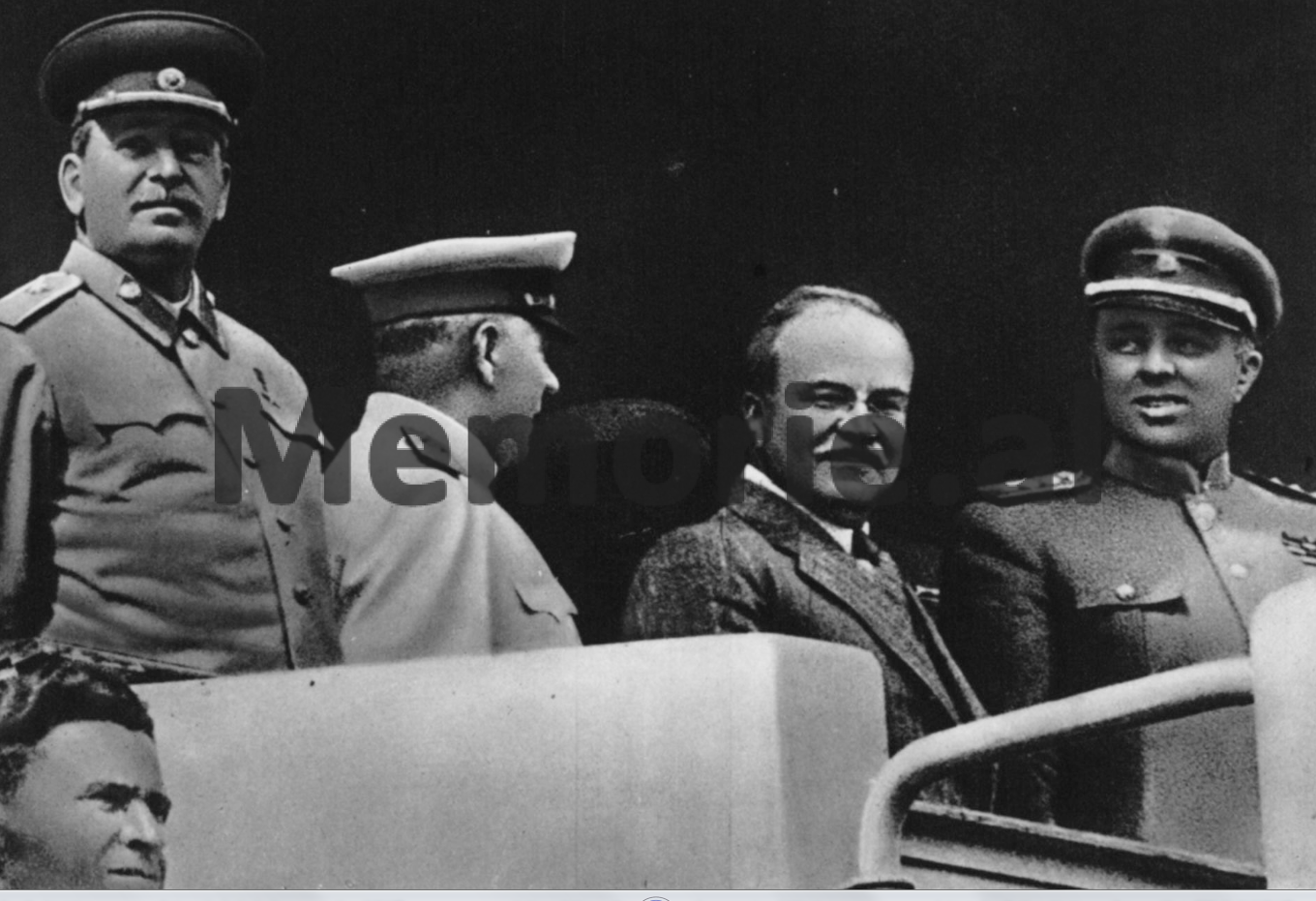

Memorie.al /The private conversation between Enver Hoxha and Stalin during the visit that the Albanian dictator made to Moscow in March 1949 has been declassified. In this period Hoxha was placed at the head of a delegation and made a blitz visit to Moscow, where he met with Stalin. The newspaper has secured the full discussion between them, declassified by the Russian archives. There it is clearly seen how Stalin holds Hoxha accountable for relations with Yugoslavia, while giving him instructions on how he should build the state.
23 March 1949
Enver Hoxha-Stalin Conversation
After the greetings Stalin asks Hoxha whether they had traveled well. Hoxha confirms and then conveys the deepest feelings of gratitude and love from the Albanian party and people for everything being done for Albania. Stalin thanks him and asks whether everything promised has been sent to Albania. Hoxha confirms. Stalin asks him about the questions he has.
Hoxha: First I want to describe to you the situation developing in the country and in the party and then return to some economic issues. I want to tell you about the needs of the army and describe the situation on our borders.
Stalin: You may raise any concern.
Hoxha: The letters of the Bolshevik Party to the Central Committee of the Communist Party of Yugoslavia and the resolution saved Albania from a catastrophe. The Yugoslav nationalists have pursued several objectives against the Soviet Union, against the anti-imperialist democratic camp and against Albania itself.
Stalin: And against the Muslims.
Hoxha: Yes. The Yugoslav nationalists of Tito’s group have carried out subversive activities in Albania since its liberation. The communists had seen that relations with Yugoslavia were weak, but their revolutionary readiness did not prove sufficient. The responsibility for this falls on me, but a role was played by our trust in friendly relations with the Yugoslavs during the war. As the saying goes, the fish rots from the head. The Yugoslav Trotskyists carried out intrigues within the Albanian party attempting to split it. In their subversion they relied on Koçi Xoxe, Pandi Kristo and others.
Stalin: Are these Slavs?
Hoxha: Yes, Xoxe was born in Macedonia, while Kristo is from Korça. They are Orthodox. We have hastened in our letters the hostile stance of the Yugoslav Trotskyists. If you have not received the letters, then honest Albanian communists will again take to the mountains to restart the effort. The Albanian communists never lost their love and loyalty for the Soviet people and the Bolshevik party and comrade Stalin.
Stalin: In the letters not all issues were clarified, since at that time we did not know everything. Later we learned that the Yugoslavs wanted to send a division to Albania, not for the purpose of defending Albania from Greek aggression, but to overthrow the regime. We learned this late, as did the Albanians.
Hoxha: The Albanians have close ties with the Yugoslavs, but regarding the sending of the division to Albania, we thought they had coordinated it with you beforehand.
Stalin: The Yugoslavs were trying to send that division there secretly, but it is possible that the Albanians made it appear that it was with the approval of the Soviets. We learned of the Yugoslavs’ intentions only from your information. When we criticized them, the Yugoslavs said it was a mistake and apologized. What percentage of non-Albanians is the population of Albania?
Hoxha: There are few Greeks and Jews and 5-6 thousand Macedonians, who live in the south of Albania.
Stalin: Are there Albanians in Yugoslavia?
Hoxha: There are about 1 million Albanians living in Yugoslavia.
Stalin: What religion do the Albanians have?
Hoxha: Mainly Muslim, partly Catholic in the north.
Stalin: Do you have Orthodox and other religions besides Islam?
Hoxha: There are about 30-35 percent Orthodox and 10-15 percent Catholic and they all speak Albanian. After the letters to the Bolshevik party, we took measures against Yugoslav nationalism, both within the party and in economic life. It was difficult to make a complete analysis of the situation in the party and in the country since the leader of the Yugoslav Trotskyists Koçi Xoxe made strong resistance and hid many things from the party.
Time was needed to determine what the sabotage activities in the economy and the subversive ones within the party by the Yugoslav Trotskyists and their servants had been. The country went to the party congress aware of the subversive activities. Many mistakes were made in the party because it had been modeled on the Yugoslav model and had mistaken. But the reactions to Tito’s treason were strong in Albania and the effort against the Trotskyists was united. The party took care that in this midst the feeling of the Albanian people toward the Yugoslav one should not be damaged.
The congress showed that in the effort against the Yugoslav Trotskyists the party had healed itself and had become stronger. The congress also showed that our party, although young, had great strength and energy for pursuing the correct line. Harsh criticism against pro-Yugoslav elements and activities came from all fields. The mistakes made by the party were acknowledged and the ways of correcting them were determined. The party did not use widespread measures of repression and acted carefully taking into account that many activists had honestly believed that the Yugoslav line was correct.
Therefore they were given the opportunity to correct themselves. Only Koçi Xoxe, Pandi Kristo and three others were arrested. Kristo Themelko, who was one of those responsible for implementing the harmful Yugoslav line and who expressed hostility toward the Soviet Union, was not arrested, since he presented all his activity, expressing deep regret for his behavior. His self-criticism was considered sufficiently honest and objective.
Stalin: What post did this Themelko have, where is he now?
Hoxha: General, political director of the Army. He is in Tirana now, he has been detained by the authorities.
Stalin: What nationality is he?
Hoxha: He is a Slav. Some time ago, our government asked the Soviets to allow Themelko to study at the “Lenin” Military Academy of Moscow.
Stalin: What answer did you receive?
Hoxha: Initially positive, but then it was postponed.
Stalin: Did you not want to get rid of Themelko by bringing him to Moscow?
Hoxha: We wanted to bring Kristo Themelko to the USSR, to rehabilitate him.
Stalin: Does the party trust Themelko politically?
Hoxha: The party continues to hope that Themelko will improve, but cannot trust him politically now.
Stalin: You do not need Themelko and we do not need him here either. Or are you sending him here because you are afraid for your security?
Hoxha: He has always wanted to study at the military academy of Moscow.
Stalin: If you wish it, we will accept him at the Moscow academy.
Hoxha: After the Congress we took safe measures for cleansing the party of those who compromised themselves with connections to the Yugoslav Trotskyists. Measures were taken for improving democracy within the party and rejecting the decrees and directives taken from Yugoslav influence. We have also taken measures in the Ministry of the Interior, for those who allowed exaggerations and wrong or malicious actions. Currently we are holding the elections of the party organizations in the regions, placing loyal comrades at the head of the party. The events had their negative effect within the party organizations and loss of discipline.
Among the weaker elements tendencies of anarchy appeared. Even currently, when the class war has become intensive, manifestations of opportunism are being distinguished. During the war against the Yugoslav subversive, the pace of the war against the rural bourgeoisie somewhat dropped, but this was done with the aim of not complicating the situation within the party. But during this time the government was not receiving sufficient production quotas from the countryside, which caused considerable economic difficulties. The Albanian market fell into chaos and only after Soviet aid did the work and improvement of the situation begin again.
Stalin: It seems Albania is creating collective farms.
Hoxha: We are establishing this at the Congress, but we will not rush.
Stalin: You should not rush with this. Albania is a backward country, and also a mountainous country. Even in the Soviet Union there are no collective farms in mountainous areas. If the Albanian farmers do not have fertilizers, livestock and technology, the state must help them, whether with plowing the land, with the harvests, or with the processing of products. Then the state can take its part from the production, but how they divide the bread among themselves, this is not the state’s business. The state must have its own economy with tractors, threshing machines and others, to give aid to the farmers if they request it.
This is not like in the collective farms, but it gives the farmers the opportunity to become acquainted with technology and understand its importance. We have long called these machine lending stations. You too must do this in Albania, as long as there is concern in the harvest season. The farmers who have more land will gain more and those who have less will gain less. This is not a war against the rural bourgeoisie, but it teaches the less wealthy farmers to work together. Do you have a commercial bourgeoisie?
Hoxha: Albania has a commercial bourgeoisie, but it has no shops and factories, since they were nationalized.
Stalin: This is not good. The national bourgeoisie can help in the production of goods and the expansion of trade. The state at the same time becomes stronger, especially if among them there are elements that value the freedom and independence of Albania. The patriotic elements among the bourgeoisie must be supported and not rejected. An example for this you can take from northern China, where some elements of the Chinese bourgeoisie, such as owners of small and medium factories, support the communist government. We have recommended to the Chinese not to reject these elements. The patriotic part of the bourgeoisie believes that only the communists can defend the independence and freedom of China, since the other parties are bankrupt.
This part of the bourgeoisie has distanced itself from Chiang Kai-shek since they believe that his party cannot keep China united and independent. The bourgeoisie is truly helping the communists. It must be that China is divided into the northern and southern part. Some trading groups of the north supply the communists with goods of the south, including American goods. To the question of why they sacrifice their money by doing this, they answer that they believe that no one else can resist Japan and America except the communists. Lenin always believed that if the revolution has an anti-imperialist character, in defense of the country’s independence, then the communists must cooperate with the national bourgeoisie.
Such cooperation is allowed in the early stages, and the Albanian comrades must remember this recommendation of Lenin. In the countries of the People’s Democracies, the bourgeoisie has stained itself with its connections to the German and Italian occupiers. Therefore when the Russian troops came to these countries, the bourgeoisie withdrew together with the Germans. In Albania no Yugoslav or Soviet troops came, therefore the elements of the bourgeoisie remained in the country and the Albanians did not kill them. We must not remove the bourgeois who want the independence of the country and who can help us.
The same applies to elements of the intellectuals, who although they do not agree with the communists, believe that the communists can defend the independence of the country. We must not remove them either. The Russian Bolsheviks did not follow this policy. No one invaded Russia at the time of the revolution and no one was threatening it, regardless of the war with Germany. Therefore the Russian revolution did not have an anti-imperialist character; its focus was within the country. There is a difference between what happened in Russia and what is happening now in China, Korea or other countries. Russia had no external threats while its bourgeoisie was not patriotic.
It called for help from France and Britain. The Albanians must not copy what happened in Russia, but must take into consideration the local features. If there are small capitalists who open enterprises or small shops, Albania must allow and license them, giving them the opportunity to increase trade and industry. After the economy of Albania improves, then there is another situation where questions about the bourgeoisie can be raised again. How many of you have come in the delegation?
Hoxha: Eight, it is me, the head of the Planning Commission Spiro Koleka, the deputy Koço Theodhosi, the Minister of Trade Vasil Kati, the deputy minister of Industry Xhafer Spahiu, Shinasi Drogoti, colonel Nexhip Vinçani, the trade representative in Moscow, Teodor Fundo.
Stalin: Who is the commander of the Army?
Hoxha: I am.
Stalin: The Soviet people, as Bolsheviks, have the following principle for building the state: if the majority is Muslim, then the majority of the government cabinet must be Muslim. The principles of religion cannot be violated. People cannot understand why the state is not led by a Muslim, if the majority is Muslim. These are elementary things, but those in Yugoslavia did not understand them. But this does not mean that there should be only Muslims in the government. We must choose capable people from the minorities to preserve unity among the people. The representation of minorities ensures the stability of the government. Have you received the army uniforms from the USSR, which the head of the army had requested earlier?
Hoxha: They have not arrived yet, but we have heard that they are coming.
Stalin: It has been decided to send the uniforms.
Hoxha: With your permission I want us to return to economic issues. Our two-year economic plan assumes the construction of industrial plants for the production of textiles, cotton, sugar, wood, and other needs of the country. The plan also emphasizes the expansion of extractive industries and other natural resources. The plan foresees the construction of the Patos-Vlorë oil pipeline and an oil refinery with a capacity of 150,000 tons per year. While in agriculture we plan the drainage and irrigation of lands, since the needs for tractors have been met with the aid of the USSR.
Stalin: What railways will you build? Have you received the rails from the USSR?
Hoxha: We are building the Durrës-Elbasan railway, last year we completed the first part of the Durrës-Peqin line, 37 km, while the Peqin-Elbasan part of 30 km remains. We have received the rails, the wagons and the equipment. We also plan the addition of schools and the increase of beds in hospitals. For this we rely on the aid of the USSR. We have received credits from Czechoslovakia, Hungary and Poland, while we are in negotiations with Romania. Then our delegation will go to Bulgaria.
Stalin: We will give you aid as much as we can. I hope you will remember to work yourselves too…! /Memorie.al