






By DASHNOR KALOÇI
Part Twelve
Memorie.al / Even though he was the main leader of communist Albania for 40 consecutive years, governing his country with an iron fist from 1945 until he died on April 11, ’85, but also after his death and until the collapse of the communist regime in early 1991, a complete official biography of Enver Hoxha was never published, although he himself left written a series of works totaling around 80 volumes. Even after the ’90s and to this day, no biography of the former communist dictator Enver Hoxha has yet been published that is based on archival documents shedding light on the early origins of his family, with its genealogical tree, as well as a life story of him, from the day he was born until he died…! This apparently also due to the fact that throughout his life, there were many shadows, indeed many dark stains, which made him never give approval for the publication of a biography of his in a separate book, even though such biographies have actually existed. Indeed three of them, with different authors, which are found even today in Enver Hoxha’s personal fund at the Central State Archive in Tirana.
The first official biography of Enver Hoxha became public in 1946, within the framework of the “popularization” of his figure, as “the main leader and first secretary of the Communist Party of Albania, commander-in-chief of the National Liberation Army with the rank of colonel-general, chairman of the presidency of the Democratic Front of Albania, prime minister of the Albanian government, minister of People’s Defense and minister of Foreign Affairs.” As can be seen in the respective facsimiles attached to this article, this biography, which is a small booklet of 58 pages, published by the “Rinia” Printing House (formerly the “Gutenberg” printing house), on the first page (after the dark maroon cover and the photo of Enver Hoxha in the military uniform of a general with medals on his chest), has written in capital letters: “ENVER HOXHA, A SHORT BIOGRAPHY.” That first official biography of Enver Hoxha was prepared for publication by the employees of the Agit-Prop sector (Agitation and Propaganda) at the apparatus of the Central Committee of the PLA, but in reality its compiler and author was the first captain, Ndreçi Plasari, whose name does not appear in the book in question, but is found written in his own handwriting on the first page of the typed material that was sent to press.
The book, or more precisely the brochure “ENVER HOXHA, A SHORT BIOGRAPHY,” begins with a description of the city of Gjirokastra where Enver was born on October 16, 1908, and continues with several paragraphs on the history of the Hoxha family (which occupies only the first two pages), while the entire remaining part is devoted to his (Enver’s) role during the period of the “Anti-Fascist National Liberation War” with some of its main events (the founding of the CPA, the Peza Conference, the Labinot Meeting and the creation of the General Staff of the National Liberation Army on July 10, 1943, the Mukja Agreement, the Përmet Congress, etc.), concluding with January 11, 1946, with the event of the proclamation of the Republic. Even today it is not known with precision why that brochure with Enver Hoxha’s first official biography (where a life story of him for the period of Zog’s Monarchy is almost entirely missing), which glorifies his figure and role (or that of the Hoxha family), from the period of childhood up to the time it was published, was immediately withdrawn from circulation (it is said after two or three months) and was never again used even for references, in books, albums, or other works dedicated to his figure.
Because from that time onward, Enver Hoxha began eliminating his close collaborators (members of the Political Bureau, ministers, deputies, etc.), by imprisoning, interning or executing them, and the book in question with his biography could no longer circulate with the names of “enemies of the people.” The second biography of Enver Hoxha was written in 1950 (15.VI.1950) and its author is Misto Treska, a close and highly trusted man of Enver Hoxha since the period of the French Lyceum of Korça and the Communist Group of that city where he was a member, who during the War period was political commissar of the partisan Battalion “Reshit Çollaku” and after 1944 was promoted to major, being appointed as prosecutor and member of the judging panel in the Special Trial of 1945, which sentenced to death former Prime Minister Maliq Bushati and the members of the Regency, Lef Nosi and Father Anton Harapi.
Just like the biography written by Ndreçi Plasari in 1946, that of Misto Treska, which has 238 pages of handwriting and the same title (“Enver Hoxha, a short biography”), glorifies beyond measure the figure and role of Enver Hoxha in all the time periods treated there. Perhaps this was also the main reason why that biography written by Misto Treska for Enver Hoxha was not only never published, but was not even typed on a typewriter, like the 1946 biography of Ndreç Plasari, or the other one written later. Likewise, it is not known with precision whether this “service” that Misto Treska did for the main leader of Albania, Enver Hoxha (with whom he was acquainted since the period of studies in France), influenced his later career, where he served as a jurist, translator, book author, diplomat, ambassador of Albania to France, Belgium, etc., as well as chairman of the Committee for Friendly and Cultural Relations with the Outside World, where he retired in 1981.
The same applies to Professor Ndreçi Plasari, a historian and researcher who during the communist regime held important academic and political posts, being for a long time also deputy director of the Institute of Marxist-Leninist Studies in Tirana, directed by Nexhmije Hoxha. In those duties, Professor Plasari served until 1982, when he was struck by the Party, accused as “a man of Mehmet Shehu, who had been sent by him to the British archives to inflate his (Mehmet’s) cult and had hidden the documents proving that Mehmet Shehu had been an agent of the Intelligence Service”! The third biography of Enver Hoxha was written in 1969 and its author is Aqif Selfo, a close friend of childhood and youth with Enver and his neighbor in the city of Gjirokastra and, later, at the French Lyceum of Korça, where they studied together and Selfo served for some time also as a dormitory supervisor at that lyceum. On the first page of that biography, it is written: “Memories from the life of the Hoxha family, its origin and a life story of comrade Enver Hoxha, for the period 1908-1930 and 1931-1939, 6.1.1969, by Aqif Selfo.”
That biography, or more precisely a life story, as its author himself titled it (it has 124 pages of handwriting, while typed 82 pages), just like those of Ndreçi Plasari and Misto Treska, from beginning to end, glorifies the figure and role of Enver Hoxha, indeed with distortions and falsifications of historical events and facts. (For example, on p. 46 of his memoirs, Aqif Selfo among other things writes that: “Enver set off for Belgium, settled in Brussels and began the duty of secretary of the Consulate. He stayed here partly in 1934, all of 1935 and partly in 1936. Alongside the duty of secretary of the Albanian Consulate in Brussels, Enver continued his studies at the faculty of law and took the exams of the second year.” While in another archival document found also in Enver Hoxha’s personal fund, the Albanian diplomat Nos Qosja who served at our embassy in Paris, among other things writes: “During my visit to Belgium with comrade Harrilla Kola, we went to the University of Brussels (Faculty of Law) and asked and established: Comrade Enver is registered at the Faculty of Law for the academic year 1934-1935. In the archive of that faculty, there exists a card with these data;
HOXHA Enver
Academic year 1934-1935
Date of birth; 3 October 1908 (Gjirokastër)
Register number; 2821
His address; “Legation d’Albania 155 Rue de la Loi, Brussels”.
The card is white; it does not appear that he has taken any exam.”
Paris, 22 February 1969 Nos Qosja
From what is stated even in the archival document in question (which is conditioned with the period when it was written and Enver’s biography by Aqif Selfo), it results that Enver Hoxha did not take any exam at the Faculty of Law of Brussels, which refutes what Aqif Selfo writes, that “Enver took the exams of the second year”! Perhaps this was also the main reason why those “Memories” were never published as a book, since in the period they were written, many of Enver’s and Selfo’s comrades and peers were still alive (in political prisons or free), whether from the period of their childhood in the city of Gjirokastra, that of the Lyceum of Korça, or even studies in France. But even though those “Memories” never saw the light of publication, in all likelihood they served their author Aqif Selfo as a shield for a quiet life (he worked as a teacher in Tirana at the “Qemal Stafa” gymnasium until he retired), unlike his two cousins, Riza and Syrja Selfo, whom Enver arrested and shot, even though they and the entire Selfo family had helped him with money during the War period, 1939-1944.
On the basis of these three biographies, in 1978, a book was published, or more precisely a type of brochure with the title: “Enver Hoxha, beloved leader of the Albanian people” – (Material for conversations, on the occasion of the 70th anniversary of his birth), where on the first page after the cover, it is written: “Prepared by the sector of Marxist-Leninist education at the C.C. of the PLA. – In aid of agitators and propagandists.” The book in question was published by the “8-Nëntori” Publishing House at the “Mihal Duri” Printing House in Tirana. The fact that these three biographies of Enver Hoxha are found in his personal fund, indeed with interventions and corrections by other persons, if they were not done by his order, in all likelihood they were written with Enver’s approval. Nevertheless these remain within the framework of hypotheses where there is room for longer investigation, but in this article we are publishing first the biography of Enver Hoxha, which was written by Aqif Selfo, which is published for the first time and with the respective facsimiles in several issues, by Memorie.al.
THE ARCHIVAL DOCUMENT EXTRACTED FROM THE PERSONAL FUND OF ENVER HOXHA FOUND IN THE CENTRAL STATE ARCHIVE, WITH THE MEMOIRS WRITTEN BY AQIF SELFO, ON THE ORIGIN OF THE HOXHA FAMILY AND A LIFE STORY OF ENVER HOXHA
Memories from the life of the Hoxha family, its origin, and the life story of comrade Enver Hoxha for the period 1908–1930 and 1931-1939
By Aqif Selfo
6.1.1969
In this period the situation of Zog’s regime in Albania was becoming more difficult: on the one hand the anti-Zog movement was growing and on the other hand the continuous pressure of fascist Italy was endangering not only Zog’s regime but also Albania’s very independence. Zog’s clique, finding it in difficult positions, began to take strict measures to eliminate the continuously growing anti-Zog activity. In January 1939, many arrests of communist elements were made, especially in Shkodra and Gjirokastra. The arrested were brought to trial, which continued for several weeks, around February 15, 1939. The trial sentenced most of the arrested to various punishments.
Besides this, Zog’s regime, despite being tied head and foot to Italian fascism, did not feel safe from the growth of continuous demands for further subjugation of Albania to fascism. For this reason Zog’s regime, seeing the continuous growth of Italian fascism’s aims, tried to take some measures within the country, especially against persons who were in the service of Italy and fascism and to strengthen the Albanian army. These measures aroused great dissatisfaction in the Italian government, which intervened at once; Zog, before this intervention of the Italian government, submitted to the Duce’s dictate. This withdrawal gave the Italian government another proof of Zog’s weakness. For this reason, the demands of the Italian government toward our country followed one after another.
All these were done in the greatest secrecy, nevertheless the Albanian people, in the first days of April 1939 learned of the plans of Italian fascism and the capitulationist stance of Zog’s clique. Before this situation the Albanian people, angered to the utmost, erupted in powerful demonstrations. At the head of these demonstrations, in the main cities such as Tirana, Shkodra, Korça, etc., stood the communist elements. In Korça high school students participated in these demonstrations, especially those of the lyceum, together with them were also professors like Enver and others, young people of Korça and many of the city’s inhabitants. In these days of April the group of Korça was in great activity. The communist group of Korça, before the created situation and the fascist danger that threatened the country, in its meeting, was examining the political line that would be held by the group in the created situation, i.e. the approaching danger and eventually the occupation of Albania by Italian fascism. “In these important meetings of the communist group of Korça,” says Stefo Grabocka, “comrade Enver also participated, called so that he too would have responsibility for the decisions that would be taken.”
Zog’s clique, in these difficult moments for the country and our people, spread many deceptive but bombastic declarations: that he would resist the enemy even in the mountains, that he had not shown his shoes and many declarations of this kind, but all these were false and to put the revolted masses to sleep. In reality Zog and his clique capitulated without a point of shame before Italian fascism and after filling their suitcases with the people’s wealth, they fled shamefully betraying the long-suffering people and the Fatherland. Zog’s betrayal and that of his clique angered the Albanian people even more in those bad days.
“The group of the communist youth of Korça,” says Skënder Topulli, “with comrade Enver at the head, when it saw how Zog betrayed the Fatherland, organized mass demonstrations, mobilized the youth for resistance and pressured the authorities of Korça for weapons. The prefect of the place and the district commander, Skënder Çami, threatened us with their armed forces out of fear of revenge, that they did not give us weapons. All those days of April seventh the comrades of the group with comrade Enver at the head had surrounded the radio in my house. Comrade Enver was very preoccupied by the created situation and told us that now great tasks lie before us: forces must be gathered, groups must be united and a sound organization is required and thought must be given to finding the opportune moment to throw these forces into action and then into war against the occupier and the traitors of the country.”
At once after the occupation of the country by Italian armies, schools began to open everywhere, likewise in Korça; Enver did not stay long in Korça after the occupation. On May 25, 1939, according to a letter sent by the lyceum’s directorate to the Ministry of Education, No. 2095/I dated 25.V.1939, Enver takes the holidays for the school year 1938-1939. He returns again to Korça for the school year 1939-1940. In this period hatred toward the fascist occupiers was great in all the masses of the people and especially in the school youth. The demonstrations or actions organized by the fascists were boycotted or turned into anti-fascist demonstrations.
In these demonstrations and manifestations Enver played a great activity. This is best proven by the letter of the prefecture of Korça sent, dated 29.XI.1939, to the Ministry of Internal Affairs. In this letter it is about the participation of the lyceum students together with their professors in a manifestation before the monument of the national hero and the punishment of Professor Enver Hoxha is requested. In the letter among other things it is said: “… the students of the local lyceum, although they were obliged to be also at the tree planting, had formed a cortege in the city, walking all the streets, they deposited a wreath before the monument of the National Hero.
To avoid the smallest incident, it is indispensable that the most rigorous measures be taken against the lyceum professors, who either have no authority to discipline their students, or agree with them. In both cases they do not deserve to continue as professors in this lyceum and their removal from here as soon as possible is necessary. We are continuing the investigations on the causes and today we are in a position to request that the Ministry of Education punish Professor Enver Hoxha. For the others we reserve to report next time, after the investigations are completed.” After this event, not much time passed, the competent authorities took the respective measures against him: at first, on 8.XII.1939, Enver was transferred, as a teacher, from the lyceum of Korça to the Gymnasium of Gjirokastra and, after several days, on 13.XII.1939, he was dismissed from work.
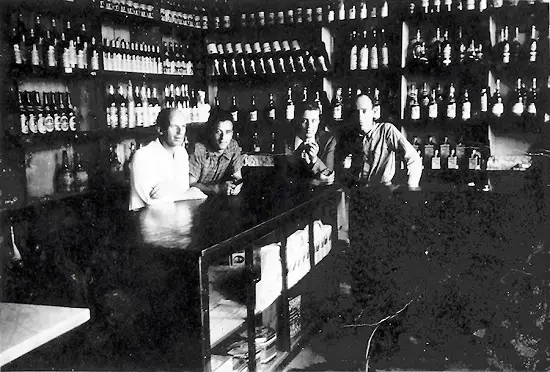
After the dismissal Enver stayed several more days in Korça, and then went by decision of the center of the communist group of Korça to Tirana. Here he opened the shop “Flora,” for the sale of cigarettes, as a basis for masking his work. Enver’s settling in Tirana had the purpose of creating a center in the capital, for the extension of the activity of the Korça group and to organize the anti-fascist movement in Tirana and in other areas and regions of the country. The shop “Flora” quickly became an important center where meetings with communist elements of various groups as well as with anti-fascist patriot elements could be held without attracting attention and the respective tasks assigned.
In the shop “Flora,” besides these, many others also went, comrades and acquaintances, to meet Enver and exchange a word with him. One of the meetings of this period, of this nature, was also the meeting of the two teachers Aleks Buda and Sotir Kuneshka with Enver. About this meeting Aleks Buda says: It was the month of August 1940, at this time both Sotiri and I were preparing to go to the military academy of Spoleto (in Umbria – Italy) as we had been designated as officers; together with us many others would also go, all teachers, the total number reaching 80 persons. One day, walking through Tirana, we said to each other let’s go pay Enver a visit to say goodbye and at once we went to the shop “Flora.” After we met and greeted him, they told him how things stood and we told him that these days we will set off therefore we came here also to say goodbye.
Enver, when he learned that we were going as officers against our will, told us briefly: this is a simple matter, don’t go. We both, almost unanimously, told him how we cannot go, they will catch us and force us to go. Then Enver tells us: don’t stay in the city so that they catch you and force you to go but go to the villages, the peasants will receive you and keep you as they have kept, in the past, many fugitives, they have kept, protected and fought against Turkey together with Mihal Grameno, Çerçiz Topulli and many other freedom fighters. It is true, I say, that our peasants have kept many fugitives but at that time it was the weak Turkish empire with a disorganized administration, while today we are dealing with the Italian empire which is a strong state, with an army equipped with more modern weapons and with a perfect organization, this power you cannot escape, sooner or later we will be forced to surrender, therefore for us there is no other way but to go.
In this answer Enver only shook his head with this he meant: it is not so. With these words we met and parted with him. After several days we set off for Spoleto. There many of the comrades, among them myself, about half, returned again to Albania, using all kinds of ways; some through friends, some others pretending to be sick etc. The rest, who remained, among them also Sotiri, were sent to various places such as Libya, Yugoslavia etc. After the liberation only a part of them returned to Albania, the rest remained killed in the various battles. Aleks Buda adds: When we went to meet comrade Enver, neither Sotiri nor I knew anything about his mission in Tirana and we were surprised by what he told us. But later when comrade Enver went into illegality, the party was formed and the armed war against fascism and nazism and the traitors of the country began, then I could understand the meaning of his words before setting off for Italy.
Thus the shop “Flora” became the base of meetings and as a result of the great work of Enver and the other sound communist comrades of the country the union of the groups was achieved and the Communist Party of Albania was formed. Under the leadership of the Communist Party of Albania, with comrade Enver Hoxha at the head, the Albanian people, in the armed war against Italian fascism, German nazism and the traitors of the country, achieved great successes, the liberation of the Fatherland from foreign occupiers and from the reactionaries of the country. The National Liberation War, led by the Party with comrade Enver at the head, gave the people true freedom. The Albanian people, in this war, realized, for the first time, their centuries-old dream and aspirations, which crystallized with the establishment of their power, the people’s power. /
Tirana, 9.7.1969. Aqif Selfo
DOCUMENT FROM THE PERSONAL FUND OF ENVER HOXHA IN THE CENTRAL STATE ARCHIVE, WITH THE LETTER OF THE ALBANIAN DIPLOMAT AT THE PARIS EMBASSY, NOS QOSJA, ON THE RESEARCH AT THE FACULTY OF LAW OF THE UNIVERSITY OF BRUSSELS, WHERE IT WAS SAID THAT ENVER HOXHA HAD STUDIED TWO YEARS
ON THE REGISTRATION OF COMRADE ENVER HOXHA AT THE UNIVERSITY OF BRUSSELS, AT THE FACULTY OF LAW
A comrade of the Portuguese Marxist-Leninist Committee had told me that one of their militants in Belgium had seen the name of comrade Enver Hoxha in the cards of the Faculty of Law of the University of Brussels. During my visit to Belgium with comrade Harrilla Kola, we went to the University of Brussels (Faculty of Law) and asked and established:
Comrade Enver Hoxha is registered at the Faculty of Law for the academic year 1934-1935. In this Faculty there exists a card with these data:
HOXHA Enver
Academic year 1934-1935
Date of birth; 3 October 1908 (Gjirokastër)
Register number; 2821
His address; “Legation d’Albania 155 Rue de la Loi, Brussels”.
The card is white, it does not result that he has taken any exam.
Note:
1). The Secretariat of the Faculty of Law promised us that they will send us a certificate of this document (card), because photocopying was not allowed; We paid 20 Belgian Francs for this that they will send us and gave our address in Paris.
2). We tried to photograph it from outside the Faculty of Law, as well as the building of the University of Brussels. This we did but the weather was very bad and we don’t know how the photographs will come out.
3) The University (Fac. Law) is located on “Franklin Roosevelt” Street, outside the city of Brussels. / Memorie.al
Paris, 22 February 1969 Nos Qosja