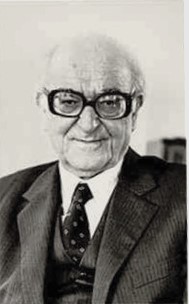
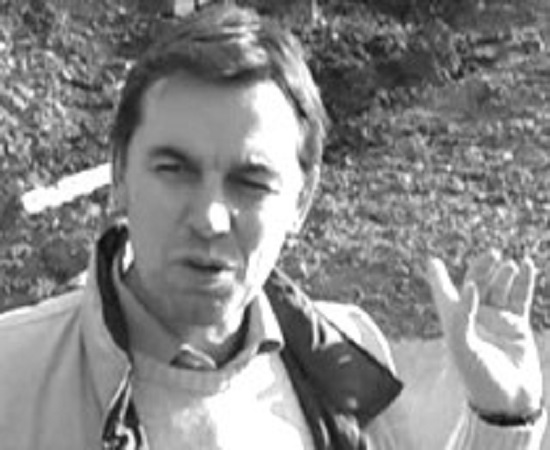
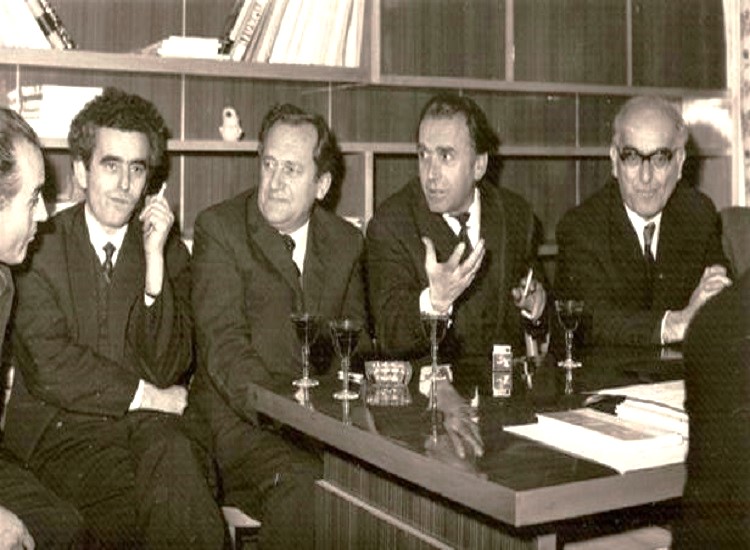
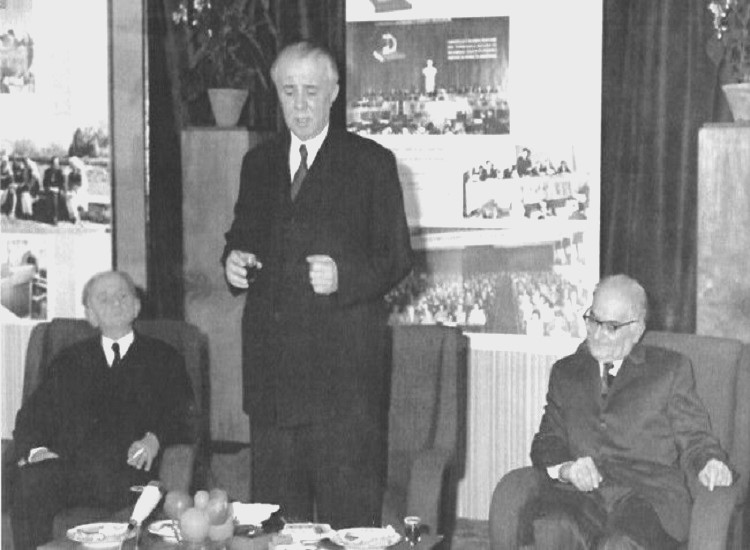
Memorie.al / Aleks Buda decided to perpetuate the name of the first author of the “History of Skanderbeg” through his grandson. Marini was raised with his grandfather’s books, and inevitably his fate would be tied to history. He carries the pride of being a descendant of Aleks Buda alongside a kind of modesty inherited from the distinguished Albanian academic. He connects his memories with books, the culture of study from childhood, and the simple life that Aleks Buda led, even though he directed the Academy of Sciences for many years. For this reason, in recent years, the Academy of Sciences placed his bust in the courtyard of the house of science, to which he contributed so much that Aleks Buda’s entire life can be considered inextricably linked with the history of Albania.
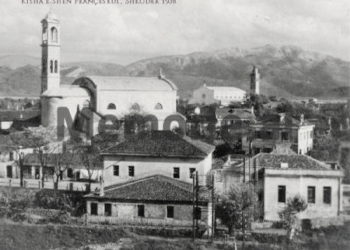
Unfortunately, aside from a few peripheral streets, the figure of Aleks Buda has not been valued as much as it should be neither by his hometown, nor by the capital where he spent a significant part of his life. Kristo Frashëri would describe Buda as the most erudite historian of the 20th century. Marini has directed the archaeological park of Apollonia for many years and has followed in his grandfather’s footsteps. The influence of Aleks Buda on the family, the great wealth of the family, and the academic’s personal profile come through in a narrative by Marin Haxhimihali.
What do you remember about the environment in which you grew up?
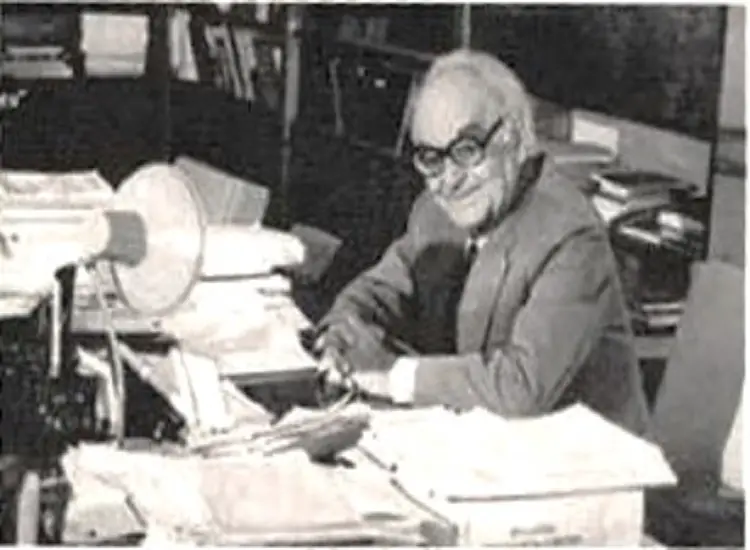
I could call my grandfather’s house an empire of books. To live in or go to his house, the first contact was with the book. The book was the most privileged object in that house. There were very old books, some of which dated back to the time of his great-grandfather, Taq Buda. He had a very large library. Most of them were well organized. Only the kitchen and the corridor had no books. The basement was completely full. The bedroom, which he called his study and where he slept with my grandmother, Vasilika, had only one large window, while three walls were lined with books.
It is estimated that there were over 20,000 volumes. The library was very rich. There were inherited books as well as works that my grandfather had collected since his time in Vienna. In my mother Tatjana Haxhimihali’s book, it is told how he saved even his last pennies to buy books rather than clothes, even though his clothes were worn out. Books were so important to him that he made every effort to bring them from Austria and succeeded.
It is said that Aleks Buda’s books saved the house in Kala from burning?
The Buda family was a large family. There were 8 children, who lived within the walls of the fortress. One of the Buda brothers, Sofokli, was involved in the movement and participated in several actions. The Germans tracked him down and identified the house. As they entered the house, one of the officers saw the books that my grandfather had brought from Vienna. They were not only history books but also psychology, sociology, literature, etc. It was first-rate literature, and the German officer, apparently an educated man, said stop, this house will not be burned. He decided to treat it as a deviation of one of the sons, but saw that the family was cultured. This fact saved the house, as many houses there were burned during the war.
Where did Aleks Buda’s numerous books end up?
As my grandfather had bequeathed, several book donations were made. A good part of the books were moved to the library of the Academy of Sciences. Whole trucks came to transport the books to the academy. For this phase, we do not have complete documentation, as it was a difficult period, referring to the years before ’97, and we still do not know where and how these books are, whether they have been cataloged in a special collection or not. This remains to be verified. Another donation, this time more organized, was made in 2006-2007. Another quantity of books was donated to the National Library. The books were well organized and are in the annex of the National Library near the Muslim Committee of Albania. Another part of the books are in my house. Of course, they no longer cover three walls of a room, but two walls are lined with books. 95% of them come from my grandfather’s library. The book is made to be read, and if things work well and there is proper organization, that library could be moved to the library of the Albanological center at the University of Elbasan.
What path did Professor Aleks’s children follow?
His daughter focused on literature. She worked as an editor at the “Naim Frashëri” Publishing House, while his son studied medicine. They submitted to the rules of the system at that time. In those years, whoever finished school was assigned wherever the party decided. In the early years, my mother went as a teacher to Burrel and was transferred only after she married a professor of sciences. Meanwhile, his son served for 5 years in Pukë, even though my grandfather was the president of the academy and, theoretically, had the means to transfer him. In fact, Aleks Buda maintained his own intellectual stance. He never became a member of the Communist Party and had left-wing convictions, but of the Western social-democratic type. He was steeped as a left-wing intellectual, as intellectuals were in Europe at that time and still are. He was a deputy in several legislatures, but never as a party representative.
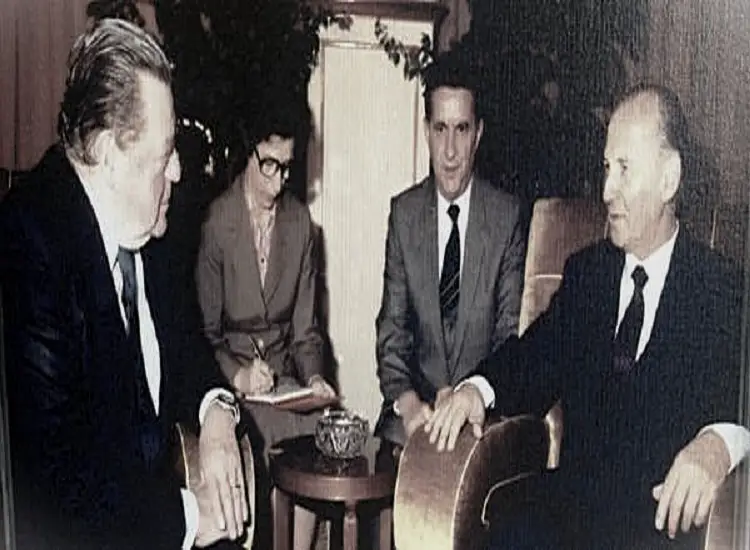
Aleks Buda also played the role of diplomat on the occasion of the visit of a high-ranking politician from West Germany, Franz Strauss. How was the ice broken with the West?
After the 1980s, when the first Western trips were made, Aleks Buda was the one who broke the ice and was the main escort for one of the most influential politicians in West Germany, Franz Strauss. The memories are very interesting. Aleks Buda was personally tasked with accompanying Strauss. When Franz Josef Strauss, the Chancellor of Bavaria, a politician of the old generation, directly after World War II, came for the first time, it was a rare event. Under extraordinary security measures from the Sigurimi, Strauss was placed in Zogu’s villa in Durrës. In the afternoon, he goes out to enjoy the sunset, and the ice needed to be broken, as it was not easy for a country still under communism.
Aleks approaches him and speaks to him in ancient Greek, citing verses of Homer, which he also returned in German. This touched Strauss deeply, who immediately responded, thus beginning the communication that would continue for a long time. Until recently, Strauss’s son-in-law, who accompanied him on that visit, has given interviews and recounted how Aleks and Strauss would go out and have debates. Aleks defended his positions with arguments. It is said that at the end, as he was leaving, he said to a high-ranking official: “Would you give me Mr. Buda to make him the head of propaganda for my party in Munich?” So great was the impression the discussion with him had made on him.
Later, Strauss invited Aleks Buda to West Germany, and he was received by the Bavarian Academy of Sciences. The reception was quite impressive. He presented a paper on a German author, Almer Reiser, who had studied the settlements of the Arvanites in Greece, a Hellenist, which caused a great stir, as even they themselves had little studied it.
Did Aleks Buda, along with his books, also greatly influence your career?
I think that in a way, my grandfather dictated my professional future in archaeology. I grew up among books. From a very young age, our grandfather subscribed us to all the magazines of the time, appropriate for our age. The book had extraordinary value. He had such an influence on us that a saying by Sartre fits us very well: during a visit to France, I read some passages by Jean-Paul Sartre: The way my grandfather cared for the books, cleaning and organizing them, instinctively made us understand as children that the fate of our family depended on these books.
Aleks Buda left Elbasan very early and lived very little in this city. How did he maintain his ties with the people of Elbasan?
It is true that my grandfather did not keep any privilege for the family, but our house had become a waiting place for the people of Elbasan. Many people came to the house that had troubles, had needs, and my grandfather tried to intervene to solve them. He tried to help them endlessly, from study rights to housing rights, and even authorizations for a television. He was a man who had the means, and people came to meet him and ask for jobs as well. All of this also had a positive side for us, as they brought us oranges and ballokume. I myself have tasted ballokume from those who came to see my grandfather. My grandfather felt a great spiritual connection to Elbasan.
Aleks Buda was the son of the patriot Taq Buda. Did his father have an influence on Aleks Buda’s life?
My great-grandfather influenced Aleks Buda quite a bit. He had wealth but was also a benefactor. A part of his wealth was donated to the monastery of Saint John Vladimir, and it is known from documents that Taq Buda was one of the main donors to this monastery. He also had a farm, but we do not know what happened to it. My great-grandfather was an influential man. He was a successful pharmacist, but also a first-rate patriot. Apart from his children’s education, he used all his wealth for the good of the national cause.
Is it true that Academician Buda “saved” intellectuals and professionals with a “bad biography” under the regime of that time?
Yes. There are several cases where my grandfather intervened for professionals who later made a name for themselves in the fields they specialized in. I can mention the case of Hasan Ceka, who studied in Graz, while my grandfather studied in Vienna, and that of Skënder Anamali. Skënder Anamali himself confirmed this to me. They had not-so-good biographies after the war, and Hasan Ceka’s case was problematic, as his name appeared in the quisling regency and he could very well have been imprisoned and suffered for it. Aleks Buda proposed to high instances that they be engaged as specialists in their fields, who would build the National Historical Museum. Both of these people were removed from the list of those at risk of persecution. They became state employees and continued on their path of science, and thus they were saved. There were other historian colleagues with partisanship who did the opposite, but Aleks Buda valued specialists.
The life of Academician Aleks Buda, in a few lines
The transition from the Albanian primary school of Elbasan, to the Italian scuola unica of Lecce, the continuation in the Austrian gymnasium of Salzburg, and the university years in cultured Vienna, equipped the professor with a cultural background both classical and modern. From this educational cycle, the Elbasan primary school gave him a love for his mother tongue and his homeland. Austrian culture and the Vienna school, as the final link of the educational cycle, equipped him with the most progressive cultural parameters of world culture. In Vienna, Aleks Buda acquired left-wing views, just as the most prominent people around the world held during the period between the two world wars.
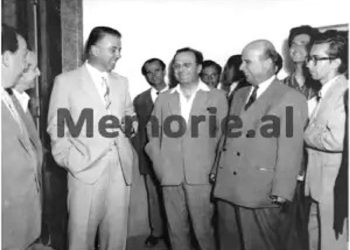
The establishment of the communist regime found Prof. Aleks Buda already fully formed and completed from an ideological and political point of view, as a left-wing democrat. He stayed away from the ranks of the Communist Party. Enver Hoxha, who had him as a colleague for some time at the Korçë Lyceum, had a special regard for him as a cultured man. Aleks felt it his duty to serve the country only in the field of education and Albanian culture. He amassed a rich bibliography of hundreds and hundreds of volumes, from the year 1500 to our days, in which hundreds and hundreds of historians, politicians, poets, and military figures from the most distant and most recent times and places have put pen to paper.
Aleks Buda represented Albania with national dignity in many international scientific meetings. As a polyglot, he participated in debates, responding as appropriate to foreign historians in their native languages: in German, English, French, Italian, Russian, Spanish, and often with short phrases in Greek, Serbian, and Bulgarian. Thanks to these merits, Professor Aleks Buda, along with Professor Eqerem Çabej, became the itinerant scientific ambassadors of Albania. / Memorie.al