From EUGEN SHEHU
Part Two
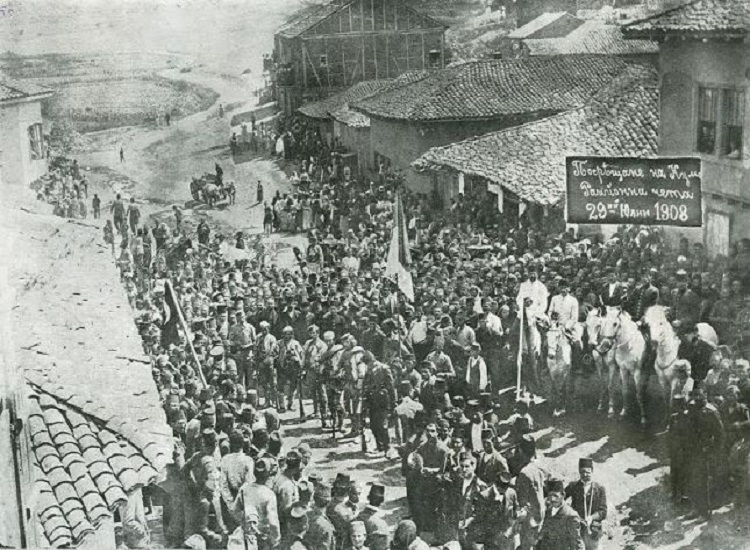
Memorie.al / The Albanians of Kumanovo, those worthy sons of the ancient Arbër, have been and remain to this day fighters for self-existence, for the protection of the most valuable Albanian traditions, and for conveying the message of natural union with the mother state. The philosophy of their self-existence, in essence, is the philosophy of endless wars, of sublime sacrifices, in order not to submit to any conqueror, not to be assimilated by the demographic, political, and criminal furies of the Serbs-Bulgarians and Slavo-Macedonians. When we speak of the endless wars of the inhabitants of these lands of Albanian Macedonia, we have in mind an entire movement for freedom and justice in the last century, which took on epochal proportions in the fights against the Young Turks, the Serbo-Slavs, and the Bulgarians, led by Bajram Vaksinca.
Continued from the previous issue
Even in the winter of 1922, Serbian violence in Kumanovo found no rest. The battalions of the Third Army of Skopje, commanded by the criminals Milan Stefanović and Vojvoda Angjelko, under the pretext of an operation to collect weapons, swept through all the Albanian villages of Kumanovo, robbing even the meager belongings that had survived the winter.
No one among the ethnic Albanians of Kumanovo could now demand the smallest right. The truth is that from the approval of the Vidovdan Constitution of June 28, 1921, by the Kingdom of Serbs, Croats, and Slovenes, the most elementary Albanian rights were trampled upon in the most brutal manner. Thus, in the village of Lipkovë, in May 1922, the Serbo-Slav-Macedonian band of Milan Stefanolliq forcibly took the livestock of two villagers, under the pretext that the army needed them.
When one of these poor villagers told the soldiers that he fed his children with that milk, he was immediately shot on the spot, thus warning of the tragedy of their fates under brutal Slavo-Slovene slavery. Meanwhile, in the village of Hotlë, the 70-year-old patriot Beqë Syla was taken away, tied with wire. His fault was that he had spoken to his children in the Albanian language.
A Macedonian peasant had passed by and told him to speak Serbian or Macedonian, because this was no longer his country. The brave Beqë Sula replied sharply that this land had been Albania since ancient times and that it would remain so forever. That was enough; the Slavo-Macedonian ran to the military post, and Beqë Sula, after being dragged through the streets, was barbarically shot in the center of the village of Hotël.
Then, in the years 1923-1924, in the name of the constructions that the Kingdom of Serbs, Croats, and Slovenes supposedly would carry out, it issued the infamous law on forced labor, especially on the railways. For the sake of truth, it must be said that the first lists and calls that arrived in Kumanovo were for Albanian families. If, for one reason or another, they did not send someone from the household, then they had to pay large sums of money.
Thus, the peasants of Albanian Kumanovo were forced to send even the elderly and children to the railway, who worked without pay for entire months. And no one could demand rights. The Albanian press of that time, regarding this, wrote: “Here, state laws do not apply, but the law of the mace, because when the names of the vojvodas and chetniks such as Tanko Trifunović, Boro Milovanović, Kosta Pećanac, Milić Krstić are mentioned, the very names evoke true terror.” (Newspaper “Hak”, September 24, 1924).
The truth is that the Serbian spirit was determinant in the political and military formations within the Yugoslav Kingdom of the 1920s. Especially in the years 1925-1930, certain Serbian circles acquired great political powers, whereby they again raised the demand for the expropriation of Albanians, as well as the colonization of areas that were completely ethnically pure, with Serbian colonists.
What was trumpeted loudly by Belgrade as a deeply agrarian reform was, in fact, a cunning and savage political reform, which later degenerated into open war to drive Albanians from their ancestral lands. In Albanian Kumanovo, this reform did not have as wide a spread as in other parts of Albanian Macedonia. Nevertheless, even there, the blow against Albanian landowners who possessed considerable lands was felt.
A series of laws burdened these landowners with high taxes, and in many cases, the lands were taken by force, supposedly for state needs, without paying a single square meter. But in general, in Albanian Kumanovo, Albanian landowners of all strata were attacked, because the fastest and deepest denationalization of these areas was sought.
What is worth not forgetting is the fact that the political parties of the Slavo-Macedonians in Albanian Macedonia, as well as military groupings and others, were in constant strife among themselves. But nevertheless, although they were divided in their daily partisan interests, they were always united by a unique action regarding the removal of Albanians from their ethnic lands.
Not infrequently, it was precisely these organizations that directly influenced the placement of Serbian colonists as quickly as possible on the seized Albanian lands. Then, in the “scientific” theses of the academicians in Belgrade, being a colonist meant, in their language, being a “great patriot.”
As always, even in this case (although the Kingdom of Serbs, Croats, and Slovenes propagated a certain kind of ethnic freedom), Albanians were seen as second-class citizens. Moreover, on this front, the response to complaints even took on ridiculous tones.
“Regarding the numerous complaints of the Albanians of Kumanovo, whose land had been unjustly seized, the Royal Directorate of the Vardar Banovina, headquartered in Skopje, decided on April 8, 1931, that the right to compensation be denied to all complainants, because they had not requested it in time, and that the request after 9 years was out of place, and that for these properties given to the chetniks, the Albanians did not possess certifications.” (Dr. Hakif Bajarami, “Social and Political Circumstances in Kosovo”, p.74).
The ethnic inhabitants of Albanian Kumanovo were also heavily manipulated with the term “abandoned lands.” It is known that especially the villages located at the foot of Karadak are characterized by excellent geographical, climatic, and especially pastoral resources. The heights of Karadak (of Kumanovo) have always served as a source of rich pastures, and the mastery of dairy processing, or the raising of livestock in these areas, has great traditions.
But when, after periodic attacks by the Third Army of Skopje, these inhabitants took to the mountains and forests to escape the bullets, then colonists from Serbia or Southern Macedonia would not be late in arriving, seizing the towers and the breadbaskets of the Albanians.
Furthermore, there were some of these Albanian peasants of Kumanovo who felt life among other ethnicities impossible, and despite great resistance, despite the longing for the land of their ancestors, “they left never to return to their hearths.” (Central State Archive. Fund 886, File 117, Sheet 4).
One of the dominant elements of the denationalization of Albanians in general, used by the Serbo-Slav-Macedonians between the two world wars, was undoubtedly also religious confession. After the elimination of schools in the Albanian language, the second action of the Serbs was precisely the attack on the religious faith of the autochthonous Albanian inhabitants, whereby it would be one more “argument” for their Old Serbia.
At the beginning of the last century, the majority of the inhabitants of Albanian Kumanovo belonged to the Muslim faith, and within this confession, they were also supporters of the Bektashi sect. In the early 1930s, the civil administration made considerable concessions to those Albanians who converted to Orthodoxy, or those Orthodox Albanians who accepted the Slavo-Orthodox church and willingly accepted their assimilation by turning into “Macedonians”; otherwise, it took draconian measures.
Nevertheless, the inhabitants of Albanian Kumanovo endured much government oppression on their shoulders without changing their religious confession, with the exception of many Orthodox Albanians. On this occasion, as in all parts of Albanian Macedonia, “many properties of mosques and teqes were arbitrarily and violently expropriated. Several places called ‘Vakëfe’ (holy places) in the regions of Kumanovo suffered the same fate.” (Central State Archive – Tirana, Fund 251, File 194, Sheet 7).
Forced displacement from ethnic lands would be another open wound for the inhabitants of Albanian Kumanovo. A detailed plan from Belgrade, and then in cooperation with the Turkish government of that time, sent Albanians to the distant borders of Asia.
The forceful taking of several families in the village of Zllakuçan, in 1937, caused the revolt of ethnic Albanians to increase tremendously, leading to the seizing of weapons and the organization of freedom fighter bands. Nevertheless, this wound in the region of Kumanovo was not as great as in other parts of Albanian Macedonia or Kosovo.
Furthermore, the interest and patriotism of the Albanian government in 1938, especially regarding this problem, should not be forgotten. Thus, one of the conditions that King Zog set for the Yugoslav Government of Stojadinović for signing a pact of friendship and non-aggression was precisely: “To stop the displacement of Albanians from Kosovo and Macedonia to Turkey.” (Central State Archive – Tirana, Fund 251, File 107/2, Sheet 768).
Thus, in the two decades between the two world wars, the ethnic Albanians of Kumanovo bore on their shoulders many furious waves of Slavo-Orthodox chauvinism. But they were not broken, they were not assimilated, they were not extinguished. They survived thanks to the valuable years inherited from their ancestors, full of messages and testaments for the Nation and Homeland, to this very day. / Memorie.al